Noah AI vs Paperpal: Evidence-Grounded Writing vs Academic Polishing
Linda
Compare Noah AI and Paperpal for biomedical paper writing, academic polishing, claim-evidence mapping, citations, and evidence-grounded research drafts.
Biomedical paper writing is not only about fluent academic language. A strong introduction, background, or discussion section also needs a clear evidence logic: what claim is being made, which source supports it, what limitations should be stated, and whether the citation actually matches the sentence. Polishing can make a manuscript easier to read, but it cannot repair weak evidence structure by itself.This Noah AI vs Paperpal comparison focuses on where each tool fits in an academic writing workflow. Noah AI is designed for evidence-grounded biomedical research work: organizing literature, mapping claims to sources, preserving traceability, and turning biomedical evidence into cited research drafts. Paperpal is useful once a draft already exists and needs grammar, tone, clarity, rewriting, paraphrasing, or submission-readiness checks.The practical takeaway is simple: Noah AI is stronger before and during evidence-grounded biomedical drafting, while Paperpal is stronger after a draft exists and needs academic polishing. We have already compared Noah AI with general-purpose chatbots in a separate Noah vs ChatGPT for evidence-first medical AI workflows article. This comparison focuses on Paperpal as a dedicated academic writing assistant.
Quick Summary: Noah AI vs Paperpal
| Comparison Area | Noah AI | Paperpal |
|---|---|---|
| Best for | Evidence organization, claim-evidence mapping, cited biomedical drafting | Academic polishing, grammar, rewriting, paraphrasing, manuscript clarity |
| Workflow stage | Before and during drafting | After a draft exists |
| Main strength | Connecting biomedical claims to traceable sources | Improving academic tone and language quality |
| Evidence handling | Built around source-aware research workflows | Useful for writing support, but not primarily a biomedical evidence mapping system |
| Writing support | Drafts paper sections from organized evidence | Polishes, rewrites, and improves existing text |
| Best user | Biomedical researchers, medical affairs teams, biopharma researchers, medical writers | Academic authors, PhD students, ESL writers, researchers preparing a manuscript draft |
Why Biomedical Paper Writing Needs More Than Polishing
In biomedical writing, language quality is only one part of the problem. A polished sentence can still be scientifically weak if the evidence behind it is unclear. Introduction sections need to establish disease burden, biological rationale, prior evidence, remaining uncertainty, and the reason the current paper matters. Each of those moves depends on source-backed logic.For example, a claim about GLP-1 receptor agonists and cardiovascular outcomes in type 2 diabetes needs a traceable source, the right study context, and a clear statement of what the evidence does and does not show. Biomedical paper writing tools should therefore be evaluated by how they handle evidence, citations, limitations, and source traceability, not only by how fluent the prose sounds.For teams still building the evidence base, Noah’s guides on PubMed search with AI and how to find sources for a research paper with AI are useful companion resources. This article focuses specifically on the writing workflow after evidence has been gathered or needs to be organized.
How We Tested Noah AI and Paperpal
To compare the tools fairly, we used the same biomedical writing task for both products. The test topic was GLP-1 receptor agonists and cardiovascular outcomes in type 2 diabetes. The expected output was not just a paragraph. It included outline creation, a short academic introduction draft, citation-sensitive claim identification, a claim-evidence table, and limitations.Unified testing prompt:I am writing the introduction section of a biomedical research paper.Topic: GLP-1 receptor agonists and cardiovascular outcomes in type 2 diabetes.
- Create a structured introduction outline.
- Create a 250-word academic introduction draft.
- Identify key claims that require citations.
- Create a table mapping each claim to supporting evidence.
- List limitations or cautions that should be mentioned.
- Do not invent citations. Only use traceable sources.
This is a workflow comparison, not a static product review. Both products may update over time, so screenshots should be recaptured before publication if the interface changes.
Noah AI Output: Claim-Evidence Mapping Before Drafting
Noah AI is strongest when the writing task starts with biomedical evidence rather than an already polished paragraph. In the test workflow, the most important output is the claim-evidence table: a structured view of claims, supporting evidence, citation/source fields, and cautions. This helps a researcher see which statements are ready for drafting and which need additional verification.
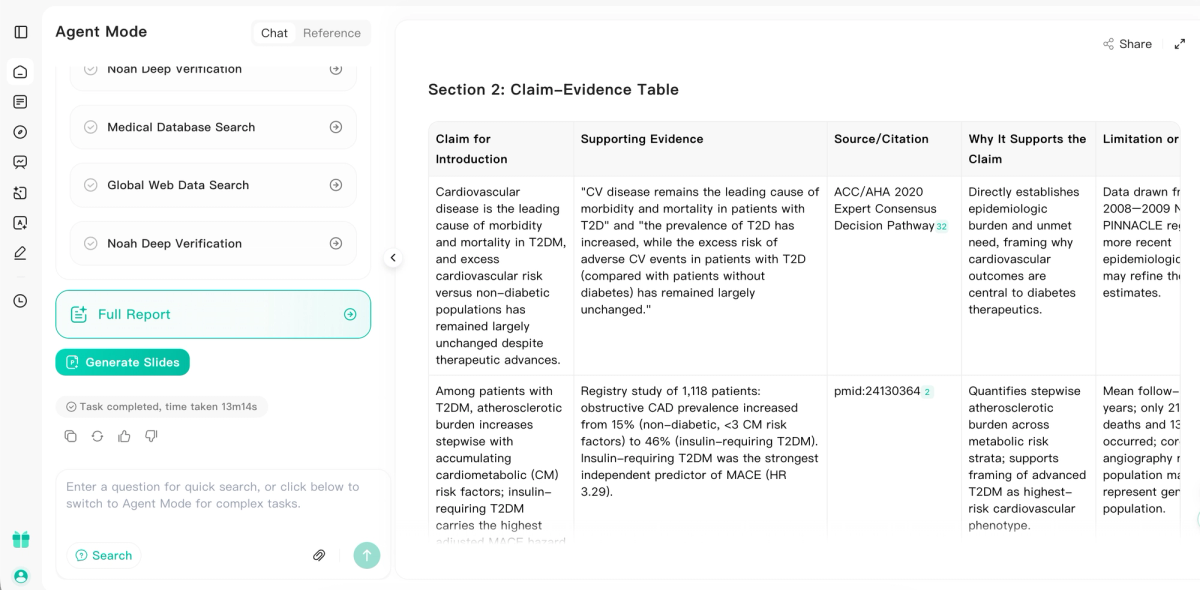
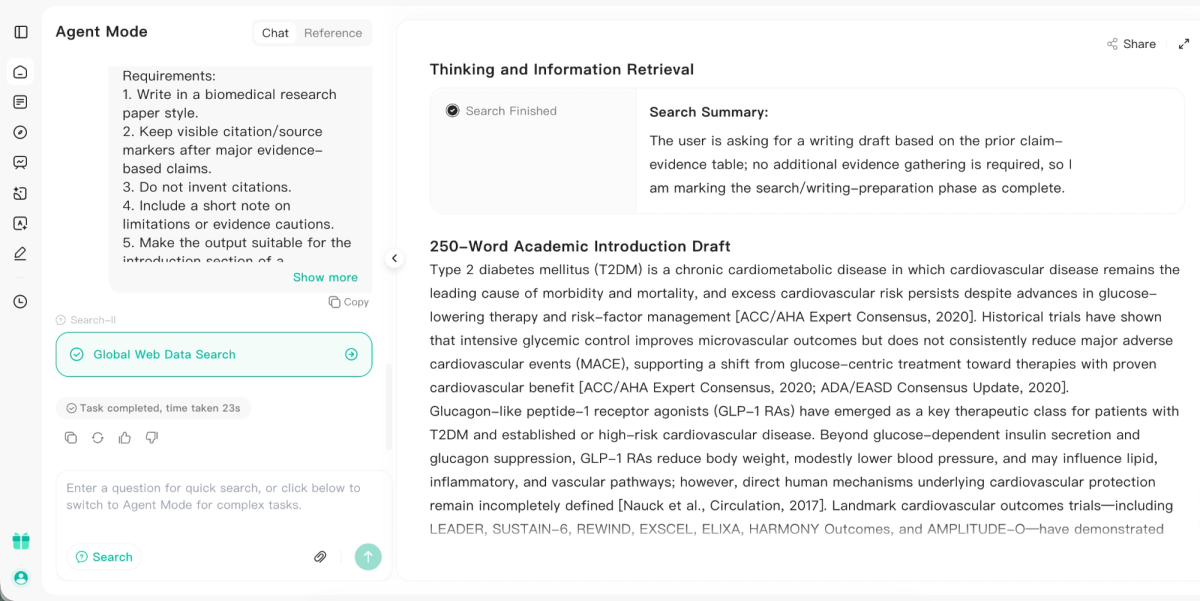
This claim-evidence mapping is valuable because biomedical authors often struggle with the middle step between “I found papers” and “I wrote an introduction.” Noah AI supports that step by organizing source-backed points before they become prose and by surfacing evidence gaps or cautions that should not be omitted.The second useful output is a cited introduction draft. Instead of producing a generic introduction, the goal is to turn structured biomedical evidence into a coherent opening section while keeping the source path visible. Researchers should still verify all references and revise manually.
Paperpal Output: Academic Polishing and Writing Suggestions
Paperpal is best understood as an academic writing and polishing assistant. According to Paperpal’s official website and product pages, it supports language and grammar checks, contextual rewriting, paraphrasing, word reduction, translation, and submission-readiness workflows. That makes it useful after an author has a draft and wants to improve academic tone, clarity, sentence flow, and manuscript presentation.
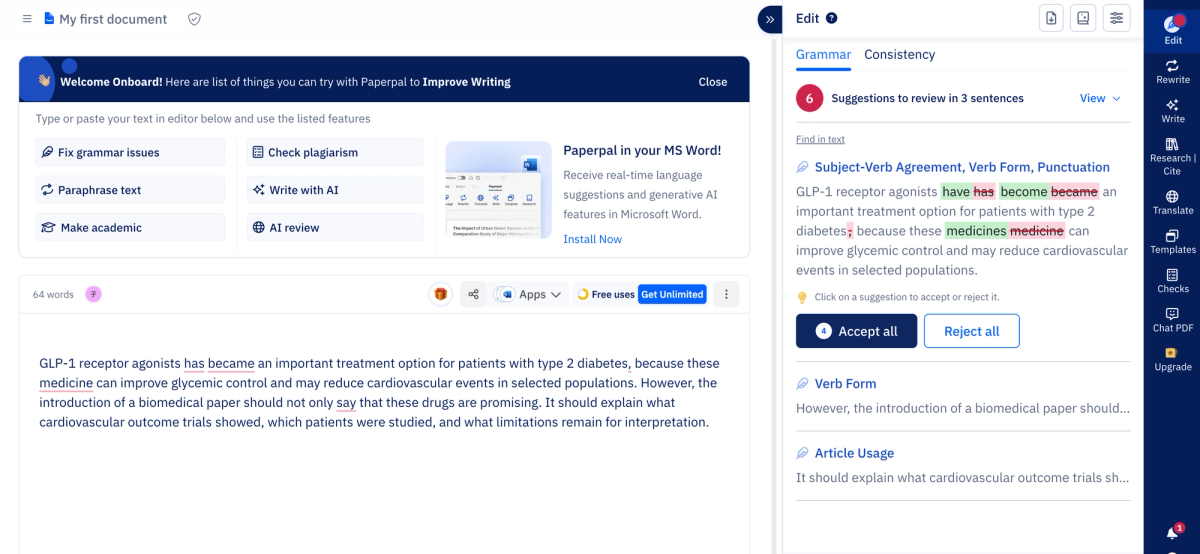
For the GLP-1 writing prompt, Paperpal is not best judged by whether it can replace a source-aware biomedical evidence workflow. Its core advantage is different: helping authors improve an existing manuscript section through clearer phrasing, grammar, and academic tone.This is a real strength. Many biomedical authors need clearer sentences, better transitions, more concise wording, and manuscript polishing before submission. Paperpal is well aligned with that stage of the workflow.
Side-by-Side Comparison Table
| Comparison Area | Noah AI | Paperpal | Practical Takeaway |
|---|---|---|---|
| Best workflow stage | Before and during biomedical drafting | After a manuscript draft exists | Use Noah to build evidence-grounded content, then Paperpal to polish language. |
| Evidence search and organization | Designed for biomedical research organization and source-aware workflows | Not primarily positioned as a biomedical evidence organization tool | Noah is the better fit when the evidence base is still being structured. |
| Claim-evidence mapping | Strong fit for mapping claims to supporting evidence and limitations | Better suited to improving the wording of claims already drafted | Use Noah when you need to know what each claim is based on. |
| Citation traceability | Emphasizes source traceability and cited research outputs | Can support academic writing, but citations still need separate verification | Neither tool removes the need to verify citations before submission. |
| Introduction drafting | Useful for drafting literature-backed introductions from organized evidence | Useful for improving an existing introduction draft | Noah helps shape evidence logic; Paperpal helps polish the prose. |
| Academic language polishing | Secondary strength | Core strength | Paperpal is stronger for grammar, tone, paraphrasing, and style refinement. |
| Grammar and style | Can support drafting clarity, but is not mainly a grammar checker | Strong fit for grammar, wording, readability, and academic tone suggestions | Use Paperpal when the main problem is language quality. |
| Limitations and cautions | Useful for surfacing caveats tied to biomedical evidence | Useful for expressing limitations clearly once they are written | Noah helps identify what cautions belong; Paperpal helps make them readable. |
| Manuscript submission support | Supports evidence-grounded research preparation | Offers writing, polishing, and submission-readiness features | Paperpal is better aligned with late-stage manuscript polishing. |
| Best user | Biomedical researchers, biopharma teams, medical affairs, medical writers | Academic authors, PhD students, researchers polishing manuscripts | The best choice depends on whether the bottleneck is evidence or language. |
When Should You Use Noah AI?
Use Noah AI when the writing problem begins before the draft. This is common in biomedical paper writing, where the author needs to move from literature search to an evidence-backed section. Noah is a strong fit when you need to organize biomedical evidence, build a claim-evidence table, preserve source traceability, create a cited research brief, or draft a literature-backed introduction, background, or discussion section. For a broader review workflow, see medical literature review with Noah AI.Noah is also useful when medical affairs teams, translational researchers, biotech analysts, and medical writers need to agree on what the evidence supports before prose is finalized.
When Should You Use Paperpal?
Use Paperpal when the writing problem begins after the draft exists. Paperpal is a strong fit when you want academic tone improvement, grammar and style checks, rewriting, paraphrasing, word reduction, or manuscript clarity support. It is especially useful for authors who have already assembled the evidence and now need to make the writing clearer, more concise, and more submission-ready.Paperpal should not be dismissed as “just grammar.” In academic writing, clarity and language quality can determine whether reviewers understand the study’s rationale.
Can You Use Noah AI and Paperpal Together?
Yes. In many biomedical writing workflows, the best answer is not Noah AI or Paperpal. It is Noah AI first, then Paperpal later.
- Use Noah AI to collect and organize biomedical evidence.
- Use Noah AI to map claims to sources and draft an evidence-grounded section.
- Revise manually as a researcher or author.
- Use Paperpal to polish grammar, clarity, tone, and manuscript style.
- Verify all citations, source claims, and journal requirements before submission.
This sequence respects the difference between evidence quality and language quality: evidence first, polish second.
Final Takeaway
Noah AI and Paperpal are not interchangeable tools. Noah AI is stronger for evidence-grounded biomedical drafting: organizing literature, mapping claims to sources, preserving citation traceability, and turning biomedical evidence into cited research drafts. Paperpal is stronger for academic polishing after a draft exists: grammar, rewriting, paraphrasing, tone, clarity, and manuscript presentation.If your bottleneck is “What evidence supports this biomedical claim?”, start with Noah AI. If your bottleneck is “How do I make this draft clearer and more academic?”, use Paperpal. If you are preparing a serious biomedical manuscript, the most reliable workflow may use both: evidence first, polish second.
FAQ
Is Noah AI a Paperpal alternative?
Noah AI can be a Paperpal alternative only for certain parts of the academic writing workflow. It is better described as an evidence-grounded biomedical research and drafting tool, while Paperpal is stronger for academic polishing after a draft exists.
What is the main difference between Noah AI and Paperpal?
The main difference is workflow stage. Noah AI helps organize biomedical evidence, map claims to sources, and draft cited sections. Paperpal helps improve grammar, tone, clarity, rewriting, and manuscript polish.
Is Paperpal better for academic polishing?
Yes. Paperpal is better suited for academic polishing, including grammar suggestions, paraphrasing, rewriting, readability, tone, and submission-readiness support.
Can Noah AI help write biomedical paper sections?
Yes. Noah AI can help turn biomedical evidence into cited research briefs and literature-backed paper sections, such as introductions, background sections, and discussion drafts. Researchers should still verify all sources and revise manually.
Which tool is better for claim-evidence mapping?
Noah AI is the better fit for claim-evidence mapping because its workflow is built around evidence organization, source traceability, and cited biomedical research outputs.
Can I use Noah AI and Paperpal together?
Yes. A practical workflow is to use Noah AI for evidence organization and cited drafting, then use Paperpal to polish grammar, clarity, academic tone, and manuscript style.
Is Noah AI or Paperpal better before manuscript submission?
Paperpal is generally better for final language polishing and submission-readiness checks. Noah AI is more useful earlier, when the evidence base and cited argument still need to be structured.
Does this comparison provide medical or publication advice?
No. This comparison is for research workflow education only and does not provide medical advice, publication guarantees, or endorsement of one tool for every use case.Disclaimer: This comparison is for research workflow education only. It does not provide medical advice, diagnosis, treatment recommendations, publication guarantees, or endorsement of any specific tool for every use case. Always verify biomedical evidence, citations, and manuscript requirements with primary sources, journal guidelines, and qualified experts.