PubMed Search with AI: How Life Science Professionals Find and Analyze Biomedical Evidence Faster
Linda
Learn how life science professionals can improve PubMed search with AI, from advanced search strategy examples to biomedical evidence analysis with Noah AI.
PubMed search is often the starting point for biomedical evidence work, but it is rarely the end of the workflow. Life science professionals need to move from a research question to a reliable search strategy, then from a long list of citations to a clear understanding of evidence quality, clinical relevance, competitive context, and knowledge gaps. Traditional PubMed search is powerful, especially when researchers use PubMed advanced search, MeSH terms, field tags, filters, and query history. The challenge is that modern evidence work often requires more than retrieval. Teams need faster ways to refine questions, compare studies, summarize findings, and connect publications with clinical trials, drug pipelines, and biomedical databases.
This guide explains how AI can support PubMed search without replacing expert judgment. It covers how to search PubMed, how to build a PubMed search strategy example, and how AI-powered medical literature search can help life science professionals analyze biomedical evidence faster. It also shows where Noah AI fits as a domain-specific life science AI agent for PubMed Mode, medical search mode, and broader biomedical database workflows.
Why Traditional PubMed Search Is Not Enough for Life Science Workflows
PubMed is one of the most important resources for biomedical and life science literature. It is especially useful for finding peer-reviewed articles, review papers, clinical evidence, and MEDLINE-indexed biomedical research. For many researchers, a PubMed database search is the first step in literature review, medical affairs research, competitive intelligence, and early drug development analysis.
The limitation is not PubMed itself. The limitation is the workflow around it. A search may return hundreds or thousands of records, and the user still needs to decide which papers are relevant, which studies are higher quality, which endpoints matter, and how the evidence connects to a business or research question.
- Common friction points include unclear search scope, missing synonyms, overly broad keyword queries, inconsistent filters, difficulty comparing study designs, manual evidence extraction, and weak links between publications, clinical trials, drug targets, and pipeline context.
This is why life science teams increasingly look beyond simple retrieval. They need a workflow that combines PubMed search, medical literature search, biomedical databases, and AI-assisted evidence analysis.
What Makes AI-Powered PubMed Search Different
AI-powered PubMed search should not mean replacing PubMed or letting AI invent evidence. A better model is AI-assisted search: the researcher keeps control of the question, sources, inclusion criteria, and interpretation, while AI helps structure the workflow.
A useful AI workflow can help researchers clarify the research question, identify related terms and synonyms, suggest possible MeSH terms, draft query variants, summarize retrieved evidence, compare findings across studies, and generate follow-up questions for deeper analysis.
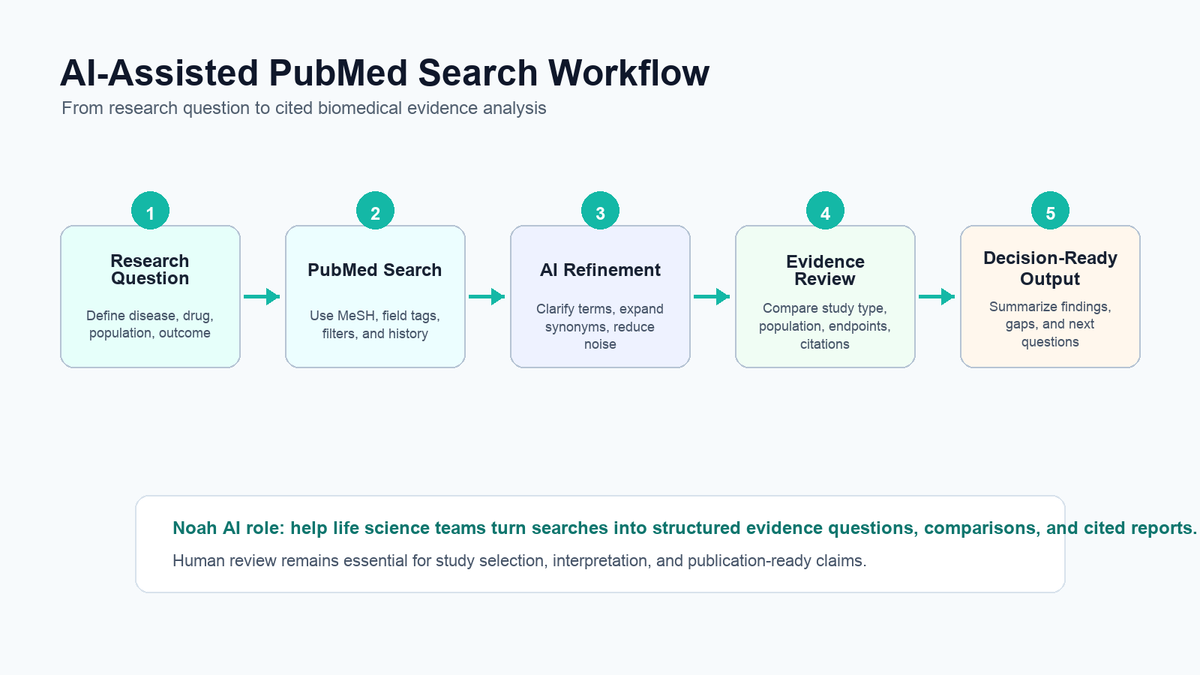
The strongest use case for AI is not simply finding more papers. It is helping researchers move from a long results list to a structured understanding of what the evidence says, where it conflicts, and what should be examined next.
How to Search PubMed: A Practical Workflow
If someone searches “how to search PubMed” or “how to search in PubMed,” they usually need more than a search box. They need a repeatable process. A practical PubMed search workflow can be broken into seven steps.
- Define the biomedical question before searching.
- Break the question into concepts such as disease, intervention, population, biomarker, endpoint, or study type.
- Search synonyms, abbreviations, and related terms.
- Use PubMed advanced search when field control, Boolean logic, date ranges, or query history matter.
- Apply filters carefully, especially article type, publication date, species, language, and clinical trial filters.
- Review titles and abstracts for relevance before drawing conclusions.
- Export, summarize, and compare the evidence using a structured extraction framework.
PubMed filters are useful, but they should be used carefully. Some filters depend on indexing and may exclude relevant recent records that have not yet been fully indexed. For high-stakes biomedical work, filters should support the search strategy rather than silently define it.
PubMed Search Strategy Example for Biomedical Research
A strong PubMed search strategy example starts with the research question. For example: “What recent clinical evidence supports PD-1 or PD-L1 therapy in non-small cell lung cancer?” This question can be converted into a structured query using PICO-style logic.
| PICO Element | Search Concept | Example Terms | PubMed Query Logic |
|---|---|---|---|
| Population | NSCLC patients | non-small cell lung cancer, NSCLC | ("Carcinoma, Non-Small-Cell Lung"[Mesh] OR NSCLC[tiab]) |
| Intervention | PD-1 / PD-L1 therapy | pembrolizumab, nivolumab, atezolizumab | ("PD-1"[tiab] OR "PD-L1"[tiab] OR pembrolizumab[tiab]) |
| Outcome | Survival or response | overall survival, PFS, ORR | ("overall survival"[tiab] OR PFS[tiab] OR response[tiab]) |
| Evidence filter | Clinical evidence | clinical trial, review, date range | Clinical Trial[pt], Review[pt], 2021:2026[pdat] |
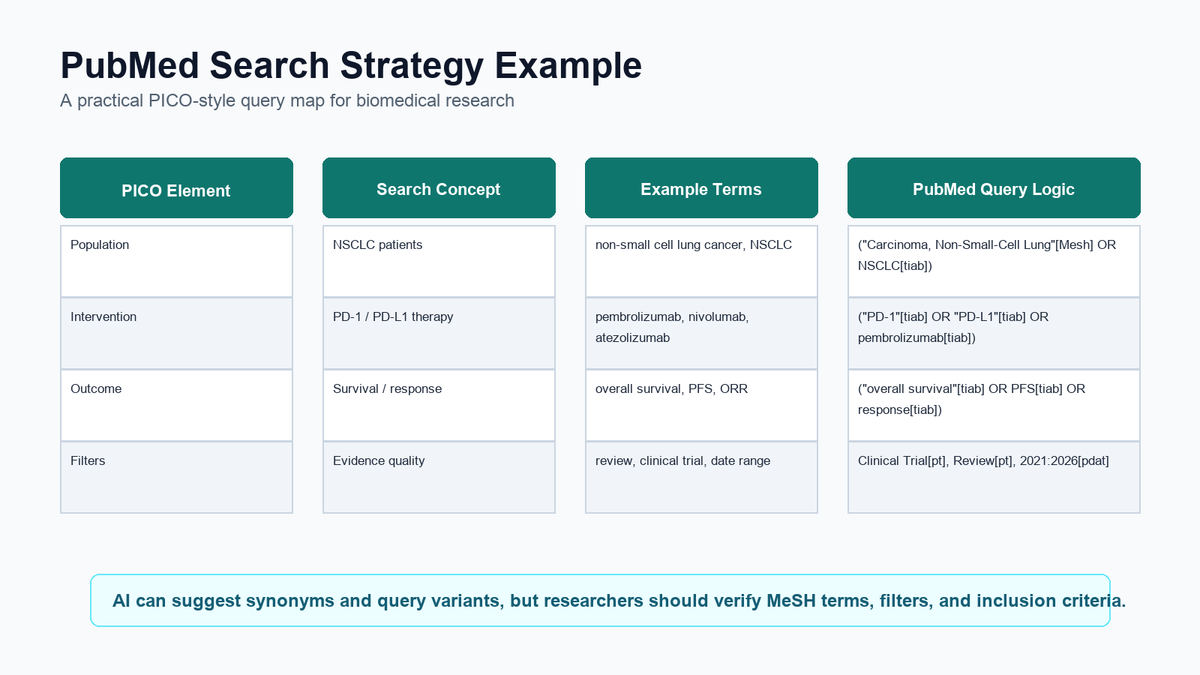
This kind of structured query is more useful than a single broad phrase because it makes the search logic visible. It also gives the researcher a clear place to refine terms, add synonyms, or change filters if the results are too broad or too narrow.
PubMed Advanced Search and PubMed Database Search Tips
PubMed advanced search is useful when a simple keyword search is not precise enough. It allows users to build queries with field selectors, Boolean operators, and search history. For life science professionals, this is especially important when the same term can mean different things across diseases, targets, drugs, and study types.
| Search Need | PubMed Feature | How AI Can Help |
|---|---|---|
| Control where a term appears | Field tags such as [tiab], [Mesh], [pt], [pdat] | Suggest whether a concept should be searched as title/abstract, MeSH, publication type, or date range |
| Combine concepts | AND, OR, NOT | Draft and explain Boolean query logic |
| Track query versions | Advanced search history | Compare why one query retrieves more relevant evidence than another |
| Narrow evidence type | Article type and date filters | Remind users to check whether filters may exclude newer or non-indexed records |
| Prepare reproducible work | Saved query logic and inclusion criteria | Turn a search into a documented search strategy |
Useful PubMed search tips include: start broad enough to avoid missing evidence, add synonyms before adding restrictive filters, separate disease and intervention concepts, check MeSH terms when available, and document each major query version. AI can support these steps by making the search logic explicit and easier to revise.
From PubMed Search to Medical Literature Analysis
For life science professionals, the real work begins after the search results appear. A medical literature search may need to answer questions such as: Which studies are randomized? Which endpoints were measured? Which patient population was included? Was the evidence preclinical, clinical, real-world, or review-based? Does the evidence support a drug development hypothesis or reveal a competitive risk?
This is where AI medical literature search becomes more valuable. Instead of treating PubMed as a destination, AI can help turn PubMed results into an evidence workflow: retrieve, screen, summarize, compare, and synthesize.
How Noah AI Agent Supports Domain-Precise Search
Noah AI is built as an AI agent for life science professionals, not as a generic chatbot. In a PubMed search workflow, Noah AI can help users clarify research intent, search biomedical evidence, compare findings, and generate cited research outputs. The goal is not to replace PubMed. The goal is to help researchers use PubMed and related biomedical databases more efficiently.
This makes Noah especially relevant for users searching for AI for PubMed search, a PubMed AI search tool, or AI tools for medical literature search and summarization. The product fit is strongest when the user needs source-aware analysis rather than a quick unsupported answer.
PubMed Mode, Medical Search Mode, and Biomedical Databases in Noah
A single PubMed database search may answer one part of a biomedical question, but life science work often requires multiple source types. Publications need to be connected with guidelines, clinical trial records, drug targets, mechanisms, company activity, and conference updates.
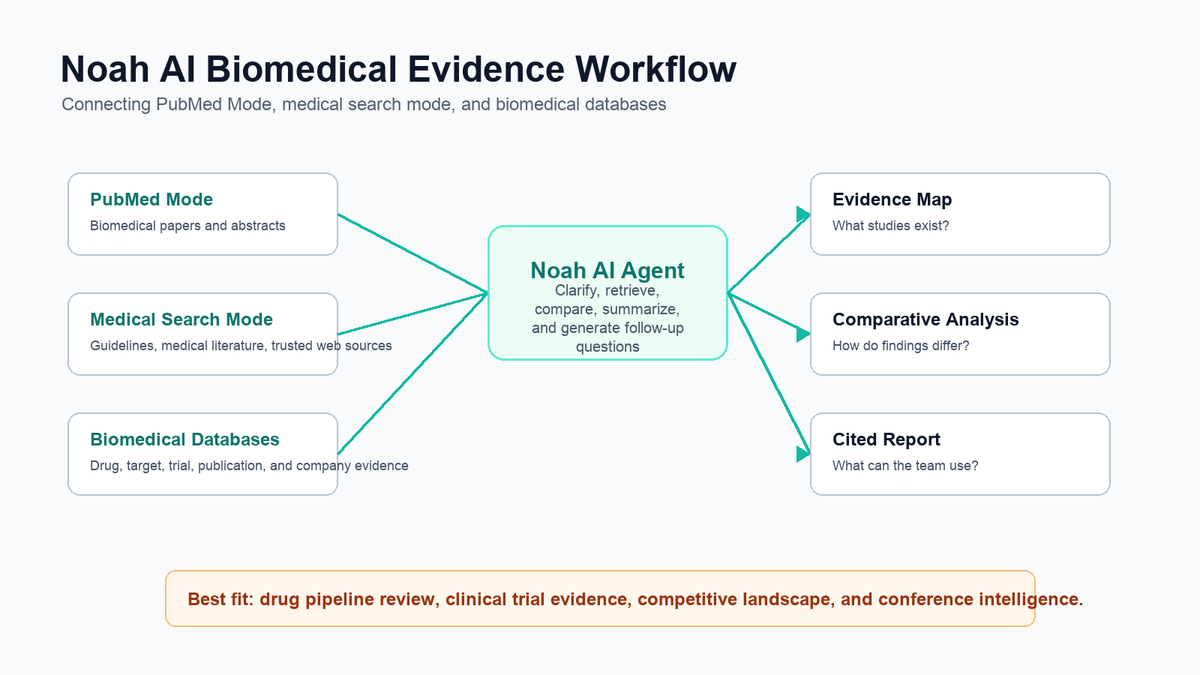
Noah AI can support this broader evidence workflow through PubMed Mode, medical search mode, and access to biomedical and pharmaceutical databases. This helps users move from paper retrieval to domain-specific analysis. For example, a user can begin with a PubMed search on a target, then ask follow-up questions about clinical trial evidence, competitor programs, mechanism of action, or publication trends.
Use Cases for Life Science Professionals
AI-assisted PubMed search is useful across several life science workflows.
Drug Pipeline Review
Teams can use PubMed and biomedical databases to understand how much evidence exists around a drug, target, mechanism, or indication. AI can help summarize recent findings and identify which publications are most relevant for pipeline strategy.
Clinical Trial Evidence
PubMed search can reveal publications linked to clinical trial outcomes, but the analysis often needs trial phase, endpoint, population, comparator, and safety context. Noah AI can help structure these comparisons for faster review.
Competitive Landscape
For competitive intelligence, teams need to compare mechanisms, study designs, publication signals, and company activity. AI-assisted literature search can help connect PubMed evidence with broader pharmaceutical databases.
Conference Intelligence
Conference abstracts and recent publications can signal emerging directions before full papers are available. Noah AI can help turn scattered evidence into a more organized research brief.
Related Resources for Biomedical Evidence Workflows
Readers who want a broader workflow for evidence synthesis can read our guide on tools for literature review for a PhD student. For product use cases, link to medical literature review with Noah AI and how to use Noah AI Agent. When explaining why a domain-specific workflow matters, link to domain-specific AI agent for biomedical research. For examples of evidence outputs, link to biomedical research insight and drug development analysis.
Final Takeaway
PubMed search remains essential for biomedical evidence work. But life science professionals increasingly need workflows that go beyond finding citations. They need to define better questions, build better search strategies, analyze evidence faster, and connect literature with biomedical databases, clinical trials, and competitive context.
AI can help when it is used responsibly: to refine search logic, organize evidence, compare studies, and generate source-aware summaries. Noah AI fits this workflow as a life science AI agent for PubMed search, medical literature search, and biomedical evidence analysis.
FAQ
What is PubMed search?
PubMed search is the process of finding biomedical and life science literature in PubMed, a major search platform for MEDLINE and related biomedical records. Researchers use it to find papers, reviews, clinical studies, and evidence related to diseases, drugs, mechanisms, and medical topics.
How do I search PubMed effectively?
Start with a clear research question, break it into concepts, add synonyms and abbreviations, use PubMed advanced search for field tags and Boolean logic, apply filters carefully, and document the search strategy so it can be reviewed or repeated.
What is a PubMed search strategy example?
A PubMed search strategy example might combine disease terms, intervention terms, and outcome terms with Boolean logic. For example, an oncology query may combine NSCLC terms with PD-1 or PD-L1 therapy terms and survival outcome terms, then apply clinical trial or publication date filters.
Can AI help with PubMed search?
Yes. AI can help clarify a question, suggest synonyms, draft query logic, summarize results, compare studies, and identify evidence gaps. Researchers should still verify sources, search logic, and conclusions.
What is the best AI for medical literature search and summarization?
The best AI tool depends on the workflow. For biomedical and life science work, a useful tool should support source traceability, biomedical databases, PubMed-style evidence retrieval, study comparison, and cited outputs. Noah AI is designed for this domain-specific workflow.