How to Find Sources for a Research Paper with AI: A Medical Literature Workflow
Linda
Learn how to find sources for a research paper using AI, PubMed search, source screening, citation traceability, and Noah AI for medical literature workflows.
Finding sources is one of the first steps in academic writing, but it is rarely as simple as typing a keyword into a search box. Medical and life science researchers often need sources that are credible, current, source-traceable, and strong enough to support a specific research claim. A weak source list can make a literature review feel shallow, while a strong one helps the reader understand the evidence behind each conclusion.
This guide explains how to find sources for a research paper using a structured workflow. It covers how to turn a broad topic into searchable concepts, where to search for biomedical evidence, how to screen sources and references, and how AI can help researchers move faster without losing control of source quality. The article focuses on medical and life science workflows, where PubMed, clinical trials, guidelines, patents, and trusted biomedical databases matter. It also shows how Noah AI can support source discovery, reference screening, citation traceability, evidence comparison, and cited research outputs without replacing expert judgment.
Why Finding Sources Is Harder Than It Looks
Many researchers start with a broad topic and search the exact phrase. That can work for simple background reading, but it often fails when the goal is to build a reliable source list for a paper, grant proposal, literature review, or research report.
The problem is not just finding articles. The harder part is deciding which sources are worth using. A paper may mention the right topic but use the wrong population, weak methods, outdated evidence, or a study design that does not match your claim. In biomedical research, this matters because a source is not only something to cite. It is evidence.
Common problems include:
- Searching broad terms without breaking the topic into concepts
- Missing synonyms, abbreviations, drug names, target names, or disease subtypes
- Collecting too many papers without screening source quality
- Citing review articles when primary clinical evidence is needed
- Using outdated references for fast-moving therapeutic areas
- Losing track of why each source was selected
- Mixing background sources with evidence that directly supports a claim
AI can help with this workflow, but it should not be used as a shortcut to invent sources or cite references blindly. The goal is to use AI to structure the search, screen sources more efficiently, and keep evidence traceable.
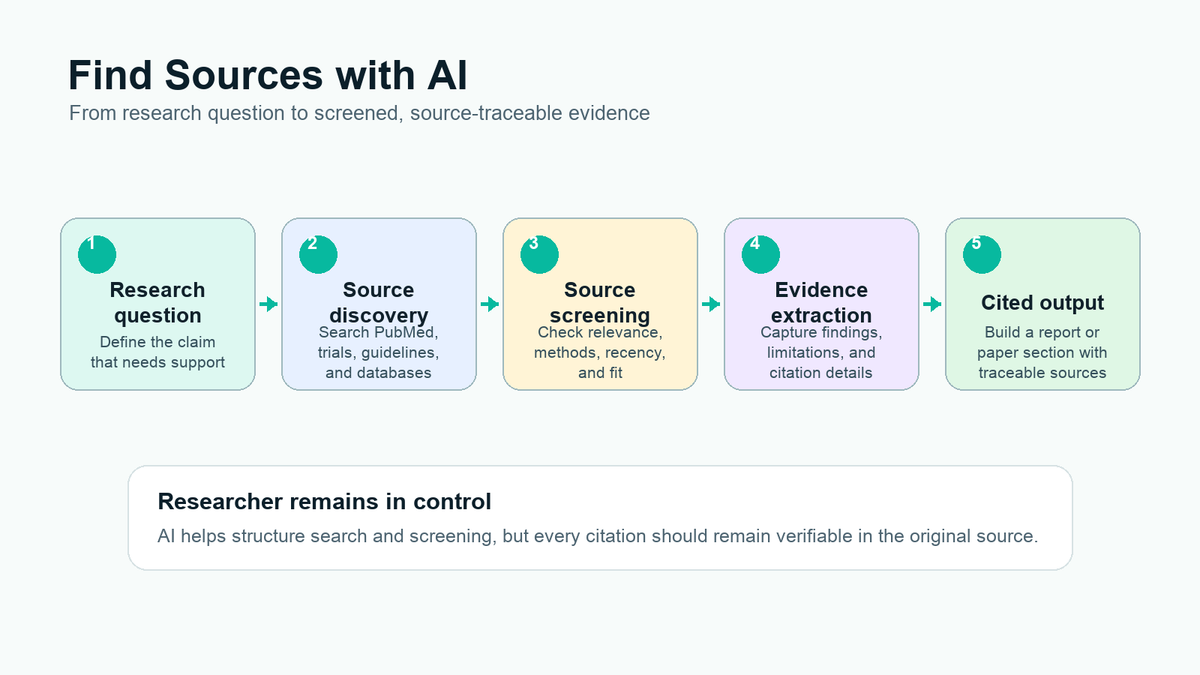
Start with a Research Question, Not a Keyword
If you want to find sources efficiently, begin with the claim or research question you need to support. A search for “breast cancer immunotherapy” is too broad for most writing tasks. A better question might be:
What recent clinical evidence supports immune checkpoint inhibitors in triple-negative breast cancer?
This question can be broken into searchable concepts:
| Research Element | Example | Why It Matters |
|---|---|---|
| Disease or condition | Triple-negative breast cancer | Narrows the biomedical context |
| Intervention or exposure | Immune checkpoint inhibitors | Defines the treatment or mechanism |
| Evidence type | Clinical trial, review, guideline | Helps separate primary evidence from background reading |
| Outcome | Survival, response rate, safety | Connects references to the claim being supported |
| Timeframe | Last 5 years, recent phase 3 studies | Keeps references current |
This structure makes searching more precise. It also helps you decide whether a reference belongs in the introduction, methods background, evidence synthesis, discussion, or future research section.
Where to Find Sources for Medical and Life Science Research
The best place to find sources depends on the research question. For medical and life science topics, researchers usually need more than one source type.
PubMed and MEDLINE
PubMed is often the first stop for biomedical literature. It is especially useful for peer-reviewed articles, clinical studies, review papers, and MEDLINE-indexed records. Researchers can use field tags, MeSH terms, article type filters, and date filters to refine results.
Clinical Trial Databases
ClinicalTrials.gov and other trial registries are useful when the question involves ongoing studies, trial design, enrollment, endpoints, or unpublished results. A paper may only show part of the evidence story, while trial records can provide additional context.
Guidelines and Professional Sources
Clinical guidelines, consensus statements, and professional society recommendations can be useful when writing about standard of care, diagnosis, treatment selection, or practice gaps.
Patents, Drug Databases, and Company Sources
For biopharma work, references may also come from patents, drug labels, company filings, pipeline updates, conference abstracts, and regulatory documents. These sources are not always traditional academic references, but they may be essential for competitive intelligence or drug development analysis.
Noah AI is designed for this kind of multi-source workflow. It can help researchers search across PubMed and other trusted biomedical sources, then organize evidence into cited outputs.
A Step-by-Step Workflow to Find Sources
A repeatable workflow helps researchers avoid random searching and build a source list with clear logic.
Step 1: Define the Claim
Write the exact statement you need to support. For example: “Recent phase 3 evidence suggests that GLP-1 receptor agonists improve weight loss outcomes in adults with obesity.”
Step 2: Break the Claim into Search Concepts
Identify the disease, population, intervention, comparator, outcome, timeframe, and evidence type. This step helps you avoid missing relevant synonyms and related terms.
Step 3: Search Trusted Databases
Use PubMed for biomedical literature, trial databases for clinical study context, and guidelines or regulatory sources when the claim depends on practice recommendations or approval status.
Step 4: Screen Titles and Abstracts
Do not save every result. Screen for relevance, publication type, study design, population, outcome, and date. AI can help summarize and group results, but the researcher should still verify the original source.
Step 5: Separate Background Sources from Claim-Supporting Evidence
A background source explains context. A claim-supporting reference directly supports a specific statement. These are not the same. Strong writing usually needs both.
Step 6: Extract Key Evidence
For each selected reference, extract the question, population, method, main finding, limitation, and citation details. This makes the final writing process easier and reduces the risk of using references incorrectly.
Step 7: Build a Traceable Citation Map
Keep a short note explaining why each source was selected and where it will be used. This is especially useful for literature reviews, medical affairs reports, and evidence-based research briefs.
How AI Can Help You Find Sources Faster
AI can support source discovery in several practical ways. It can help convert a broad topic into searchable concepts, suggest synonyms, compare query versions, summarize abstracts, and group references by theme. In a medical literature workflow, AI can also help identify whether a source is likely to be background, primary evidence, guideline-level support, or a weak match.
| Task | Manual Workflow | AI-Assisted Workflow |
|---|---|---|
| Define search scope | Researcher writes a broad keyword list | AI helps break the question into disease, intervention, outcome, and evidence type |
| Expand terms | Researcher manually remembers synonyms | AI suggests related terms, abbreviations, drug names, targets, and disease subtypes |
| Screen references | Researcher reads every abstract one by one | AI summarizes abstracts and flags likely relevance |
| Compare evidence | Researcher builds notes manually | AI helps organize studies by design, population, endpoint, and finding |
| Check gaps | Researcher notices gaps late | AI can ask follow-up questions about missing evidence types or source categories |
| Prepare output | Researcher writes citations into a draft | AI helps generate source-aware summaries and cited reports |
The key is source traceability. A useful AI workflow should make it easier to inspect the original source, not harder. If an AI tool gives a claim without a clear source, the researcher should treat it as a lead to verify, not a reference to cite.
How Noah AI Supports Source and Reference Discovery
Noah AI is built for life science and medical research workflows. Instead of acting like a general chatbot, it is designed to help users ask domain-specific questions, search trusted sources, compare evidence, and generate cited outputs.
Researchers can use Noah AI to:
- Turn a broad topic into a structured research question
- Search PubMed and biomedical sources
- Summarize candidate sources with citation context
- Compare studies across population, endpoint, method, and finding
- Identify evidence gaps or weak support
- Generate cited research reports that preserve source traceability
- Connect literature with clinical trials, guidelines, patents, and pharmaceutical databases
For example, a researcher writing about a new oncology target could ask Noah AI to find recent references on mechanism of action, clinical trial evidence, competing programs, and safety signals. Instead of manually jumping between many databases, the researcher can use Noah to structure the evidence and then review the original sources.
Readers who want to understand the product positioning can start from the Noah AI homepage. For a broader evidence workflow, read Noah's guide to literature review tools for PhD students. For a product-specific workflow, see medical literature review with Noah AI and the Noah AI tutorial. If you are comparing general AI tools with a domain-specific workflow, the Noah vs ChatGPT comparison explains why source-aware biomedical research needs a different approach.
How to Judge Whether a Source Is Good Enough
Finding a source is only the first step. Before citing it, ask whether it actually supports your statement.
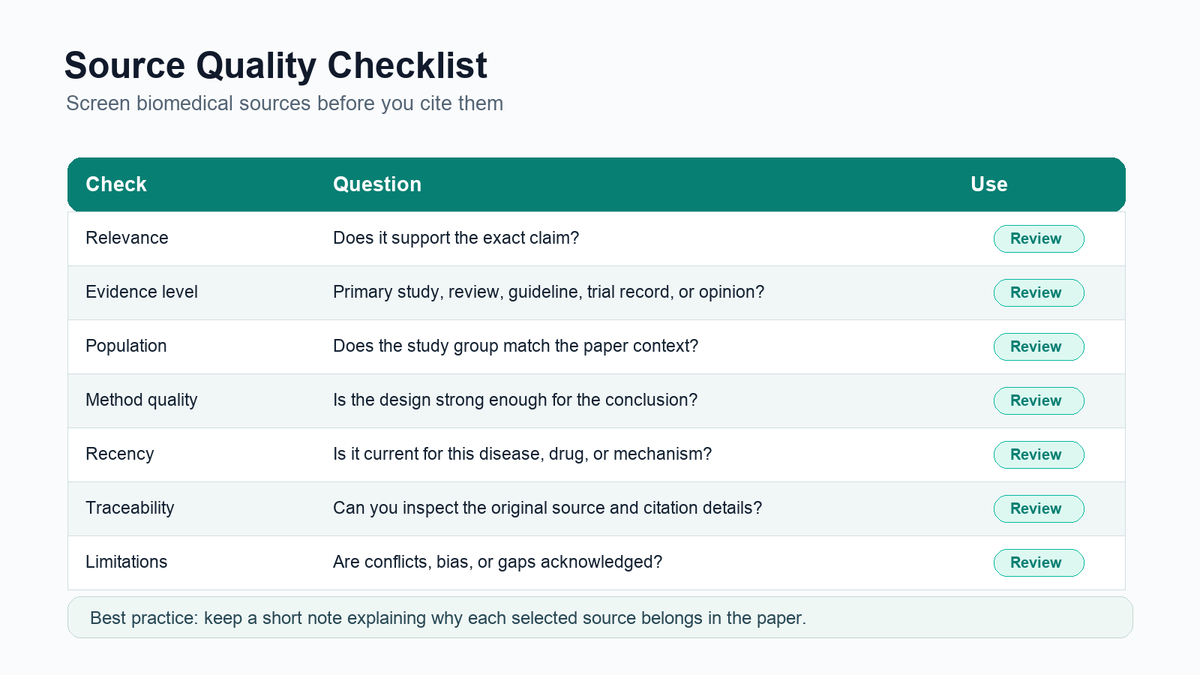
Use this checklist:
- Relevance: Does the source answer the exact question or only mention the topic?
- Evidence level: Is it a primary study, review, guideline, trial record, or opinion piece?
- Population: Does the study population match the claim?
- Method quality: Is the design strong enough for the conclusion?
- Recency: Is the reference current for the field?
- Source traceability: Can the original source be inspected?
- Conflict or limitation: Does the reference have limitations that should be acknowledged?
- Fit in the paper: Is it background support, direct evidence, or a contrast point?
For biomedical research, a recent paper is not automatically better, and a highly cited paper is not automatically the right source. The best source is the one that fits the claim, evidence level, and context.
Example: Finding Sources for a Medical Literature Review
Imagine a researcher needs sources for a literature review on GLP-1 receptor agonists in obesity and type 2 diabetes. A weak workflow might start with a broad search for “GLP-1 weight loss” and save the first ten papers.
A stronger workflow would:
- Define the question: What recent clinical evidence supports GLP-1 receptor agonists for weight loss and metabolic outcomes?
- Break the question into concepts: GLP-1 receptor agonists, obesity, type 2 diabetes, weight loss, glycemic control, clinical trials, safety.
- Search PubMed and clinical trial sources.
- Screen references by study type, population, endpoint, and date.
- Separate background mechanism references from clinical outcome evidence.
- Compare major studies and identify limitations.
- Create a cited summary that links each claim to a source.
Noah AI can help at each step by clarifying scope, retrieving relevant sources, summarizing candidate references, and generating a structured cited report. The researcher still reviews the sources and decides which references belong in the final paper. For examples of source-backed outputs, researchers can browse Noah AI research insights or read how Noah supports searches for latest authoritative medical data.
Common Mistakes When Finding Sources
Using the First Search Results as the Source List
Search ranking does not always equal evidence quality. Always screen sources before citing them.
Citing Sources That Only Mention the Topic
A source that mentions a drug, disease, or mechanism may not support the specific claim you are making.
Ignoring Study Design
A review article, case report, randomized trial, animal study, and guideline all serve different purposes. Choose references based on the type of evidence your claim requires.
Forgetting Negative or Conflicting Evidence
A strong literature review should not only cite supportive findings. It should also acknowledge uncertainty, limitations, and conflicting evidence when relevant.
Letting AI Replace Verification
AI can speed up the workflow, but researchers should still inspect the original source, confirm citation details, and judge whether the reference is appropriate.
Final Takeaway
Learning how to find sources is really about learning how to build an evidence trail. For medical and life science research, the strongest source workflow starts with a clear question, searches trusted databases, screens evidence carefully, and keeps every citation connected to the claim it supports.
AI can make this process faster by helping researchers clarify search intent, expand terms, screen references, compare studies, and produce cited summaries. Noah AI fits this workflow as a life science AI agent for source-aware research, medical literature review, and biomedical evidence analysis.
FAQ
How do I find sources for a research paper?
Start with a clear research question, break it into searchable concepts, search trusted databases, screen titles and abstracts, evaluate source quality, and keep notes on why each source supports your paper.
What is the best way to find sources for medical research?
For medical research, use PubMed, clinical trial databases, guidelines, and other trusted biomedical sources. Screen references by study design, population, outcome, date, and relevance to the claim.
Can AI help me find sources?
Yes. AI can help structure search terms, suggest synonyms, summarize candidate references, compare studies, and identify evidence gaps. Researchers should still verify original sources before citing them.
What makes a reference reliable?
A reliable reference is relevant to the claim, traceable to an original source, methodologically appropriate, current enough for the field, and transparent about limitations or conflicts.
Is Noah AI a source or reference finder?
Noah AI can support source and reference discovery as part of a broader medical and life science research workflow. It helps users search trusted sources, screen evidence, compare findings, and generate cited research outputs.