Best AI Tools for Medical Literature Search and Research Writing (2026)
Linda
Compare AI tools for medical literature search and research writing, with a real Noah AI test showing how evidence from FIDELIO-DKD and FIGARO-DKD carries into a source-grounded finerenone research draft.
Finding relevant medical papers is only half of the research-writing problem. The harder part is deciding which evidence belongs in the draft, preserving important differences between studies, and turning those findings into coherent writing without losing the connection to the original sources.That makes medical literature search and research writing a single handoff problem. A tool can retrieve excellent papers and still be a poor writing partner if the evidence context has to be rebuilt from scratch once drafting begins.For this comparison, the main question is therefore simple: which AI tools are best at carrying medical evidence from literature search into source-grounded research writing?
Quick Answer
Noah AI is a strong fit in this comparison when the user starts with a biomedical research question and wants to move from medical literature search into a structured, source-grounded research draft. Elicit is better suited when writing follows a formal systematic-review process. SciSpace is useful when the work starts from papers or PDFs that need deeper analysis. Consensus is useful when the goal is to move quickly from a research question to a structured academic literature review.
What Has to Survive From Search to Writing?
| What needs to survive | Why it matters |
|---|---|
| Relevant studies | The draft needs to start from the right evidence base, not from generic model knowledge. |
| Population and study context | Different trials should not be flattened into one broad claim when they studied different populations or outcomes. |
| Outcome-specific evidence | Renal, cardiovascular, and safety claims need the studies that actually support them. |
| Source traceability | Researchers need to be able to verify what supports a statement before using it. |
| Evidence limitations | Uncertainty and trial differences should survive the move into prose rather than disappearing during summarization. |
Noah AI — Best for Carrying Biomedical Evidence From Search Into Writing
Noah AI is most relevant here when literature search and medical writing are part of the same research task. The case below tests whether evidence identified during search remains visible and usable when the work moves into a structured draft.
A Search-to-Writing Test With Finerenone
We used a focused question on finerenone for cardiorenal risk reduction in adults with chronic kidney disease and type 2 diabetes. The search needed to distinguish the pivotal FIDELIO-DKD and FIGARO-DKD trials, including their populations, primary focus, outcomes, safety context, limitations, and source references.The purpose was not to test whether Noah could find the trial names. The useful test was whether the distinctions established during search would still be present when the evidence was turned into research writing.
What Evidence Did the Search Stage Surface?
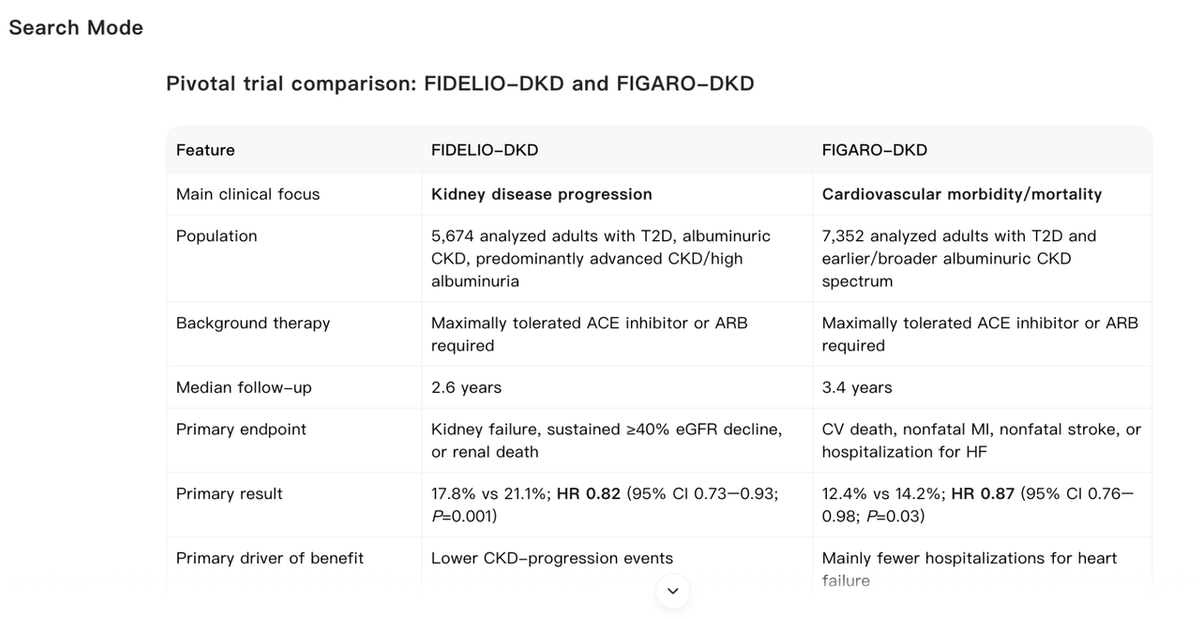
Figure 1. Noah AI Medical Search compares FIDELIO-DKD and FIGARO-DKD across clinical focus, population, background therapy, follow-up, primary endpoint, and trial results.The search output already separates the two studies rather than collapsing them into one finerenone claim. FIDELIO-DKD and FIGARO-DKD evaluated overlapping cardiorenal outcomes, but differed in the emphasis of their primary endpoints and enrolled populations. FIDELIO-DKD enrolled a population with generally more advanced CKD and used a kidney composite as its primary endpoint, whereas FIGARO-DKD included a broader CKD population and used a cardiovascular composite as its primary endpoint.That distinction matters for downstream writing. A draft that treats the trials as interchangeable could easily attach the wrong emphasis to a claim, while a search result that preserves trial context gives the writer a clearer evidence structure to carry forward.For a dedicated source-finding workflow, see How to Find Sources for a Research Paper with AI.
Did the Writing Preserve the Evidence Context?
This is the central test in the article. Medical research writing should not reduce the evidence to a vague statement such as “finerenone improves cardiorenal outcomes.” The draft needs to preserve which trial supports which part of the argument.In this example, the two trials remain distinct because their primary endpoints and enrolled populations differed in emphasis. Both contribute to the cardiorenal evidence base for finerenone, but their results should be interpreted in the context of those design and population differences. Preserving that distinction is what keeps the writing tied to the underlying evidence instead of becoming a generic drug summary.
The Final Research Draft
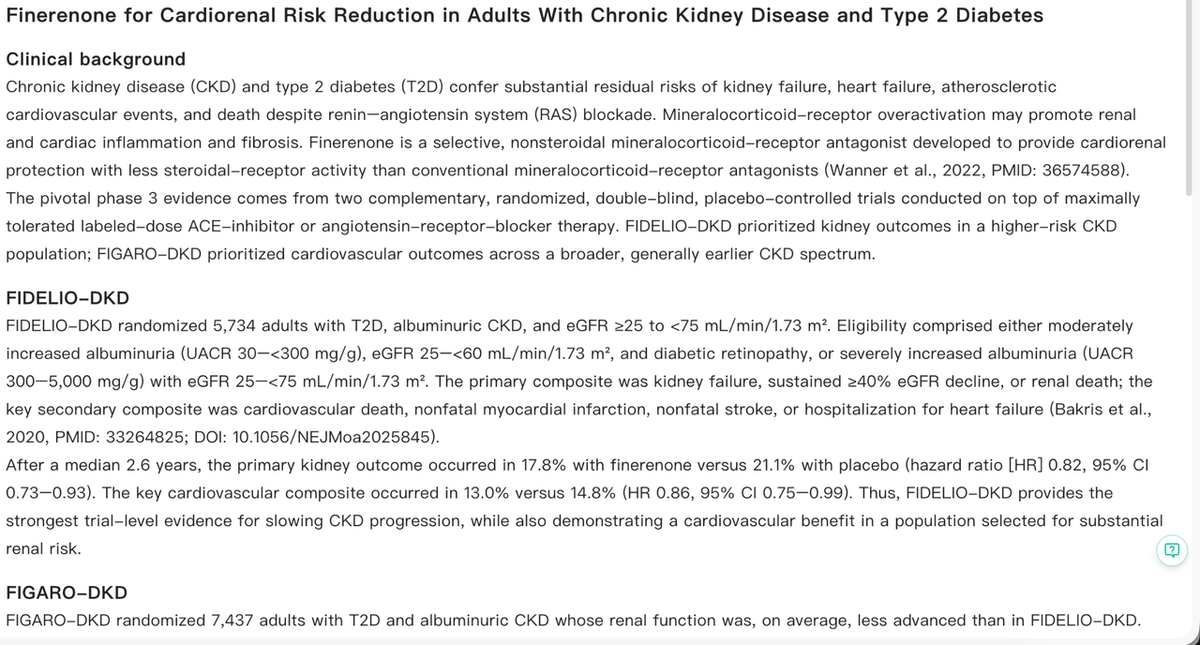
Figure 2. The final Noah AI research draft preserves the clinical context and distinguishes FIDELIO-DKD from FIGARO-DKD within the written evidence narrative.The draft opens with the clinical background, then introduces the two pivotal phase 3 trials as complementary studies rather than treating them as a single evidence block. The visible FIDELIO-DKD section retains its population, kidney-focused primary composite, cardiovascular secondary outcome, and source details.Primary trial sources: FIDELIO-DKD — Bakris GL et al., Effect of Finerenone on Chronic Kidney Disease Outcomes in Type 2 Diabetes, New England Journal of Medicine (2020), PMID 33264825, DOI 10.1056/NEJMoa2025845. FIGARO-DKD — Pitt B et al., Cardiovascular Events with Finerenone in Kidney Disease and Type 2 Diabetes, New England Journal of Medicine (2021), PMID 34449181, DOI 10.1056/NEJMoa2110956.The final draft preserves the same trial distinctions surfaced during the search stage. FIDELIO-DKD and FIGARO-DKD remain separated by population, clinical focus, and outcome evidence rather than being collapsed into a generic finerenone summary.This is the specific advantage demonstrated by the case: Noah can support both biomedical evidence retrieval and evidence-grounded drafting around the same research question while preserving important study context in the final writing.A related comparison on evidence-grounded drafting is available in Noah AI vs Paperpal: Evidence-Grounded Writing vs Academic Polishing.
How Other Tools Handle the Search-to-Writing Handoff
Elicit — Better When Writing Follows a Formal Systematic Review
Elicit is better suited when the writing output comes after a formal systematic-review process. Its current workflow covers protocol refinement, source gathering, screening, data extraction, and evidence synthesis with cited reports.Compared with Noah, Elicit is more methodology-driven. It is the better fit when reproducible review steps and screening rigor are central; Noah is more direct when the goal is to move from a biomedical question into source-grounded writing without first building a full systematic-review protocol.
SciSpace — Better When the Work Starts From Papers or PDFs
SciSpace is useful when researchers already have papers or need to analyze documents in depth before writing. Its Literature Review, Deep Review, and PDF tools are oriented around finding papers, extracting findings, identifying themes or gaps, and building literature synthesis.Compared with Noah, SciSpace is more paper- and document-centered.Noah's advantage in this task is that it supports biomedical evidence retrieval and evidence-grounded drafting around the same research question.
Consensus — Better for Fast Question-to-Literature-Review Synthesis
Consensus is useful when a researcher wants to move quickly from a question to a structured review of the academic literature. Deep Review can break the question into subquestions, run targeted searches, and produce a literature-review-style synthesis.Compared with Noah, Consensus is broader academic evidence synthesis. Noah is more specifically relevant when the final task is biomedical research writing that needs to preserve medical evidence context from the earlier search stage.
Where Does Your Search-to-Writing Process Break?
You cannot find the right biomedical evidence. Start with a tool that has strong medical literature retrieval and source traceability.
You need a formal systematic review before writing. Elicit is the better fit when protocol, screening, extraction, and auditable review steps are the center of the project.
You already have a folder of papers or PDFs. SciSpace is more useful when the main bottleneck is reading, extracting, and synthesizing existing documents.
You mainly need a fast academic synthesis. Consensus is useful when the priority is moving quickly from a research question to a structured review of the literature.You find evidence but lose study context when drafting. The Noah case shows that the final writing can preserve the same trial distinctions surfaced during medical literature search.
FAQ
Can AI search medical literature and write from the same evidence?
Yes, some tools can support both stages. The important question is whether the writing remains traceable to the studies and evidence context established during search.
How can I check whether AI-generated medical writing is actually supported by the cited papers?
Verify the study population, endpoint, result, and limitation against the original source rather than checking only whether a citation is present.
Is a search-to-writing AI workflow the same as a systematic review?
No. A formal systematic review requires a defined protocol, reproducible search and screening methods, eligibility criteria, quality assessment, and transparent reporting.
Should researchers verify citations before using an AI-generated draft?
Yes. Source-grounded writing reduces the distance between evidence and prose, but important claims and citations should still be checked against the original studies before formal use.
Final Takeaway
The hardest part of medical literature search and research writing is often the handoff between the two.In the Noah case, the final research draft preserves the same trial distinctions surfaced during medical literature search, keeping FIDELIO-DKD and FIGARO-DKD tied to their different populations and evidence roles.
Turn your next medical research question into source-grounded research writing with Noah AI.