
Best Text-to-Figure AI Tools for Biomedical Research (2026)
Linda
Compare text-to-figure AI tools for biomedical research, with a KEYNOTE-189 case study in Noah AI and workflow-based comparisons of other tools.
Turning biomedical text into a figure is harder than generating an image from a prompt. A clinical trial description may contain patient eligibility, randomization, treatment arms, treatment phases, endpoints, and outcome data. A useful text-to-figure tool has to decide how those relationships should appear visually without losing or rearranging the scientific meaning.
For this comparison, the key question is not which AI produces the most attractive image. It is which tools are best at translating biomedical text into a structured scientific figure draft that a researcher can inspect, verify, and refine.
To make the evaluation concrete, we use a KEYNOTE-189 clinical-trial case study in Noah AI, then examine where BioRender, Mind the Graph, and Canva fit in similar text-to-figure workflows. We tested Noah AI directly. Other tools were evaluated based on their official documentation and published workflows.
Quick Answer
Noah AI is a strong fit when the source text contains biomedical study context that needs to be translated into a structured figure draft. BioRender is better suited when the scientific content is already defined and detailed post-generation editing matters most. Mind the Graph fits simpler scientific concepts that can be assembled with templates and scientific illustrations, while Canva is more appropriate for general explanatory or presentation graphics.
Best Text-to-Figure AI Tools at a Glance
| Tool | Best when the text contains... | Main advantage | Less suitable when... |
|---|---|---|---|
| Noah AI | Biomedical study or literature context | Research context → structured figure draft | You only need final visual polishing |
| BioRender | Clearly defined scientific content | Text prompt → editable scientific figure | You still need help interpreting the underlying research |
| Mind the Graph | A simpler scientific concept | Template- and illustration-based visual assembly | The text contains dense trial or pathway logic |
| Canva | General explanatory content | Fast communication-oriented visual design | Biomedical structure and terminology are the main challenge |
What Should a Biomedical Text-to-Figure Tool Preserve?
The important test is whether the scientific message survives the translation from text to visual structure. A useful draft should preserve the relationships and hierarchy in the source material, keep biomedical terminology recognizable, retain research context when the task depends on specific evidence, and remain easy enough to inspect that a researcher can identify what needs correction.The evaluation criterion is therefore not visual attractiveness alone. The more useful question is whether the generated draft preserves enough of the source structure to support efficient researcher review.
Noah AI — Best for Research-Grounded Visual Translation
Noah AI is most relevant when the source text describes a biomedical study, pathway, or research concept that benefits from domain context before visualization.
A KEYNOTE-189 Text-to-Figure Case Study
We tested Noah AI with a clinical-trial prompt focused on KEYNOTE-189 in metastatic nonsquamous non-small-cell lung cancer. The case is useful because the source material contains several relationships that need to survive visual translation: patient population → randomization → treatment arms → induction treatment → maintenance treatment → disease assessment → survival follow-up, with crossover shown separately as a conditional pathway.The goal of this case study is not to prove that Noah produces a fully accurate clinical-trial figure in one pass. It is to examine how much of the underlying study structure the first draft preserves, and what still requires researcher correction.
Research Context Before Figure Generation
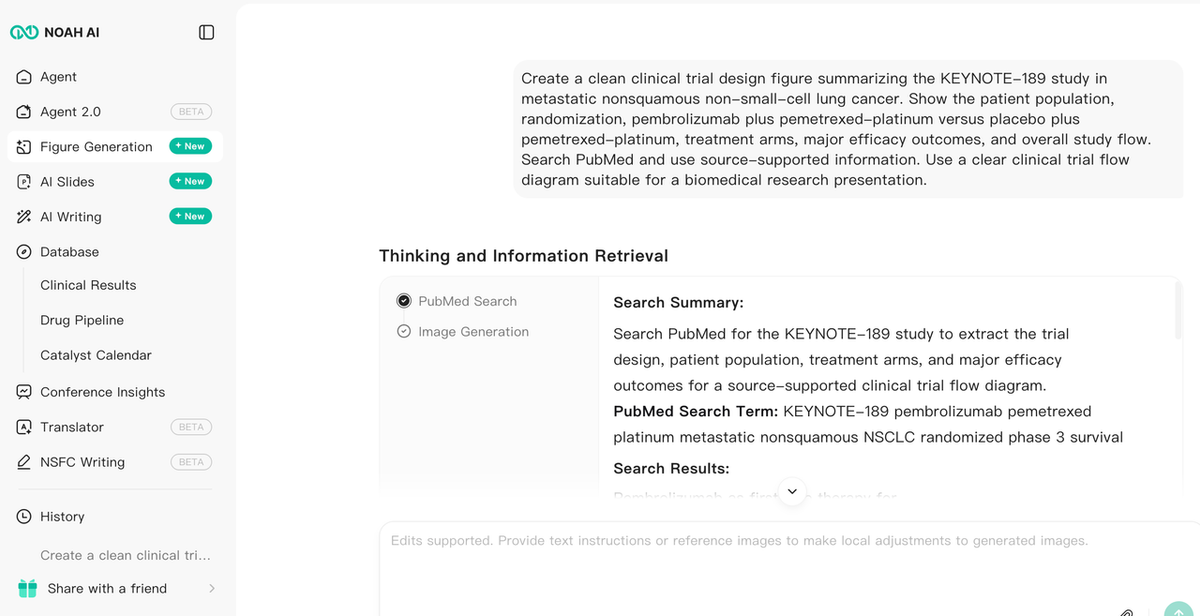
Figure 1. Noah AI retrieves PubMed context for the KEYNOTE-189 trial before generating the clinical-trial design figure.
Before image generation, the workflow retrieves PubMed context for KEYNOTE-189, including the study design, patient population, treatment arms, treatment phases, and efficacy context relevant to understanding the trial.For this case study, the retrieval stage matters because the requested figure represents a specific clinical trial rather than a generic two-arm study. The retrieved evidence provides research context for the draft, but the generated figure still needs to be checked against the original publications.For a broader comparison of biomedical figure tools, see The 10 Best Scientific Figure Creation Tools in 2026.
How Well Did the Figure Preserve the Study Structure?
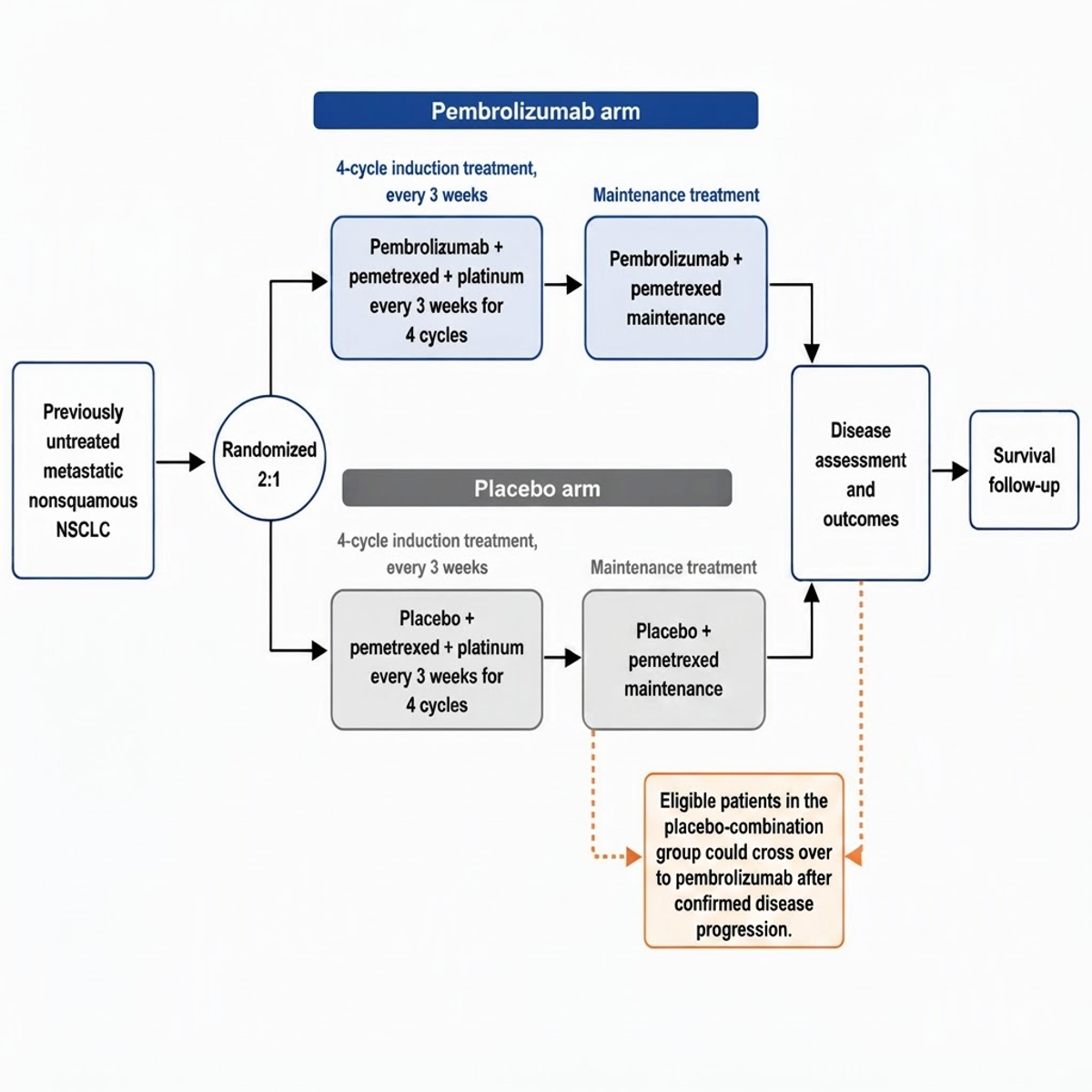
Figure 2. Revised Noah AI-generated KEYNOTE-189 clinical-trial figure draft showing the patient population, 2:1 randomization, treatment phases, disease assessment, survival follow-up, and conditional crossover pathway.
The revised figure preserves the main study structure in a clear visual sequence: the metastatic nonsquamous NSCLC population, 2:1 randomization, separate pembrolizumab and placebo arms, four-cycle induction treatment, maintenance treatment, disease assessment, survival follow-up, and the conditional crossover pathway for eligible patients in the placebo-combination group.An earlier generated draft required researcher correction. It combined details from separate KEYNOTE-189 publications in the reference, used potentially ambiguous wording around treatment duration, presented follow-up and crossover in a way that could imply the wrong sequence, and displayed efficacy results without clearly anchoring them to a specific analysis time point. The revised figure removes these ambiguities and focuses on the study design and treatment flow rather than embedding detailed efficacy statistics or publication citations directly into the image.This case illustrates both the value and the limitation of text-to-figure AI. Noah AI can turn a biomedical study description and retrieved research context into a structured visual starting point, but the figure should still be treated as a researcher-reviewable draft rather than a scientific source of record. Researchers remain responsible for checking study logic, terminology, numerical claims, citations, and visual relationships against the original publications.In this case, the main value was not one-click accuracy. It was the ability to move from biomedical text and research context to an inspectable visual structure that could then be reviewed, corrected, and refined.If the task is specifically a biological pathway rather than a trial design, see Best AI Tools for Creating Medical Mechanism Diagram Drafts (2026).
How Other Tools Fit Text-to-Figure Workflows
BioRender — Better for Editable AI-Generated Scientific FiguresBioRender is a strong fit when the scientific content is already defined and the researcher wants AI to convert that description into an editable scientific figure. Its current Generate Editable Figure workflow can create visual drafts from text prompts and add selected outputs to the canvas as editable figure elements.Compared with Noah, BioRender is more suitable when post-generation editing and precise visual refinement are the priority. Noah is more relevant when the figure task also benefits from biomedical literature context before generation.
Mind the Graph — Better for Template-Based Scientific Communication
Mind the Graph is more suitable when the scientific message is already understood and the main task is assembling it into a clear visual using scientific illustrations and templates. Its current platform provides a large scientific illustration library and hundreds of ready-to-use templates.Compared with Noah, Mind the Graph is better for manual scientific communication and simpler visual assembly. It is less suited to text that first needs research-heavy trial or pathway interpretation.
Canva — Better for General Text-to-Visual Communication
Canva is useful when source text needs to become a presentation visual, explainer, or general communication graphic.Compared with Noah, Canva is more suitable when layout and communication are the main challenge. It is less suitable when the text contains dense biomedical relationships, trial design, or domain-specific structure that needs scientific interpretation before visualization.
What Text-to-Figure AI Still Gets Wrong
Even a convincing biomedical figure can contain incorrect labels, invented or oversimplified relationships, source mismatches, or numerical details that look plausible but are wrong. A polished visual can therefore create false confidence if the underlying scientific content is not checked.AI-generated biomedical figures should be treated as reviewable drafts rather than final scientific authority. The KEYNOTE-189 case study illustrates this directly: an earlier generated draft captured much of the trial structure, but citation details, treatment wording, sequencing, and outcome presentation still required human correction. The researcher remains responsible for verifying terminology, study logic, quantitative claims, and the final visual interpretation.
What Kind of Text Are You Trying to Turn Into a Figure?
Clinical-trial or evidence-heavy biomedical text. Noah AI is particularly relevant when research context and structural translation matter.
Clearly defined scientific content that needs detailed editing. BioRender is the better fit when the scientific story is already understood and visual control matters most.
A simpler scientific concept. Mind the Graph fits tasks where templates and scientific illustrations are enough.
General explanatory or presentation text. Canva is more appropriate when communication design matters more than biomedical interpretation.
FAQ
Can AI turn a research paper or abstract into a scientific figure?
Yes, but the quality depends on how well the tool identifies the scientific relationships that need to be visualized. Researchers should still verify the final structure, labels, and quantitative claims against the source.
What biomedical text works best for text-to-figure AI?
Structured descriptions work best when they clearly specify the population, pathway, treatment arms, stages, relationships, endpoints, or other visual components that should appear in the draft.
How should researchers verify an AI-generated clinical trial figure?
Check the patient population, randomization, treatment arms, dosing or treatment phases, endpoints, numerical results, terminology, and source citation against the original trial publication.
Is an AI-generated text-to-figure draft ready for journal submission?
Not automatically. It should be treated as a first draft that still requires scientific verification, visual refinement, and any journal-specific formatting or figure requirements.
Final Takeaway
Text-to-figure AI is most useful when it translates scientific relationships—not just words—into a reviewable visual structure.In the KEYNOTE-189 case study, Noah AI turned biomedical study context into a structured clinical-trial figure draft. Researcher review was still necessary, and an earlier version required corrections before the revised study flow was produced. This makes Noah most useful as a research-informed drafting tool rather than a replacement for scientific verification. Its value is helping researchers move from biomedical text and retrieved evidence to an inspectable visual starting point that can be checked and refined.Turn your biomedical research text into a structured scientific figure draft with Noah AI.