Literature Review Tools for PhD Students: From Search Funnel to Final Conclusion with Noah AI
Linda
A practical guide for PhD students on using a literature review funnel, academic databases, reference managers, and Noah AI to move from paper search to evidence synthesis and final conclusion.
A strong literature review is not just a list of papers. It is a structured process that moves from a broad topic to a focused research question, then from search results to evidence synthesis and final conclusion. For PhD students, medical researchers, and early-career academics, the hardest part is often not finding papers, but deciding which evidence matters, how to compare studies, and how to write a conclusion that clearly answers the research question.
This guide explains how to use a literature review funnel to organize the process. It also compares systematic review vs literature review, explains annotated bibliography vs literature review, and introduces practical literature review tools for PhD students, including PubMed, Google Scholar, reference managers, screening tools, and AI tools for literature review. Noah AI is included as one useful AI research assistant for medical and life science researchers who need help clarifying research questions, reviewing references, asking follow-up questions, and generating cited research reports.
Introduction
Many PhD students begin a literature review by collecting as many papers as possible. This feels productive at first, but it often creates a bigger problem: too many PDFs, too many directions, and no clear argument.
A good literature review needs more than search volume. It needs a workflow. Students must define the scope, build a search strategy, screen papers, synthesize themes, and write a conclusion that connects back to the research question.
Common challenges include:
- Too many papers and unclear priorities
- A broad or vague research question
- Weak search strategy
- Unclear inclusion and exclusion criteria
- Summarizing sources one by one without synthesis
- Missing citations or weak source traceability
- Difficulty writing the final conclusion
For medical literature reviews, the challenge is even greater because evidence may come from PubMed, clinical studies, guidelines, systematic reviews, and biomedical databases. This is where a clear workflow and the right tools can make the process much easier.
What Is a Literature Review Funnel?
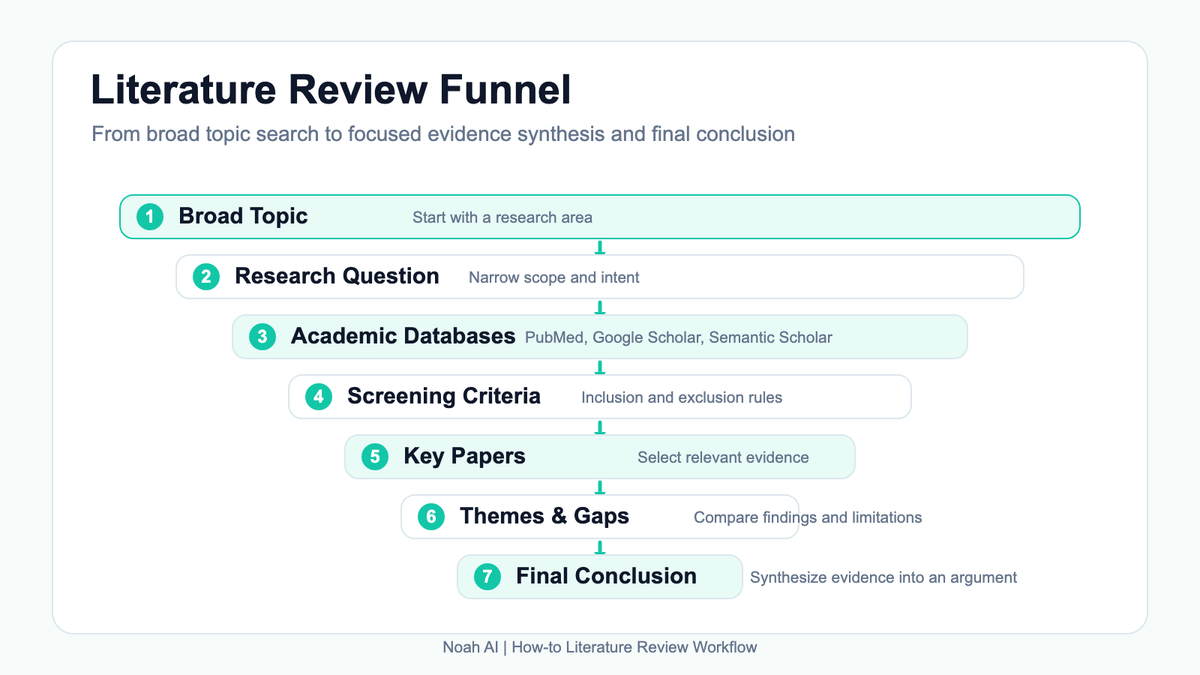
Figure 1. Literature review funnel from broad topic to final conclusion.
A literature review funnel is a structured way to narrow a broad topic into a focused academic review. The funnel model of literature review helps students move step by step from general search to specific synthesis.
A typical literature review funnel looks like this:
| Funnel Stage | What It Means | Example |
|---|---|---|
| Broad topic | General research area | AI in oncology |
| Research question | Focused academic question | How are AI imaging tools evaluated in lung cancer screening? |
| Databases | Sources to search | PubMed, Google Scholar, Semantic Scholar |
| Criteria | Inclusion and exclusion rules | Recent clinical studies, adult patients, English-language papers |
| Key papers | Most relevant evidence | Studies directly answering the question |
| Themes | Patterns across studies | Accuracy, validation, workflow integration |
| Evidence gaps | What remains unclear | Limited external validation or small sample sizes |
| Final conclusion | What the literature shows | Current evidence is promising but needs stronger validation |
Instead of reviewing a topic like "AI in medicine," a student might narrow it to:
"How have AI-based imaging tools been evaluated for early lung cancer detection in clinical research over the past five years?"
This narrower question is easier to search, screen, synthesize, and conclude.
Systematic Review vs Literature Review
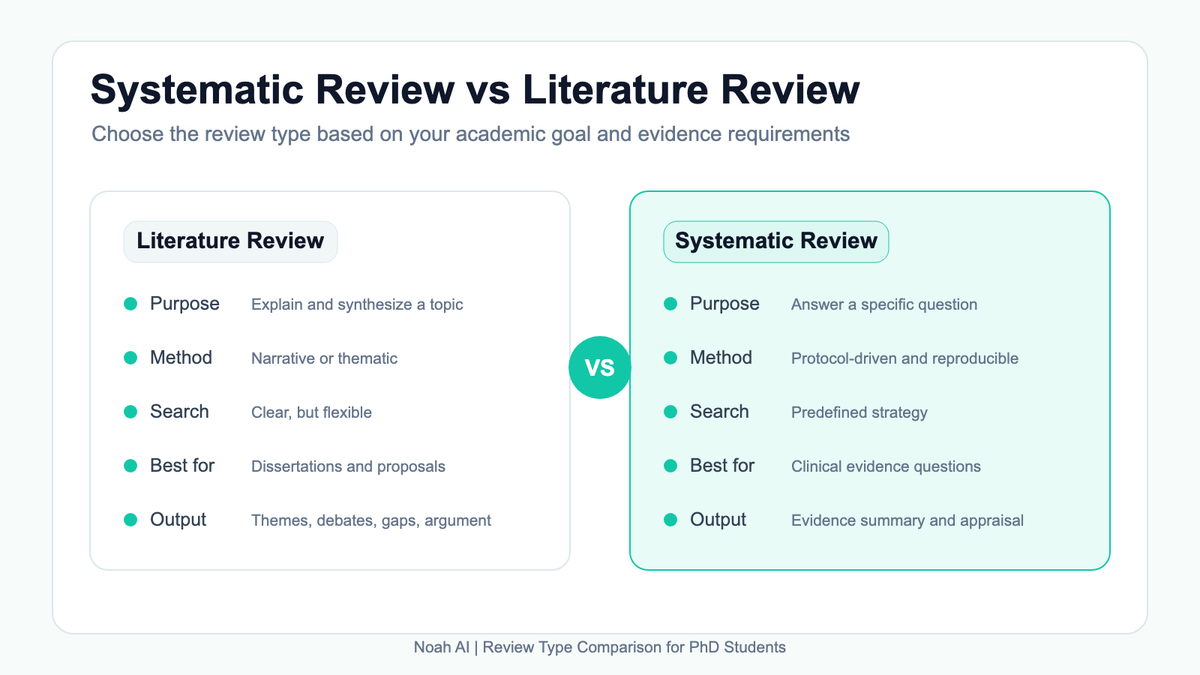
Many students search for tools for literature review for a PhD student because they are unsure what type of review they need. One common confusion is systematic review vs literature review.
A literature review is usually broader and more thematic. It explains what a field currently knows, where debates exist, and what research gaps remain.
A systematic review is more protocol-driven. It uses predefined methods, reproducible search strategies, strict screening criteria, and often formal quality appraisal.
| Feature | Literature Review | Systematic Review |
|---|---|---|
| Main goal | Explain and synthesize a research area | Answer a specific question using reproducible methods |
| Scope | Broader and more flexible | Narrower and more strictly defined |
| Method | Narrative or thematic synthesis | Protocol-based search, screening, and appraisal |
| Search strategy | Clear but may be flexible | Systematic and reproducible |
| Screening | Useful but not always formal | Required and documented |
| Best for | Dissertation chapters, proposals, background sections | Clinical questions, evidence synthesis, guideline support |
| Output | Themes, debates, gaps, and argument | Evidence summary, appraisal, sometimes meta-analysis |
PhD students should choose the format based on their academic goal. A dissertation chapter may need a thematic literature review, while a clinical evidence question may require a systematic review.
Annotated Bibliography vs Literature Review
Another common issue is annotated bibliography vs literature review.
An annotated bibliography summarizes individual sources one by one. Each entry usually includes a citation, a short summary, and sometimes a note about relevance.
A literature review goes further. It synthesizes multiple sources around themes, debates, gaps, and conclusions.
An annotated bibliography might say:
- Paper A studied one population.
- Paper B used a different method.
- Paper C reported a different outcome.
A literature review asks:
- What pattern appears across these studies?
- Do the findings agree or conflict?
- Are differences explained by methods or populations?
- What evidence gap remains?
- How does this literature support the research question?
In short, an annotated bibliography is source-centered. A literature review is argument-centered.
Best Literature Review Tools for PhD Students
The best literature review tools for PhD students usually work together as a toolkit. No single tool solves every part of the process.
Academic Databases
Academic databases help students find peer-reviewed research, reviews, clinical studies, guidelines, and related academic sources.
Common databases include:
- PubMed for biomedical and clinical literature
- Google Scholar for broad academic discovery
- Semantic Scholar for AI-assisted academic search
- Web of Science or Scopus for citation tracking
- ClinicalTrials.gov for clinical trial records
- Field-specific databases depending on the discipline
For a PubMed literature review, students should pay attention to search terms, MeSH terms, study types, date filters, and clinical relevance.
Reference Managers
Reference managers help students save, organize, cite, and format sources. Common tools include:
- Zotero
- EndNote
- Mendeley
These tools are useful when a review grows from 20 papers to 100 or more. They reduce citation errors and make it easier to prepare manuscripts, dissertations, and proposals.
Screening and Organization Tools
For larger reviews, students need a way to screen papers and extract evidence. This can be done through dedicated screening software or a structured spreadsheet.
Useful fields include:
- Citation
- Study design
- Population
- Research question
- Methods
- Main findings
- Limitations
- Relevance to the review
- Notes for synthesis
AI Tools for Literature Review
AI tools for literature review can support question refinement, evidence summarization, study comparison, and report drafting.
However, source traceability matters. In medical and life science research, students should verify important claims against original sources and avoid relying on unsupported summaries.
Noah AI can support this workflow as an AI research assistant for medical and life science researchers. It can help clarify research questions, summarize PubMed and clinical evidence, review cited references, answer follow-up questions, and generate cited research reports.
For a detailed workflow, see How to Use Noah for Medical Literature Review. New users can also read the Noah AI tutorial for biopharma and medical research.
A Step-by-Step Literature Review Workflow
Step 1: Define the Research Question
Start by turning a broad topic into a focused question.
Broad topic: "Biomarkers in cancer."
Focused question: "How are circulating tumor DNA biomarkers being evaluated for treatment monitoring in advanced colorectal cancer?"
Noah AI can help at this stage by turning a broad idea into more precise research questions and suggesting possible directions for a medical literature review.
Step 2: Build the Search Funnel
Define your main concepts, synonyms, related terms, databases, date range, study types, and inclusion and exclusion criteria.
For medical and life science topics, this may include disease terms, intervention terms, outcome terms, PubMed search terms, and clinical filters.
Step 3: Search Academic Databases
Search databases such as PubMed, Google Scholar, Semantic Scholar, and other relevant sources.
Record:
- Keywords
- Search strings
- Filters
- Date of search
- Number of results
- Database used
This makes your review more transparent and easier to update later.
Step 4: Screen Papers with Inclusion and Exclusion Criteria
Screen papers in stages:
- Title screening
- Abstract screening
- Full-text review
At each stage, ask whether the paper directly answers your research question.
Examples of inclusion criteria:
- Relevant population
- Relevant outcome
- Peer-reviewed article
- Appropriate study type
- Published within the target date range
Examples of exclusion criteria:
- Wrong population
- Not related to the question
- Duplicate publication
- No relevant outcome
- Opinion piece without supporting evidence
Step 5: Extract Themes and Evidence
After screening, extract key information into a table or structured notes.
Track:
- Study design
- Population
- Intervention or exposure
- Comparator
- Outcomes
- Main findings
- Limitations
- Evidence quality
- Relevance to your question
Noah AI can help summarize PubMed evidence and generate a cited report, but researchers should still review references and confirm that each source fits the inclusion criteria.
Step 6: Compare Findings and Identify Gaps
This is where summary becomes synthesis.
Look for:
- Consistent findings
- Conflicting results
- Methodological differences
- Understudied populations
- Missing outcomes
- Weak evidence
- Unanswered questions
Noah AI can be useful here for follow-up questions, such as "Which studies report conflicting results?" or "What are the main limitations across these papers?" This helps students move from paper-by-paper reading to thematic synthesis.
Step 7: Write the Final Conclusion
The conclusion should connect back to the research question. It should summarize evidence, identify gaps, explain implications, and suggest future research directions.
How to Write a Conclusion for a Literature Review
Many students search for how to write a conclusion for a literature review because this section is difficult to write clearly.
A strong conclusion should:
- Summarize the key findings.
- Return to the research question.
- Highlight evidence gaps.
- Explain implications.
- Suggest future research directions.
Useful sentence templates include:
- "Overall, the literature suggests that…"
- "Across the reviewed studies, the strongest evidence points to…"
- "However, the current evidence remains limited by…"
- "A key gap in the literature is…"
- "Future research should focus on…"
For medical literature reviews, conclusions should be careful and evidence-based. Avoid making strong clinical claims unless the evidence clearly supports them.
Example: Using Noah AI for a Medical Literature Review
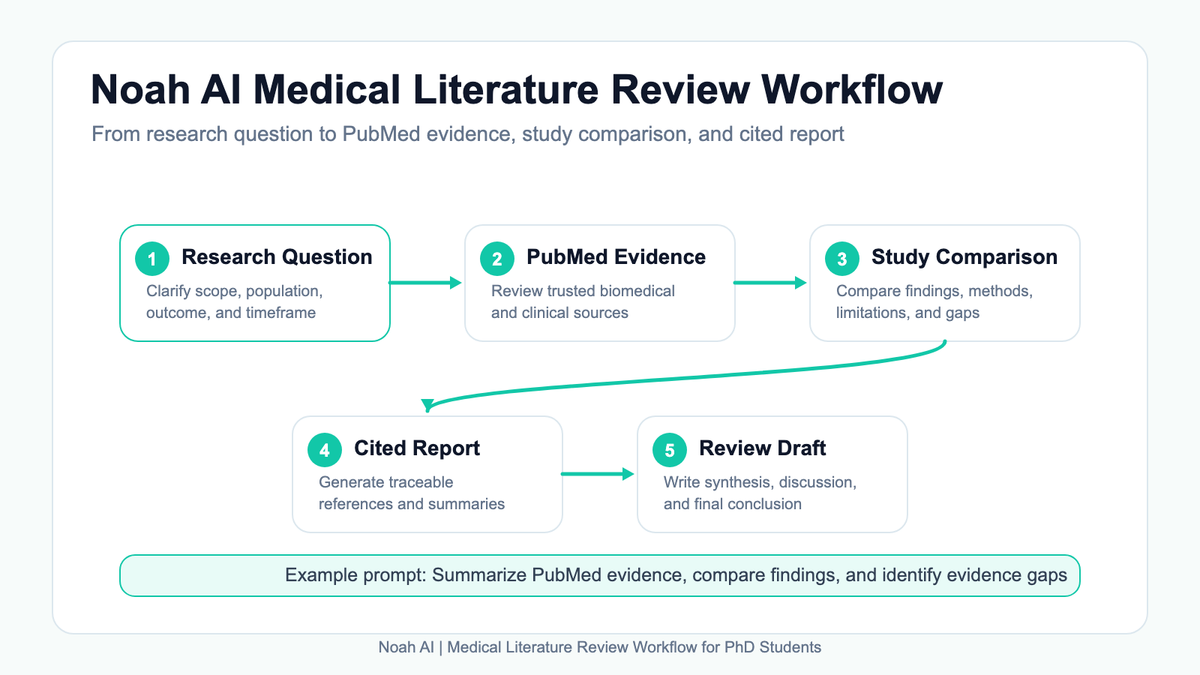
Imagine a PhD student is preparing a medical literature review on GLP-1 receptor agonists and cardiometabolic outcomes in a specific patient population.
A practical workflow could look like this:
- The student asks Noah AI to clarify the research scope.
- Noah AI suggests narrowing the topic by population, outcome, and study type.
- The student chooses a focused research question.
- Noah AI helps summarize relevant PubMed evidence and clinical sources.
- The student reviews the cited references and applies inclusion and exclusion criteria.
- The student asks follow-up questions, such as which studies have similar outcomes or conflicting findings.
- Noah AI helps compare findings across studies and organize themes.
- Noah AI generates a cited research report as a starting point.
- The student uses academic judgment to write the final review sections and conclusion.
This workflow does not replace the researcher. It helps reduce time spent organizing evidence and supports clearer thinking.
For readers comparing specialized medical AI workflows with general-purpose AI tools, see Noah vs ChatGPT for evidence-first medical AI workflows. You can also browse Noah AI research insights to see examples of research-style outputs.
Common Mistakes PhD Students Make in Literature Reviews
Starting Too Broad
A topic like "AI in medicine" or "cancer biomarkers" is too broad. A focused research question usually leads to a stronger review.
Collecting Papers Without a Review Question
Saving papers before defining the question often creates confusion. The research question should guide the search.
Summarizing Paper by Paper Without Synthesis
A literature review is not a list of summaries. It should compare, group, and interpret evidence.
Ignoring Inclusion and Exclusion Criteria
Without clear criteria, the review can become inconsistent. Students may include papers because they are interesting rather than because they answer the question.
Missing Citations or Source Traceability
In medical and life science research, readers need to know where claims come from.
Writing a Weak Conclusion
A weak conclusion simply says that more research is needed. A stronger conclusion explains what the literature shows, what remains uncertain, and why the next research question matters.
Relying on AI Output Without Human Review
AI tools can support literature review workflows, but students should verify sources, check citations, and apply their own academic judgment.
Final Takeaway
A literature review becomes easier when students use a clear funnel workflow and the right tools. Start with a broad topic, narrow it into a research question, build a search strategy, screen papers carefully, synthesize themes, identify gaps, and write a conclusion that connects back to the original academic goal.
The best literature review tools for PhD students are not only databases or citation managers. They are tools that help students think clearly, organize evidence, compare findings, and produce defensible academic writing.
For medical and life science researchers, Noah AI can support the literature review process as an AI research assistant, especially when users need cited research reports, PubMed evidence, reference review, follow-up questions, and structured medical literature review workflows.
For medical and life science researchers who need a more structured literature review workflow, Noah AI can help organize questions, review evidence, and generate cited research reports.
FAQ
What are the best literature review tools for PhD students?
The best literature review tools for PhD students include academic databases such as PubMed, Google Scholar, and Semantic Scholar; reference managers such as Zotero, EndNote, and Mendeley; screening tools; and AI tools for literature review that help summarize, compare, and organize evidence.
What is the literature review funnel?
The literature review funnel is a workflow that starts with a broad topic and gradually narrows it into a focused research question, search strategy, inclusion and exclusion criteria, key papers, themes, evidence gaps, and final conclusion.
What is the difference between a systematic review and a literature review?
A literature review is usually broader, narrative, and thematic. A systematic review follows a predefined protocol, uses stricter screening methods, and aims to be reproducible.
Is an annotated bibliography the same as a literature review?
No. An annotated bibliography summarizes individual sources one by one. A literature review synthesizes multiple sources around themes, debates, gaps, and conclusions.
Can AI tools help with medical literature reviews?
Yes. AI tools can help clarify research questions, summarize evidence, compare studies, review references, support follow-up questions, and organize cited outputs. For medical literature reviews, researchers should verify citations, source quality, and scientific accuracy before using AI-generated outputs in academic writing.