How Noah AI Helps Life Science Teams Track Drug Pipelines, Clinical Trials, and Market Signals
Linda
See how Noah AI helps life science teams track drug pipelines, clinical trial evidence, and market signals with cited biomedical intelligence workflows.
Introduction
Life science teams are under pressure to monitor more signals with less time: drug pipeline movements, clinical trial updates, new publications, regulatory changes, company announcements, BD transactions, conference abstracts, and competitor positioning. The problem is not that information is unavailable. The problem is that relevant information is scattered across databases, literature, trial registries, press releases, and internal notes. By the time a team manually collects the pieces, the strategic context may already have shifted.
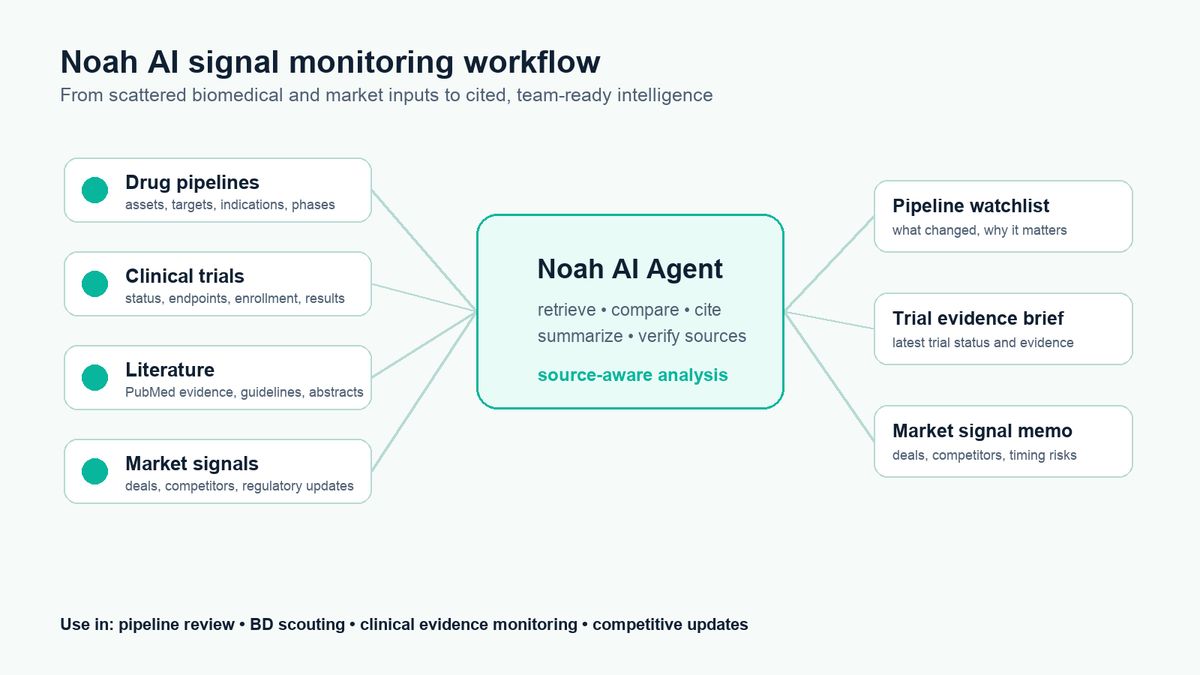
This blog explains how Noah AI can help life science teams build a repeatable monitoring workflow for drug pipelines, clinical trial evidence, and market signals. Instead of using AI only to summarize a single article, teams can use Noah as a domain-specific AI agent to clarify the monitoring scope, retrieve relevant biomedical evidence, compare updates across assets or competitors, and turn scattered signals into cited, team-ready intelligence. The goal is not to replace expert judgment. The goal is to reduce manual searching, make evidence easier to review, and help teams move faster from raw updates to better questions, clearer briefs, and more confident decisions.
Why pipeline, trial, and market signals are hard to track
Life science monitoring is difficult because the same strategic question usually cuts across several evidence layers. A BD team evaluating an oncology opportunity may need to know the current drug pipeline, the mechanism of action, active competitors, trial endpoints, safety signals, regulatory milestones, recent publications, and whether similar assets have attracted licensing or acquisition interest. A medical affairs team may start with a clinical question, but still need to understand trial designs, guideline changes, market adoption signals, and competitor messaging.
Traditional search workflows often separate these questions. PubMed helps with literature. Clinical trial registries help with trial records. Company websites and press releases help with announcements. Commercial databases may help with pipeline or deal data. But teams still need to connect these sources manually. That manual stitching is where important context can be lost: a trial update may look minor until it is connected to a crowded target landscape; a deal may look commercial until it is connected to an emerging biomarker strategy; a publication may look incremental until it validates a mechanism that competitors are already pursuing.
This is why monitoring needs to be structured around entities and decisions, not just documents. The key entities are usually drugs, companies, targets, indications, mechanisms, clinical trials, publications, and market events. The key decision is usually practical: should the team keep watching, investigate further, update a landscape, brief leadership, or act on a new opportunity?
What Noah AI helps teams monitor
Noah AI is built for medical and life science workflows, so it can help users ask questions in the language of biomedical strategy rather than generic search. For a monitoring use case, Noah can help teams define what they are watching, retrieve relevant evidence, compare changes, and prepare structured outputs that are easier to share across teams.
The strongest fit is not a one-off search. The stronger workflow is continuous monitoring: create a watch area, define the signal types, ask Noah for evidence-backed updates, compare new findings against the prior landscape, and convert the result into a brief or watchlist. This makes Noah useful for drug pipeline tracking, clinical trial monitoring, pharma market intelligence, and competitive intelligence workflows without making the article only about “competitive intelligence pharma” as a title topic.
Monitoring areas for life science teams
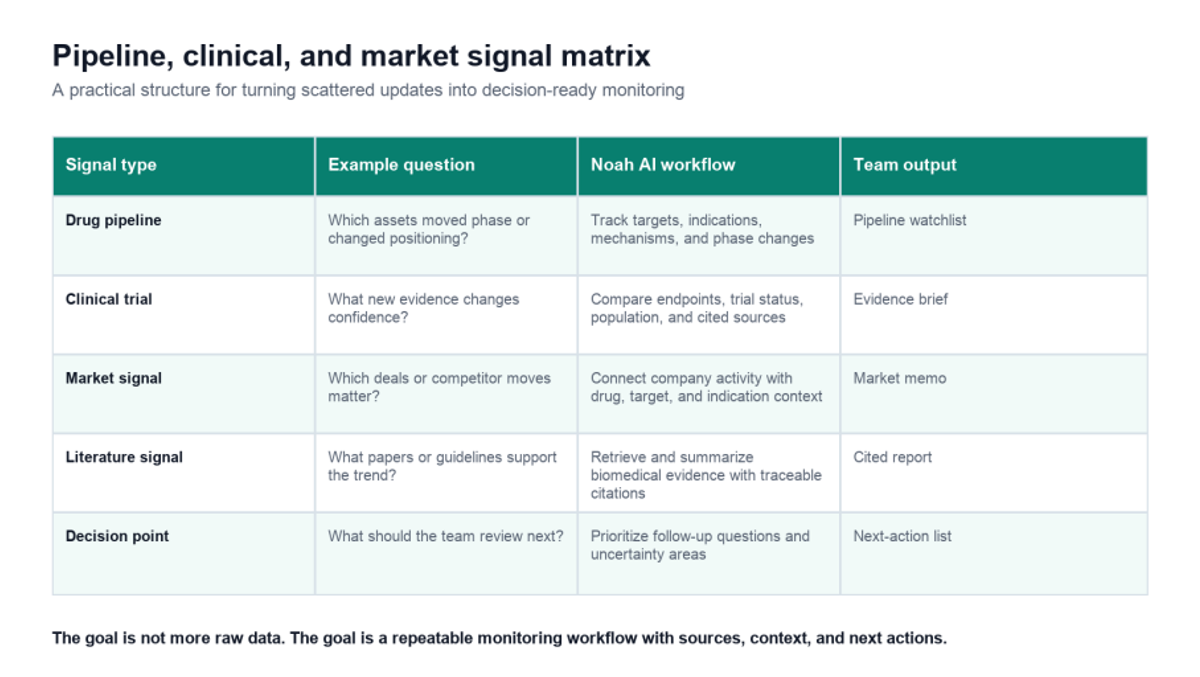
| Monitoring area | What teams need to know | How Noah AI can help |
|---|---|---|
| Drug pipeline tracking | Which assets, targets, indications, or phases are changing | Organize pipeline signals by drug, company, target, indication, mechanism, and evidence level |
| Clinical trial monitoring | Which trials are active, delayed, completed, or reporting meaningful evidence | Summarize trial status, endpoints, population, outcomes, and cited evidence |
| Market signal monitoring | Which deals, partnerships, regulatory updates, or competitor moves may affect strategy | Connect market events to biomedical context and competitive implications |
| Literature and evidence monitoring | Which papers, guidelines, or abstracts support a claim or trend | Retrieve and synthesize cited biomedical sources into structured briefs |
From scattered updates to a repeatable intelligence workflow
A useful intelligence workflow should be repeatable. If every analyst, researcher, or BD manager asks questions in a different way, the team will get inconsistent outputs. Noah helps by making the monitoring process more explicit: what is the scope, what evidence is needed, what has changed, why does it matter, and what should be reviewed next?
For example, a team monitoring antibody-drug conjugates in breast cancer might define a watch area around HER2-low or TROP2 assets, include trial status and endpoint updates, watch competitor deals, and review literature that explains mechanism or resistance. Noah can help turn that into a structured monitoring prompt and then summarize findings in a way that preserves the connection between signal and source.
The practical advantage is speed plus consistency. A team does not need to restart from a blank search every week. It can reuse a monitoring structure and ask Noah to update the same questions as new evidence appears.
Example workflow for drug pipeline and clinical trial monitoring
| Workflow step | Team question | Noah AI output |
|---|---|---|
| 1. Define the watch area | Which disease, target, drug class, or market should we monitor? | A scoped monitoring question with entities and timeframe |
| 2. Retrieve evidence | What sources support the latest changes? | Relevant publications, trial records, database evidence, and market signals |
| 3. Compare changes | What changed compared with the previous landscape? | Side-by-side comparison of assets, trials, competitors, and evidence strength |
| 4. Interpret impact | Why does this signal matter for the team? | Implications for R&D, BD, medical strategy, or commercial planning |
| 5. Produce a brief | What should stakeholders read or review next? | A cited summary, watchlist, or next-action memo |
How Noah AI supports drug pipeline tracking
Drug pipeline tracking is more than listing assets. The strategic value comes from understanding movement. Which assets have advanced? Which programs were delayed or terminated? Which mechanisms are becoming crowded? Which indications are seeing more sponsor activity? Which companies are using similar trial designs or biomarker strategies?
Noah can help structure pipeline questions around the fields that matter most to life science teams: drug name, company, target, mechanism of action, modality, indication, phase, trial status, geography, and evidence level. When the question is framed this way, the output becomes easier to review because it mirrors how teams already evaluate opportunities.
A useful Noah prompt might be: “Track recent pipeline changes for CD47-targeting therapies in hematologic malignancies. Summarize active assets, clinical phase, recent trial or publication evidence, sponsor activity, and potential strategic implications with citations.” This type of prompt gives Noah a defined scope and asks for both evidence and interpretation.
For BD teams, this can support early scouting and competitive landscape review. For R&D teams, it can reveal where a target is becoming scientifically validated or commercially crowded. For strategy teams, it can help identify where the pipeline is moving before the broader market narrative becomes obvious.
How Noah AI supports clinical trial monitoring
The phrase clinical trial monitoring can mean different things. In this blog, it does not refer to site monitoring, trial operations, or clinical trial management. The Noah use case is evidence monitoring: tracking trial status, endpoints, populations, results, publications, safety signals, and competitive implications.
This distinction matters for SEO and for the reader. A clinical operations team searching for monitoring visit workflows is not the main audience. The main audience is a life science professional trying to understand what clinical evidence is emerging and how it changes a disease or drug landscape.
Noah can help compare trial designs across competitors, summarize endpoint choices, explain inclusion and exclusion criteria, and connect trial updates to publications or market movement. For example, a team can ask Noah to compare Phase 2 trial designs for competing GLP-1, oncology, or autoimmune assets, then identify which endpoints, populations, and results appear most relevant to strategic decision-making.
The output should still be reviewed by domain experts. Noah can accelerate retrieval and synthesis, but clinical interpretation requires human judgment, especially when evidence is early, endpoints are exploratory, or safety signals are incomplete.
How Noah AI supports market signal monitoring
Market signals often appear outside the formal literature. A licensing deal, acquisition, trial readout, regulatory update, guideline change, conference presentation, manufacturing partnership, or competitor press release can all affect how a team interprets a therapeutic area. The challenge is that these signals are only useful when connected back to biomedical context.
Noah can help connect market events to scientific and clinical evidence. If a company announces a collaboration around a target in oncology, a team may need to understand the target biology, active clinical assets, trial evidence, prior deal activity, and which companies are already positioned in the space. Noah can help organize that into a cited market signal memo with Noah AI rather than leaving the team to manually assemble separate notes.
This is where keywords like pharma market intelligence and market intelligence pharma fit naturally. The article does not need to become a generic market intelligence guide. Instead, it can show how market intelligence becomes more useful when combined with drug pipeline and clinical trial context.
Use cases for life science teams
BD and corporate strategy teams can use Noah to identify areas where pipeline activity, clinical evidence, and partnership signals are converging. This can support early opportunity scouting, target prioritization, and competitor watchlists.
Medical affairs teams can use Noah to monitor new publications, guidelines, clinical trial results, and evidence gaps around a therapeutic area. The output can support internal briefings, medical education planning, and evidence landscape updates.
R&D teams can use Noah to evaluate whether a target or mechanism is gaining validation, where uncertainties remain, and whether trial outcomes support further investigation. This is especially useful when a team wants to move from literature review to experiment planning.
Commercial and leadership teams can use Noah-generated briefs to stay aligned on important changes without reading every source manually. A concise market signal memo can help executives understand what changed, why it matters, and which team should follow up.
Example monitoring prompts for Noah AI
A good monitoring prompt should include the disease area, drug class or target, timeframe, evidence sources, and desired output. Below are examples that can be adapted for different teams.
Drug pipeline prompt: “Create a pipeline watchlist for TIGIT-targeting therapies in solid tumors. Include sponsor, drug name, indication, mechanism, clinical phase, recent trial updates, and strategic implications.”
Clinical trial prompt: “Compare recent Phase 2 and Phase 3 clinical trial evidence for CDK4/6 inhibitors in breast cancer. Focus on endpoints, patient populations, safety signals, and published evidence.”
Market signal prompt: “Summarize recent BD, partnership, and acquisition signals related to CAR-T therapies over the past 12 months. Connect each signal to relevant targets, indications, and clinical evidence.”
Executive brief prompt: “Prepare a one-page cited brief explaining the most important pipeline, clinical trial, and market signals in hepatocellular carcinoma this quarter. Include what changed, why it matters, and what to monitor next.”
A practical SOP for repeatable monitoring
Teams can turn this use case into a simple SOP. First, define the watch area: disease, target, drug class, company group, geography, and timeframe. Second, define signal types: pipeline movement, clinical trial updates, publications, guidelines, regulatory events, deals, competitor announcements, or conference abstracts. Third, ask Noah to retrieve and summarize the evidence with citations. Fourth, compare the new output against the previous view. Fifth, write a short conclusion: what changed, what did not change, and what requires follow-up.
For teams with GSC or content data, this SOP can also inform blog planning. If searches and impressions appear around clinical trial monitoring, pharma market intelligence, drug pipeline tracking, or AI agents in life sciences, the team can create more supporting articles around specific workflows. Without GSC data, teams can still use Semrush and product knowledge to identify low-competition long-tail topics, then validate performance after publication.
Common mistakes to avoid
The first mistake is making the scope too broad. A prompt like “track oncology” will produce a broad overview, not a useful monitoring brief. A better prompt defines an indication, target, modality, timeframe, and output type.
The second mistake is mixing different meanings of clinical trial monitoring. For Noah, the focus should be evidence and landscape monitoring, not clinical operations monitoring. The article and metadata should make that distinction clear.
The third mistake is treating AI output as final strategy. Noah can help retrieve, organize, and synthesize evidence, but teams should still review citations, validate interpretation, and add internal context before making scientific, medical, commercial, or investment decisions.
How teams can measure whether the workflow is working
A monitoring workflow should be measured by usefulness, not word count. Good signals include fewer repeated manual searches, faster preparation of landscape updates, more consistent evidence briefs, clearer team alignment, and better follow-up questions.
For SEO content performance, teams can track impressions, clicks, CTR, and ranking queries for terms such as clinical trial monitoring, pharma market intelligence, competitive intelligence pharma, drug pipeline tracking, and agentic AI in life sciences. If a page gets impressions but low CTR, the title and excerpt may need to be clearer. If it ranks for related but not core terms, the article may need stronger internal links and more precise sections.
Final takeaway
Final takeaway
Drug pipeline tracking, clinical trial monitoring, and pharma market intelligence are no longer separate workflows. For life science teams, the value comes from connecting biomedical evidence with market context and turning scattered updates into decision-ready intelligence.
Noah AI helps teams move from search to synthesis: define the watch area, retrieve evidence, compare changes, interpret implications, and produce cited outputs that can be reviewed by experts. That makes Noah useful not only for medical literature review with Noah AI, but also for ongoing pipeline, clinical, and market signal monitoring across life science teams.
FAQ
What is drug pipeline tracking?
Drug pipeline tracking is the process of monitoring drug assets, development phases, targets, indications, companies, and evidence updates over time. It helps teams understand how a therapeutic landscape is changing.
How is clinical trial monitoring used in this article?
Here, clinical trial monitoring refers to evidence and landscape monitoring, not clinical operations or site monitoring. It focuses on trial status, endpoints, populations, results, publications, and competitive implications.
How can AI help with pharma market intelligence?
AI can help retrieve, summarize, compare, and connect signals from literature, clinical trials, company activity, regulatory updates, and market events. Human review is still important for final interpretation.
Is Noah AI a general search tool?
Noah AI is positioned as a domain-specific AI agent for life science and medical research workflows, including cited evidence retrieval, biomedical analysis, and structured research outputs.
Who should use this workflow?
This workflow is useful for BD teams, medical affairs, strategy teams, research teams, and life science professionals who need to monitor biomedical and market signals repeatedly.