Best AI Tools for Medical Research Workflow Automation (2026)
Linda
Compare the best AI tools for medical research workflow automation, from research planning and evidence retrieval to study comparison and cited research outputs.
Medical research rarely stops after finding a few papers. A single question may require researchers to define the comparison, retrieve relevant trials and guidance, compare populations and endpoints, check where the evidence is incomplete, and turn the findings into something colleagues can actually review.The friction comes from the handoffs. Search results sit in one tool, PDFs in another, extracted study details in spreadsheets, and the final synthesis somewhere else. The more complex the question, the more manual work is required to keep those stages aligned.So the useful question is not which AI tool can summarize medical literature. It is which tool is best suited to help connect and accelerate multiple stages of a research task while producing a structured, source-traceable output at the end.
Quick Answer
Noah AI may be a strong fit when researchers want to connect and accelerate multiple stages of a biomedical research workflow, including research planning, evidence retrieval, study comparison, evidence review, and cited research output. Elicit is better suited to formal systematic-review pipelines. SciSpace is useful when literature discovery and PDF-centered analysis are the main bottlenecks. Consensus is useful when the priority is moving quickly from a research question to a structured review of the academic literature.We tested Noah AI directly. Other tools were evaluated based on their official documentation and published workflows.
Best Tools at a Glance
| Tool | Best when the workflow starts with... | What it helps connect or accelerate |
|---|---|---|
| Noah AI | A complex biomedical research question | Planning → retrieval → study comparison → evidence review → cited output |
| Elicit | A systematic-review protocol | Search → screening → extraction → synthesis/report |
| SciSpace | A literature question or a set of research PDFs | Search → paper analysis → literature synthesis |
| Consensus | A research question needing a fast evidence review | Question decomposition → targeted search → structured literature review |
What Medical Research Workflow Automation Needs to Solve
A useful workflow tool should reduce the manual coordination between research stages without hiding the scientific logic. For this article, the key test is whether a tool can keep the research question, the evidence being retrieved, the study-level comparison, the uncertainty, and the final deliverable connected.That is a more demanding task than producing a good summary. The system needs to preserve the structure of the question as the work moves from search to synthesis, while still leaving the researcher able to inspect sources and challenge the conclusion.
Noah AI — Best for Question-to-Output Biomedical Research Workflows
Noah AI is most useful here when the starting point is a complex medical research question and the desired endpoint is a structured, cited research deliverable rather than a list of search results.
What We Tested
We used a comparative CKD question involving dapagliflozin, empagliflozin, and canagliflozin. The task asked for major clinical trials, patient populations, study design, renal and cardiovascular outcomes, safety findings, important evidence gaps, and a cited report.This is a useful workflow test because the studies are not interchangeable. The final analysis needs to preserve differences in trial populations, endpoint definitions, and evidence context instead of forcing a simple ranking.
Step 1: Turn the Research Question Into a Research Plan
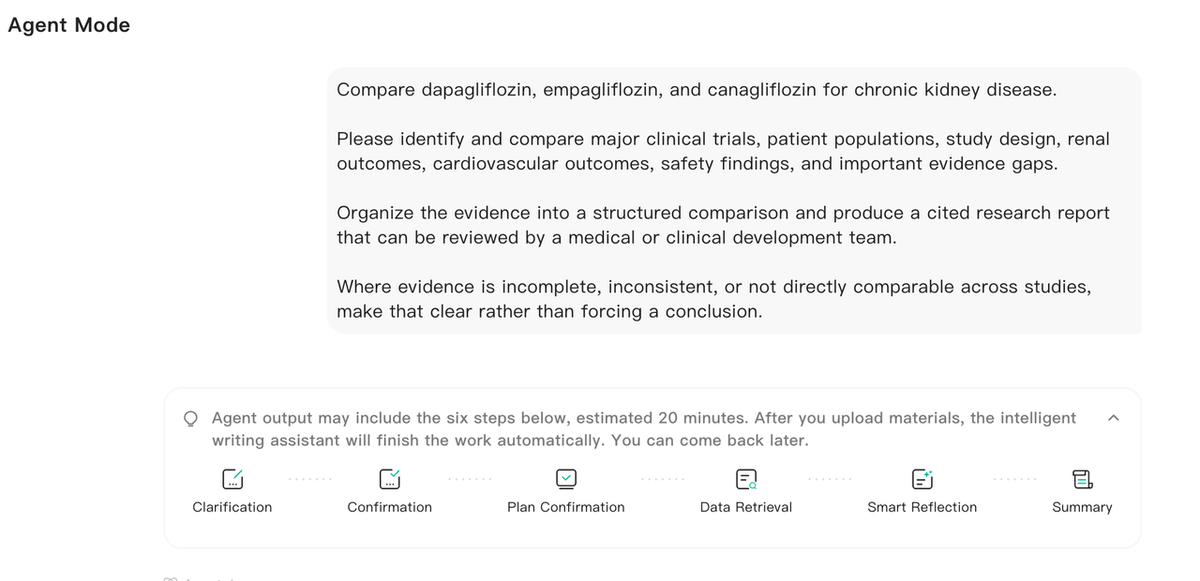
Figure 1. Noah AI Agent Mode shows the research task moving through Clarification, Confirmation, Plan Confirmation, Data Retrieval, Smart Reflection, and Summary.The first workflow-coordination challenge is not search. It is deciding how a multi-part research question should be organized across research steps. In this run, the requested comparison includes trials, populations, design, outcomes, safety, uncertainty, and a final report, so the work has to remain organized around the same comparison criteria from beginning to end.The visible workflow matters because it gives the researcher checkpoints instead of turning the entire task into one opaque prompt-and-answer exchange.
Step 2: Compare Trial Populations Before Comparing Outcomes
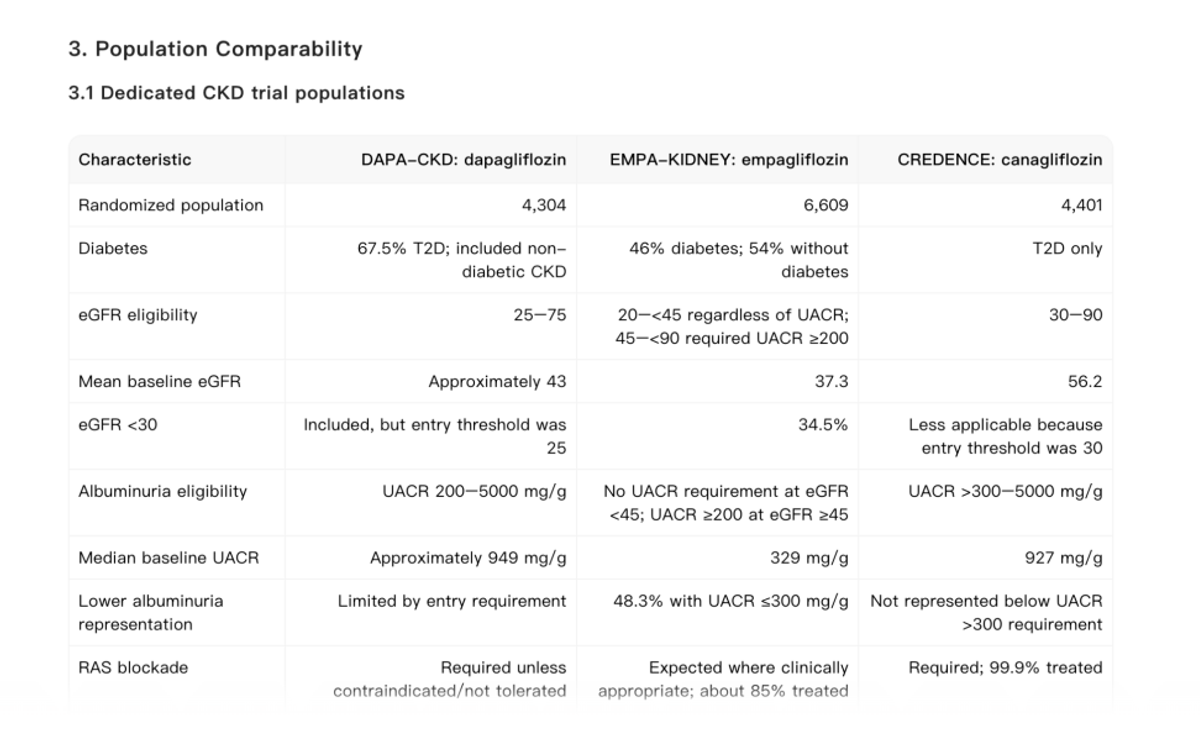
Figure 2. Noah AI compares the DAPA-CKD, EMPA-KIDNEY, and CREDENCE trial populations across key enrollment characteristics relevant to cross-trial interpretation.Sources: DAPA-CKD - Heerspink et al., N Engl J Med (2020), doi:10.1056/NEJMoa2024816; EMPA-KIDNEY - EMPA-KIDNEY Collaborative Group, N Engl J Med (2023), doi:10.1056/NEJMoa2204233; CREDENCE - Perkovic et al., N Engl J Med (2019), doi:10.1056/NEJMoa1811744. Evidence review cutoff for this CKD case: 20 August 2026.The table makes the comparison study-aware before any outcome ranking is attempted. DAPA-CKD, EMPA-KIDNEY, and CREDENCE differ in diabetes status, eGFR eligibility, albuminuria requirements, baseline kidney function, and background RAS blockade.Those differences help explain why the three trials answer related but not identical clinical questions. For example, EMPA-KIDNEY includes a broader non-diabetic and lower-albuminuria population, while CREDENCE is restricted to type 2 diabetes with higher albuminuria. Putting these characteristics side by side gives the researcher a clearer basis for interpreting outcome differences without treating the trials as directly interchangeable. Because DAPA-CKD, EMPA-KIDNEY, and CREDENCE enrolled different patient populations and used different endpoint definitions, their hazard ratios should not be used to directly rank dapagliflozin, empagliflozin, and canagliflozin by efficacy.
Step 3: Preserve Evidence Limitations Before Final Synthesis
Finding several high-quality trials does not mean the research question is fully answered. The studies still need to be interpreted in the context of differences in patient populations, eligibility criteria, follow-up, and endpoint definitions.These differences matter in the CKD comparison because they limit how directly results from DAPA-CKD, EMPA-KIDNEY, and CREDENCE can be compared across agents.The final Noah report preserves this limitation rather than turning the evidence into a simple molecule ranking. The hazard ratios remain tied to the populations, endpoint definitions, and study designs from which they were estimated.This is an important part of the workflow: differences and limitations visible in the underlying evidence remain visible in the final research output.
Step 4: Produce a Cited Research Deliverable
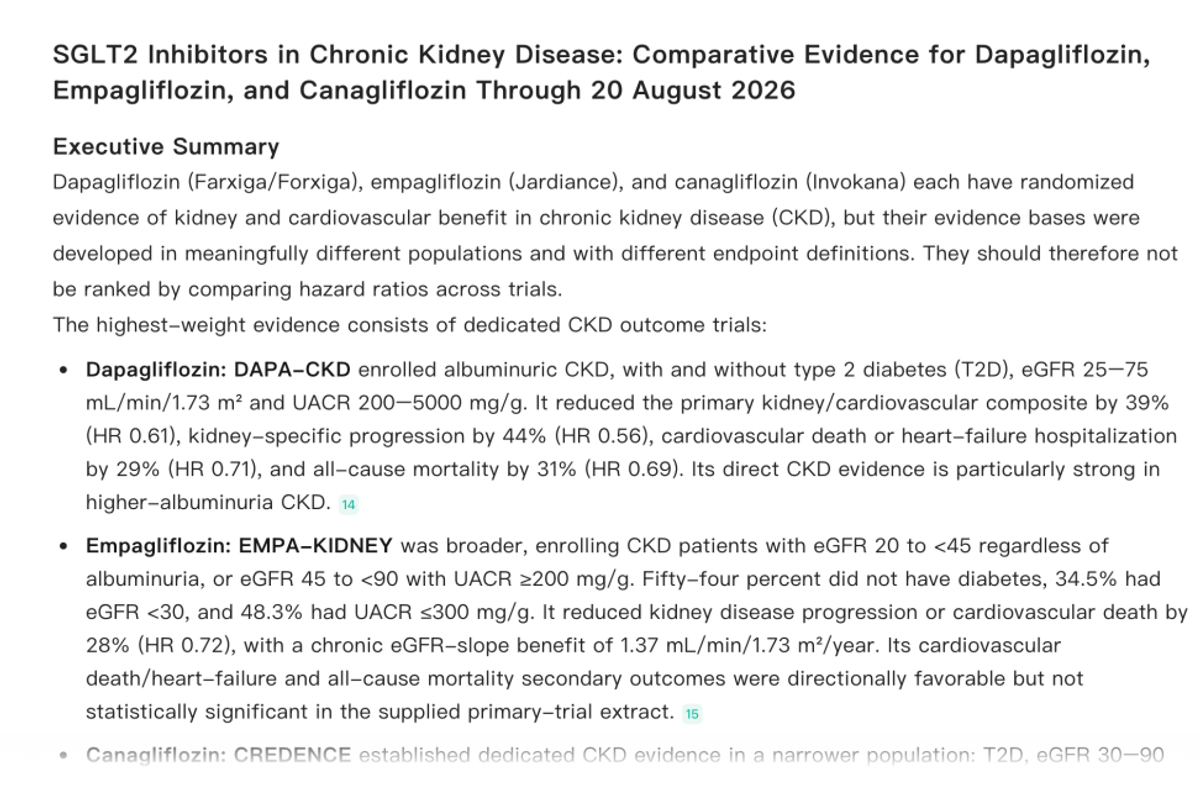
Figure 3. The final Noah AI report opens with a cited executive summary comparing dapagliflozin, empagliflozin, and canagliflozin while preserving differences in trial populations and endpoint definitions.The final output turns the earlier research work into a reviewable cited report rather than ending with a collection of papers or extracted findings.The executive summary keeps citation markers attached to trial-level claims and preserves the distinctions established during the comparison. A medical or clinical development team can therefore continue reviewing the evidence from a structured research deliverable rather than reconstructing the analysis from separate search results.This is the main advantage demonstrated by the Noah case: the research question, comparison structure, and source-linked evidence remain connected through to the final output.For a dedicated biomedical literature-retrieval workflow, see PubMed Search with AI.
Elicit — Better for Formal Systematic Review Workflows
Elicit is better suited when the project is governed by a formal systematic-review process. Its workflow is designed around source gathering, screening, data extraction, and evidence synthesis/reporting.Based on Elicit’s official documentation and published workflow, it is a strong fit when reproducible screening and extraction are central to the task. This recommendation is based on publicly described product capabilities rather than direct testing in this article.
SciSpace — Better for Literature and PDF-Centered Research Workflows
SciSpace is useful when the main bottleneck is literature analysis itself. Its literature and PDF-centered workflows are designed around finding papers, analyzing research content, identifying themes or gaps, and building a structured literature synthesis.Based on SciSpace’s official documentation and published workflow, it is a strong fit for document- and literature-centered research, including paper discovery, PDF analysis, and literature synthesis. This recommendation is based on publicly described product capabilities rather than direct testing in this article.
Consensus — Better for Fast Question-to-Literature-Review Workflows
Consensus is useful when the task starts with a research question and the main goal is to build a structured view of the academic evidence quickly. Its deeper review workflow is oriented around breaking a question into subquestions, running targeted searches, and synthesizing a structured literature review.Based on Consensus’s official documentation and published workflow, it is a strong fit for rapid question-to-literature synthesis and structured academic evidence review. This recommendation is based on publicly described product capabilities rather than direct testing in this article.
Which Tool Fits Your Research Workflow?
Consider Noah AI if you start with a complex biomedical question and want AI support to help connect and accelerate planning, evidence retrieval, study comparison, evidence review, and cited output.
Choose Elicit if you are running a formal systematic review and screening and extraction are the core workload.
Choose SciSpace if papers and PDFs are already the center of the workflow and your main need is literature analysis and synthesis.
Choose Consensus if you want to move quickly from a research question to a structured review of the academic literature.The main decision is not which product has the longest feature list. It is where the research workflow begins and what deliverable you need at the end.
FAQ
What is medical research workflow automation?
It is the use of AI or software to reduce manual handoffs across research stages such as question planning, literature retrieval, study comparison, evidence review, and report generation while keeping the researcher responsible for scientific judgment.
Can AI automate an entire medical literature review?
AI can automate or accelerate many stages, but formal reviews still require researcher-defined methods, eligibility decisions, source verification, quality assessment, and review of the final conclusions.
Which AI tool is best for medical research workflow automation?
It depends on the task. Noah AI is well suited to question-to-output biomedical workflows; Elicit to systematic reviews; SciSpace to literature and PDF-centered analysis; and Consensus to fast question-driven academic synthesis.
Should AI-generated medical research reports be used without review?
No. Even cited outputs should be checked against original studies and trusted sources before they are used in publications, clinical development, regulatory work, or other high-stakes contexts.
Final Takeaway
Medical research workflow automation is most useful when it reduces handoffs between research stages without losing the context needed to interpret the evidence.In the CKD example tested for this article, Noah AI helped connect structured evidence comparison with a cited research report while preserving important differences between the underlying trials.
Turn your next biomedical research question into a structured, cited research output with Noah AI.