How to Write Study Limitations in Medical Research with AI (2026)
Linda
Learn how to write evidence-based study limitations with Noah AI. Review sample size, follow-up, selection bias, confounding, and generalizability.
A useful limitations section does more than list weaknesses. It connects specific study features to what readers can—and cannot—conclude. This tutorial shows how to review a published cardiovascular cohort study with Noah AI, organize a Study Limitations Evidence Table, and turn the findings into carefully qualified academic writing.Key takeaways
- Start with the original Methods, Results, and Discussion, not a generic list of limitations.
- Assess sample size separately from participant representativeness and event-specific precision.
- Distinguish limitations expressly acknowledged by study authors from methodological concerns suggested for further review.
- Preserve the original association, confidence interval, and observational design when drafting conclusions.
- AI can organize evidence and propose wording; it cannot establish the size of an unmeasured bias or guarantee reviewer acceptance.
Why Study Limitations Matter in Medical Research
Every empirical design creates boundaries around interpretation. Randomized trials can have narrow eligibility criteria, short follow-up, or incomplete outcome ascertainment. Observational studies can follow large populations over time but still leave room for confounding and selection effects. A well-written limitations section explains which uncertainty is consequential for the research question.For observational studies, the STROBE reporting framework calls for discussion of potential sources of bias or imprecision and of generalizability. These are reporting expectations, not proof that any particular study is biased. Likewise, the ICMJE recommendations emphasize appropriately contextualized interpretation of research results.A strong limitations paragraph gives readers enough information to judge the scope of an inference without exaggerating what the evidence demonstrates.
Common Challenges When Writing Study Limitations
Researchers often write broad statements such as “the sample was small” or “more studies are required.” Such phrases can be uninformative or inaccurate. A better approach asks three questions for each potential limitation: What exactly did the study do? Why might that choice matter? What conclusion is still justified?Some challenges are especially common in biomedical writing:
- Sample size versus representativeness: A cohort can be numerically large but unrepresentative of its intended target population.
- Follow-up duration: A follow-up period may be adequate for observed mid-term outcomes yet inadequate for lifetime effects.
- Residual confounding: Statistical adjustment addresses measured factors but cannot prove all unmeasured differences have disappeared.
- Exposure measurement: Repeated dietary records can improve measurement while remaining subject to self-report and classification error.
- Wording strength: A reported association should not become a statement of causation during AI-assisted revision.
How Noah AI Supports Evidence-Based Limitation Review
Noah AI can be prompted to examine the source article, extract methods and results relevant to limitations, classify the evidence, and prepare a draft for author review. The useful output is not a generic assurance that limitations are “transparent.” It is an audit trail connecting each proposed sentence to a verifiable source detail.In this workflow, researchers ask Noah to separate author-acknowledged limitations, directly documented design features, and additional methodological interpretations. This distinction reduces the risk of treating an AI-generated concern as a confirmed flaw or attributing newly written phrasing to the paper's authors.For a manuscript under preparation, researchers should give Noah the correct manuscript version, study protocol when available, and relevant Methods and Results. For the published case below, the study itself provides the evidence base.
Five-Step Workflow: From Evidence to a Limitations Paragraph
- Verify the study record.Confirm the title, DOI, design, population, follow-up, analyzed sample, outcomes, and published effect estimate. Avoid combining details from different cohorts or papers.
- Extract the facts behind possible limitations.Record recruitment methods, outcome and exposure measurement, event counts, adjustment variables, missing-data information, and generalizability-relevant population characteristics.
- Classify each limitation by evidence strength.Mark whether the authors acknowledged it, whether it is evident from the Methods, or whether further expert interpretation is required. Do not invent quantitative bias estimates.
- Build a Study Limitations Evidence Table.Link study features to their implications, useful wording, and outstanding verification steps. Keep proposed editorial text separate from original quotations.
- Draft and audit the paragraph.Write balanced, precise prose; cross-check it against the original study and reporting guidance. A human author must approve the final interpretation.
Real Case Study: Ultra-Processed Food and Cardiovascular Disease
Source paper: Srour B, et al. Ultra-processed food intake and risk of cardiovascular disease: prospective cohort study (NutriNet-Santé). The BMJ. 2019;365:l1451.DOI: 10.1136/bmj.l1451 · PMID: 31142457 · Read the original paperThis prospective French NutriNet-Santé cohort included 105,159 adults and observed 1,409 first cardiovascular disease events during a median 5.2 years of follow-up (interquartile range 2.6–7.3 years; 518,208 person-years for the overall cardiovascular outcome). Dietary information came from repeated 24-hour records, with an average of 5.7 records per participant.The published model reported a hazard ratio of 1.12 (95% CI 1.05–1.20) for overall cardiovascular disease per absolute 10-percentage-point increase in the dietary proportion of ultra-processed foods. This is an adjusted observational association, not proof that changing ultra-processed food consumption by that amount would cause a corresponding change in cardiovascular events.Importantly, a sample of more than 100,000 people should not be described reflexively as a “small sample.” More relevant issues include volunteer recruitment, exposure classification, observational confounding, follow-up duration, and whether findings apply to populations with different characteristics.
Study Limitations Evidence Table from Noah AI
The following screenshot is the actual Noah-generated evidence table supplied for this case. It organizes seven study features against underlying evidence, interpretation constraints, and possible wording or next checks.
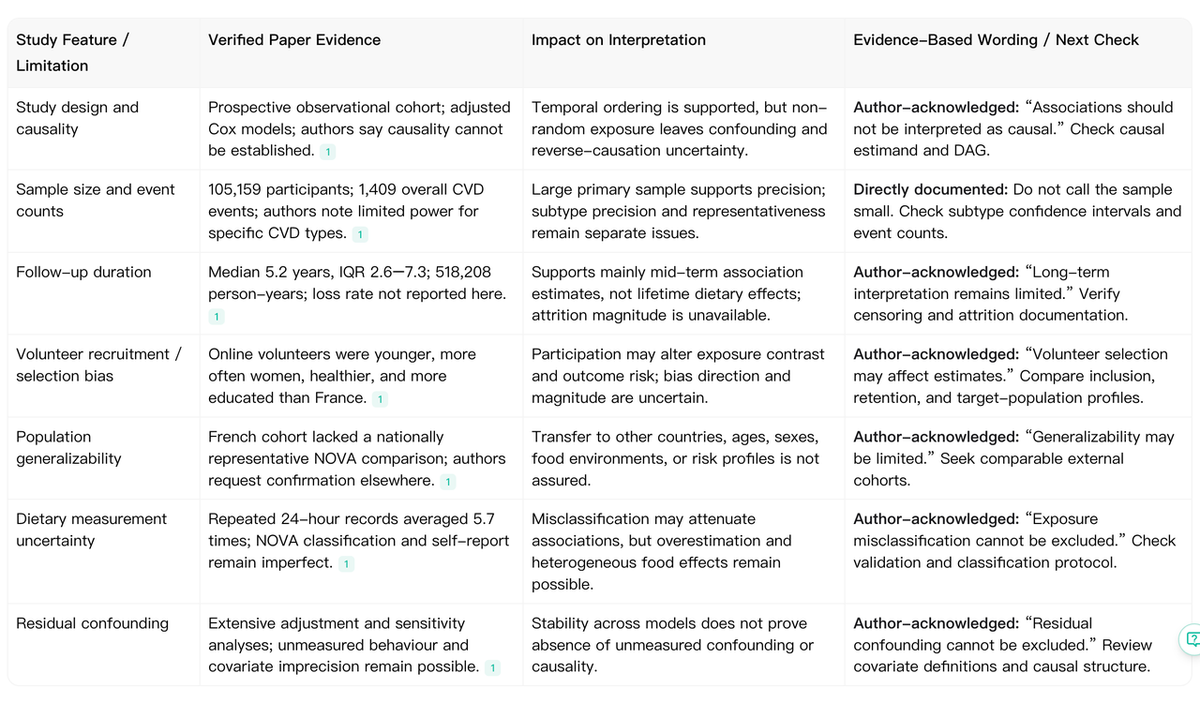
The table is most useful when treated as a review aid rather than a completed bias assessment. For example, “author-acknowledged” indicates that the type of concern was discussed by the study authors; the quotation-style examples in Noah's output should be verified or paraphrased rather than presented as exact extracted sentences.
Seven Limitation Domains and Their Implications
| Domain | Evidence from the cohort | Defensible interpretation |
|---|---|---|
| Observational design | Prospective cohort; multivariable Cox models | Temporal ordering is informative, but confounding and causal uncertainty remain. |
| Sample and precision | 105,159 participants; 1,409 overall CVD events | Large overall sample does not guarantee the same precision in every outcome subgroup. |
| Follow-up | Median 5.2 years | Results inform the observed period, not lifetime dietary effects. |
| Volunteer selection | Online volunteer recruitment in France | Participants may differ systematically from those who did not enroll. |
| External validity | French cohort with a nonrepresentative participant profile | Transferability to other populations, diets, and healthcare settings requires care. |
| Dietary measurement | Repeated self-reported 24-hour dietary records and NOVA classification | Repeated assessment helps but cannot eliminate reporting or classification error. |
| Residual confounding | Extensive covariate adjustment and sensitivity checks | Unmeasured or imperfectly measured factors could still influence the association. |
These points should not be interpreted as seven equally severe defects. Their practical importance depends on the causal question, observed effect, available sensitivity analyses, and the population to which a reader wants to apply the result.
Example: An Evidence-Based Study Limitations Paragraph
The paragraph below is an original illustrative draft based on the reported study features, not the published authors' own limitations text. It is intended to demonstrate cautious academic wording.Several limitations should be considered when interpreting these findings. First, this prospective observational design cannot establish a causal effect of ultra-processed food intake on cardiovascular disease, and residual confounding may remain despite adjustment for multiple measured factors. Participants were recruited as volunteers to a French web-based cohort and differed from the broader population in sociodemographic and health-related characteristics, which may limit generalizability. Dietary exposure was assessed using repeated 24-hour self-reports and a food-processing classification system; some reporting error or misclassification is therefore possible. Although the cohort included more than 100,000 adults, precision may vary for individual cardiovascular outcomes and subgroups. The median follow-up of 5.2 years supports analysis over the observed period but does not establish lifetime effects. These considerations do not negate the observed association; they define the circumstances under which it should be interpreted and underscore the need for complementary evidence from other populations and study designs.AI-assisted editorial example. Compare this text against the original manuscript before reuse; neither the direction nor magnitude of any residual bias was independently quantified here.
Best Practices and Common Mistakes
When using AI to prepare a limitations section, focus on specificity and verification rather than polished language alone.
- Describe the study feature before its consequence. “Online volunteer recruitment” is observable; a numerical impact on bias is not established without additional analysis.
- Preserve the original estimand. In this paper, the main HR corresponds to a particular increment in dietary exposure and to the cardiovascular outcome; it is not a general percentage reduction or increase in absolute risk.
- Keep sample size and external validity separate. A large cohort may still lack representation of certain ages, socioeconomic groups, or countries.
- Acknowledge mitigation methods without claiming they remove all uncertainty. Repeated diet records and covariate adjustment can strengthen measurement and analyses while leaving limitations.
- Check the authors' own discussion. Add methodological interpretations only when they can be grounded in the study and clearly labeled as additional assessment.
- Do not promise reviewer approval. Evidence-based writing supports transparency; it cannot guarantee favorable peer review.
Final Study Limitations Verification Checklist
- Confirm the final publication, design, sample sizes, outcome counts, and follow-up figures.
- Identify which limitations are explicitly acknowledged and which are inferred.
- Verify recruitment methods, measurement procedures, adjustment variables, and missing-data handling.
- Do not invent bias magnitudes, causal effects, attrition rates, or subgroup precision.
- Check that the drafted text does not contradict the published effect estimate or its confidence interval.
- Discuss generalizability to the actual target population, not an unspecified “general public.”
- Use STROBE guidance where relevant and obtain final human-author approval.
Frequently Asked Questions
Does a large sample size eliminate study limitations?
No. It may improve precision, depending on the outcome and event distribution, but cannot by itself eliminate volunteer selection, confounding, measurement error, or limited external validity.
Is selection bias always present in volunteer cohorts?
Volunteer recruitment creates a plausible selection mechanism, but whether and how it biases a particular association requires further investigation. The sample may be unrepresentative without every estimated association necessarily being biased in the same direction.
Can Noah AI write the final limitations section automatically?
It can prepare evidence-organized drafts for review. Researchers still need to verify factual claims, judge the importance of each concern, and ensure the final language accurately reflects the analysis and target journal's requirements.
Should a limitations paragraph include the study's strengths?
When relevant, yes. Strengths such as a large cohort or repeated exposure assessment provide context for the limitations. They should not be used to dismiss unresolved methodological concerns.
Conclusion: Write Boundaries, Not Generic Disclaimers
Strong limitations writing is a scientific interpretation task. The NutriNet-Santé case illustrates why study design, volunteer selection, dietary measurement, follow-up, and residual confounding should be linked to specific evidence before a paragraph is drafted. Noah AI can help make this work more structured by collecting study features into a reviewable table and suggesting bounded language. The final assessment remains the responsibility of the study authors and human reviewers.
Build a Verifiable Study Limitations Table with Noah AI
Use Noah AI to organize study design, participant characteristics, exposure measurement, follow-up, potential confounding, and other methodological considerations into a source-linked Study Limitations Evidence Table.Distinguish limitations explicitly acknowledged by the study authors from additional questions that require methodological review. Connect each concern to the original paper and identify what remains unverified.
Noah AI supports evidence organization and critical review; it does not automatically identify every study flaw, quantify unmeasured bias, or replace independent methodological judgment.