How to Verify Dataset and Software Citations in Bioinformatics with AI (2026)
Linda
Learn how to verify GEO dataset accessions, software versions, GitHub repositories, and DOIs in bioinformatics papers using a real CellMentor case study.
Bioinformatics studies depend on more than journal articles. They reuse sequencing datasets, run versioned analysis software, and reference code repositories that can change after publication. A complete citation needs to identify the right resource, original creators, relevant version, and stable source—not merely a plausible URL. This guide demonstrates how to organize a source-grounded citation audit with Noah AI, using the CellMentor single-cell RNA-sequencing paper.Key takeaways
- A GEO accession such as
GSE84133identifies a GEO series; it is not itself a DOI. - A methods-paper DOI, a software-release DOI, and an article DOI refer to different research objects.
- A public GitHub repository does not by itself identify the exact commit used for a published analysis.
- Noah AI can organize identifiers and verification gaps into a traceable review table, but an AI-generated status is not evidence of code execution or full reproduction.
Why Dataset, Software, and Code Citations Matter
In single-cell RNA-seq research, the biological observations may originate in a public dataset while the published result depends on a particular package release, parameter configuration, and analysis script. Citing only the journal article can obscure the original data creators; citing only a GitHub homepage can leave the computational version ambiguous.The FORCE11 Software Citation Principles emphasize attribution, persistent identifiers, accessibility, and version specificity. The same practical logic applies to datasets: record the accession or persistent identifier, follow the associated metadata, and distinguish the deposited source from a later article that reused it.
Common Bioinformatics Citation Problems
- Missing accession numbers: describing “public PBMC data” without identifying the exact GEO series or other authoritative data resource.
- Wrong identifier type: treating a
GSEaccession as a DOI, or using a software-methods DOI as if it identified an exact binary release. - Version ambiguity: citing Seurat or scvi-tools without recording the version used in the analysis.
- Repository drift: relying on a current GitHub main branch when the published figures may have used a different commit.
- Overstated access: calling all raw reads open because the GEO series landing page is publicly visible.
- Incomplete attribution: citing a downstream benchmark but not the original dataset publication or submitters.
Real Case Study: The CellMentor Paper
The worked example is CellMentor: cell-type aware dimensionality reduction for single-cell RNA-sequencing data, by Or Hevdeli, Ekaterina Petrenko, and Dvir Aran. The article was published online on 11 December 2025 and appears in Nature Communications, volume 17, article 396 (2026). Its article DOI is 10.1038/s41467-025-67088-7. The 2025 publication date and 2026 volume designation should not be mistaken for two separate publications.CellMentor reports five GEO series spanning PBMC, pancreas, and melanoma analyses, as well as additional data sources such as 10x Genomics and Tabula Muris. Its Methods specify several software versions, and its Code Availability statement points to a software repository, separate paper-analysis scripts, and a Zenodo DOI. That combination makes it well suited to a provenance audit.
How Noah AI Supports Citation Verification
The Noah AI workflow shown here began in Agent → Deep Research with a structured question about GEO accession records, reported versions, persistent identifiers, repositories, and source attribution. The output was then organized into a citation verification table and a separate software inventory.
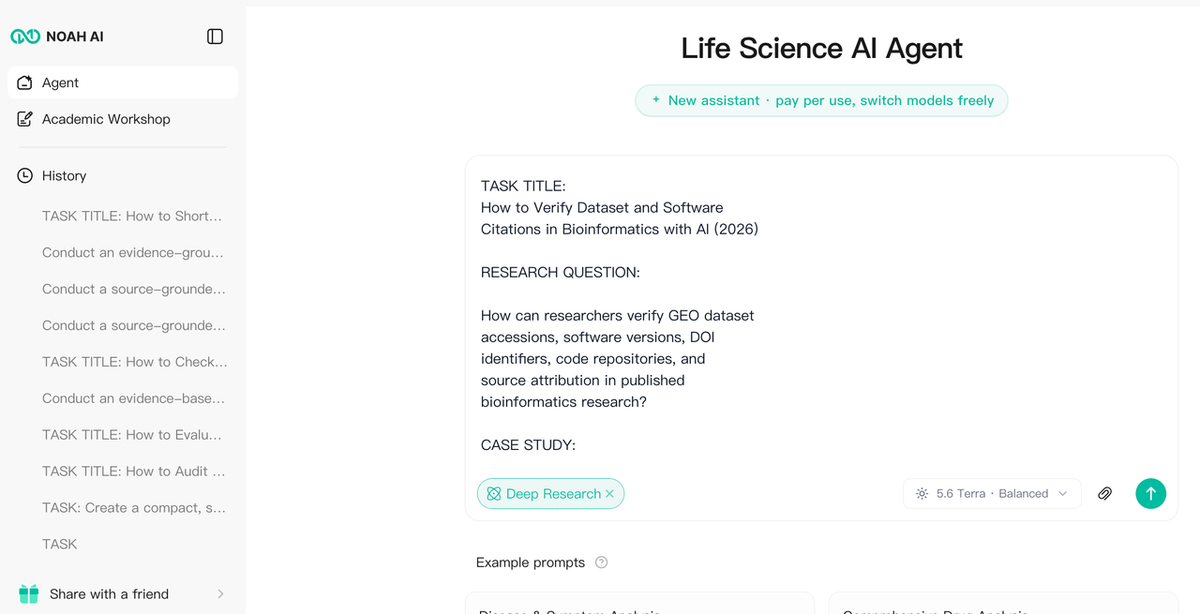
The important distinction is between reported by the paper, checked against a source record, and not verified. A structured table makes these boundaries visible without assigning invented citation-accuracy scores.
Five-Step Dataset and Software Citation Verification Workflow
Identify the research object
Start with the paper DOI and the original Data Availability, Code Availability, and Methods sections. Separate journal articles, GEO series, R or Python packages, development repositories, and archived software releases. Each resource requires its own appropriate identifier.
Extract accession numbers and confirm original datasets
Collect every GEO series ID and map it to the original data submitters and study context. For the CellMentor case, the paper names the five accessions below. Use each NCBI GEO record to check title, organism, study design, linked publication, and available files, as access permits.
Capture software versions from Methods
Record what the authors actually report—rather than today's installed or latest version. Here, the Methods identify R 4.3.2, Seurat 5.1.0, scvi-tools 1.2.1, Matrix 1.6-5, and SingleR 2.4.1. A software methods paper may explain an algorithm without identifying the exact release that generated a figure.
Distinguish GitHub development from archived releases
The CellMentor project repository and the CellMentor_paper analysis repository serve different purposes. The publication also supplies a Zenodo DOI for an archived version. Verify the archive's creator, release, files, and relationship to the executed commit before claiming it captures the precise published environment.
Record the evidence and outstanding checks
Build a table with the resource, identifier or version, observed source, and next check. Use Reported in paper, Verified, Metadata incomplete, or Human check required only where supported. Finalize the reference format after the underlying resource identity is clear.
CellMentor Dataset and Software Citation Verification Table
In the actual Noah output, five GEO records and three software/repository resources were combined into a compact audit table. The status column is essential: it distinguishes records that could be checked from information that still needs manual review.
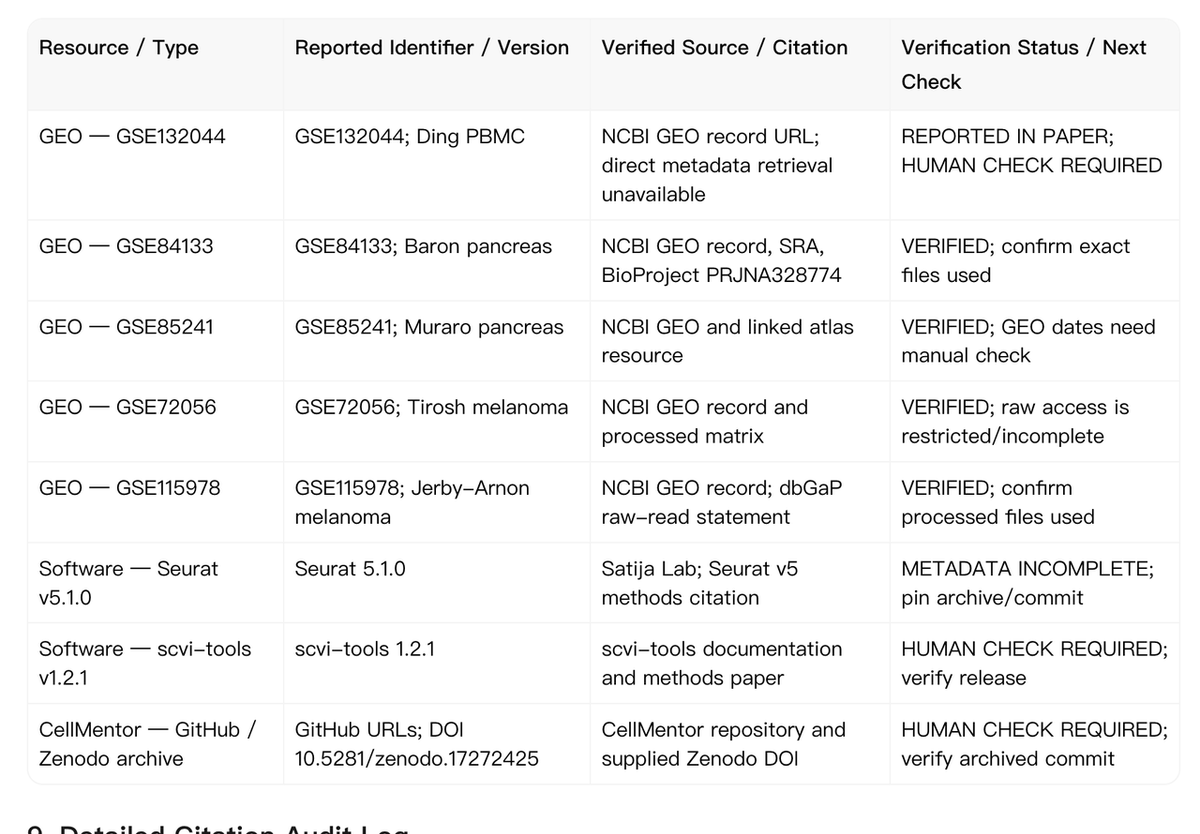
These are GEO accession identifiers, not five dataset DOIs. The existence of a public metadata record does not establish that every raw read, exact input matrix, or linked sample was downloaded or independently reanalyzed. In particular, the audit identified raw-read access limitations for the melanoma datasets.
How to Check Software Versions and Methods Citations
The second Noah screenshot inventories software used in the paper and shows its role and official source. The screenshot displays the first five columns of the longer audit, so the outstanding release-verification decisions are summarized separately below rather than attributed to an unseen image column.
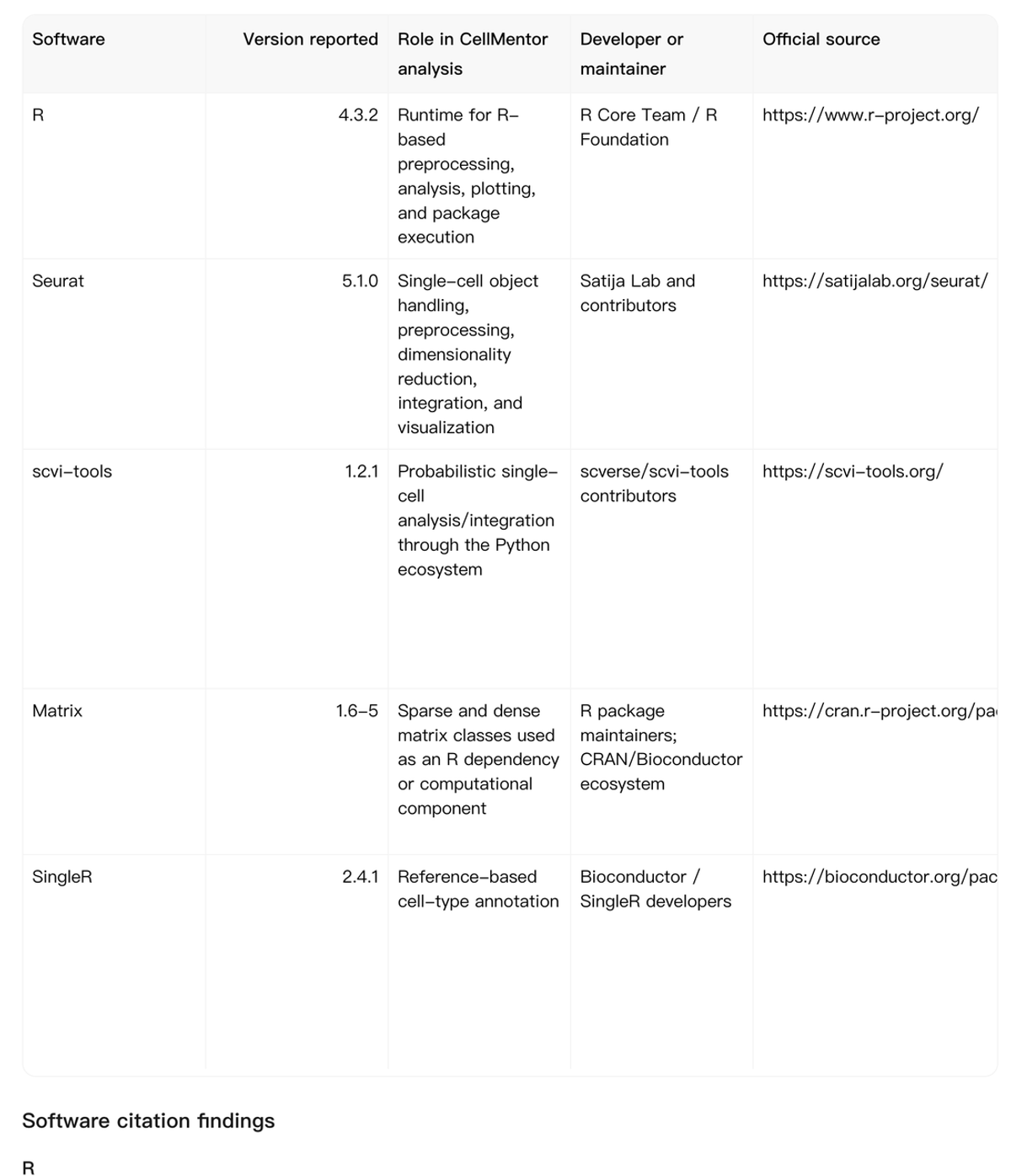
How to Cite a GEO Dataset or Bioinformatics Software
Reference formatting should follow the target journal, but the underlying metadata must remain identifiable. The templates below are illustrative rather than automatically validated final reference entries.Dataset citation template Original dataset creators. Year. Dataset title [Data set]. NCBI Gene Expression Omnibus. Accession: GSE number. Dataset URL. Add the original publication as a separate citation when appropriate.Software citation template Software creator(s). Year of verified release. Software name (exact version) [Computer software]. Repository or archive. Release DOI or persistent URL.Source-code citation template Repository author or organization. Verified release year. Repository title (release/tag or commit) [Source code]. Persistent archive DOI if available, otherwise the appropriate source URL.For example, the original Baron pancreas paper is 10.1016/j.cels.2016.08.011, whereas Muraro's pancreas atlas is 10.1016/j.cels.2016.09.002. These are original publication DOIs, not DOIs assigned to GEO GSE84133 or GSE85241. Keeping them separate prevents accidental misattribution.
Best Practices and Common Citation Mistakes
- Record dataset accession identifiers exactly, including the
GSEprefix. - Link datasets to original submitters, associated publications, and the dataset host.
- Retain software version strings exactly as reported; do not silently replace them with the latest release.
- Separate the DOI for a methods paper from a persistent DOI for an archived source-code release.
- Prefer a citable archived release when available, while recording the repository and commit relationship.
- Distinguish a publicly visible GEO record from unrestricted access to all raw reads.
- Use not verified when source-level metadata cannot be checked rather than inventing a precise date, release, or repository hash.
- Do not claim a study was reproduced merely because the code and data links exist.
Final Dataset and Software Citation Checklist
- Verify the target article's title, DOI, authors, and publication year.
- Extract GEO accessions from Data Availability and identify their original records.
- Check dataset title, creators, organism, associated publication, and file-access restrictions.
- Record software versions directly from Methods and supplemental information.
- Check whether software citations identify methods, exact releases, or both.
- Separate code repositories, figure scripts, and persistent software archives.
- Log unresolved metadata and request human confirmation where necessary.
- Format citations using the target journal's style only after identity and provenance checks.
Frequently Asked Questions
Is a GEO accession number the same as a DOI?
No. A GEO accession identifies a record within NCBI GEO. An associated research article may have its own DOI, but that DOI should not be presented as the accession's DOI.
Can I cite GitHub code without a DOI?
Yes, when no DOI is available, use verified repository attribution and a version or commit reference with the URL according to journal rules. A stable archived release is preferable when it exists and corresponds to the code used.
Why does the specific software version matter?
Dependencies, algorithms, defaults, and output formats can change between releases. A methods paper describes the approach, while a version-specific source record helps document the implementation used.
Does Noah AI automatically verify every GEO record and code release?
No such claim is supported by this example. The Noah report itself flags GSE132044, software release archives, and the Zenodo-to-commit relationship for further checks. This is a structured citation audit, not proof of universal repository access or computational reproduction.
Conclusion
Good bioinformatics citations connect the published claim to the correct data and software objects. The CellMentor example shows why that requires more than formatting a bibliography: researchers must distinguish GEO accessions from publication DOIs, record software versions, and link development repositories to the right archived release. Noah AI can help structure those checks and surface missing evidence, while final citation decisions depend on the original sources and human review.
Verify Research Sources with Noah AI
Use a structured biomedical literature workflow to organize dataset identifiers, software references, and citation-verification gaps before preparing your manuscript.Try Noah AI for FreeCheck current signup terms for free-credit availability. AI-assisted reference auditing does not replace manual source verification.
References and Source Links
- Hevdeli O, Petrenko E, Aran D. CellMentor: cell-type aware dimensionality reduction for single-cell RNA-sequencing data. Nature Communications. Published online 11 December 2025; 17:396 (2026). DOI: 10.1038/s41467-025-67088-7.
- NCBI Gene Expression Omnibus. Official GEO repository and accession viewer.
- Baron M, et al. A single-cell transcriptomic map of the human and mouse pancreas. Cell Systems. 2016. DOI: 10.1016/j.cels.2016.08.011.
- Muraro MJ, et al. A single-cell transcriptome atlas of the human pancreas. Cell Systems. 2016. DOI: 10.1016/j.cels.2016.09.002.
- Smith AM, Katz DS, Niemeyer KE, FORCE11 Software Citation Working Group. Software Citation Principles. PeerJ Computer Science. 2016. DOI: 10.7717/peerj-cs.86.
- CellMentor software repository; CellMentor paper-analysis repository; author-reported Zenodo archive DOI.