TL1A Target Evaluation Report 2026: Biology, Clinical Validation, Competition and Biomarker Strategy
Linda
Evaluate TL1A/TNFSF15 as a 2026 drug-development target across biology, disease association, clinical validation, competitive landscape, biomarkers, and final R&D strategy.
TL1A has moved from an emerging inflammatory-bowel-disease target into a clinically validated development class, with randomized human efficacy signals now reported across multiple independent anti-TL1A programs.
In this report, “clinically validated” refers specifically to randomized clinical efficacy evidence in humans. It does not imply regulatory approval of the TL1A class or of the investigational therapies discussed below.
The key question in 2026 is therefore no longer whether TL1A biology can translate into clinical activity.
It is whether a new program can still differentiate against increasingly mature anti-TL1A competitors in efficacy, dosing convenience, exposure, biomarker strategy, tissue activity, or disease positioning.
Executive View
Preliminary recommendation: ADVANCE, conditionally.
TL1A/TNFSF15 remains attractive because target biology, human disease association, and randomized clinical efficacy signals increasingly point in the same direction.
The target should be considered clinically validated at the level of human efficacy signal, particularly in ulcerative colitis. This does not mean the class has received regulatory approval.
The strongest near-term development opportunity is moderate-to-severe ulcerative colitis, followed by luminal Crohn’s disease.
Fibrostenotic Crohn’s disease is strategically interesting because TL1A biology extends beyond inflammatory signaling into pathways associated with fibroblast activity and extracellular-matrix remodeling. However, this remains a higher-risk development thesis rather than a clinically validated anti-fibrotic indication.
Competition is already substantial at the conventional antibody level.
Tulisokibart, duvakitug, afimkibart, SPY002, XmAb942, and other programs are increasingly competing not simply on target engagement, but on:
- clinical efficacy;
- subcutaneous administration;
- dosing frequency;
- half-life;
- tissue exposure;
- biomarker strategy;
- antibody engineering;
- and breadth of IBD positioning.
A new entrant therefore needs a defined source of superiority rather than a standard me-too anti-TL1A profile.
Biomarker tractability is promising but incomplete.
TNFSF15 genotype, circulating TL1A, tissue pathway activity, inflammatory phenotype, and structural disease features may all contribute to patient selection, but no single marker is currently sufficient as a universally reliable responder test.
1. Target Biology
TL1A, encoded by TNFSF15, is a member of the TNF superfamily.
Its principal signaling receptor is DR3 / TNFRSF25, while DcR3 / TNFRSF6B can act as a soluble decoy receptor.
In development terms, this means TL1A biology depends not only on total ligand concentration, but also on:
- receptor abundance;
- cellular source;
- tissue localization;
- disease state;
- and the balance between signaling and decoy-receptor activity.
TL1A/DR3 signaling can amplify effector T-cell programs, innate lymphoid-cell activity, and inflammatory cytokine production.
The pathway has also been linked to fibroblast activation and extracellular-matrix remodeling.
That combination is important strategically.
TL1A is increasingly being developed not simply as another inflammatory cytokine target, but as a potential immuno-fibrotic pathway that may connect immune activation with structural tissue remodeling.
The major unresolved biological question is how much of clinical benefit comes from:
- immune-cell modulation;
- stromal or fibroblast effects;
- or a combination of both.
This distinction could affect:
- the most responsive patient population;
- biomarker selection;
- disease stage;
- endpoint design;
- and whether the strongest future opportunity lies in conventional inflammatory disease or structural disease modification.
2. Disease Association
The evidence is strongest in inflammatory bowel disease.
A practical 2026 development hierarchy is:
Ulcerative Colitis
Highest current validation.
UC has the most mature randomized human evidence for TL1A blockade.
Published Phase 2 evidence and subsequent late-stage development support continued investment in the indication.
Luminal Crohn’s Disease
Strong development opportunity with growing randomized support.
Duvakitug has provided randomized Phase 2b evidence in Crohn’s disease in addition to ulcerative colitis, supporting the view that TL1A activity is not limited to UC. Sanofi and Teva reported that the RELIEVE UCCD Phase 2b program met its primary endpoints in both UC and CD, and subsequent long-term-extension results were also reported in 2026.
However, Crohn’s development remains less mature than UC at the late-stage level.
Fibrostenotic Crohn’s Disease
Strategically attractive but higher risk.
The fibrosis-related biological rationale creates an appealing development thesis, especially in patients with structural bowel damage or stricturing disease.
However, there is not yet definitive randomized evidence showing that anti-TL1A therapy can prevent, reverse, or meaningfully modify established intestinal strictures.
A fibrosis program should therefore be treated as an explicit high-risk hypothesis rather than an extension automatically validated by luminal IBD efficacy.
Other Inflammatory or Fibrotic Diseases
Exploratory.
The broader immuno-fibrotic biology supports expansion hypotheses outside IBD.
But until disease-specific randomized clinical evidence exists, those indications should remain exploratory rather than being treated as part of a clinically validated TL1A platform.
Development Implication
TL1A should currently be treated as an IBD-validated target with expansion potential, not as a broadly validated autoimmune or fibrotic platform.
3. Clinical Validation
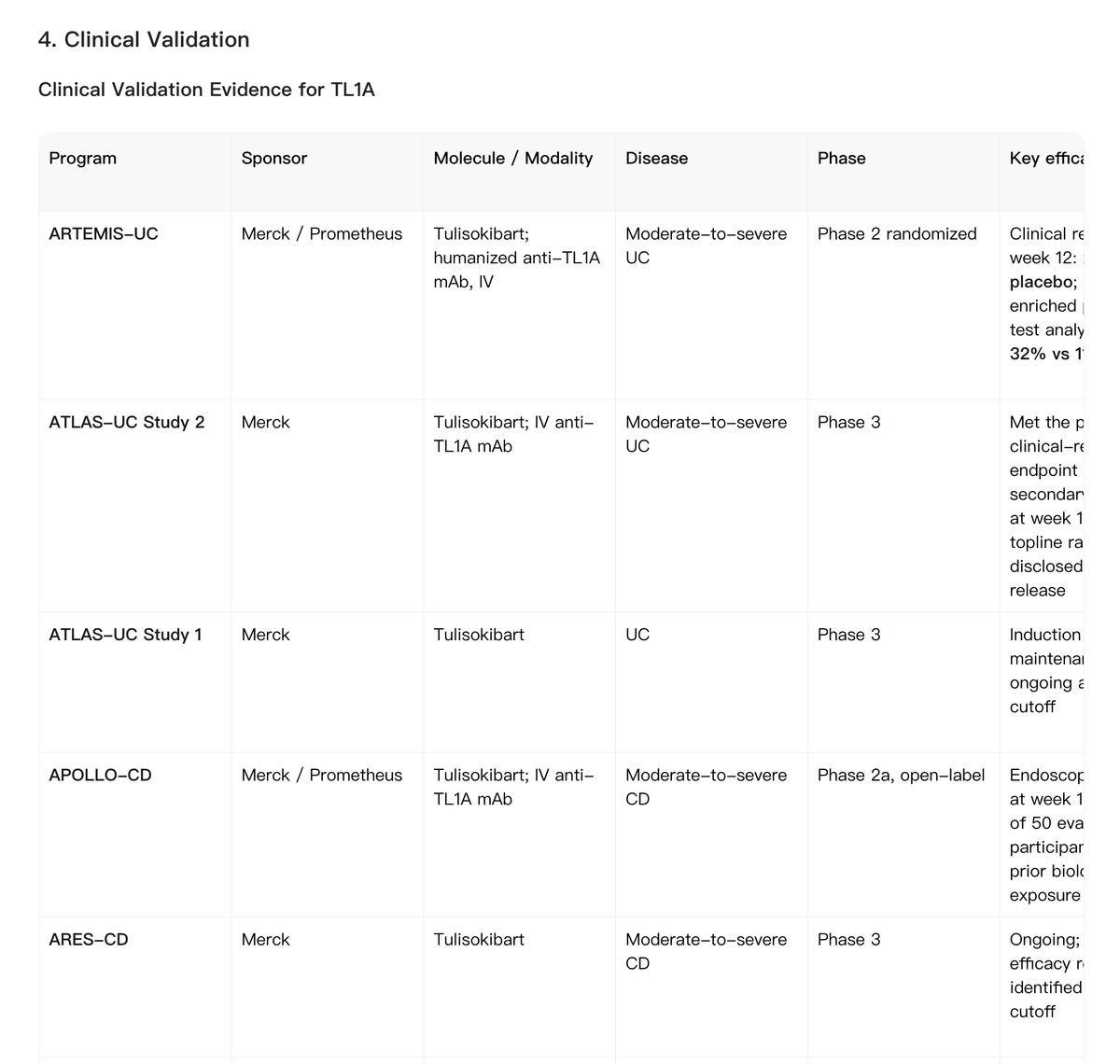
As of September 29, 2026, the TL1A class has generated randomized human efficacy evidence across multiple independent programs.
However, the maturity and strength of that evidence differ materially by molecule.
Tulisokibart
Tulisokibart currently provides one of the strongest clinical-validation packages in ulcerative colitis.
The randomized Phase 2 ARTEMIS-UC study was published in the New England Journal of Medicine in September 2024.
In the primary cohort, clinical remission at Week 12 occurred in 26% of tulisokibart-treated patients versus 1% with placebo, supporting randomized proof of concept for TL1A blockade in moderately to severely active UC.
In June 2026, Merck reported positive topline results from the Phase 3 ATLAS-UC induction-only study.
According to the sponsor announcement, the study met its primary endpoint of clinical remission at Week 12 as well as key secondary endpoints.
The evidence status should remain explicit:
Evidence status as of September 29, 2026:
Published randomized Phase 2 efficacy + positive sponsor-reported Phase 3 induction topline; investigational.
The Phase 3 result should not yet be described as equivalent to a fully published peer-reviewed Phase 3 evidence package.
Duvakitug
Duvakitug provides important independent support for TL1A activity across both ulcerative colitis and Crohn’s disease.
Sanofi and Teva reported that the randomized Phase 2b RELIEVE UCCD study met its primary endpoints in both diseases.
At Week 14, the high-dose group was reported to achieve:
- 47.8% clinical remission in UC versus 20.45% with placebo
- 47.8% endoscopic response in CD versus 13.0% with placebo
The companies subsequently reported long-term-extension data in February 2026 showing continued clinical and endoscopic activity among induction responders, while Phase 3 programs in UC and CD were ongoing.
This matters strategically because duvakitug provides randomized evidence that TL1A activity extends beyond UC into Crohn’s disease.
Evidence status as of September 29, 2026:
Randomized Phase 2b efficacy reported in UC and CD + long-term-extension data reported + Phase 3 programs ongoing; investigational.
Afimkibart
Afimkibart provides randomized human evidence for TL1A inhibition, but its Phase 2b result requires a more qualified interpretation.
The randomized, placebo-controlled Phase 2b TUSCANY-2 trial evaluated afimkibart in moderately to severely active ulcerative colitis.
Clinical remission by total Mayo Score—the study’s primary endpoint—was numerically higher with afimkibart, but the differences versus placebo were not statistically significant at any tested dose.
Reported remission rates were approximately 23–26% across afimkibart groups versus 12% with placebo.
Secondary analyses using the modified Mayo Score showed more favorable signals, and the program advanced into Phase 3 development.
Afimkibart therefore contributes to class-level human evidence, but it should not be presented as having the same efficacy-validation profile as a molecule that clearly met its prespecified primary efficacy endpoint.
Evidence status as of September 29, 2026:
Published randomized Phase 2b human efficacy data + primary endpoint not statistically significant + Phase 3 development ongoing; investigational.
SPY002
SPY002 represents a next-generation competitive threat focused partly on dosing and antibody design.
In June 2026, Spyre reported positive 12-week induction data from Part A of the Phase 2 SKYLINE study in moderately to severely active UC.
The sponsor reported that SPY002 met the study’s primary endpoint based on change in Robarts Histopathology Index and reported clinical remission and endoscopic-improvement signals among secondary endpoints.
These results are relevant to the competitive landscape, but they should be labeled as sponsor-reported Phase 2 data rather than treated as equivalent to mature pivotal evidence.
XmAb942
XmAb942 illustrates another important competitive strategy: extended half-life.
Xencor describes XmAb942 as an anti-TL1A antibody incorporating its Xtend Fc technology.
Following Phase 1 development, Xencor is conducting the randomized Phase 2b XENITH-UC study in moderate-to-severe ulcerative colitis.
As of the evidence cutoff, Phase 2b efficacy data had not yet matured, so XmAb942 should be considered an emerging competitive program rather than part of the established randomized efficacy base.
Class-Level Interpretation
The strongest defensible conclusion is therefore class-level but qualified:
TL1A blockade has demonstrated randomized clinical activity in inflammatory bowel disease, with the strongest current validation in ulcerative colitis.
That conclusion does not mean:
- every anti-TL1A molecule has demonstrated equivalent efficacy;
- every Phase 2 signal will translate into Phase 3 success;
- TL1A blockade has been proven to reverse fibrosis;
- or the TL1A class has received regulatory approval.
Development success still depends on:
- molecule design;
- dose and exposure;
- pharmacokinetics;
- endpoint selection;
- patient population;
- biomarker strategy;
- and differentiation from increasingly mature competitors.
4. Competitive Landscape
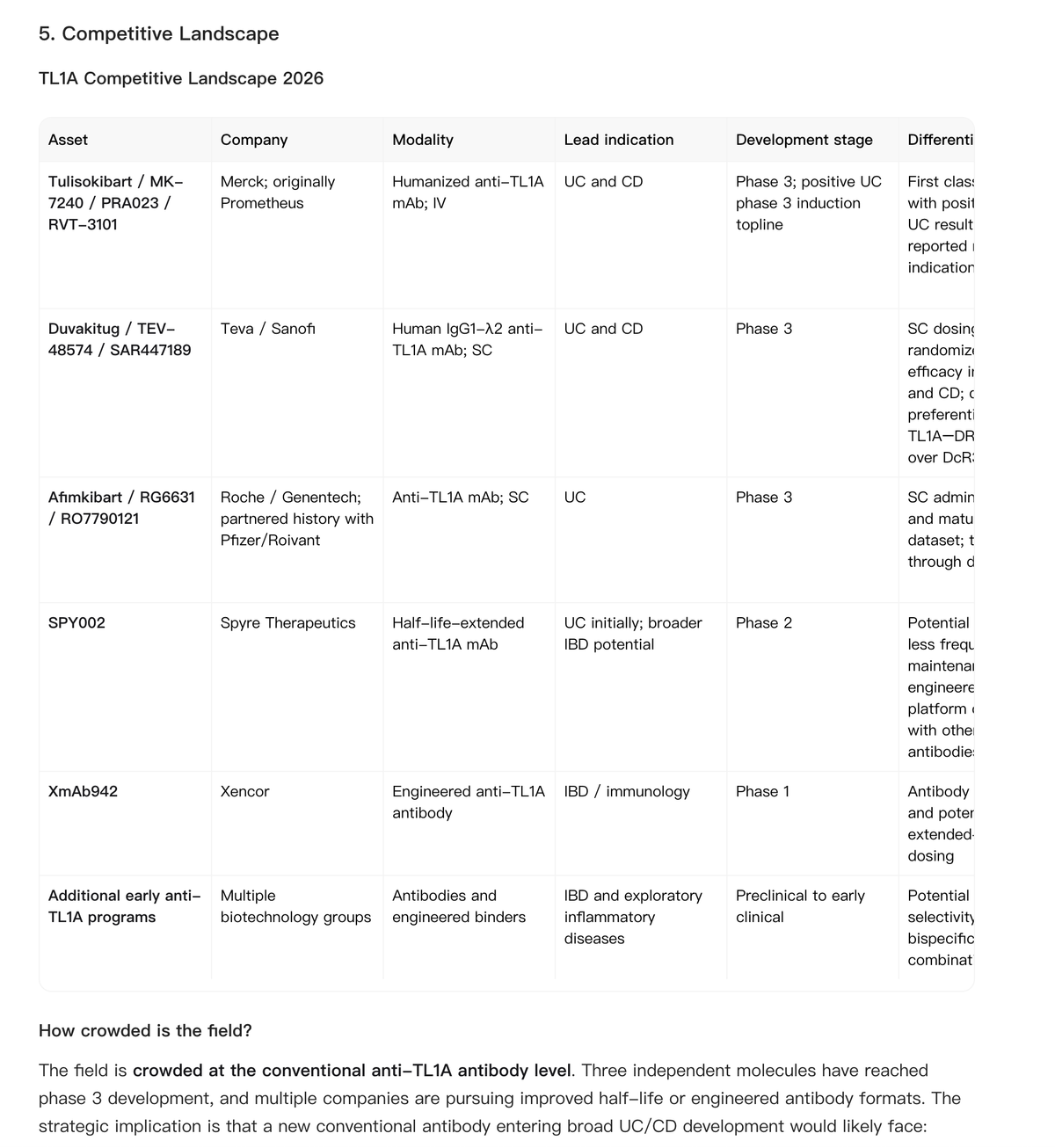
The TL1A field is already crowded at the conventional antibody level.
The most strategically important programs include:
| Program | Developer | Development Position as of Sep 29, 2026 | Strategic Feature |
|---|---|---|---|
| Tulisokibart | Merck | Phase 3 UC topline reported | Advanced clinical validation and biomarker-development history |
| Duvakitug | Sanofi / Teva | Phase 3 UC and CD programs ongoing | Randomized activity across both UC and CD |
| Afimkibart | Roche | Phase 3 development | Broad IBD development despite mixed Phase 2 primary-endpoint result |
| SPY002 | Spyre | Phase 2 UC data reported | Next-generation antibody profile and dosing ambitions |
| XmAb942 | Xencor | Phase 2b UC | Extended-half-life antibody engineering |
SPY002 reported positive Phase 2 UC induction data in June 2026, while XmAb942 had entered Phase 2b development with an explicit extended-half-life strategy.
This makes the competitive problem for a new entrant clear.
It is no longer enough to:
develop an antibody that binds TL1A.
A new program needs to demonstrate a meaningful advantage over competitors already optimizing:
- efficacy;
- dosing frequency;
- exposure;
- administration;
- antibody potency;
- tissue activity;
- and IBD indication breadth.
Where Whitespace May Still Exist
Meaningful whitespace remains, but it is narrower than it was when TL1A was an early target.
The strongest differentiation opportunities may include:
- materially less frequent self-administered dosing;
- improved tissue exposure;
- improved pharmacokinetics;
- biomarker-guided enrollment;
- difficult-to-treat or biologic-experienced IBD;
- fibrostenotic or transmural Crohn’s disease;
- mechanistically justified combination therapy;
- or clear superiority in treatment persistence or patient convenience.
A new entrant should therefore be developed against an explicit target product profile relative to the Phase 3 class, not against placebo alone.
5. Biomarker and Patient-Selection Strategy
No single TL1A biomarker is ready to carry the entire development program.
The most realistic strategy is a composite biomarker model that combines biological pathway activity with conventional clinical and disease-phenotype measures.
| Biomarker / Feature | Potential Role | Current Development Value | Key Limitation |
|---|---|---|---|
| TNFSF15 genotype | Identify genetically defined pathway-associated subgroups | Potential enrichment or stratification variable | Not established as a universal responder test |
| Circulating TL1A | Reflect systemic pathway activity | Pharmacodynamic or exploratory enrichment marker | Blood concentration may not reflect tissue-level signaling |
| Tissue TL1A / DR3 pathway activity | Measure local pathway activation | Potential mechanistic and response biomarker | Requires tissue access and assay standardization |
| Inflammatory disease phenotype | Define clinically active IBD populations | Important for trial enrollment and interpretation | Not specific to TL1A biology |
| Endoscopic activity | Measure disease severity and response | Established clinical-development endpoint | Measures disease activity rather than target-specific biology |
| Fecal calprotectin / CRP | Noninvasive inflammatory monitoring | Practical pharmacodynamic and disease-response measures | Limited target specificity |
| Imaging / structural disease features | Identify transmural or fibrostenotic disease | Important if pursuing anti-fibrotic or disease-modification claims | Requires longitudinal validation and appropriate structural endpoints |
A practical 2026 program should avoid relying on one blood-based marker as a binary responder test.
A stronger development strategy would combine:
genotype + pathway activity + clinical phenotype + standard disease measurements
and then test prospectively whether the composite improves:
- response prediction;
- dose selection;
- subgroup identification;
- or trial efficiency.
For Crohn’s disease programs seeking fibrosis or disease-modification claims, structural assessment should be incorporated explicitly.
Potential tools include:
- cross-sectional imaging;
- stricture characterization;
- bowel-wall measures;
- and longitudinal structural outcomes.
A program should not claim anti-fibrotic efficacy based solely on improvement in inflammatory symptoms or standard luminal endpoints.
6. Target Evidence Matrix
The target-level evidence can be summarized as follows:
| Evidence Dimension | Assessment | Interpretation |
|---|---|---|
| Biological rationale | Strong | TL1A/DR3 links immune activation with inflammatory and potentially fibrotic biology |
| Human disease association | Strong in IBD | Genetic and disease-expression evidence support relevance in UC and CD |
| Randomized clinical validation | Strongest in UC | Multiple independent programs have produced randomized human efficacy signals |
| Crohn’s disease validation | Moderate and increasing | Duvakitug provides randomized activity; pivotal validation is less mature than UC |
| Fibrostenotic disease validation | Early / unproven | Attractive mechanistic thesis without definitive structural disease-modification evidence |
| Biomarker tractability | Promising but incomplete | Multiple candidate biomarkers exist; no universal responder marker is established |
| Competitive intensity | High | Multiple advanced and next-generation antibodies reduce room for a conventional me-too program |
| Dosing / PK differentiation opportunity | Moderate | Long-acting engineering creates room for convenience-based differentiation, but competitors are already pursuing it |
| Combination opportunity | Potentially attractive | Mechanistically plausible, but benefit must be demonstrated rather than assumed |
| Development risk | Moderate | Target risk has fallen, but molecule-level and competitive risk have increased |
Overall Target Interpretation
The evidence has shifted TL1A from:
high biological uncertainty / low competition
toward:
lower target-level uncertainty / high competitive execution risk.
That changes the central R&D question.
The main risk is no longer:
Does TL1A work at all?
The more important question is:
Can a new molecule produce a clinically meaningful advantage over an increasingly mature class?
7. Final Target Assessment
Recommendation: ADVANCE — Conditionally
TL1A should remain an active drug-development target in 2026, but only for a program with a defined source of superiority.
The target is no longer an early exploratory cytokine.
Randomized human evidence has established clinically meaningful activity in IBD, particularly ulcerative colitis.
However, a conventional undifferentiated anti-TL1A antibody would enter an increasingly crowded field.
Why Advance
The case for continued investment includes:
- strong target biology;
- human disease association;
- randomized clinical evidence across independent programs;
- published positive Phase 2 evidence;
- a positive sponsor-reported Phase 3 UC induction signal for tulisokibart;
- randomized activity across UC and CD for duvakitug;
- and a plausible immuno-fibrotic development thesis.
Main Competitive Risk
The primary strategic risk is no longer target failure.
It is competitive compression.
By the time a new entrant reaches late-stage development, first-generation and next-generation programs may already have established:
- efficacy benchmarks;
- preferred dosing schedules;
- broad IBD positioning;
- and commercial relationships.
A late entrant without meaningful differentiation could therefore face a strong scientific result but a weak strategic position.
Best Differentiation Strategy
A credible new program should combine at least two or more of the following:
- materially improved dosing convenience;
- durable exposure;
- strong subcutaneous feasibility;
- biomarker-guided enrollment;
- differentiated tissue activity;
- biologic-experienced positioning;
- difficult-to-treat IBD;
- fibrostenotic or transmural Crohn’s disease;
- or a mechanistically justified combination strategy.
ADVANCE / NO-GO Framework
| Development Scenario | Decision |
|---|---|
| Strong target engagement + reproducible pharmacodynamic signal + differentiated PK or dosing profile | ADVANCE |
| Human efficacy signal plus credible advantage in difficult-to-treat or biomarker-defined IBD | ADVANCE |
| Credible structural or fibrosis signal in Crohn’s disease with validated imaging or disease-modification endpoints | HIGH-PRIORITY ADVANCE |
| Conventional anti-TL1A antibody with similar dosing and no defined clinical advantage | NO-GO / PARTNER ONLY |
| Strong preclinical biology but weak or inconsistent human target engagement | NO-GO |
| Biomarker hypothesis without reproducible enrichment signal | CONDITIONAL / RE-DESIGN |
| Improved PK but no meaningful clinical or operational differentiation versus Phase 3 competitors | NO-GO |
| Combination concept without additive biological rationale or tolerability margin | NO-GO / DEFER |
Kill Criteria
Stop, redirect, or partner a new TL1A program if it cannot demonstrate:
- reliable target engagement;
- a reproducible pharmacodynamic marker;
- acceptable chronic-use safety;
- meaningful exposure or dosing differentiation;
- a clinically relevant efficacy advantage;
- a biomarker or disease-segment strategy that improves positioning;
- or a credible development path against the current class leaders.
The program should also be reconsidered if its only thesis is:
another anti-TL1A antibody with similar efficacy and a similar dosing profile.
By 2026, that is unlikely to be sufficient differentiation.
Build a Source-Linked Target Evaluation with Noah AI
Build a source-linked target evaluation covering target biology, clinical validation, competitive landscape, biomarkers, and development strategy in one structured research workflow.
Use Noah AI to move from fragmented scientific and clinical evidence to a decision-oriented target assessment with sources attached to the underlying claims.
Free to use · Free credits included · No credit card required
Build a Target Evaluation with Noah AI →
Sources Used for Key Clinical-Status Claims
- Tulisokibart Phase 2 UC: Phase 2 Trial of Anti-TL1A Monoclonal Antibody Tulisokibart for Ulcerative Colitis, New England Journal of Medicine, published September 2024.
- Tulisokibart Phase 3 UC: Merck ATLAS-UC induction-only topline announcement, June 22, 2026.
- Duvakitug Phase 2b: Sanofi / Teva RELIEVE UCCD randomized Phase 2b update, December 17, 2024.
- Duvakitug maintenance / LTE: Sanofi / Teva RELIEVE UCCD long-term-extension update, February 17, 2026.
- Afimkibart Phase 2b: TUSCANY-2 randomized Phase 2b study, published in The Lancet Gastroenterology & Hepatology in 2025.
- SPY002 Phase 2: Spyre SKYLINE Part A induction update, June 15, 2026.
- XmAb942: Xencor Phase 1 update and ongoing XENITH-UC Phase 2b development information, 2026.