TIGIT Competitive Landscape 2026: Clinical Failures, Combination Strategies and Development Outlook
Linda
A 2026 TIGIT competitive landscape covering clinical programs, molecular formats, Fc strategies, biomarkers, failure analysis, and development implications.
TIGIT entered immuno-oncology with a compelling checkpoint biology and an early randomized signal. By 2026, however, the central question is no longer whether TIGIT can produce activity, but whether any molecule, Fc configuration, biomarker strategy or combination can deliver reproducible benefit beyond an active PD-(L)1 backbone.
This report uses a structured competitive-intelligence workflow to separate target-level risk from molecule-, strategy- and indication-level risk. The goal is not to rank programs by trial count or development phase, but to compare them using the same evidence standard and identify what a genuinely differentiated entrant would still need to prove.
Method note: This report was built using a structured Noah AI research workflow to compare TIGIT programs across mechanism, molecular format, indication, trial design, efficacy, safety, development status, and evidence maturity. The analysis separates documented clinical outcomes from broader target-level interpretations and does not treat the failure of any single program as proof of TIGIT class failure.
Evidence cutoff: October 9, 2026.
1. Why Structured TIGIT Competitive Analysis Matters
The TIGIT field illustrates why early activity should not be confused with class validation. CITYSCAPE produced a meaningful randomized proof-of-concept for tiragolumab plus atezolizumab, but subsequent confirmatory studies failed to establish reproducible survival benefit. That divergence makes evidence maturity, comparator strength and durability more important than headline response rates.
Four levels should remain separate: target biology, molecule design, combination strategy and indication context. A negative trial may affect all four differently.
2. Define the Competitive Scope
Direct competitors include conventional anti-TIGIT antibodies, Fc-active or Fc-engineered antibodies, Fc-silent antibodies, TIGIT/PD-1 or TIGIT/PD-L1 bispecifics, and co-administered TIGIT plus PD-(L)1 combinations. Adjacent checkpoint programs should be treated as competing strategies rather than counted as TIGIT assets.
Fc configuration is particularly important because different constructs test different biological hypotheses. Fc-silent and Fc-enabled antibodies may produce distinct effects on regulatory T cells, myeloid cells and exhausted CD8-positive T cells. That makes Fc design a development variable—not proof of clinical differentiation by itself.
3. TIGIT Asset Landscape in 2026
The field is now defined more by failed or mixed late-stage programs than by a validated front-runner. Tiragolumab remains the historical reference case; domvanalimab is the most informative Fc-silent program; vibostolimab and ociperlimab add important negative phase III evidence; belrestotug shows that an FcγR-enabled design did not automatically create a viable program; and rilvegostomig represents a next-generation bispecific hypothesis that remains early.
The practical implication is that “active,” “completed,” “terminated” and “discontinued” describe program state, not clinical validation. Competitive analysis must preserve that distinction.
4. Standardized Clinical Comparison
Across TIGIT programs, small randomized or single-arm signals have not reliably translated into larger, OS-driven success. Tiragolumab, domvanalimab, vibostolimab and ociperlimab were tested in different tumor types, backbones and biomarker settings, but their combined history points to the same requirement: any future TIGIT program must demonstrate incremental benefit over an active standard, not activity in isolation.
5. What the Clinical Evidence Shows
TIGIT development has produced both early clinical activity and multiple negative late-stage outcomes, but those results occurred across different molecules, Fc designs, tumor types, backbones, and biomarker settings.
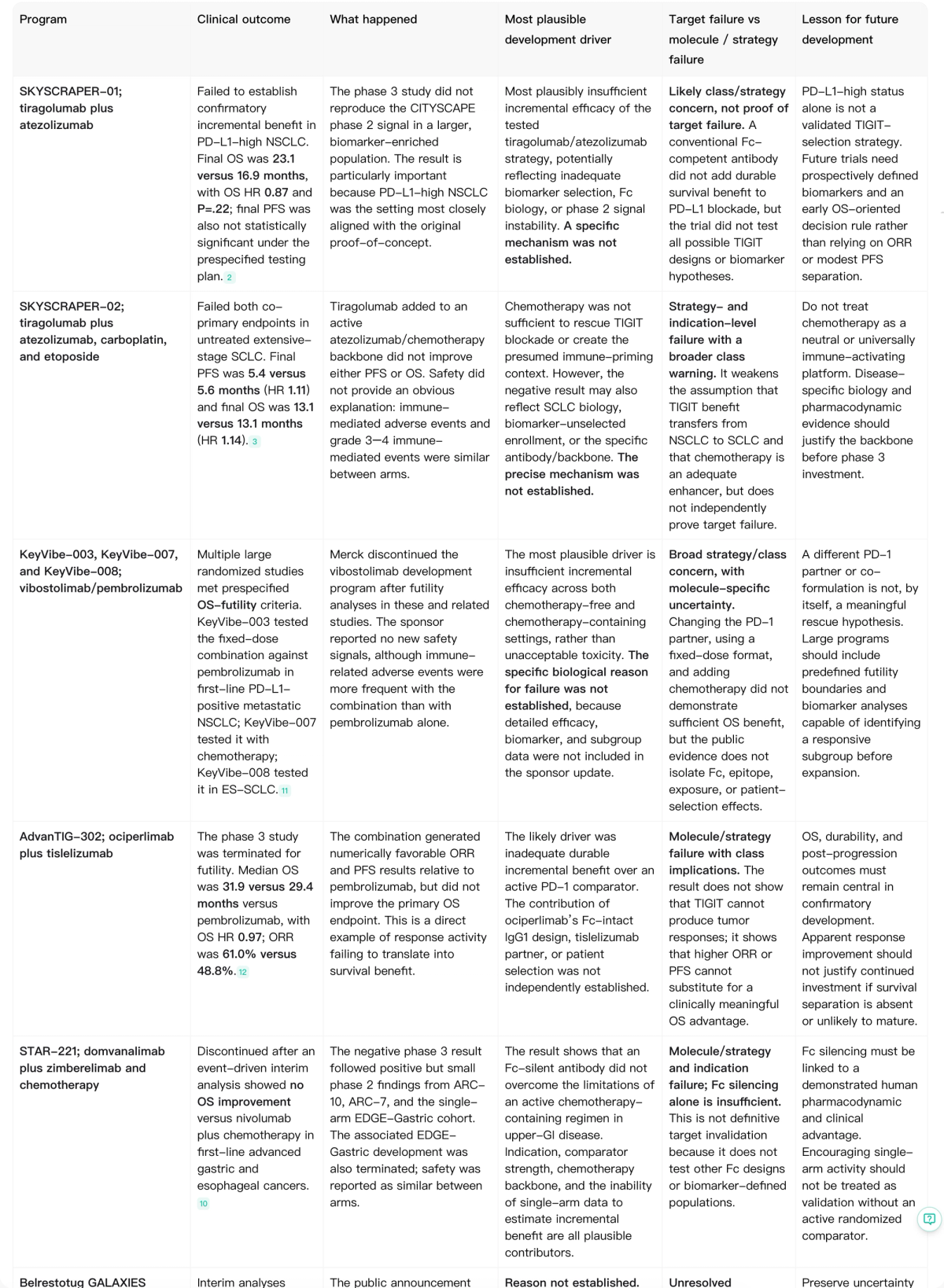
Tiragolumab generated an encouraging randomized Phase II signal in CITYSCAPE, but that signal was not reproduced consistently in later Phase III development. SKYSCRAPER-01 did not demonstrate a statistically significant overall survival benefit at final analysis, while SKYSCRAPER-02 failed its progression-free survival endpoint.
Domvanalimab remained an important test of the Fc-silent TIGIT hypothesis, but the Phase III STAR-221 study was discontinued after an interim analysis showed no overall survival improvement versus nivolumab plus chemotherapy.
Vibostolimab development was discontinued after multiple KeyVibe Phase III studies met prespecified futility criteria, including overall survival futility in KeyVibe-003 and KeyVibe-007.
Ociperlimab also failed to establish an overall survival advantage in the Phase III AdvanTIG-302 study despite numerically higher response and progression-free survival measures.
Rilvegostomig represents a different PD-1/TIGIT bispecific strategy and remains under clinical development. Its continued development should be interpreted as an active hypothesis rather than evidence that the bispecific format has already solved the problems seen with earlier TIGIT programs.
Taken together, these results increase the development risk around broad TIGIT strategies. They do not establish that every TIGIT molecule or format will fail, because molecular design, Fc configuration, indication, biomarker strategy, and treatment backbone differ across programs.
6. Target-Level vs Molecule / Strategy-Level Risk
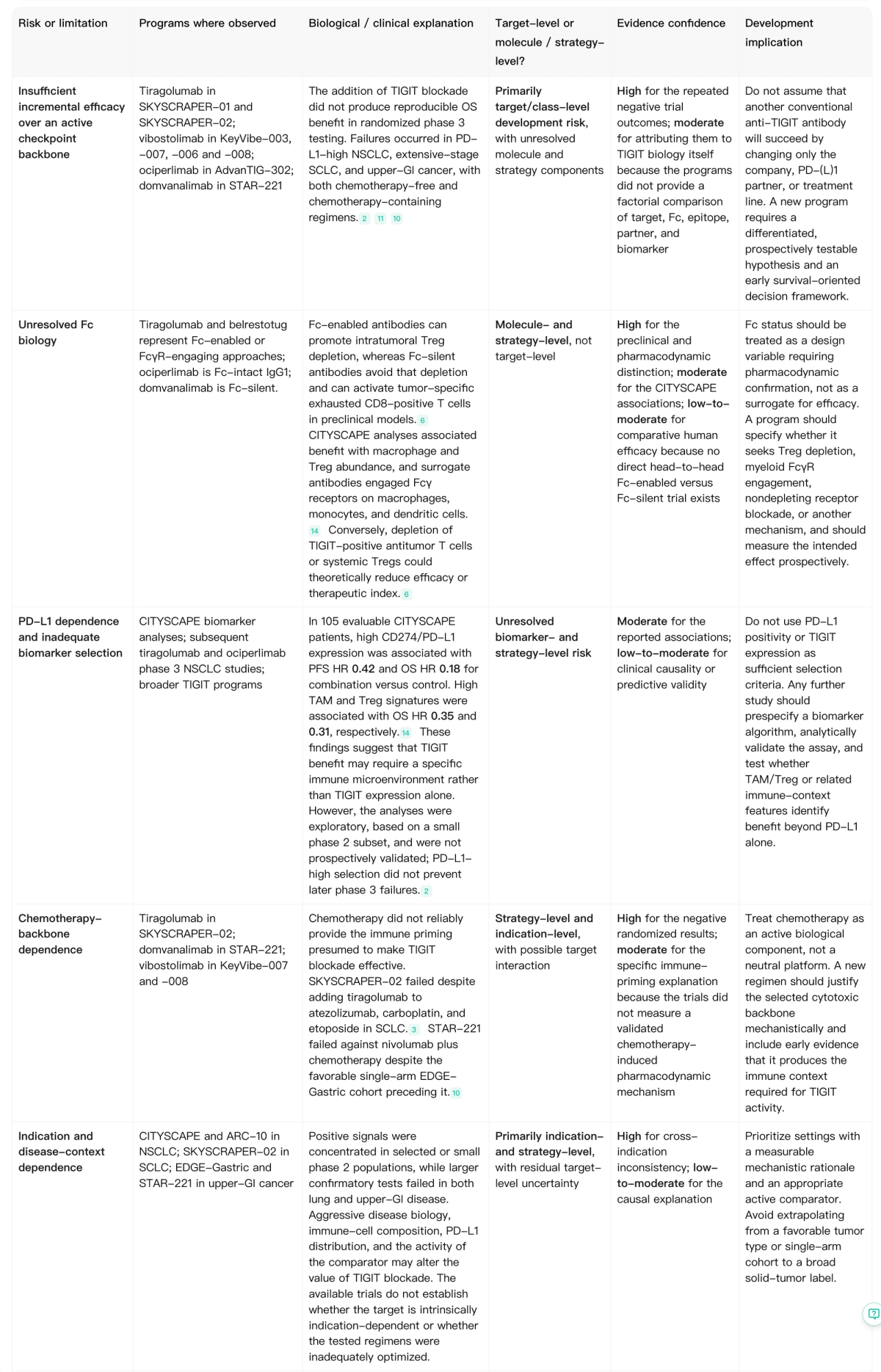
The strongest signal in the 2026 landscape is repeated failure to generate durable incremental efficacy over active checkpoint backbones. But the mechanism of failure is not uniform. Fc biology, biomarker selection, chemotherapy context and indication dependence remain partially unresolved, so the correct conclusion is higher class-level development risk rather than automatic target invalidation.
Try Noah AI for Free
Use Noah AI to search, compare, and analyze biomedical evidence with AI-powered research workflows. Free credits are available, and no credit card is required to get started.
7. Failure Analysis
Program failure should be interpreted carefully. SKYSCRAPER-01 and SKYSCRAPER-02 weakened confidence in broad tiragolumab development. KeyVibe showed that changing the PD-1 partner and using a fixed-dose combination did not create sufficient incremental efficacy. AdvanTIG-302 showed that a numerically stronger response rate can still fail to translate into a clinically meaningful survival advantage.
8. Competitive Prioritization
Historical importance and current investability are not the same. Tiragolumab remains the benchmark against which new TIGIT programs are interpreted, but it is not a current development leader. Domvanalimab remains strategically informative because it tests an Fc-silent hypothesis, although the negative STAR-221 result prevents treating that design as validated. Rilvegostomig remains one of the most important next-generation formats to monitor, but it still lacks randomized evidence of an advantage over separately administered checkpoint antibodies.
9. Development Implications for a New TIGIT Entrant
Biological validation
TIGIT remains mechanistically credible and has clinical proof-of-concept, but it is not de-risked as a broad therapeutic class. Early randomized signals show that co-blockade can generate incremental activity in selected settings, while later failures show that this effect is not reliably transferable across populations and backbones.
Biomarker and patient selection
PD-L1 positivity alone is not sufficient. Any new program should prospectively test a broader immune-context hypothesis, potentially incorporating macrophage, Treg, myeloid or related features, rather than relying on TIGIT expression or PD-L1 status as a stand-alone selection rule.
Format and combination strategy
Fc configuration and bispecific design remain plausible differentiation levers only if they produce a measurable pharmacodynamic and clinical advantage. A new construct should show why it changes tumor localization, immune-cell engagement, exposure or therapeutic index—and then validate that hypothesis in human samples.
Development gates
| Gate | What must be demonstrated |
|---|---|
| Prospective biomarker | A predefined immune-context hypothesis with an analytically defined assay and confirmatory cohort. |
| Pharmacodynamic engagement | Evidence that the molecule produces its intended Fc, non-Fc, myeloid, Treg or co-localization effect in humans. |
| Active comparator | Randomized comparison with the contemporary PD-(L)1 standard rather than historical control. |
| Durable efficacy | PFS improvement supported by durable response and a credible path to OS benefit, not ORR alone. |
| Therapeutic index | Incremental benefit that justifies immune-mediated toxicity, discontinuation burden and regimen complexity. |
| Reproducibility | Benefit reproduced across independent cohorts and prespecified biomarker strata. |
10. Bottom Line
TIGIT should be treated neither as a dead target nor as a validated checkpoint class. The 2026 evidence supports a narrower conclusion: TIGIT/PVR biology is plausible and has produced real early clinical signals, but broad development has not delivered reproducible randomized OS benefit.
The remaining opportunity is therefore hypothesis-specific. A credible new entrant must explain why its molecule, Fc design, bispecific format, biomarker, disease setting or combination backbone should succeed where prior programs failed—and test that explanation prospectively against an active standard.
Build a TIGIT Competitive Landscape with Noah AI
Use Noah AI to compare clinical programs, molecular formats, Fc strategies, biomarkers, combination backbones, trial outcomes, and development risks across the TIGIT landscape.
Build a source-linked competitive view that separates target-level risk from molecule-, indication-, and strategy-level evidence.
Free to use · Free credits included · No credit card required
Build a TIGIT Competitive Landscape with Noah AI →