Statistics Checklist for Biomedical Peer Review: How to Review Clinical Research with AI
Linda
Use this biomedical statistics checklist to review sample size, endpoints, confidence intervals, missing data, subgroup analyses, survival methods, and reviewer comments with AI support.
A practical workflow for checking whether a biomedical manuscript reports its statistical methods, results, uncertainty, and interpretation clearly enough for rigorous peer review.
Important: a statistical checklist is an audit framework, not proof that a study is valid. When information is missing, label it "Not clearly reported" rather than assuming an error.
Key Takeaways
- A structured checklist makes statistical peer review more consistent and auditable.
- The checklist should change with study design: RCTs, cohorts, diagnostic studies, biomarker studies, and survival analyses require different checks.
- P-values alone do not describe effect size, clinical importance, or uncertainty.
- Effect estimates and confidence intervals should be reviewed alongside model assumptions, missing data, multiplicity, and analysis populations.
- AI can accelerate extraction, consistency checks, and reviewer-comment drafting, but every flag still requires source-level verification.
Important: A Checklist Flag Is Not a Statistical Error
Noah AI can help identify missing reporting, inconsistencies, unclear assumptions, and questions that require reviewer attention. It does not independently determine that a statistical analysis is correct or incorrect.
Use the following rule throughout the review:
If the manuscript does not provide enough information to verify a statistical choice, label it "Not clearly reported" rather than treating it as an error.
A checklist flag should therefore be interpreted as a prompt for source-level verification or reviewer clarification, not as proof of statistical invalidity.
What Is a Statistics Checklist for Peer Review?
A statistics checklist is a structured audit of a manuscript's design, outcomes, analysis population, statistical methods, assumptions, uncertainty, and conclusions. It helps the reviewer follow the evidence from the research question to the reported result instead of checking isolated statistical terms.
Comparison of Statistics Checklists by Study Type
| Study type | Key checks | Common pitfalls |
|---|---|---|
| Randomized clinical trial | Randomization, allocation, primary endpoint, ITT population, sample size, multiplicity, missing outcomes, harms. | Post-randomization exclusions, changed endpoints, unplanned subgroups, selective emphasis. |
| Observational cohort | Eligibility, exposure timing, confounding strategy, missingness, follow-up, model specification. | Residual confounding, immortal-time bias, selection bias, unsupported causal language. |
| Survival analysis | Time origin, censoring, event definition, competing risks, proportional-hazards assumptions, absolute effects. | Interpreting HR as a constant risk reduction, unclear censoring, ignoring non-proportional hazards. |
| Diagnostic accuracy study | Index test, reference standard, threshold, sensitivity, specificity, AUC, participant flow. | Post-hoc thresholds, spectrum bias, unclear reference standard, missing uncertainty. |
| Biomarker / omics study | Assay QC, cutoffs, multiplicity, batch effects, validation cohort, prognostic vs predictive claims. | Overfitting, data leakage, data-driven cutoffs, absent external validation. |
Why Do Statistics Checklists Matter?
Statistical peer review is easier to reproduce when the reviewer uses explicit questions rather than general impressions. A structured checklist can reveal whether the manuscript clearly reports its sample-size rationale, analysis population, effect estimates, confidence intervals, missing-data handling, subgroup methods, and the relationship between results and conclusions.
- Reproducibility: can another reader reconstruct what was analyzed?
- Power and precision: are the number of participants or events appropriate for the planned analysis?
- Clinical meaning: are effect magnitude and uncertainty considered alongside statistical significance?
- Reporting consistency: do the abstract, methods, tables, figures, and conclusions tell the same statistical story?
- Interpretation: are exploratory findings or observational associations being overstated?
Key Challenges in Biomedical Peer Review
The most important distinction is between missing reporting and a demonstrated statistical problem. If the manuscript does not provide enough evidence to decide, the reviewer should request clarification rather than infer an error.
- Unclear sample-size justification or event requirements.
- Missing-data assumptions that are not described.
- Statistical tests that are named but not fully specified.
- Multiplicity across endpoints, subgroups, biomarkers, or time points.
- Subgroup claims without interaction testing.
- Survival analysis without clear censoring rules or assumption checks.
- P-values reported without effect estimates or confidence intervals.
- Observational associations described using causal language.
How to Use Noah AI for Statistical Peer Review
Noah can help organize a manuscript, extract statistical methods, identify missing reporting, compare sections for inconsistencies, and turn verified observations into structured reviewer questions. The reviewer still needs to inspect the original manuscript, supplementary material, protocol, registry, and analysis plan where available.
Explore Noah's human-in-the-loop research workflow →
- Upload the manuscript when journal policy and confidentiality requirements allow it.
- Identify the study design.
- Extract outcomes, populations, models, assumptions, missing-data methods, and subgroup analyses.
- Apply the design-specific checklist.
- Flag candidate issues as questions, not confirmed errors.
- Link every flag to manuscript evidence.
- Draft neutral reviewer comments.
- Manually verify important statistical and clinical judgments.
Step-by-Step Workflow
Step 1: Identify the Study Design
Start by establishing whether the manuscript is an RCT, cohort, case-control study, diagnostic-accuracy study, biomarker study, prediction-model study, systematic review, or a mixed design. The design determines the relevant estimand, bias threats, assumptions, and reporting framework.
Step 2: Extract the Statistical Plan
Before judging the analysis, reconstruct what the authors planned and what they actually report. Extract the primary endpoint, sample-size calculation, analysis population, models, adjustment variables, missing-data methods, multiplicity strategy, subgroup analyses, and survival-analysis rules.
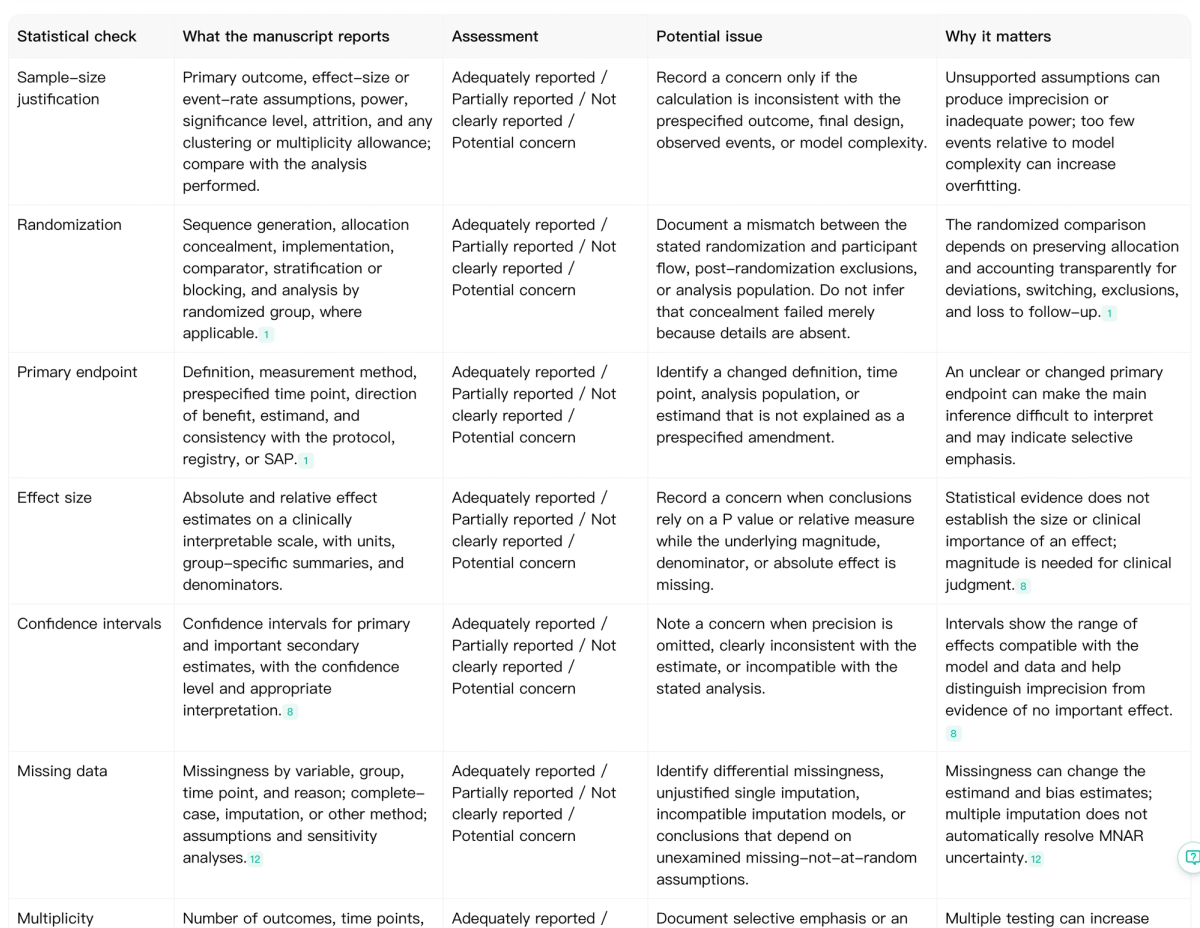
Step 3: Apply the Statistical Checklist
The checklist should separate what is adequately reported, partially reported, not clearly reported, and potentially concerning. The goal is not to assume errors, but to identify what evidence is available and what still needs clarification.
Step 4: Check Interpretation
Next, compare the statistical result with the manuscript's interpretation. Review whether statistical significance is being treated as clinical importance, whether exploratory findings are described as confirmatory, whether subgroup claims are supported by interaction testing, and whether observational associations are described as causal effects.
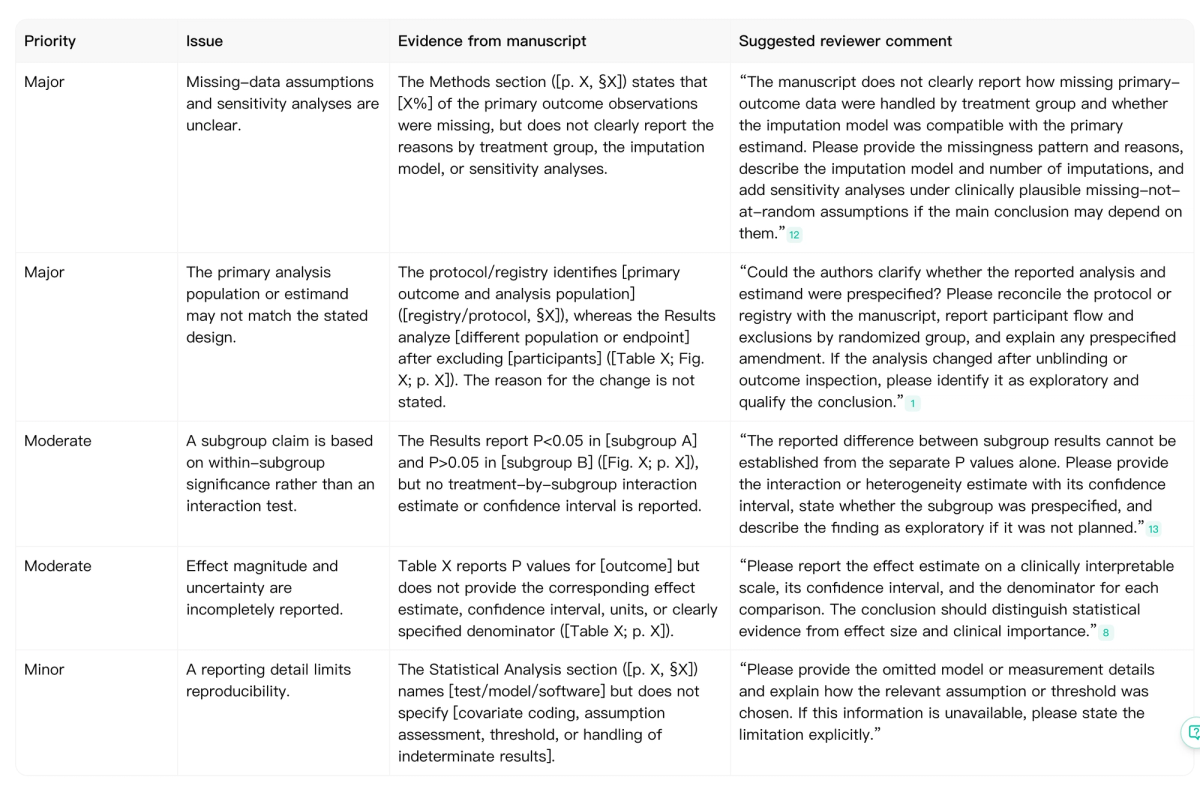
Step 5: Build Reviewer Comments
Strong reviewer comments move from evidence → implication → actionable request. They should distinguish an incomplete report from a confirmed methodological problem and request the smallest useful correction, clarification, or sensitivity analysis.
Citing Sources and Avoiding Plagiarism in Peer Review
A statistical review should separate what the manuscript itself reports from what an external reporting standard recommends. Manuscript-derived observations should point to a page, table, figure, section, protocol entry, or reported number. External methodological guidance should support the reviewer's question rather than be used as proof that the authors made an error.
- Verify the applicable version of CONSORT, STROBE, PRISMA, STARD, TRIPOD+AI, REMARK, or another relevant standard.
- Do not invent guideline requirements.
- Do not treat reporting-checklist completion as proof of validity.
- Keep external methodological claims linked to their source.
- Do not copy reviewer language from unrelated reviews.
Best Practices and Common Pitfalls
Best practices
- Start with study design and primary estimand.
- Distinguish primary, secondary, and exploratory analyses.
- Inspect effect sizes and confidence intervals, not just P-values.
- Check missing data by group, time point, and reason.
- Check multiplicity across outcomes, models, thresholds, and subgroups.
- Reconcile denominators across participant flow, tables, figures, and the abstract.
- Link every potential concern to manuscript evidence.
Common pitfalls
- Focusing only on statistical significance.
- Treating P<0.05 as proof of clinical importance.
- Reviewing only the abstract.
- Ignoring supplementary methods or analysis plans.
- Treating an AI flag as a confirmed statistical error.
- Ignoring discrepancies between the manuscript and the prespecified analysis plan.
Example Use Case: Reviewing a Phase III Oncology Trial
For a Phase III oncology randomized trial, a statistical reviewer would typically examine randomization, sample size, the primary endpoint, hazard ratios, confidence intervals, censoring, PFS and OS analyses, interim-analysis rules, subgroup analyses, safety denominators, and conclusion wording.
| Area | What to review | Typical reviewer question |
|---|---|---|
| Randomization | Sequence generation, concealment, stratification, analysis population. | Does participant flow preserve the randomized comparison? |
| Primary endpoint | Definition, time origin, analysis population, estimand. | Does the reported endpoint match the registry and SAP? |
| Hazard ratio | Model, CI, event count, follow-up, PH assumptions. | Is the HR interpreted appropriately and supported by absolute effects? |
| Subgroups | Prespecification, interaction tests, sample size, multiplicity. | Is treatment heterogeneity supported by an interaction test? |
| Safety | Exposure, denominators, serious events, discontinuations. | Are differences in follow-up or exposure accounted for? |
Final Checklist for Biomedical Statistical Peer Review
Use the final checklist as a structured audit. A checked item means the manuscript provides the relevant evidence; it does not by itself prove validity.
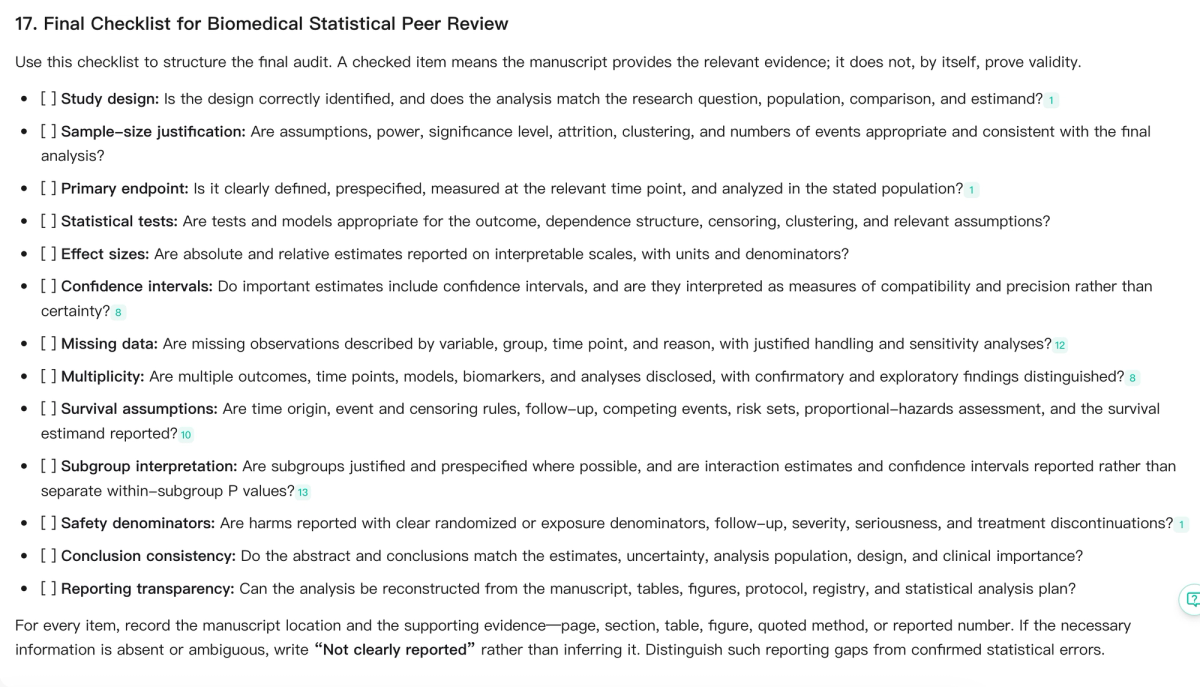
For each item, record the supporting manuscript location—page, section, table, figure, quoted method, or reported number. If the necessary information is absent or ambiguous, use "Not clearly reported" rather than inferring it.
Audit Statistical Reporting with Noah AI
Use Noah AI to audit reporting, uncertainty, and statistical assumptions with source-level verification.
Organize manuscript evidence, flag information that is not clearly reported, compare statistical claims across sections, and turn verified observations into structured reviewer questions.
Free to use · Free credits included · No credit card required
Audit Statistical Reporting with Noah AI →
Conclusion and Next Steps
A statistics checklist gives biomedical peer review a consistent path from study design and endpoints to analysis, uncertainty, missing data, subgroup claims, and interpretation. AI can make this workflow faster by organizing evidence and surfacing questions, but the reviewer remains responsible for source verification, statistical judgment, and clinical interpretation.
FAQs
What is a statistics checklist for peer review?
It is a structured audit of whether a manuscript's design, outcomes, statistical methods, assumptions, uncertainty, and conclusions align with the study question and reported analysis.
Can AI check statistics in a research paper?
AI can assist with extraction, consistency checks, missing-reporting flags, and reviewer-question drafting. It cannot independently validate the underlying data, code, assumptions, or clinical importance of the findings.
What statistical issues should reviewers check first?
Start with study design, the primary endpoint and estimand, analysis population, sample-size rationale, effect estimates, confidence intervals, missing data, multiplicity, and whether the conclusions match the design.
Is a significant p-value enough to support a conclusion?
No. Review effect magnitude, confidence intervals, analysis population, multiplicity, clinical relevance, and whether the result was prespecified or exploratory.
How should subgroup analyses be reviewed?
Check whether the subgroup was prespecified, clinically justified, adequately sized, and supported by an interaction or heterogeneity test rather than separate within-subgroup P-values.
Can AI replace a statistical reviewer?
No. AI can support coverage and consistency, but a qualified reviewer still needs to verify evidence, assumptions, bias, numerical claims, and clinical meaning.
Related Research Guides
- Best AI Tools for PubMed Literature Review (2026)
- Best AI Tools for Turning Research Questions into Evidence Tables (2026)
- AI Tools for Clinical Trial Results Analysis (2026)
- PubMed Search with AI
For research and educational use. AI-assisted review should not replace source-level verification or qualified statistical review.