Similar Products to Consensus for Biomedical Evidence Synthesis (2026)
Linda
Compare products similar to Consensus for biomedical evidence synthesis, with a live Noah AI Agent test on GLP-1 receptor agonists and 3-point MACE.
The problem behind "similar products to Consensus"
Most readers who search this title already know Consensus. They can ask a question over a very large paper index and get an evidence-backed answer, a yes/no read, or a Deep Search report. That is not the same job as biomedical evidence synthesis at the endpoint level.
A biomedical draft has to keep 3-point MACE separate from expanded composites, keep type 2 diabetes CVOTs separate from obesity-only trials, and keep a pooled hazard ratio attached to a paper a reviewer can open. A meter of agreement cannot do that work by itself.
Quick answer
Noah AI Agent is the product in this comparison that turns a biomedical question into a structured table and a cited synthesis a reviewer can check.
Use Consensus when the job is a fast read of where the literature stands, including Deep Search reports and Medical Mode. Use Elicit for screening and extraction, Scite for citation context, SciSpace for PDF reading, and Covidence for a formal dual-review workflow. If the result you need is a source-linked biomedical draft, start with Noah.
What Consensus is best at
Consensus is an AI research engine over a very large scholarly index. Official pages describe evidence-backed answers from published papers, Pro synthesis, Deep Search literature-review reports, and Medical Mode that narrows retrieval toward selected medical journals and clinical guidelines.
That is a real strength for "what does the field say?" It is also the limit. A Consensus Meter is not an evidence table. A Deep Search report can look like a literature review without keeping every trial on a strict 3-point MACE row. Consensus can show you the literature. It does not replace opening the primary CVOT.
Quick comparison
| Product | Best for | Synthesis strength |
|---|---|---|
| Noah AI | Medical question → cited biomedical draft | Structured, cited outputs you can verify |
| Consensus | Evidence-backed answers and Deep Search reports | Answers and reviews grounded in retrieved papers |
| Elicit | Screening and extraction | Sentence-level citations on extracts |
| Scite | Citation context | Supporting / contrasting / mentioning labels |
| SciSpace | PDF reading | Questions anchored to papers |
| Covidence | Formal systematic reviews | Dual review and audit trail |
| Semantic Scholar | Broad scholarly search | Paper-level citation metadata |
Noah AI: biomedical evidence synthesis you can verify
Noah AI built Agent for medical-evidence work, not as a general chatbot. In one workspace, PubMed Search, Health Search, and Agent move researchers from trusted sources to structured, cited outputs they can verify: search the evidence, then let Agent synthesize it. Consensus answers where the literature stands. Agent answers the biomedical question in a draft a reviewer can check.
The case below is one live Agent run in Medical & Academia, not a product tour. The question was whether GLP-1 receptor agonists reduce 3-point MACE in adults with type 2 diabetes — the kind of yes/no biomedical question Consensus is also built to receive. Adjacent workflows are covered in how to use Noah for medical literature review and PubMed search with AI.
Why Noah fits this job
- Medical-first workspace: PubMed and trusted medical sources, a structured research workflow, and cited outputs you can verify.
- Search and synthesis stay together. PubMed Search and Health Search retrieve sources; Agent synthesizes them.
- The question can name the endpoint. This run asked for 3-point MACE and for rows that say when a trial used a modified composite.
- The draft is reviewable. Official positioning is not "trust the answer"; it is a cited output a researcher can check.
What this live run returned
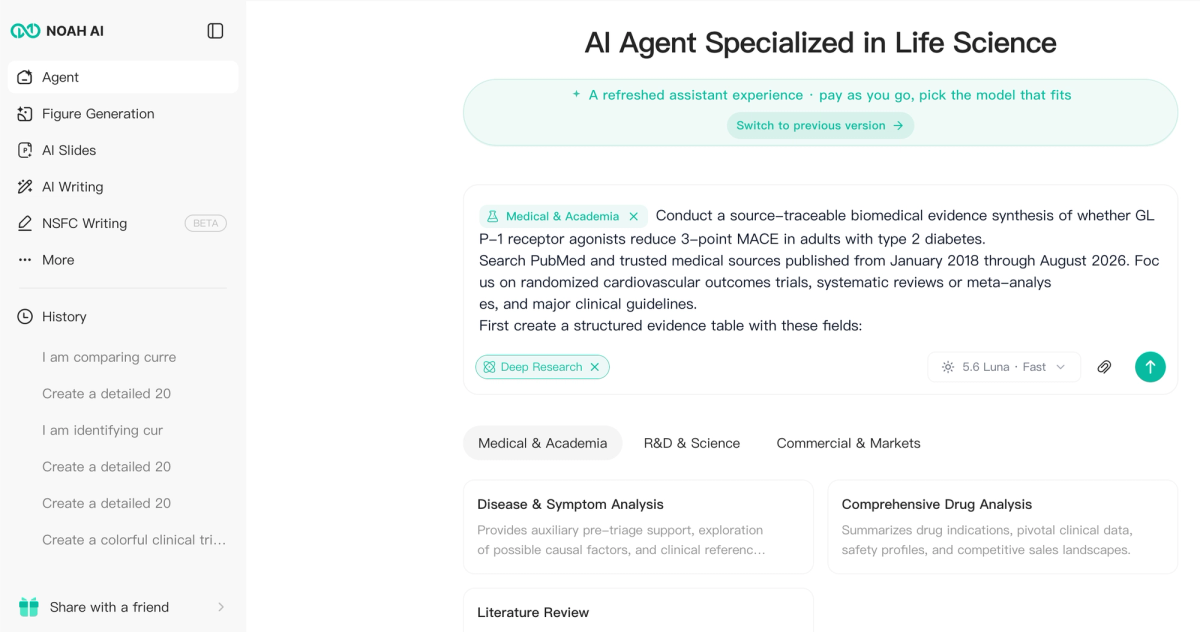
Figure 1. The live Noah AI Agent prompt for the GLP-1 / 3-point MACE evidence synthesis.
Agent mode and Medical & Academia selected. The visible prompt names the population, intervention, endpoint, date window, and the request for a structured evidence table.
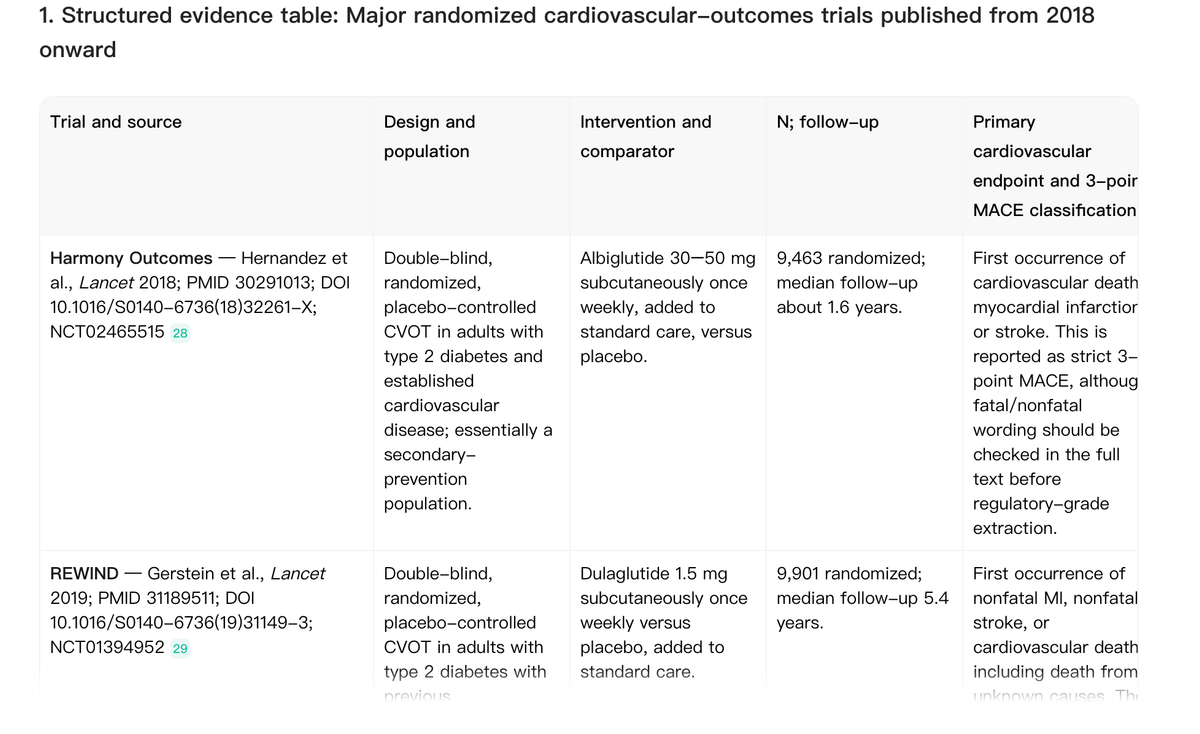
Figure 2. The structured CVOT table generated in the same GLP-1 / 3-point MACE run. Visible rows include Harmony Outcomes (PMID 30291013; n=9,463) and REWIND (PMID 31189511; n=9,901).
This is the synthesis difference versus a Consensus-style answer. The table keeps albiglutide and dulaglutide on separate rows, keeps n and follow-up visible, and flags that REWIND's death component included unknown causes. A reviewer can challenge one trial without collapsing the class into a single yes.
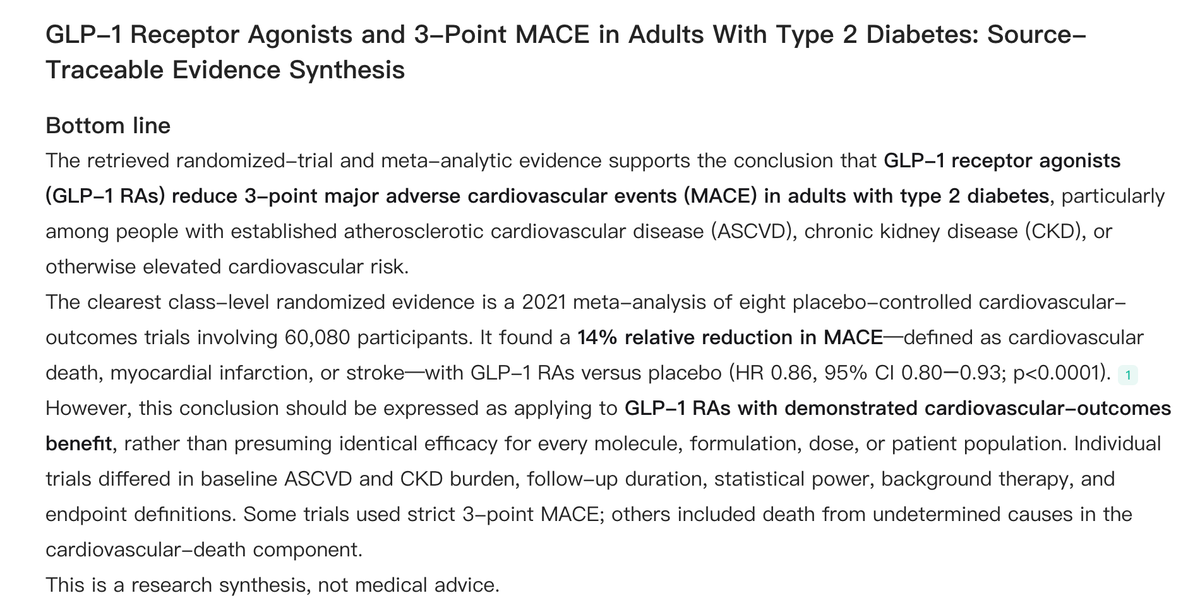
Figure 3. The cited bottom line from the same run, with the class-level estimate linked to a retrieved source.
The draft reports a 2021 meta-analysis of eight CVOTs (n=60,080; HR 0.86, 95% CI 0.80–0.93) and immediately limits the claim to GLP-1 RAs with demonstrated cardiovascular-outcomes benefit.
What this case proves — and what it does not
- Shown here: Agent turned a biomedical question into a trial table plus a cited bottom line.
- Shown here: 3-point MACE stayed distinct from modified composites, and a PMID stayed attached to a trial row.
- Not a Noah product claim: a Consensus Meter, Deep Search across 200 million papers, dual-review systematic review software, or guaranteed completeness of every GLP-1 CVOT.
If that draft is the result you need, open Noah Agent and name the population, intervention, and endpoint.
Other similar products
Elicit is strongest for screening and field extraction. Use it when the job is a paper set and a spreadsheet, not a medical Agent draft. This article did not run Elicit on the same GLP-1 question.
Scite classifies how later papers cite a finding. That is citation context, not biomedical evidence synthesis.
SciSpace is a PDF workbench. Use it when the papers are already in hand.
Covidence is the right product when two reviewers and an audit trail are required.
Semantic Scholar is a broad academic index. It helps you find the next paper. It does not produce the table-and-synthesis pair shown above.
Which tool for which result
- Cited biomedical draft with a trial table: Noah AI Agent, then verify primary sources.
- Fast evidence-backed answer, Medical Mode, or a Deep Search literature-review report: Consensus.
- Screening and extraction: Elicit.
- Citation-context checking: Scite.
- PDF reading: SciSpace. Formal systematic review operations: Covidence.
Try Noah AI for Free
Use Noah AI to search, compare, and analyze biomedical evidence with AI-powered research workflows. Free credits are available, and no credit card is required to get started.
Final takeaway
Consensus remains the reference product for a fast, paper-grounded read of where the literature stands. The useful similar product for biomedical evidence synthesis is the one that returns a checkable draft. This article ran that task in Noah AI Agent. Search the evidence, let Agent synthesize it, then open the primary sources. No tool in this list removes that last step.
FAQ
What is the best Consensus alternative for biomedical evidence synthesis?
If the result you need is a source-linked biomedical draft, Noah AI Agent is the closest product in this comparison. Keep Consensus for a fast literature-level read.
Can Consensus replace a systematic review?
No. Deep Search can produce a literature-review-style report. It is not dual-review systematic review software.
Does Noah replace Consensus?
No. Consensus is stronger for a broad, paper-index answer and a Deep Search report. Noah Agent is stronger when the biomedical question must become a checkable table and cited synthesis.
Can AI tools verify trial endpoints automatically?
They can speed the first pass. They cannot finish it. A real PMID can still sit next to a modified MACE definition.
Build a biomedical evidence draft with Noah AI
Start with one biomedical question that names the population, intervention, and endpoint. Ask Agent for a structured table and a cited synthesis. Then open the original sources.