How to Shorten a Medical Research Abstract Without Losing Meaning (2026)
Linda
Learn how to shorten a medical research abstract with AI while preserving sample sizes, statistical results, study limitations, and scientific meaning.
A journal word limit can force difficult editorial choices. But shortening a medical abstract is not just a writing task: one missing qualifier can turn an association into a causal claim, confuse matched pairs with individual participants, or make an uncertain result appear definitive. This guide shows a two-step Noah AI workflow for deciding what to keep before rewriting, using a published type 2 diabetes study as a worked example.Key takeaways
- Separate scientific content assessment from sentence-level compression.
- Preserve study design, population, comparator direction, matched sample sizes, outcomes, hazard ratios, confidence intervals, and meaningful limitations.
- Use a content audit first, then compare the revised abstract against the source paper.
- A target of 150 words is a demonstration constraint here—not a verified requirement of the study's publishing journal.
Why Is Shortening a Medical Research Abstract So Difficult?
Abstracts compress a study into its most consequential facts. They are also frequently read apart from the full paper. A fluent rewrite can be scientifically inaccurate if it removes the population restriction, changes which drug was compared with which, or converts a nonsignificant comparison into proof of equal outcomes.The ICMJE recommendations emphasize that research abstracts should report essential methods, major findings, uncertainty, important limitations, and conclusions without overinterpretation. For observational studies, the STROBE reporting framework also calls for clear study-design identification and a balanced summary.Rather than asking AI to "make it shorter" immediately, a safer editing workflow separates two decisions: which content carries scientific meaning and how that content can be stated concisely.
What to Keep, Compress, and Remove
| Category | Meaning | Typical abstract material |
|---|---|---|
| Essential | Removing or changing it could mislead readers about the study. | Design, population, exposure, outcomes, key numbers, comparison direction, limitations, and qualified conclusions. |
| Compressible | Scientifically accurate but expressed with more words than necessary. | Extended background, repetitive methods, secondary explanatory phrases, and general implications. |
| Removable | Does not contribute distinct information to the concise abstract. | Repeated sentences, vague filler, and details that belong elsewhere when the target journal permits. |
Small words can be essential. Associated with, suggest, may, and a 95% confidence interval are not decorative wording. They constrain the strength and scope of the conclusion. An abstract can become shorter while still becoming less accurate.
Real Medical Paper Used in the Noah AI Walkthrough
The case study is the published comparative safety analysis by Crisafulli et al., Comparative Gastrointestinal Safety of Dulaglutide, Semaglutide, and Tirzepatide in Adults With Type 2 Diabetes, published online in 2025 and in the January 2026 issue of Annals of Internal Medicine (DOI: 10.7326/ANNALS-25-01724; PMID: 41183330).This is a population-based, new-user, active-comparator observational cohort study, not a randomized trial. It examined a composite of severe gastrointestinal events in adults with type 2 diabetes using three separate propensity-score-matched comparisons. Those details make it useful for testing whether an abstract rewrite preserves design and numerical meaning.Values cross-checked against the published full-text article. These are three matched cohorts, not a count of unique patients that can simply be added together. The paper reports possible residual confounding related to glycemic control and body mass index.
How to Shorten an Abstract with Noah AI: A Two-Step Workflow
Step 1: Audit scientific content before editing
In Noah AI Agent, begin with the article's verified abstract and a content-classification request. The first task is not to produce a polished 150-word text; it is to label each component Essential, Compressible, or Removable, with an explanation for each decision.
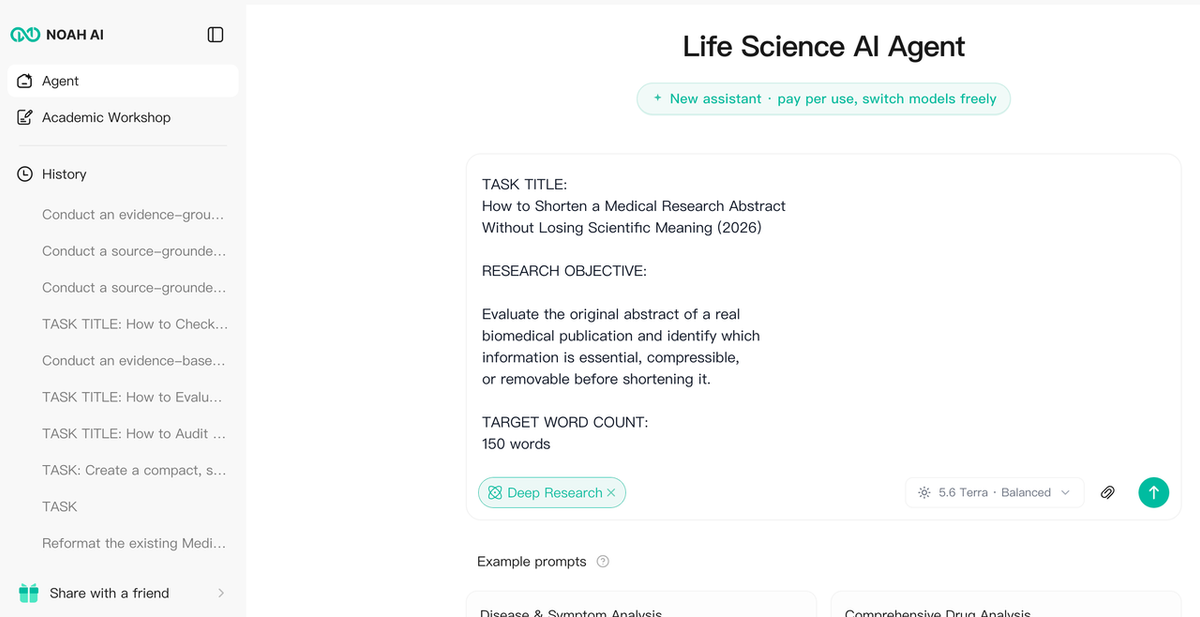
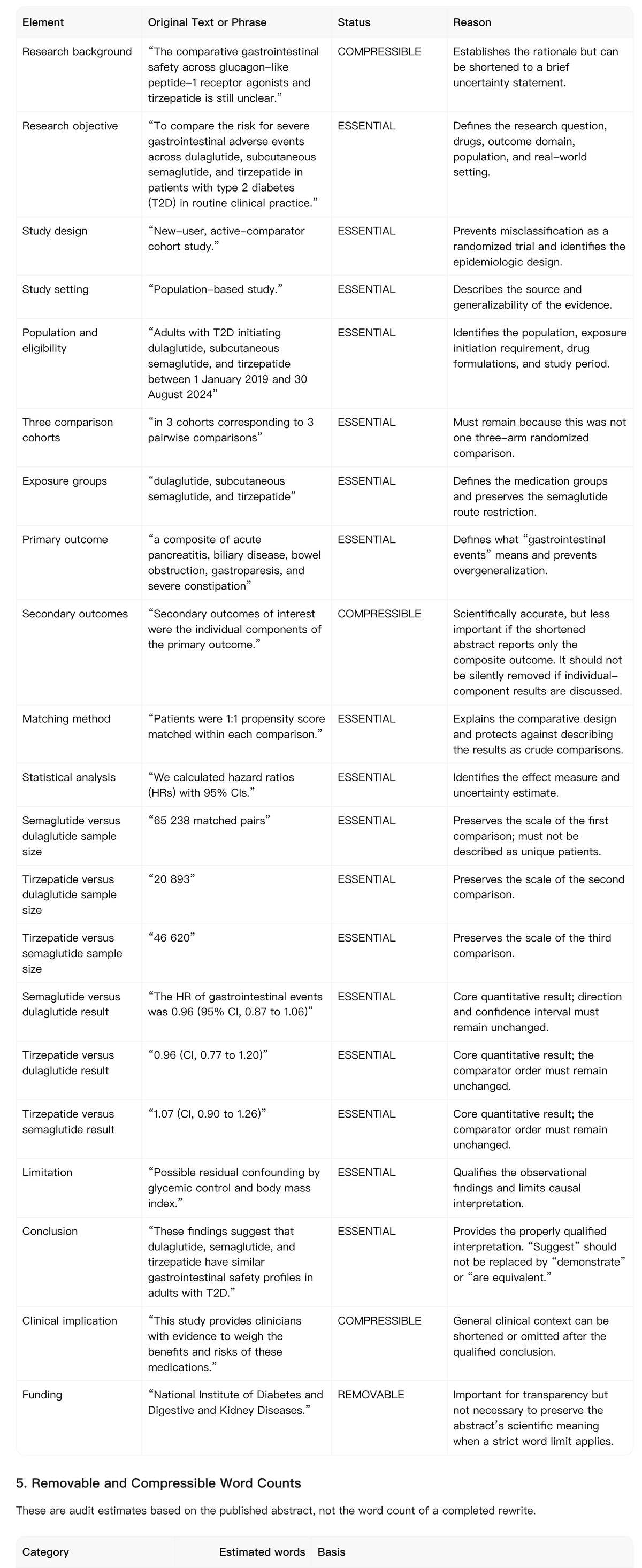
Review this medical research abstract without rewriting it yet. Return a table with: Element | Original text or phrase | Status (Essential / Compressible / Removable) | Reason. Preserve study design, population, matched sample sizes, outcome definitions, all key numerical results, confidence intervals, and uncertainty. Identify genuinely redundant material, then estimate how much wording can be removed or compressed. State what must be checked against the full paper. [Paste the original abstract and DOI.]For this case, the supplied Noah output classified the research objective, observational design, population, pairwise matched samples, primary outcome, statistical findings, limitation, and qualified conclusion as essential. The longer background and some contextual language were marked compressible. A funding line was classified as removable from the shortened narrative.Funding disclosure caveat: Removing a funding sentence from the abstract does not mean deleting funding information from the manuscript. The journal's submission rules and required disclosure fields still govern where that information appears.
Step 2: Trim the abstract while preserving all load-bearing results
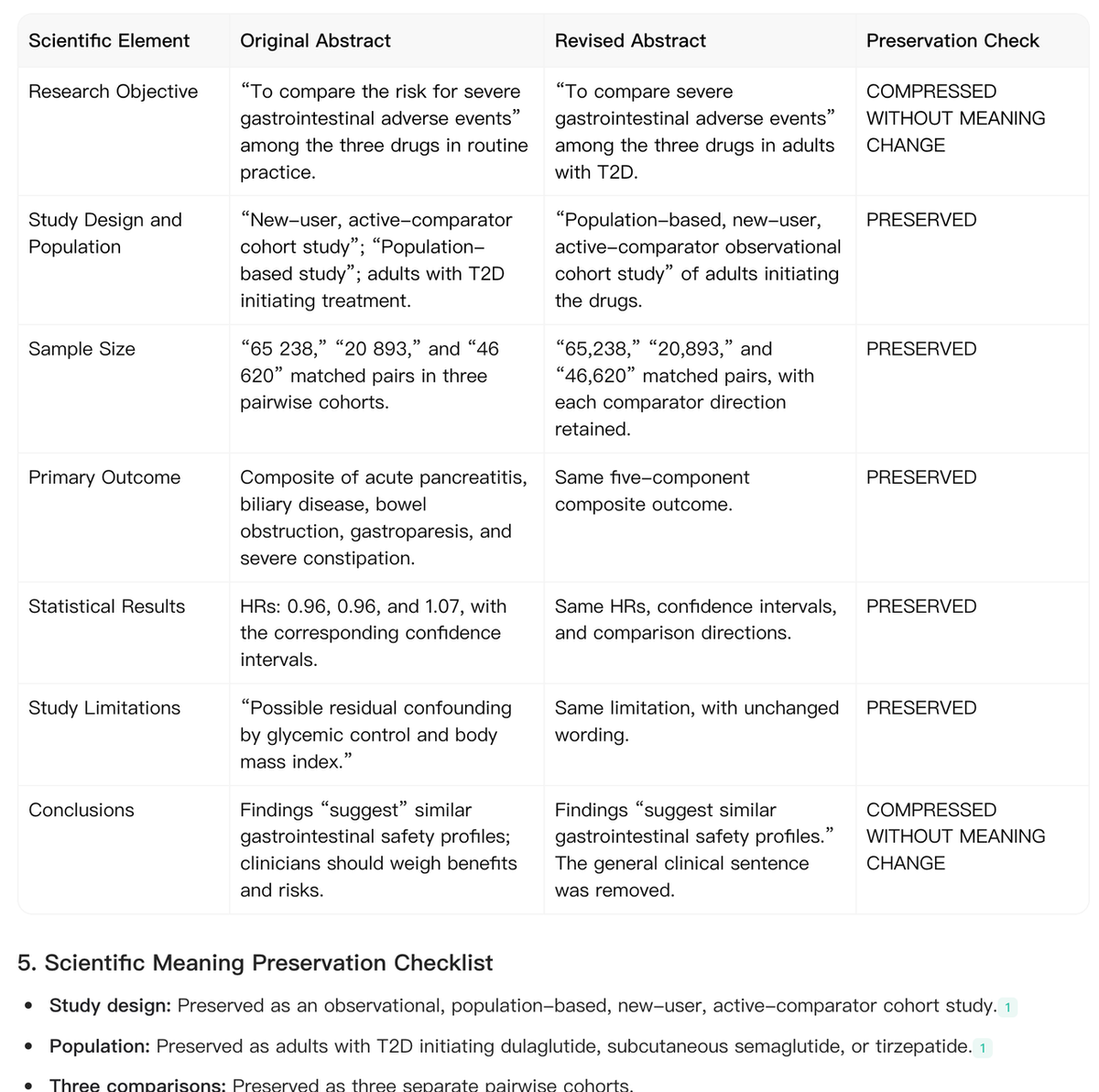
Continue in the same Noah conversation so that the second instruction can reference the complete source abstract and Step 1 audit. Ask for a target count, an explicit before/after checklist, and a realistic minimum if the requested limit would require deleting scientifically necessary information.Use the original abstract and the previous content audit to create a version targeting 150 words. First report the original word count and the planned cuts. Remove redundant material and compress background and methods, but do not change study design, matched comparison directions, sample sizes, primary outcome components, hazard ratios, 95% confidence intervals, residual-confounding limitation, or conclusion strength. If 150 words is unsafe, report the shortest defensible version instead. Return the revised abstract, verified word count, a seven-row before/after comparison table, and a brief change log.Do not assume that every element can be preserved merely because a model says "PRESERVED." Check the final prose directly, particularly comparator order and numerical results. A rewritten sentence can sound plausible while describing a different calculation.
Example of a 150-Word Medical Abstract
The paragraph below is a separately prepared editorial demonstration based on the published study—not a verbatim transcript of Noah's final edited abstract. The provided screenshots show the audit and comparison tables but do not show the full final Noah-generated abstract or its independently checked word count.Objective: To compare severe gastrointestinal adverse events among adults with type 2 diabetes initiating dulaglutide, subcutaneous semaglutide, or tirzepatide in routine care. Methods: A population-based, new-user, active-comparator cohort study used three separate propensity-score-matched comparisons. Participants initiated treatment between January 2019 and August 2024. Outcomes were compared using hazard ratios with 95% confidence intervals following 1:1 propensity-score matching within each cohort. The composite outcome comprised acute pancreatitis, biliary disease, bowel obstruction, gastroparesis, and severe constipation. Results: Semaglutide versus dulaglutide included 65,238 matched pairs (hazard ratio [HR], 0.96; 95% confidence interval [CI], 0.87–1.06). Tirzepatide versus dulaglutide included 20,893 pairs (HR, 0.96; 95% CI, 0.77–1.20); tirzepatide versus semaglutide included 46,620 pairs (HR, 1.07; 95% CI, 0.90–1.26). Limitations: Residual confounding by glycemic control and body mass index may remain. Conclusions: Findings suggest similar severe gastrointestinal safety profiles among these medications in adults with type 2 diabetes. The observational design precludes causal or equivalence claims.Editorial example: 150 words using whitespace-separated word counting, including section labels. Different journal submission systems may count hyphenated terms or symbols differently; verify against the target journal's own counter.
Common Mistakes When AI Shortens Clinical Abstracts
- Changing association into causation. Observational comparisons do not, by themselves, demonstrate that a drug caused an outcome.
- Confusing statistical nonsignificance with equivalence. Confidence intervals crossing 1 do not prove identical safety profiles or establish a predefined equivalence margin.
- Mixing comparator directions. A hazard ratio belongs to a specific exposed-versus-reference comparison.
- Adding matched pairs into a unique-patient total. Separate pairwise cohorts may overlap, so simple addition is misleading.
- Removing the outcome definition. This study evaluated a severe-event composite, not every possible gastrointestinal adverse effect.
- Hiding important limitations. Residual confounding remains relevant even when a sentence must be shortened.
- Forcing the count. If the essential evidence cannot fit, report the minimum defensible length and seek journal-specific editing guidance.
Final Checklist Before Submitting a Shortened Abstract
- Confirm the journal's current word limit, structured headings, and counting rules.
- Compare the edited version line by line with the source manuscript.
- Check population, study period, design, and all intervention/comparator names.
- Verify every sample size, effect estimate, confidence interval, and unit.
- Keep the primary endpoint definition and clinically relevant uncertainty.
- Ensure conclusions do not exceed what the methods and results support.
- Confirm funding and disclosure information appears in the correct journal-required location.
- Have a qualified author or reviewer approve the final wording.
Frequently Asked Questions
Can AI shorten a medical abstract to exactly 150 words?
It can draft a version for that limit, but the target is not always achievable without loss of key information. Count words using the intended journal's rules and prioritize factual accuracy over a forced number.
Should every number from the original abstract remain?
Not necessarily. Prioritize prespecified outcomes, main results, comparison direction, and estimates needed to interpret uncertainty. In this case, three HRs and their corresponding CIs are central to understanding the result.
Does a preservation table prove that the abstract is accurate?
No. A table records an AI-assisted comparison. Independent review of the complete revised text and original publication is still necessary.
Can the same workflow be used for trials and systematic reviews?
Yes, with design-specific safeguards. Randomized trials require attention to allocation, trial registration, prespecified outcomes, and harms; systematic reviews require attention to eligibility, included studies, synthesis methods, and certainty. Use the applicable reporting guidance rather than reusing a cohort-study checklist unchanged.
Conclusion: Cut Words, Not Scientific Meaning
The safest approach to abstract shortening is to review scientific content before rewriting. Noah AI can help structure an audit, prepare a shorter candidate, and organize a before/after comparison. The final responsibility remains with the researcher: confirm that the new version reports the same study, results, and limitations as the original.
Review Your Medical Research Abstract with Noah AI
Explore source-grounded biomedical research workflows, organize the information your abstract must preserve, and review a concise draft against the underlying evidence.Try Noah AI for FreeCheck the current signup page for applicable free credits and usage terms. AI-assisted editing does not replace author review.
References
- Crisafulli S, et al. Comparative gastrointestinal safety of dulaglutide, semaglutide, and tirzepatide in adults with type 2 diabetes. Annals of Internal Medicine. Online November 4, 2025; January 2026 issue. DOI: 10.7326/ANNALS-25-01724. Open full text.
- International Committee of Medical Journal Editors. Preparing a Manuscript for Submission to a Medical Journal. Abstract reporting recommendations.
- STROBE Initiative. Strengthening the Reporting of Observational Studies in Epidemiology.