Severe Asthma Indication Strategy Report 2026: TSLP Biology, Clinical Competition and Development Strategy
Linda
A 2026 severe asthma strategy report covering TSLP biology, unmet need, clinical validation, biologic competition, biomarker segmentation, and development strategy.
Severe asthma remains an attractive development indication, but the strategic question has changed. The issue is no longer whether biologic therapy can work. It is whether a new entrant can improve outcomes in patients who remain uncontrolled despite current biologics, reduce oral corticosteroid burden, reach harder-to-classify phenotypes, or offer a meaningfully better treatment experience.Portfolio recommendation: PRIORITIZE WITH DIFFERENTIATION. A me-too q4w systemic anti-TSLP program is unlikely to be compelling. A credible new program needs a pre-specified advantage in efficacy, patient segment, biomarker strategy, route, dosing interval, or combination biology.
Executive Indication Thesis
TSLP is now a clinically validated upstream target in severe asthma. Tezepelumab established that blocking this epithelial alarmin can reduce exacerbations across a broader biomarker spectrum than therapies restricted to eosinophilic or allergic disease. That is strategically important, but it also raises the competitive bar for any new TSLP-directed program.The remaining opportunity is concentrated in residual disease: patients who continue to exacerbate after biologic treatment, patients dependent on oral corticosteroids, patients with mixed or intermediate biomarker profiles, and patients whose structural airway disease or fixed obstruction remains insufficiently addressed.
Disease Background and Unmet Need
Development-relevant severe asthma is not simply asthma with severe symptoms. It is disease that requires high-intensity controller therapy to maintain control or remains uncontrolled despite optimized treatment, adherence review, inhaler technique correction, and management of modifiable factors.The highest-value unmet-need segments in 2026 include:
- patients with persistent exacerbations despite biologic therapy;
- patients requiring maintenance or frequent rescue oral corticosteroids;
- patients with low or intermediate eosinophils and FeNO who do not fit a clean type 2-high profile;
- patients with persistent symptoms, mucus plugging, small-airway dysfunction, or fixed obstruction despite inflammatory control;
- patients facing high treatment burden from injection frequency, access requirements, or switching complexity.
Epidemiology and Addressable Population
Global asthma prevalence is commonly estimated in the hundreds of millions, but only a minority of patients have severe disease. Published estimates commonly place severe asthma at roughly 3.6% to 10% of the overall asthma population depending on definition, geography, and ascertainment method.The treatment-addressable population is smaller still. It is shaped by uncontrolled disease, exacerbation history, biomarker profile, prior therapy, payer rules, specialist access, and local biologic eligibility criteria. For indication strategy, total asthma prevalence should therefore never be treated as the commercial or clinical addressable population.A meaningful opportunity remains because many biologic-eligible patients are untreated, while a separate group receives biologic therapy but remains inadequately controlled. These two populations require different development and access strategies.
TSLP Biology and Translational Rationale
TSLP is an epithelial-derived alarmin released in response to airway injury and environmental triggers including allergens, viruses, pollutants, and inflammatory stress. It acts upstream of several immune programs and signals through a receptor complex containing TSLPR and IL-7Rα.Strategically, upstream blockade matters because TSLP can influence dendritic cells, ILC2s, mast cells, T cells, eosinophils, and broader airway inflammatory networks. This helps explain why TSLP inhibition may retain activity across overlapping allergic, eosinophilic, and lower-biomarker phenotypes rather than being restricted to one downstream pathway.That does not mean upstream is automatically superior. TSLP dependence is heterogeneous, direct patient-selection biomarkers remain immature, and lower blood eosinophils or FeNO do not define one unified TSLP-responsive disease state.
Clinical Validation of TSLP
The strongest clinical evidence comes from tezepelumab. Randomized studies support substantial exacerbation reduction and improvements in lung function and asthma control across clinically relevant subgroups. Mechanistic studies also support effects on airway eosinophils, mucus plugging, and airway hyperresponsiveness.Clinical validation is not equally strong across every claim. Exacerbation reduction is well validated. Oral corticosteroid sparing is more mixed, with the randomized SOURCE trial failing its primary OCS-sparing endpoint overall, while later supportive studies provide additional but less definitive evidence. Reversal of established airway remodeling remains unproven.
Severe Asthma Competitive Landscape 2026
The market is crowded across established biologic mechanisms. TSLP already occupies the broadest upstream-label position, while IL-4Rα, IL-5, IL-5Rα, and IgE therapies retain strong positions in defined phenotypes. The strategic question is not whether there are competitors, but where clinically meaningful whitespace remains.
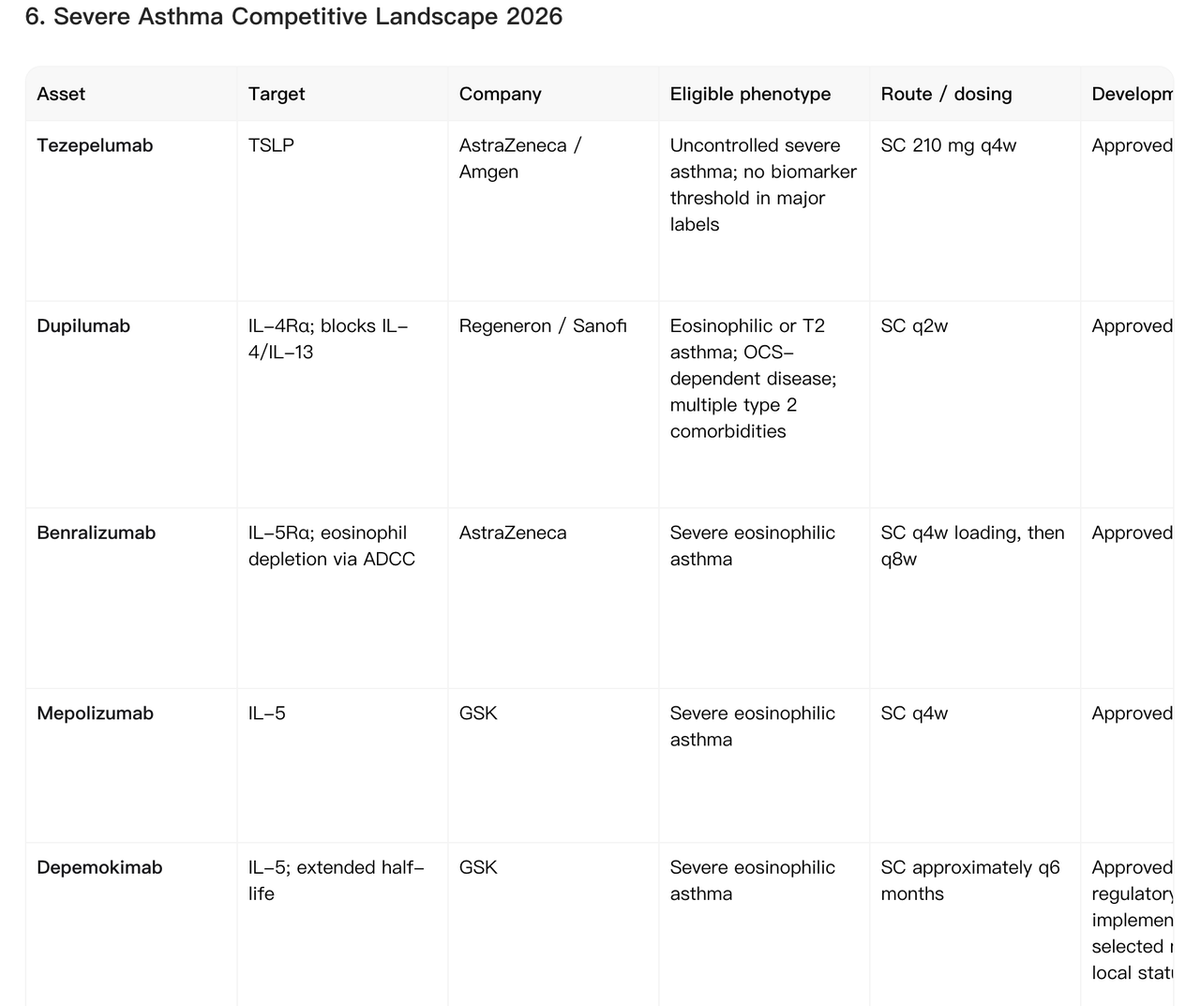
Broad phenotype coverage alone is no longer enough to differentiate a new TSLP program. More defensible whitespace includes superior efficacy after prior biologic failure, stronger OCS-sparing evidence, lower treatment burden, inhaled delivery, longer dosing intervals, or dual and multi-specific approaches that demonstrate additive clinical value.
Biomarker and Patient-Segmentation Strategy
No single biomarker currently identifies TSLP dependence with sufficient precision for routine companion-diagnostic use. Blood eosinophils and FeNO remain the most useful practical stratification variables, but they are not TSLP-specific.A stronger development strategy would combine:
- blood eosinophils and FeNO;
- IgE and allergic status;
- exacerbation history;
- oral corticosteroid dependence;
- prior biologic target and response;
- airway-function and structural-disease measures where feasible;
- exploratory airway or epithelial TSLP-response signatures.
The most credible initial population is a broad severe-asthma cohort enriched for clinical risk, not an unselected all-comer population and not a low-eosinophil-only population defined by a single blood threshold.
Strategic Partnering and Transaction Signals
Publicly verifiable transaction evidence specifically tied to severe-asthma TSLP programs is limited. The historical Amgen and AstraZeneca development collaboration around tezepelumab demonstrates that the biology was considered strategically valuable before pivotal validation, but it should not be used as a direct valuation precedent for a new 2026 asset.For a new entrant, partnerability should come from differentiated human data rather than from target novelty alone. The strongest partnering package would include a clinically meaningful residual-disease segment, credible biomarker logic, convenient delivery, and a clear path to active-comparator differentiation.
Indication Strategy Assessment
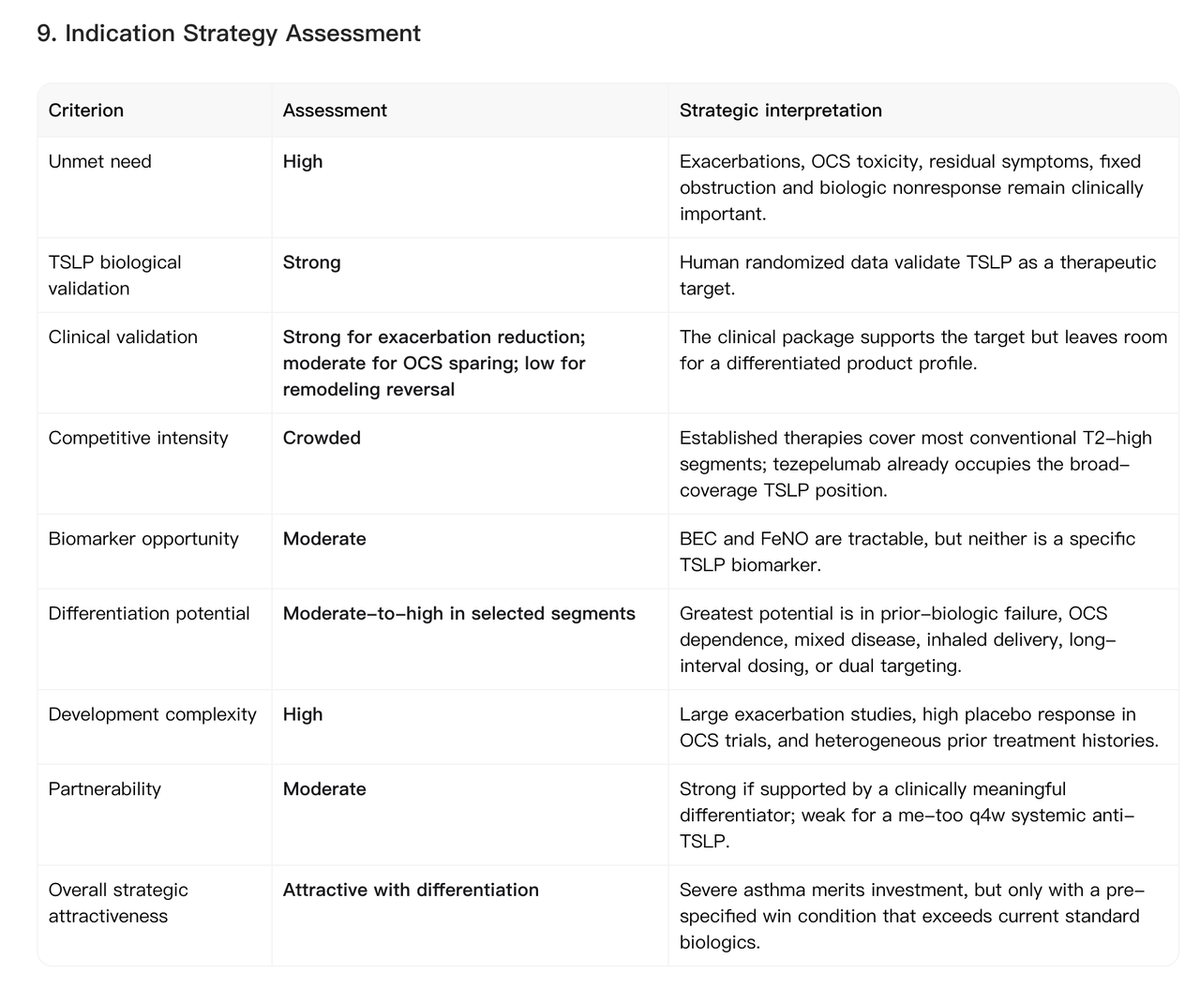
The overall conclusion is straightforward: severe asthma remains attractive, but only selectively. The unmet need and biological validation are strong, while competition and development complexity are also high. This favors programs with a sharply defined win condition rather than broad me-too development.
- Recommended Development Strategy
Target product profile
A new entrant should aim for add-on maintenance treatment in adults with severe uncontrolled asthma and should seek evidence in both biologic-naïve and biologic-experienced populations.The most strategically valuable profile would combine meaningful exacerbation reduction with one or more of the following:
- robust OCS reduction;
- benefit after prior biologic inadequacy;
- q8–12 week or longer dosing;
- inhaled or lung-directed delivery with acceptable device burden;
- clear benefit in biomarker-intermediate or mixed disease;
- improvement in structural or functional residual disease.
Comparator strategy
Placebo-controlled development may establish regulatory efficacy, but it will not establish commercial superiority. Depending on the differentiation thesis, active benchmarking against tezepelumab, dupilumab, benralizumab, or a long-interval eosinophil-directed biologic may ultimately be necessary.
Endpoint strategy
The core endpoint should remain annualized severe asthma exacerbation rate over an adequately long period. Important secondary endpoints include hospitalization or emergency treatment, OCS use, complete OCS discontinuation, lung function, asthma control, quality of life, rescue medication, healthcare utilization, and patient-reported treatment burden.
- Key Risks and Kill Criteria
A program should be stopped or redirected if it fails to demonstrate a real advantage over existing biologics. Important kill criteria include:
- no consistent exacerbation benefit in an enriched high-risk population;
- no meaningful OCS-sparing advantage in a properly controlled study;
- no evidence of benefit after prior biologic inadequacy when that is the differentiation thesis;
- no separation from tezepelumab or another relevant comparator on the main clinical objective;
- target engagement without clinically meaningful translation;
- no route or dosing advantage relative to current biologics;
- safety, immunogenicity, or infection signals that erode the value of upstream blockade;
- an impractical biomarker or patient-selection strategy.
- Bottom Line
Severe asthma remains a legitimate development opportunity in 2026 because residual exacerbations, OCS toxicity, biologic nonresponse, access gaps, and persistent structural disease remain clinically important. TSLP is one of the better validated upstream targets in respiratory medicine, but that validation has already converted into strong competition.The winning strategy is therefore not simply to build another anti-TSLP therapy. A new program needs a defined advantage in OCS sparing, prior-biologic failure, biomarker-intermediate or mixed disease, route, dosing durability, or combination biology.Portfolio decision: PRIORITIZE WITH DIFFERENTIATION.
Use Noah for Indication and Competitive Intelligence
Use Noah AI to compare disease biology, clinical evidence, competing programs, biomarkers, and development strategy in one structured research workflow.Free to use · Free credits included · No credit card requiredResearch Indications and Competitive Landscapes with Noah AI →