The RAS Revolution in Pancreatic Cancer 2026: Targeted Therapy, Combination Strategies and Prevention
Linda
A 2026 review of RAS-targeted therapy in pancreatic cancer covering daraxonrasib, KRAS G12D and G12V strategies, phase 3 outcomes, combination therapy, synthetic lethality, and cancer interception.
Pancreatic cancer is moving from a chemotherapy-dominant disease toward a molecularly stratified treatment landscape. The central shift is no longer whether RAS can be drugged, but how broadly, how selectively, and how durably its signalling can be suppressed.
From the Editor
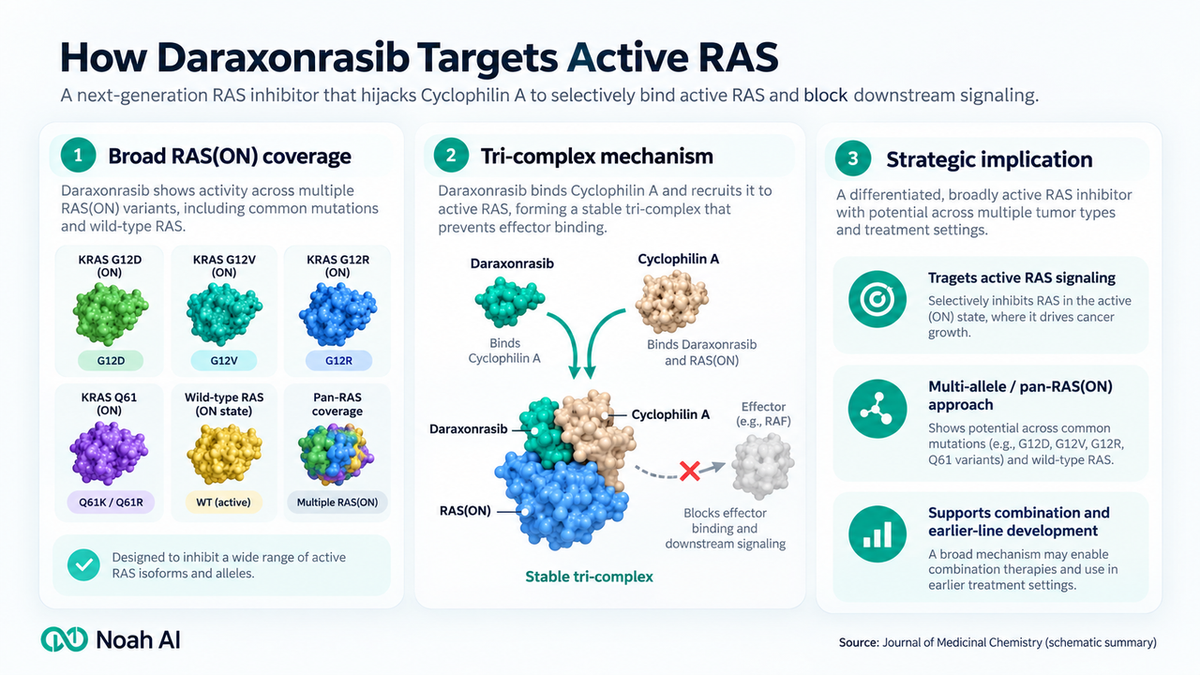
Pancreatic ductal adenocarcinoma has long exposed the limits of precision oncology. KRAS mutations occur in the large majority of PDAC, but the dominant alleles in pancreatic cancer are not the same ones that first made direct KRAS inhibition possible.KRAS G12C proved that direct RAS inhibition could work, but G12C represents only a small fraction of pancreatic cancers. The more consequential question for PDAC was whether the active RAS state could be targeted across the G12D, G12V and G12R alleles that account for much of the disease.That is where the RAS(ON) strategy changed the field. Daraxonrasib, a multi-selective active-state RAS inhibitor, uses a Cyclophilin A–drug–RAS tri-complex to block effector engagement rather than competing with GTP or relying on a single mutation-specific covalent handle.
The RAS Breakthrough
RAS cycles between an inactive GDP-bound state, RAS(OFF), and an active GTP-bound state, RAS(ON). The first generation of direct KRAS drugs exploited the inactive state, most notably in KRAS G12C. That approach was an important proof of principle, but it is limited by allele coverage and by the biology of tumours that maintain a large fraction of RAS in the active state.Daraxonrasib approaches the problem differently. The drug first binds Cyclophilin A, creating a composite recognition surface that can engage active RAS. The resulting ternary complex occupies the RAS switch region and prevents downstream effector interactions such as RAS–RAF binding.
Why active-state multi-selectivity matters in PDAC
The mutation distribution in pancreatic cancer makes breadth strategically important. G12D, G12V and G12R account for most common KRAS-mutant PDAC, while G12C is uncommon. A multi-selective RAS(ON) strategy can therefore address a substantially larger fraction of the disease than a G12C-only platform.That breadth does not eliminate resistance. KRAS amplification, MAPK reactivation, receptor-tyrosine-kinase signalling and PI3K-pathway escape can all restore pathway output. The key advance is that active RAS has become pharmacologically accessible; the next challenge is making suppression durable.
Clinical Proof of the Breakthrough
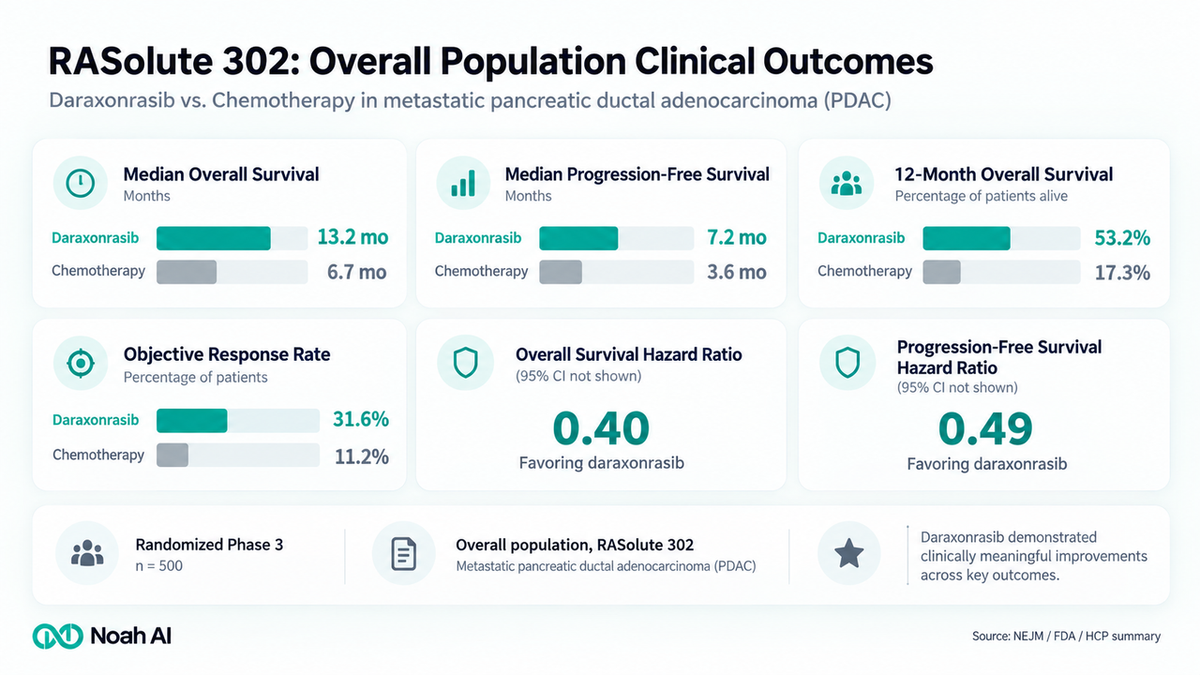
The clinical case for daraxonrasib progressed from early single-arm activity to randomized phase 3 evidence. In the RASolute 302 study of previously treated metastatic PDAC, daraxonrasib produced a substantial survival advantage over physician-choice chemotherapy.In the overall population, median overall survival was 13.2 months with daraxonrasib versus 6.7 months with chemotherapy. Median progression-free survival was 7.2 versus 3.6 months, and the reported objective response rate was 31.6% versus 11.2%. The RAS G12 population showed a similar direction and magnitude of benefit.Safety remained clinically relevant, but randomized evidence suggested fewer treatment discontinuations than with chemotherapy. Patient-reported outcomes also pointed toward longer preservation of pain control and global health status.
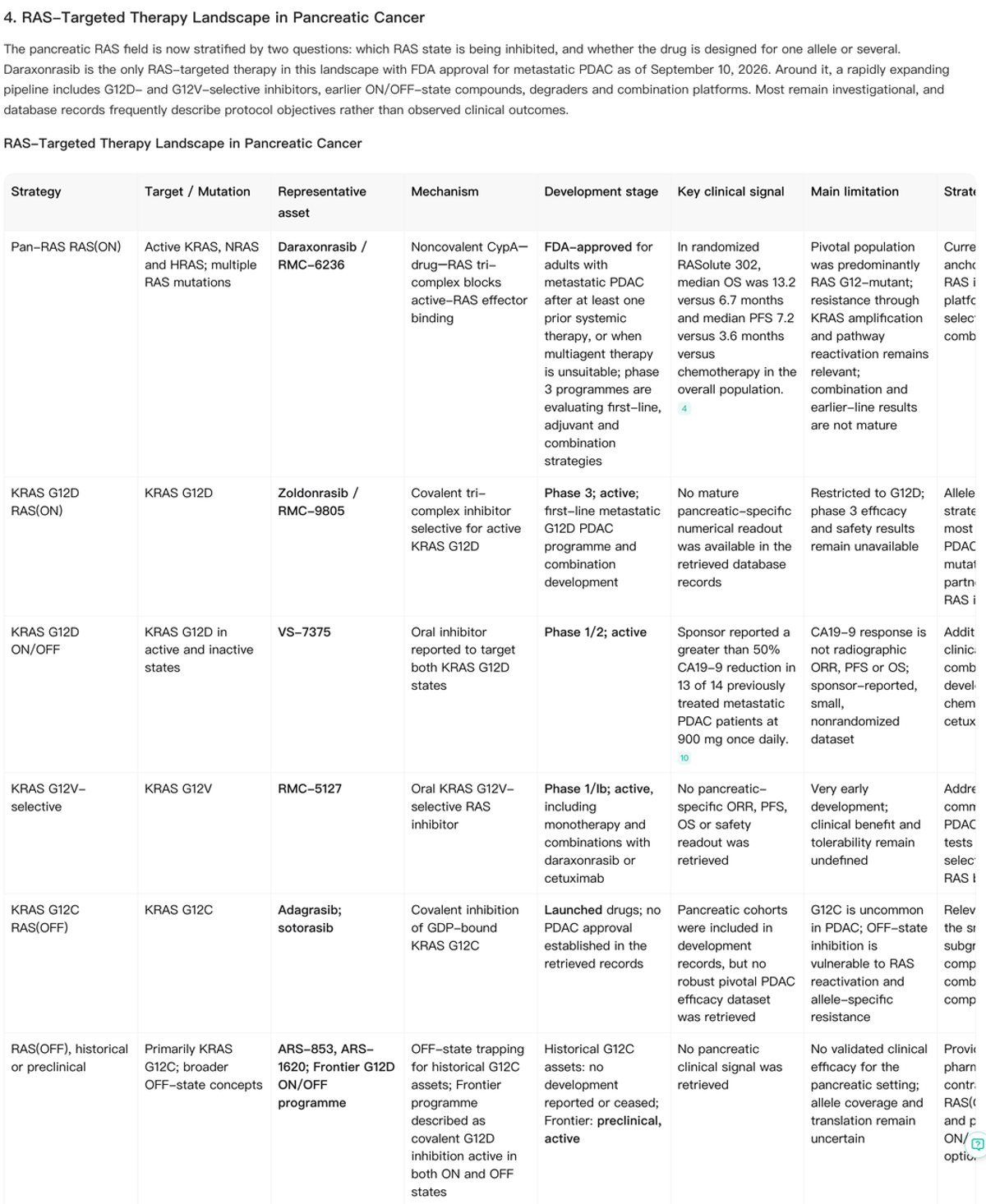
RAS-Targeted Therapy Landscape in Pancreatic Cancer
The field is now stratified by two questions: which RAS state is being inhibited, and whether the drug is designed for one allele or several. Daraxonrasib currently provides the broad clinical anchor, while mutation-selective programs are pushing deeper into G12D and G12V biology.
G12D: the largest selective opportunity
KRAS G12D is the most common reported allele in PDAC and therefore the clearest case for a mutation-selective development strategy. Zoldonrasib has moved into phase 3 development, while other G12D programs are exploring active-state, dual-state and combination approaches.The central trade-off is precision versus coverage. A selective inhibitor may better spare wild-type RAS and improve the therapeutic window, but it addresses a narrower population and may be vulnerable to allele-specific resistance or alternative RAS signalling.
G12V and G12R: clinically important, less mature
G12V is common in PDAC but remains less clinically developed than G12D. RMC-5127 represents an allele-selective G12V strategy, while broad RAS(ON) inhibition currently provides the most advanced clinical coverage. G12R is biologically distinctive, with altered effector wiring that may influence combination strategy and pathway dependence.
G12C: proof of principle, limited pancreatic reach
Adagrasib and sotorasib demonstrated that direct mutant KRAS inhibition could become clinically viable, but G12C is uncommon in pancreatic cancer. Their biggest contribution to PDAC may therefore be conceptual: they proved that a previously undruggable oncogene could be targeted directly, while also revealing the limits of relying on a single conformational state.
Combination Therapy With Multiple RAS Inhibitors
The next development question is not simply whether to inhibit RAS, but how to prevent pathway recovery after initial suppression. One strategy is layered blockade: use a broad active-state inhibitor to suppress multiple RAS proteins and add an allele-selective drug to deepen pressure on the dominant oncogenic clone.Daraxonrasib plus zoldonrasib is the clearest example of this logic for G12D disease. A similar approach is being explored for G12V. These combinations are scientifically attractive because they engage overlapping biology through different recognition strategies, but they should still be regarded as resistance-management hypotheses until mature efficacy and safety data are available.
Synthetic Lethality Beyond RAS
RAS is not the only exploitable dependency in PDAC. MTAP deletion creates a second, biomarker-defined vulnerability through altered MTA metabolism and partial suppression of PRMT5 activity. MTA-cooperative PRMT5 inhibitors are designed to exploit this metabolic state more selectively than earlier systemic PRMT5 inhibitors.The combination rationale is especially interesting in tumours carrying both MTAP loss and an activating KRAS mutation. RAS inhibition and PRMT5 inhibition attack biologically distinct dependencies, creating a dual-biomarker strategy that may be more selective than either pathway alone.Clinical evidence remains early. Programs such as AMG 193, MRTX1719 and TNG462 have generated encouraging signals across MTAP-deleted cancers, but pancreatic-specific response durability and combination benefit remain immature. The major question is whether the biology can be translated without creating an unacceptable haematologic or gastrointestinal toxicity burden.
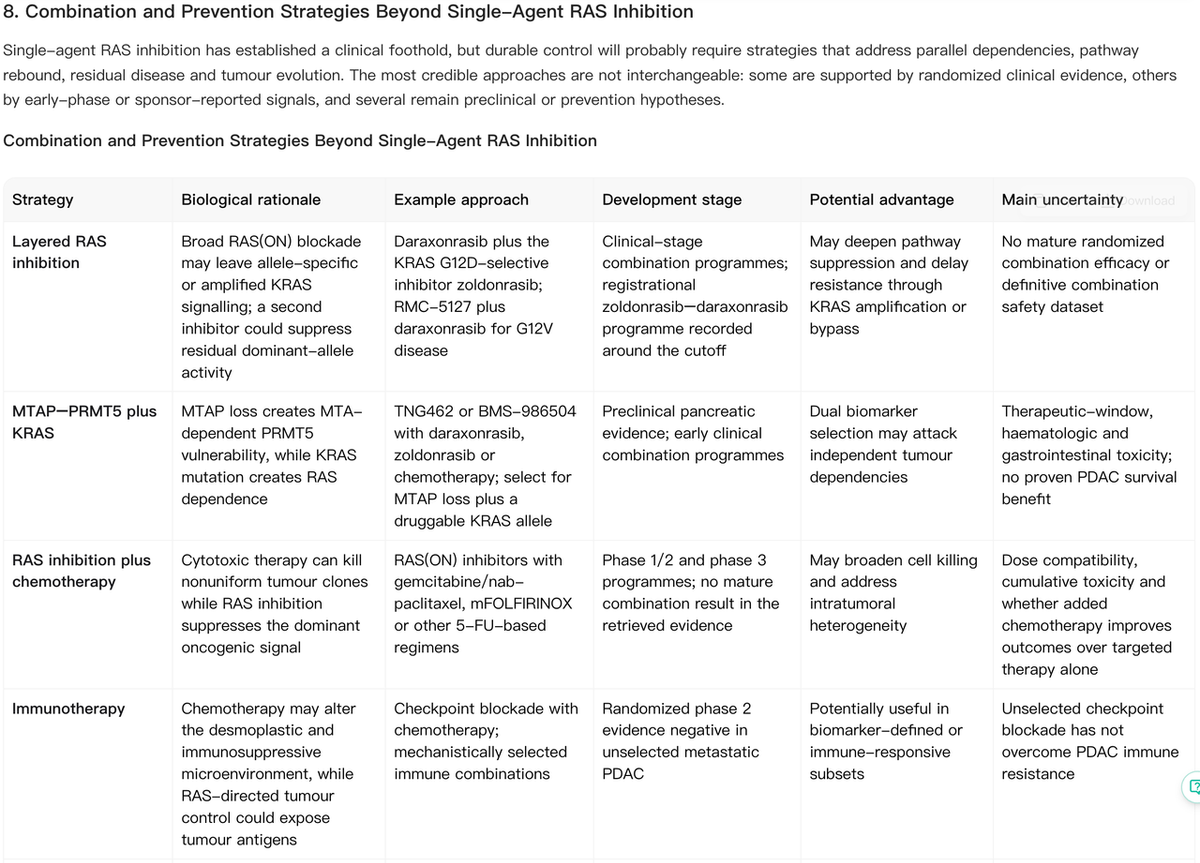
Combination and Prevention Strategies Beyond Single-Agent RAS Inhibition
The broader strategy space now includes layered RAS inhibition, PRMT5 combinations, chemotherapy, selected immune approaches and cancer interception. These approaches should not be treated as equivalent: some have randomized clinical support, others are in early development, and several remain prevention hypotheses.
Immunotherapy still requires selection
Checkpoint blockade has not overcome the immunosuppressive biology of unselected metastatic PDAC. The implication for future RAS combinations is not that immune therapy is irrelevant, but that immune combinations require a mechanistic or biomarker-defined rationale rather than empirical addition.
Mutant-RAS vaccines: interception, not yet prevention
Mutant-KRAS vaccines have produced strong T-cell responses in postoperative molecular-residual-disease and high-risk interception settings. But immunogenicity is not the same as prevention. Small single-arm studies and subgroup signals cannot establish that vaccination reduces the incidence of invasive pancreatic cancer.The more rigorous test is whether immune responses translate into prospectively defined disease-free or cancer-incidence endpoints. That evidence remains incomplete.
The Future: Pancreatic Cancer Interception
Pancreatic precursor lesions can evolve over years, creating a potential window for interception before invasive disease emerges. But KRAS mutation alone is not destiny. Risk depends on lesion type, grade, clonality, additional genomic events, inherited predisposition and clinical context.The future of interception will therefore require three things at once: better detection of biologically consequential precursor lesions, more accurate separation of high-risk from low-risk disease, and interventions capable of changing the natural history of progression.KRAS vaccination, cfDNA surveillance and imaging may eventually work together across a continuum from hereditary high-risk surveillance to postoperative molecular residual disease. As of 2026, however, the strongest evidence remains immunological feasibility rather than proven primary prevention.
Conclusions
Pancreatic cancer is beginning to move beyond a chemotherapy-dominant model. The most important established advance is broad RAS(ON) inhibition with daraxonrasib, supported by randomized phase 3 evidence and regulatory approval in previously treated metastatic disease.The next wave is more heterogeneous: G12D- and G12V-selective inhibitors, layered RAS combinations, degraders, MTAP–PRMT5 synthetic lethality, and mutant-RAS vaccines. Their strategic value will depend on whether they can add durability, selectivity or earlier intervention without sacrificing the therapeutic window.
The RAS revolution is no longer about proving that RAS can be drugged. It is about deciding which RAS state, which allele, which combination, and which disease stage should be targeted next.Related Research Guides
- Best AI Tools for Clinical Trial Results Analysis (2026)
- Analyze Clinical Trial Results With AI
- Drug Pipeline, Clinical Trial and Market Signals
Run Deeper Pancreatic Cancer Research with Noah AI
Use Noah AI to compare RAS mechanisms, clinical programs, trial outcomes, resistance pathways, and combination strategies across the biomedical evidence base.Free to use · Free credits included · No credit card requiredResearch Pancreatic Cancer with Noah AI →