How to Preregister a Medical Meta-analysis with AI (2026)
Linda
Learn how to plan a medical meta-analysis preregistration with AI, identify fixed and conditional methods, and document protocol amendments using a real Long COVID case.
A well-designed meta-analysis protocol makes critical decisions visible before results can influence them. But preregistration does not mean every operational detail must stay unchanged. This guide explains how to distinguish advance commitments from justified conditional choices, using a published Long COVID living network meta-analysis protocol and a real Noah AI research audit.Key takeaways
- Prespecify the research question, eligibility rules, outcomes, search strategy, and synthesis methods before assessing the findings whenever possible.
- Build conditional rules into the protocol for predictable challenges, such as disconnected evidence networks or newly emerging trials.
- Record substantive deviations with their timing, rationale, version history, and whether outcome results had already been observed.
- Use Noah AI to organize and inspect the documented plan; human researchers retain responsibility for methodological choices and any registry submission.
Why Preregister a Medical Meta-analysis?
Systematic reviews and meta-analyses combine evidence from multiple studies. Their conclusions can change substantially when researchers alter eligibility criteria, switch primary outcomes, combine incompatible populations, or choose statistical analyses after looking at results. A protocol creates a record of intended decisions so those changes can be recognized and explained.The PRISMA-P guidance addresses what a systematic review protocol should report, including objectives, eligibility, information sources, planned synthesis, registration details where applicable, and amendments. The Cochrane Handbook provides further methodological guidance for planning and conducting reviews. Neither checklist completion nor a journal protocol article automatically creates a preregistration record.Preregistration chiefly strengthens transparency. It does not guarantee that a search will find every study, that the analysis will be unbiased, or that the eventual conclusions will be valid. Its value lies in making the intended design and later deviations open to scrutiny.
Key Challenges in Planning a Meta-analysis
Medical evidence rarely arrives in a perfectly comparable format. Randomized trials may use different interventions, doses, diagnostic criteria, follow-up periods, and outcome instruments. Some planned comparisons will have too little evidence, while others may be connected only through indirect comparisons.
- Clinical heterogeneity: different patients or intervention classes may make a single pooled answer inappropriate.
- Outcome inconsistency: similar concepts may be measured with different scales or time points.
- Network feasibility: a connected network meta-analysis may not be possible for every prespecified outcome.
- New evidence: living reviews must account for emerging trials, new terminology, and clinically important changes.
- Missing information: incomplete reporting can require follow-up requests or sensitivity analyses.
The solution is not to leave everything open. Instead, the protocol should state the default method, identify reasonable exceptions in advance, and establish how unexpected decisions will be documented.
What to Lock In and What to Leave Conditional
| Protocol component | Advance commitment | Legitimate conditional rule |
|---|---|---|
| Review objective and population | Define the clinical question and eligibility. | New scope requires an explicit amendment rather than silent expansion. |
| Outcomes | Specify important outcome domains and measurement choices. | Additional outcomes should be dated, justified, and identified as added or exploratory. |
| Searches | Prespecify databases, key concepts, and update frequency. | Record new sources or terminology when the literature changes. |
| Statistical synthesis | Specify the main model, effect measures, and assessment methods. | Apply a prespecified fallback if a planned network cannot be constructed. |
| Subgroups and sensitivity analyses | Define hypotheses and triggers in advance. | New result-informed analyses must be labeled post hoc and interpreted cautiously. |
These are protocol-design principles, not a universal list of rules automatically accepted by every registration service.
How Noah AI Supports Protocol Review
In this workflow, Noah AI was asked to examine the published protocol, extract the prespecified research design, distinguish fixed commitments from conditional decisions, and produce a concise decision table. The research prompt emphasized source-grounded findings and explicitly prohibited invented trial results, amendments, registration numbers, or completed submissions.

The useful distinction is between what a paper states, what a public record independently confirms, and what researchers still need to decide. A generated table is an aid to checking the protocol, not proof that a prospective registration or an updated analysis has been completed.
How to Use Noah AI for a Medical Meta-analysis Protocol
A five-step review workflow
- Supply a real protocol. Provide its exact title, DOI, full-text URL, and a focused question about planned methods. Use the protocol rather than a later results paper as the source for original commitments.
- Extract prespecified design details. Ask for population, eligible study types, outcomes, searches, screening, data extraction, risk-of-bias methods, and statistical approaches, with corresponding source sections.
- Classify each commitment. Separate fixed rules from prespecified conditional decisions. Have the model explain the trigger behind every conditional choice.
- Identify amendment requirements. For any proposed change, record the original rule, proposed change, rationale, decision date, knowledge of results, and required approval or public update.
- Review and register appropriately. Researchers check the extraction, finalize their own protocol, then use the relevant registry or repository. Noah's report does not submit or approve a registration.
Real Case Study: A Living Network Meta-analysis for Long COVID
The worked example is Interventions for the management of post-COVID-19 condition (long COVID): protocol for a living systematic review and network meta-analysis, by Zeraatkar and colleagues, published in BMJ Open on 7 February 2025 (15:e086407; DOI 10.1136/bmjopen-2024-086407).The protocol describes a living review of pharmacological and non-pharmacological interventions for adults with Long COVID. It plans to include randomized trials, exclude pseudorandomized trials and trials with fewer than 25 participants per arm, and assess patient-important outcomes such as fatigue, pain, postexertional malaise, cognitive function, dyspnoea, physical function, quality of life, and serious adverse events.Its search plan covers MEDLINE, Embase, CINAHL, PsycINFO, AMED, and CENTRAL, supplemented by sources including preprints, Epistemonikos, and reference screening. Independent duplicate reviewers are planned for study selection and data extraction. The synthesis plan includes frequentist random-effects network meta-analysis where feasible, risk-of-bias assessment, and GRADE certainty judgments.The published plan is particularly instructive because it explicitly anticipates disconnected evidence networks, differences between Long COVID subtypes, and periodic updates. These are circumstances under which prespecified conditional methods can be preferable to improvising after seeing pooled estimates.
What the Noah decision table shows
The real Noah report organized eight protocol elements into the prespecified plan, status, and amendment or verification rule. It marked the research question and population/eligibility as fixed; search updates, synthesis choices, outcome handling, risk-of-bias considerations, and network feasibility were represented with conditions that require verification or transparent documentation.
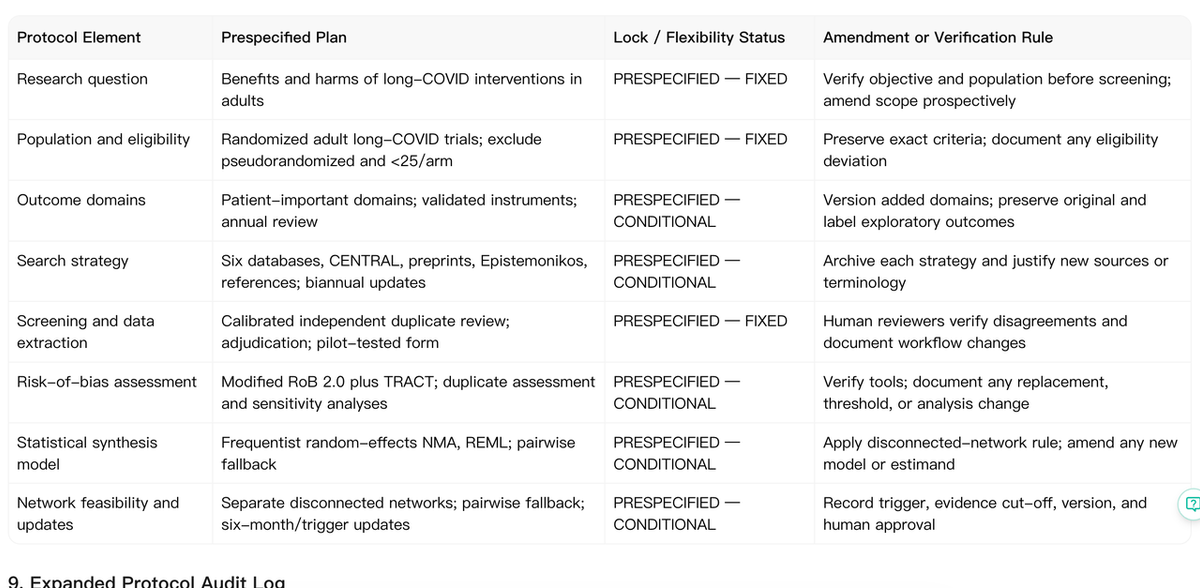
Two rows illustrate why a binary “locked versus flexible” label is insufficient. The statistical synthesis has a specified primary approach, but the protocol anticipates situations in which pairwise analysis is required. Meanwhile, the living-review update schedule is planned in advance but permits earlier updates when important new evidence emerges. Conditional flexibility must therefore be tied to an identifiable trigger.
Publication timing and registration status matter
This is a published protocol, not a newly submitted preregistration. The research group also published a related living systematic review in November 2024, before the February 2025 journal protocol publication. That chronology alone does not establish the timing or status of any separate earlier registration. The paper links to an OSF project, but a project workspace is not automatically equivalent to a dated, immutable preregistration. Any claim of prospective registration requires checking the actual record and its dates.
How to Document a Protocol Amendment
Good protocol governance distinguishes an anticipated condition from a substantive change to the original plan. A dated amendment record can include the protocol version, the section being changed, the reason, who approved it, when the decision was made, and whether relevant study findings were already visible.All four entries above are hypothetical teaching examples, not claims that these amendments occurred in the Zeraatkar protocol.
Best Practices and Common Preregistration Mistakes
A practical protocol should be detailed enough to constrain result-driven choices without becoming impossible to execute. Make the primary outcome and analysis explicit; identify likely problems; state how each is addressed; and record changes as they occur rather than reconstructing a rationale after the review is complete.
- Avoid vague eligibility. “Relevant clinical studies” does not specify the actual population or design threshold.
- Do not treat updates as permission to redesign. Living-review updates can add evidence without silently changing the original question.
- Do not confuse subgroup exploration with confirmation. A subgroup proposed after reviewing effects has different evidential status from a prespecified hypothesis.
- Preserve a search audit trail. Keep databases, strategies, dates, and subsequent changes rather than reporting only the latest search.
- Separate protocol and results reporting. PRISMA-P addresses protocols; relevant PRISMA extensions address completed network and living reviews.
- Do not invent registration metadata. A published article DOI, OSF project URL, or Noah output is not a substitute for a verified registry identifier.
Citing Protocols, Registrations, and Supporting Sources
Use the published protocol DOI when discussing its methods, and link separately to any confirmed registration record or public amendment history. Cite the original methodological standards for claims about reporting requirements. Do not treat a protocol publication as evidence that a meta-analysis was completed, or cite a results paper as though it were the initial plan.For a new review, prepare the protocol with reference to PRISMA-P, check the current scope and timing rules of PROSPERO if it is an eligible health-related review, or consider a suitable OSF registration. These services have different functions, requirements, and public-record structures.
Trust and Limits of AI-Assisted Protocol Review
What Noah did in this example: organized a published protocol into an evidence-grounded decision table and highlighted fixed and conditional methodological commitments.What this example does not establish: that Noah performed a meta-analysis, retrieved or screened all trials, verified a prospective registry timestamp, approved amendments, submitted a registration, or produced statistically valid review results.An AI-generated classification still needs a researcher to review the source language. If a table marks a component “conditional,” the condition should be traceable to the protocol; otherwise it is an editorial recommendation, not a statement of the authors' original prespecified plan.
Final Meta-analysis Preregistration Checklist
- Define the research question using the relevant population, interventions, comparators, and outcomes.
- Prespecify included study designs and eligibility thresholds.
- Identify primary outcomes, measurement time points, and effect measures.
- Record databases, search methods, limits, and planned updates.
- Plan independent screening, data extraction, and disagreement resolution.
- Specify risk-of-bias methods and evidence-certainty assessment.
- Describe the primary statistical model and conditions for alternatives.
- Define planned subgroup and sensitivity analyses in advance.
- Set out a dated version-control and amendment procedure.
- Check registry eligibility and submit through the registry itself before relevant work stages.
- Preserve the public registration link and subsequent amendment history.
- Compare eventual review methods and reported results with the original plan.
Conclusion: Prespecify the Rules, Not Every Future Event
Useful preregistration makes the important decisions testable: who will be included, what will be measured, which evidence will be sought, how it will be synthesized, and how deviations will be handled. The Long COVID protocol illustrates that conditional rules can be planned rigorously without sacrificing adaptability to clinical evidence.Noah AI can support this work by extracting and organizing the stated methods into a reviewable table. The final protocol, prospective timing, statistical decisions, amendments, and any registry submission remain the research team's responsibility.
Review and Organize Your Meta-analysis Protocol with Noah AI
Use Noah AI to extract planned methods from published research protocols, distinguish prespecified decisions from conditional choices, and build a source-linked protocol review table.Identify documentation gaps and questions that require researcher verification before preparing a registration.Noah AI does not complete, approve, or submit PROSPERO registrations. Researchers remain responsible for finalizing their protocols and submitting them through the appropriate registry.Try Noah AI for Free →
References
- Zeraatkar D, Ling M, Kirsh S, et al. Interventions for the management of post-COVID-19 condition (long COVID): protocol for a living systematic review and network meta-analysis. BMJ Open. 2025;15:e086407. doi:10.1136/bmjopen-2024-086407.
- Zeraatkar D, et al. Interventions for the management of long covid (post-covid condition): living systematic review. BMJ. 2024;387:e081318. doi:10.1136/bmj-2024-081318.
- Moher D, Shamseer L, Clarke M, et al. PRISMA-P 2015: Preferred Reporting Items for Systematic Review and Meta-analysis Protocols.
- Cochrane. Cochrane Handbook for Systematic Reviews of Interventions.
- University of York, Centre for Reviews and Dissemination. PROSPERO International Prospective Register of Systematic Reviews.
- Center for Open Science. Open Science Framework.