Noah AI vs Sourcely for Finding Literature Review Sources (2026)
Linda
Compare Noah AI and Sourcely for finding literature review sources in 2026, with real research examples, citation verification, and biomedical evidence mapping.
Finding a paper on the right topic is not the same as finding evidence that supports a specific sentence in a literature review. Researchers need to verify the publication, identify the population and endpoint, and determine whether the source supports the claim as written.
Sourcely approaches this from a draft: paste academic text and look for relevant citations. Noah AI can start from a biomedical research question and organize publications, study populations, reference identifiers, and claim-to-source relationships. This comparison uses a real literature-review example involving PARP inhibitor maintenance therapy in advanced ovarian cancer.
Testing disclosure: We examined Sourcely's Quick Search/editor interface and its visible premium restriction on citation-worthy highlights. We also ran a Noah AI Deep Research task that generated a source-verification table and claim-to-source mapping. We did not conduct a controlled citation-accuracy benchmark or a paid Sourcely Deep Search test.
Try Noah AI Free — Get 200 Signup Credits
Noah AI vs Sourcely: At a Glance
| Question | Noah AI | Sourcely |
|---|---|---|
| Starting input | Research question and specified seed publications | Existing paragraph, claim, or draft |
| Observed example | Verification table and claim-to-source mapping | Quick Search/editor with citation-worthy highlights and an upgrade prompt |
| Evidence organization | Study design, population, relevance, DOI/PMID, interpretation boundaries | Source suggestions and citation support for supplied text |
| Free access | Basic plan with 200 signup credits (limited use) | Limited free Quick Search; premium functions require a plan |
| Best fit | Source-grounded biomedical literature reviews | Finding citations for text already drafted |
These are workflow distinctions, not comparative scores for search coverage, reliability, or accuracy.
What Is Sourcely?
Sourcely is an AI-assisted academic source finder. Users can paste an essay, paragraph, or research claim to search for relevant papers and add citations. The product also describes source summaries, citation export, and more extensive Deep Search options.
For researchers who already have a draft, this paragraph-first workflow can be convenient. However, finding a topically related article is only the first step: the exact population, endpoint, and strength of the claim still need to be checked against the original study.
Sourcely Hands-On Test: Free Features and Upgrade Restrictions
We entered a short paragraph about PARP inhibitor maintenance therapy in newly diagnosed advanced ovarian cancer. It mentioned the SOLO1 trial of olaparib and the PRIMA trial of niraparib. In the tested Sourcely workspace, Quick Search was selectable and citation-worthy passages were highlighted.
The same screen displayed an “Unlock all citation-worthy highlights” prompt and an Upgrade button, indicating that full access to this highlight-analysis view required a paid plan in this account. Sourcely's publicly documented Deep Search is also included in paid plan allowances.
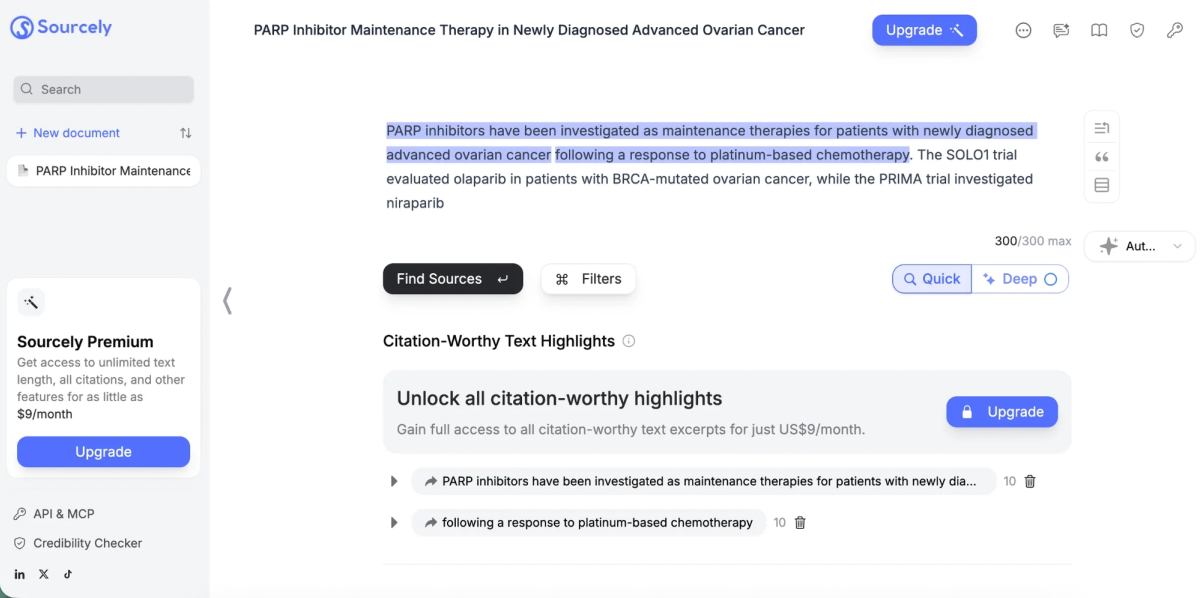
Sourcely screenshot from the tested account: a paragraph-based source-finding workflow with a visible premium restriction on full citation-worthy highlights.
Important distinction: This is not evidence that Sourcely offers no free source search. Quick Search has a limited free entry point. We did not unlock or test the paid highlighting or Deep Search output, and therefore cannot evaluate the quality of their full results. The price displayed in the account is a screenshot of an offer, not a guarantee of a universal billing rate.
What Is Noah AI?
Noah AI is a life-science-oriented research assistant. In the workflow tested here, Noah was asked to locate and verify literature, distinguish trial publications from follow-up reports, map review claims to sources, and synthesize clinical findings without overstating what the evidence established.
For a literature review in medicine, this is useful because a reference is only relevant when its design, patient population, biomarker criteria, and reported endpoints actually match the proposed statement.
Real Research Example: PARP Inhibitors in Ovarian Cancer
The demonstration focused on first-line PARP inhibitor maintenance therapy for advanced ovarian cancer, particularly the SOLO1 and PRIMA randomized trials. We asked Noah to verify literature sources related to BRCA status, homologous recombination deficiency (HRD), progression-free survival (PFS), overall survival (OS), and safety.
Step 1. Start With a Source-Verification Prompt
Our Deep Research prompt supplied seed publications and instructed Noah not to invent DOI or PMID identifiers, treat long-term follow-up reports as separate trials, or infer an overall-survival benefit from a progression-free-survival result.
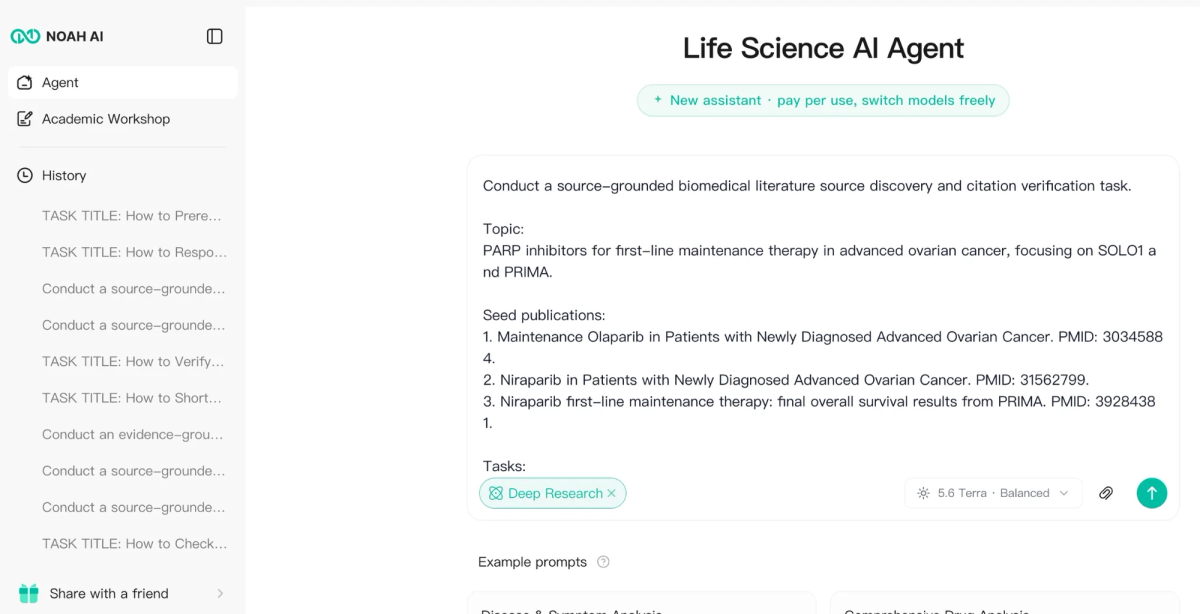
Noah AI research input identifying the ovarian-cancer topic and seed references.
Step 2. Verify Which Papers Belong in the Review
Noah produced a source table with the publication, study design and population, relevance to the review, and DOI/PMID information. The output distinguished the original randomized SOLO1 and PRIMA reports from their later follow-up analyses and from secondary evidence reviews.
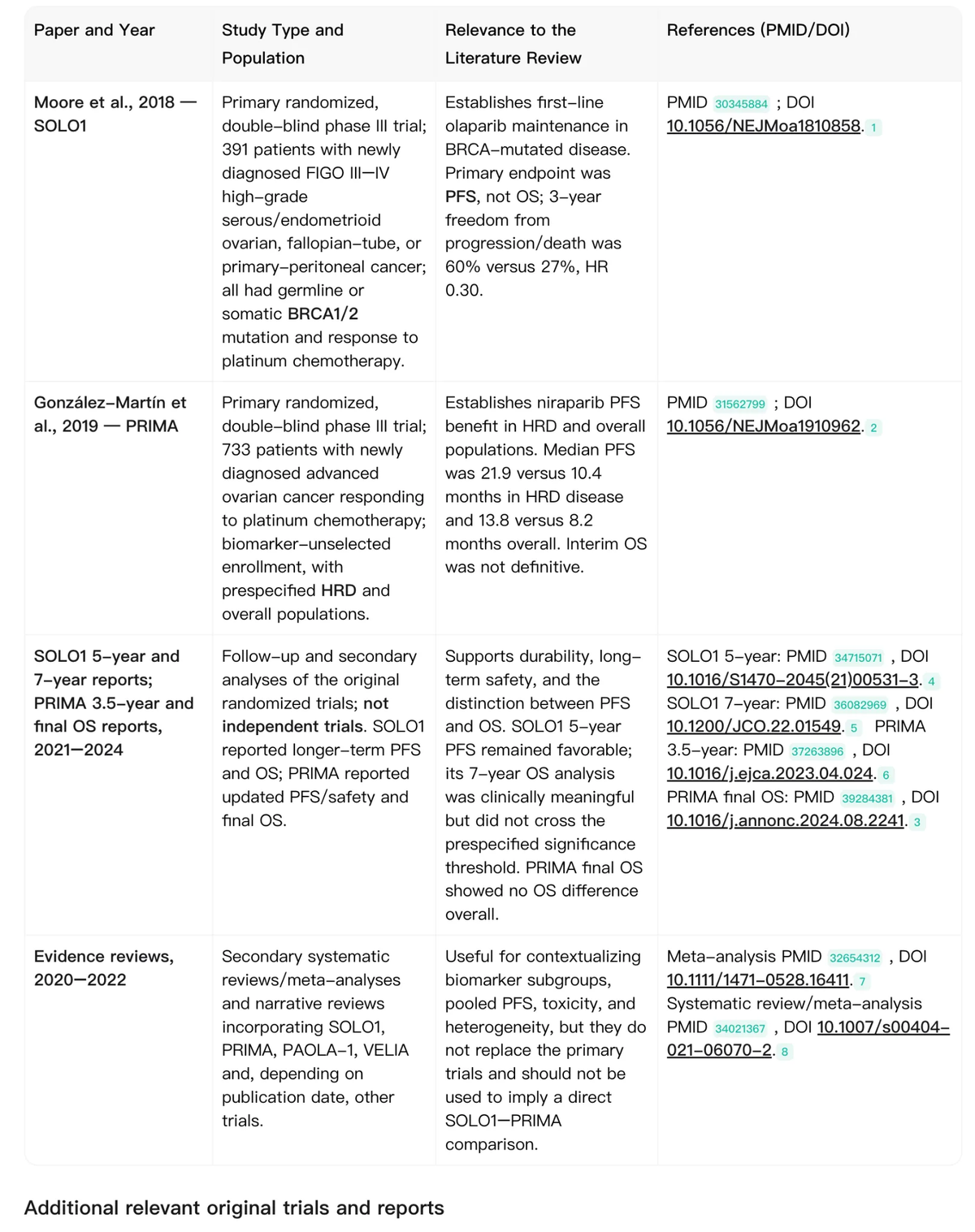
Source-verification table from the actual Noah run. References and study-type distinctions remain visible.
For example, the primary SOLO1 trial studied BRCA-mutated advanced ovarian cancer, whereas PRIMA included a broader trial population with prespecified HRD analyses. Their baseline risk, eligibility, biomarkers, and outcomes should not be treated as interchangeable.
The original publications found PFS benefits versus placebo in their respective trial populations. But a reader should not use separate-trial results to conclude that olaparib is superior or inferior to niraparib.
Step 3. Match Each Literature-Review Claim to Evidence
The most useful part of this test was the Claim-to-Source Mapping table. Noah connected review statements to the most suitable publications and added interpretation notes showing when a statement was supported—and when it required qualification.
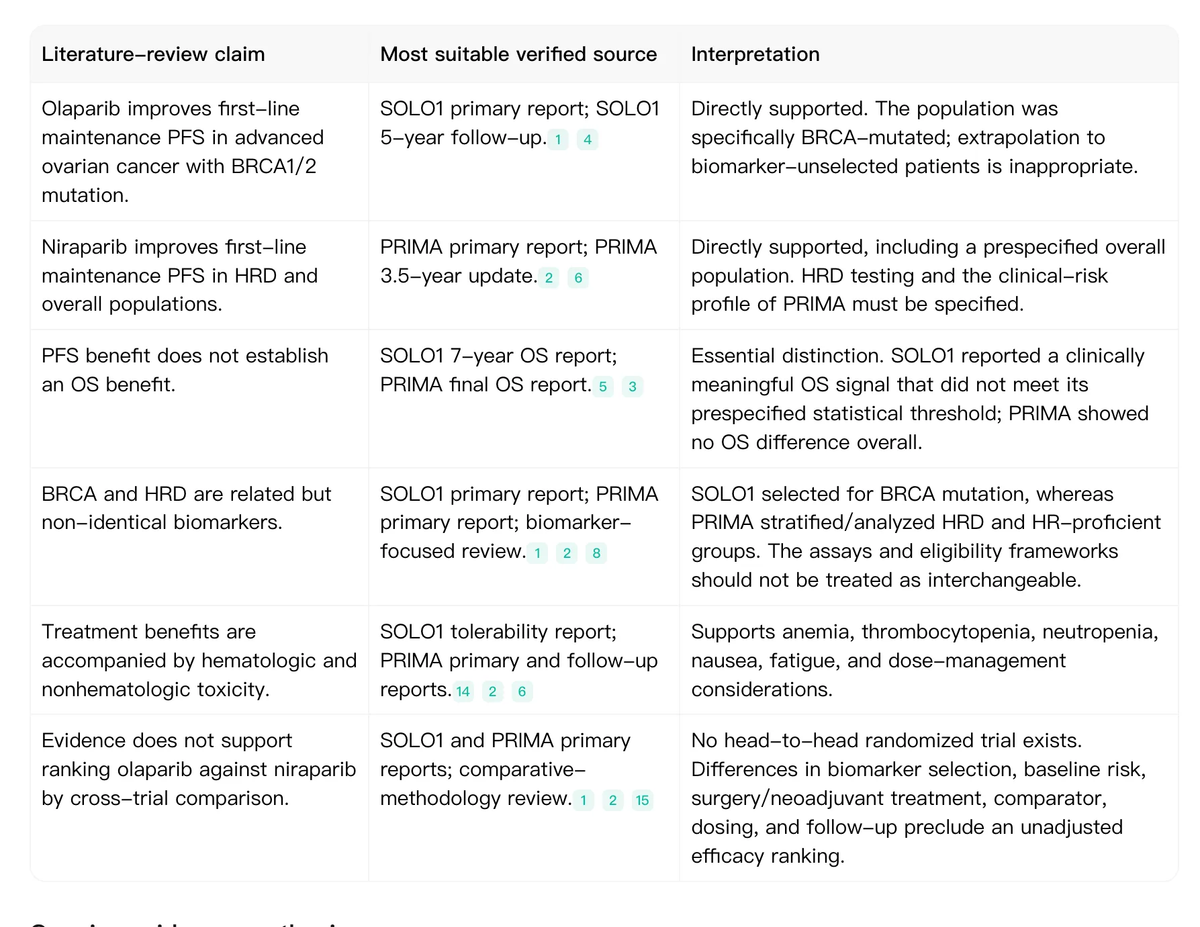
Noah AI mapping literature-review claims to original trial reports and follow-up findings, with explicit interpretation boundaries.
One especially important mapping separated PFS and OS. In the seven-year SOLO1 update, overall survival showed a clinically meaningful numerical signal but did not pass the trial's prespecified statistical significance threshold. PRIMA's final overall-survival report did not show an OS difference in the overall population. A PFS improvement should therefore not be rewritten automatically as a proven OS improvement.
These examples show why source relevance is different from source verification. A paper can mention the same drug and disease yet fail to support a specific survival, biomarker, or comparative-effectiveness claim.
Free Access: Where the Difference Matters
The free-to-paid transition is a practical consideration when trying tools for a new literature review. In our Sourcely account, complete citation-worthy highlights were behind an Upgrade prompt. Its Deep Search has paid plan allowances, although limited Quick Search is available without a subscription.
Noah AI offers a free Basic entry point with signup credits. New users receive 200 signup credits with the Basic plan. These credits let researchers begin exploring the platform before purchasing additional usage. Credits are not equivalent to unlimited Deep Research runs; consumption depends on task complexity and the plan rules.
The distinction is not that one product is universally free and the other universally paid. It is that they offer different free entry points, and the tested Sourcely highlighting feature presented a visible paywall. Researchers should check live entitlements and task costs before choosing a platform.
When to Choose Sourcely or Noah AI
Consider Sourcely when you already have a drafted paragraph and want suggestions for papers that could support it, especially if you prefer a citation-oriented editor and may use premium source-analysis features.
Consider Noah AI when a biomedical research question still needs to be developed into a defensible literature review: identifying original papers, distinguishing follow-ups, checking clinical endpoints, and explaining exactly how each publication relates to the proposed claims.
The tools can also complement one another. A researcher might identify candidate citations while drafting and then verify methods, findings, and interpretation limits against the original literature.
Limitations of This Comparison
This was a practical workflow demonstration, not an accuracy study. The two tools were not subjected to identical indexed search conditions, a blinded reference gold standard, or independent citation-by-citation scoring. Sourcely's paid functions were not tested. Noah's visible tables are AI-produced research aids and must still be checked against the original studies.
We also did not perform a systematic review or meta-analysis. The displayed sources are a focused biomedical example, not an exhaustive survey of all PARP inhibitor studies or current clinical treatment recommendations.
Frequently Asked Questions
Is Sourcely free to use?
Sourcely offers limited free Quick Search access. However, our screenshot showed a premium restriction on accessing all citation-worthy highlights. Deep Search is offered through paid plan allowances. Exact limits and pricing can change.
Can Noah AI find literature review sources?
In this test, Noah generated a source-verification table and mapped claims about SOLO1 and PRIMA to the relevant publications. The output requires primary-source checking before it is used in academic writing.
Does Noah AI have free signup credits?
Yes. The Basic plan includes 200 signup credits for new users. Usage is limited and varies by task; check the live signup page for current terms.
Which tool has more accurate citations?
We cannot determine that from this test. A defensible answer would require the same source set and standardized questions, followed by independent checks of each DOI, study population, and supporting passage.
Final Verdict
Sourcely is oriented toward finding sources for claims a researcher has already written. Noah AI can be used for a broader biomedical workflow—from source discovery and verification to structured evidence mapping. In the ovarian-cancer example, Noah made the distinction between PFS and OS, and between BRCA-selected and broader biomarker-defined populations, visible within the source mapping.
For researchers evaluating a free starting point, the meaningful comparison is the availability of useful functionality before subscribing—not an unsupported claim that either platform produces uniformly better citations.
Find and Verify Biomedical Literature With Noah AI
Move beyond collecting paper titles. Use Noah AI to investigate biomedical research questions, organize original studies and follow-up reports, match literature-review statements to sources, and draft evidence-aware research summaries that make limitations visible.
Start for free with 200 signup credits. Explore the Basic research experience without an upfront payment, then decide whether you need additional credits for more extensive work.
Start Exploring Noah AI for Free — Get 200 Signup Credits
Limited credits. Usage varies by research task; Deep Research is not unlimited. Confirm current plan terms at signup, and verify all important scientific claims against original publications.
Sources and References
- SOLO1 primary publication — PMID 30345884
- PRIMA primary publication — PMID 31562799
- SOLO1 seven-year OS follow-up — PMID 36082969
- PRIMA final overall survival report — PMID 39284381
- Sourcely official feature updates and Deep Search information
- Sourcely pricing and premium plans
- Noah AI plans and credits
Product and workflow review: November 2026. Free credits are limited; usage depends on the task. Sourcely's free and premium features may change. Only the demonstrated workflows were tested.