Noah AI vs R Discovery for Biomedical Literature Discovery (2026)
Linda
Compare Noah AI and R Discovery for biomedical literature discovery in 2026, including AI research answers, references, evidence mapping, and real screenshots.
Finding relevant biomedical papers is only the beginning of a research workflow. Researchers also need to distinguish original clinical trials from reviews, follow citation trails, identify safety findings, and understand which questions remain unresolved. Noah AI and R Discovery both help users explore scientific literature, but they emphasize different parts of that process.
R Discovery combines scholarly search, personalized paper recommendations, reading tools, and citation-backed answers through Ask R Discovery. Noah AI supports life-science research workflows that can begin with a biomedical question and progress toward structured evidence mapping and research synthesis.
We examined both tools using the same topic: anti-amyloid monoclonal antibody therapies for early Alzheimer's disease, focusing on lecanemab, donanemab, and related clinical studies. This article shows actual interface screenshots from both tools and explains what the limited test does—and does not—demonstrate.
Explore Biomedical Literature with Noah AI
Noah AI vs R Discovery: Quick Comparison
| Research task | Noah AI | R Discovery |
|---|---|---|
| Main workflow | Question-driven biomedical investigation and evidence synthesis | Scholarly discovery, personalized recommendations, reading, and Ask R Discovery |
| Observed hands-on output | Prompt, a multi-paper discovery table, and thematic synthesis | Question-based AI answer with visible reference cards |
| Citation workflow | Paper table with DOI/PMID reference links in the test | Source cards and citation actions visible in Ask R Discovery |
| Continuing discovery | Research themes and unanswered questions in the generated output | Officially documented personalized feeds, paper suggestions, and saved reading lists |
| Good fit | Researchers preparing structured biomedical evidence overviews | Researchers discovering, following, and reading papers over time |
These are workflow descriptions, not experimentally verified rankings of accuracy, search coverage, retrieval quality, or speed.
What Is R Discovery?
R Discovery, developed by Editage/Researcher.Life, is a research discovery and reading platform. Its official product documentation describes keyword and topic discovery, personalized paper feeds, reading recommendations, bookmarks, and links with reference-management workflows. It also offers Ask R Discovery, which presents AI-generated responses accompanied by references. Availability and limits can vary by plan.
Hands-On Test: Ask R Discovery
We entered the query “anti-amyloid monoclonal antibodies early Alzheimer's disease lecanemab donanemab” into Ask R Discovery. In the captured interface, the main panel displayed a narrative explanation of the topic, while a separate Q1 References panel showed source cards with actions such as Cite and Save.
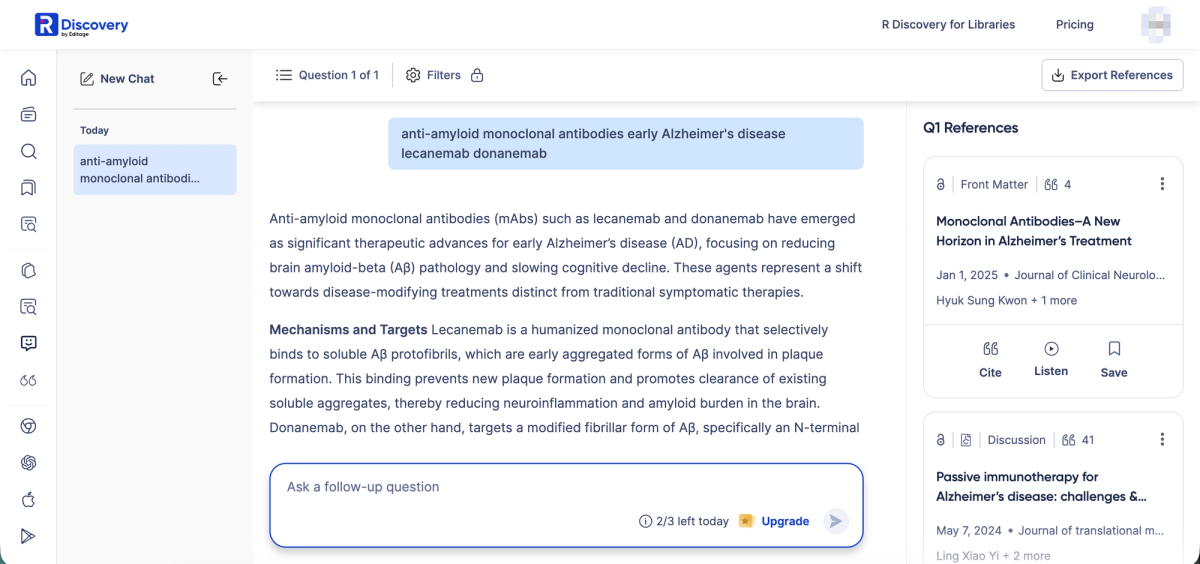
Actual R Discovery test: an AI answer on anti-amyloid therapies with visible research reference cards. This is an Ask R Discovery result, not a conventional search-result ranking screenshot.
What this screenshot establishes: R Discovery can present a question-based explanation alongside linked source cards in the tested interface. The screenshot alone does not establish that its references are comprehensive, that every answer claim is correct, or that the platform retrieved all pivotal clinical trials.
Its personalized recommendation feed and ongoing reading workflow are useful distinctions, but those features were not separately tested in this example; they are described based on R Discovery's official documentation.
What Is Noah AI?
Noah AI focuses on biomedical and life-science research workflows. Its published literature-review materials describe searching scientific sources, organizing studies into tables, and synthesizing the evidence by theme. In our hands-on example, we used Noah Agent with Deep Research to discover and organize papers about lecanemab and donanemab.
Step 1: Start With a Biomedical Research Question
The Noah prompt specified the research area, the two seed clinical trials, and the required output: verified publication details, study-type distinctions, a compact DOI/PMID-linked literature table, efficacy and safety themes, and remaining evidence gaps. It also instructed the agent not to invent sources or rank the two drugs through indirect cross-trial comparisons.
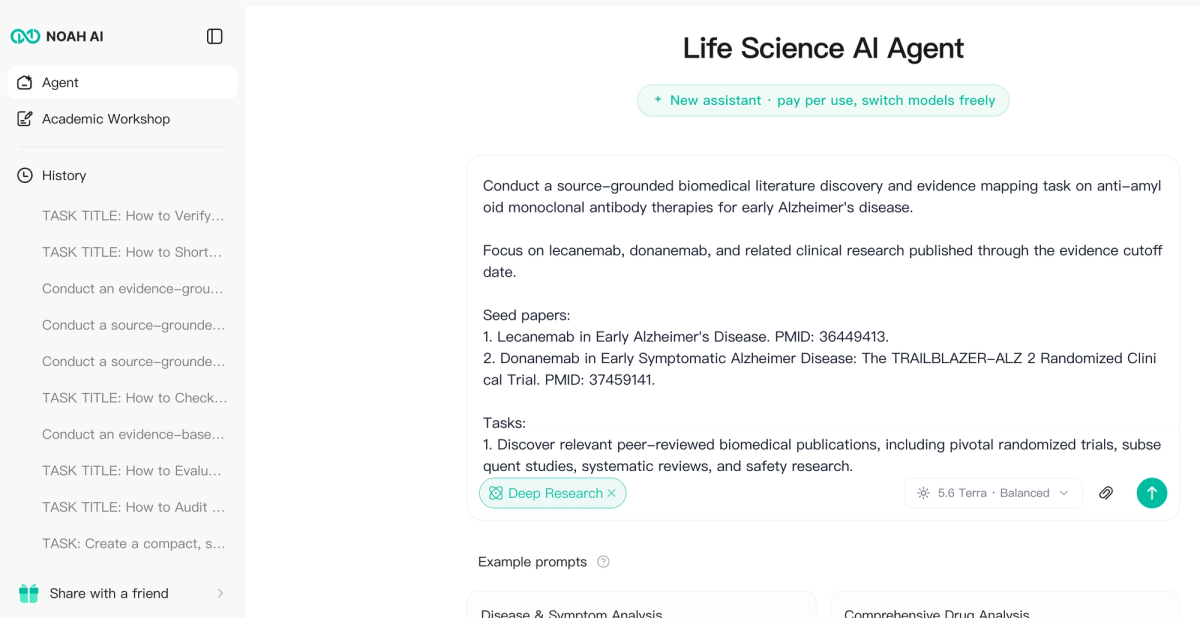
Noah AI Deep Research input focused on lecanemab, donanemab, and source-grounded biomedical literature discovery.
Step 2: Organize Discovered Papers by Study Type and Relevance
Noah returned a Literature Discovery Table with columns for paper and year, study type, research focus, key findings and relevance, and DOI/PMID references. The screenshot shows four representative publications: early phase 2 lecanemab and donanemab trials, followed by the pivotal phase 3 lecanemab and donanemab trials.
Those are different levels of evidence. Distinguishing an exploratory or dose-finding study from a pivotal randomized controlled trial matters when building a biomedical literature map: an early biological signal is not equivalent to confirmatory clinical evidence.
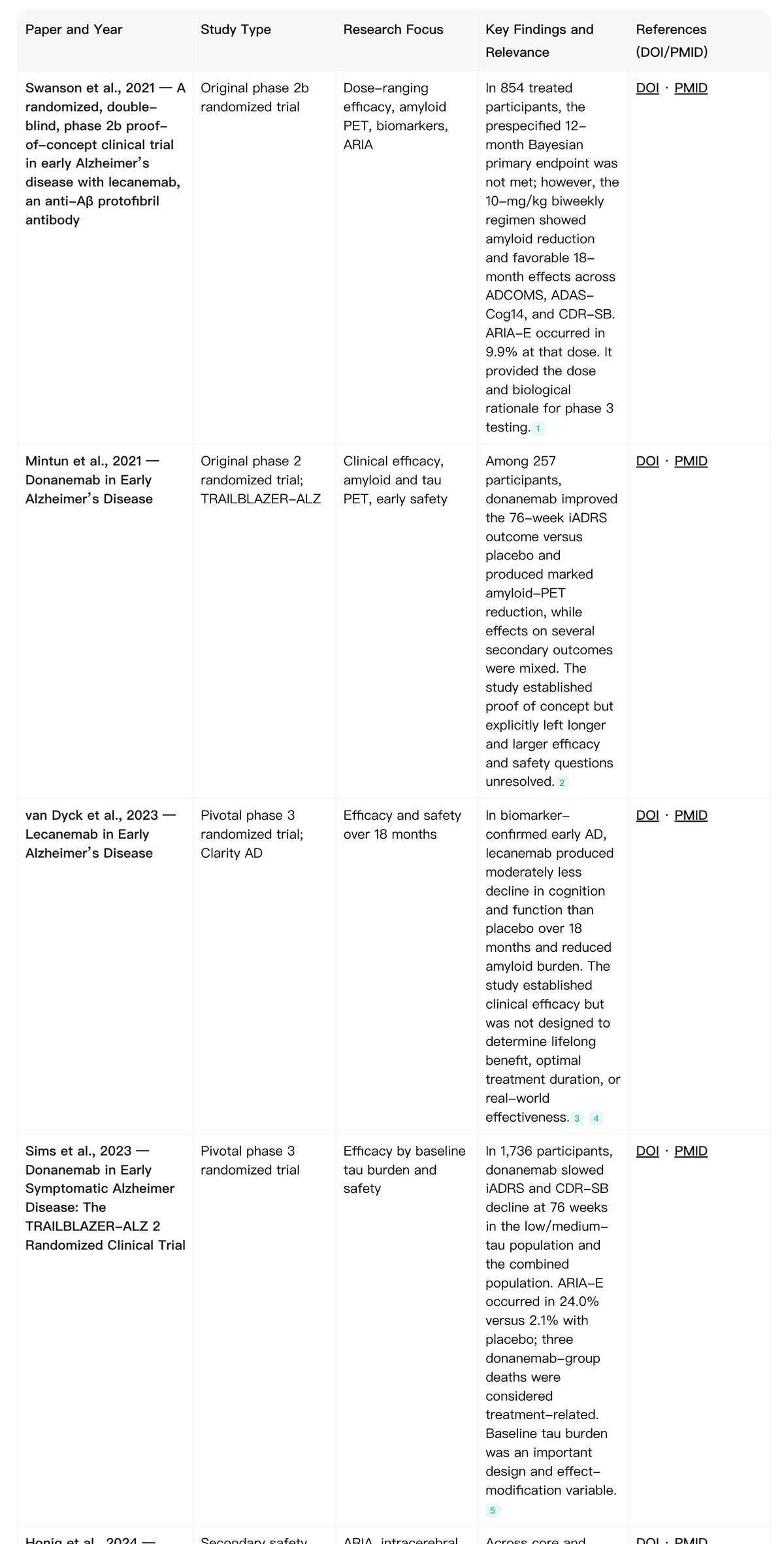
Excerpt from Noah's literature discovery table. The original report contains additional papers; this image shows a readable subset rather than the complete output.
The table is a useful navigation aid, not a substitute for checking the source publications. Long narrative cells in AI-generated tables should be traced back to the original articles before being quoted in a scientific manuscript.
Step 3: Connect the Evidence Into a Thematic Map
After the discovery table, Noah organized the literature into themes. In the Efficacy outcomes section, it described the progression from early-stage dose-finding studies to phase 3 randomized trials and explained that each drug had demonstrated benefits compared with placebo in the populations studied.
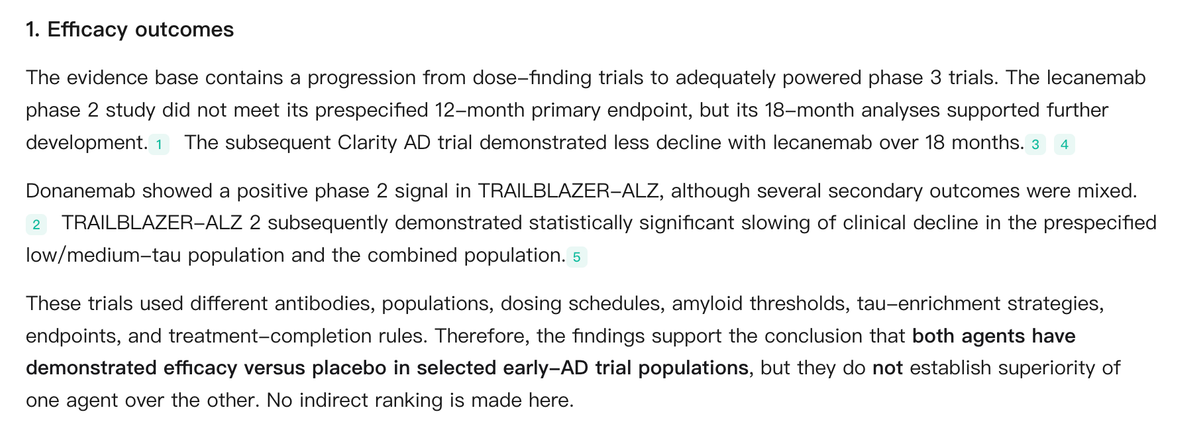
Noah's cited efficacy synthesis links trial development stages and explicitly avoids a cross-trial drug superiority ranking.
This distinction is important. The lecanemab and donanemab trials differed in populations, biomarkers, treatment approaches, and outcome definitions. Comparing their headline effects as if they came from a direct head-to-head randomized trial would be misleading.
For example, the pivotal Clarity AD trial evaluated lecanemab versus placebo over 18 months; TRAILBLAZER-ALZ 2 evaluated donanemab versus placebo over 76 weeks. Both are highly relevant original publications for literature discovery, but their results should be interpreted within each study design.
Which Tool Fits Each Stage of Biomedical Literature Discovery?
Finding and Following Relevant Research
R Discovery is particularly relevant for researchers who want to explore papers, save interesting articles, and follow continuing developments in a topic. Personalized recommendations and reading feeds are prominent parts of its documented workflow. Ask R Discovery also lets users start with a question and inspect accompanying references.
Building a Biomedical Evidence Map
Noah's tested workflow emphasizes organizing discovered publications into study categories and a reusable summary: which sources are primary trials, what each study examined, and which findings contribute to efficacy, safety, or research-gap questions. This can help when moving from discovery toward preparation of a literature review.
Checking the Literature, Not Just the AI Answer
Both approaches require human source checking. Authors should verify DOI and PMID identifiers, read relevant original study sections, distinguish trial results from reviews or commentary, and assess whether an AI summary accurately reflects endpoints, populations, and limitations.
Why Safety Papers Matter in This Research Topic
For anti-amyloid antibodies, a discovery workflow should not focus only on cognitive efficacy. It should also identify safety evidence involving amyloid-related imaging abnormalities (ARIA), infusion reactions, risk factors, and follow-up duration.
The Clarity AD publication reported amyloid-related imaging abnormalities with edema or effusions among lecanemab-treated participants. The TRAILBLAZER-ALZ 2 publication also reported ARIA events in its donanemab trial. Such findings underscore the importance of discovering original safety results and later analyses—not simply repeating positive efficacy summaries.
Because clinical populations and ascertainment can differ, these values should not be used as an uncontrolled ranking of drug safety. Neither our tool test nor this article offers individual treatment recommendations.
Testing Methodology and Limitations
Test case: Anti-amyloid monoclonal antibody literature for early Alzheimer's disease, with lecanemab and donanemab as the two seed treatments.
R Discovery: We captured an Ask R Discovery response with a references panel. We did not independently benchmark its personalized recommendations, traditional search ranking, total index coverage, citation accuracy, or advanced filtering.
Noah AI: We captured the Deep Research prompt, a selected portion of the discovered-paper table, and one thematic synthesis section. This was a single biomedical research example—not a systematic search validation, a citation-accuracy study, or a comparison of two models under identical prompts and retrieval constraints.
Interpretation: The screenshots document different outputs and workflows. They do not prove that either tool is universally faster, more comprehensive, or more scientifically accurate.
Frequently Asked Questions
Is R Discovery only a paper recommendation app?
No. In addition to personalized recommendations and reading tools, R Discovery offers Ask R Discovery for citation-backed research questions, as demonstrated in the screenshot above.
Can Noah AI help with biomedical literature discovery?
In this example, Noah generated a structured table of relevant publications with study types and DOI/PMID reference fields, followed by a narrative evidence map. A researcher should still validate any selected sources and claims against the original papers.
Which platform has the larger or more accurate biomedical index?
This test does not establish a winner. A valid comparison would need predefined topics, identical eligibility criteria, known relevant-paper sets, date cutoffs, and independent measurement of recall, precision, and citation accuracy.
Can these tools replace a systematic literature search?
No. For systematic reviews, formal search strategies, documentation, screening procedures, and reproducible eligibility decisions still require dedicated methods and researcher oversight. AI-assisted discovery can support, but does not by itself replace, these procedures.
Can I try Noah AI for free?
Noah offers an entry-level free plan, subject to current limits and credit usage rules. Check the official pricing page for the allowance shown to your account before starting a resource-intensive research task.
Final Verdict
Choose R Discovery if your priority is discovering papers, staying updated through recommendations, and navigating source-linked answers while building a personal reading library.
Consider Noah AI if your priority is turning a biomedical question into a structured paper list, distinguishing study types, and developing a source-aware evidence map that can inform subsequent literature review work.
For many researchers, the two approaches can be complementary: continuous reading and discovery on one side, structured evidence organization and thematic synthesis on the other.
Turn Biomedical Literature Discovery Into Structured Evidence
Go beyond a growing list of papers. Use Noah AI to investigate biomedical questions, organize relevant clinical studies, examine reported outcomes and limitations, and create thematic research summaries with traceable references.
Whether you are exploring Alzheimer's disease therapies, mapping clinical trial evidence, or preparing a biomedical literature review, Noah AI can help you move from initial sources to an organized research starting point. Important claims and citations should always be checked against original publications.
Start with the free plan. Explore Noah's research workflow before deciding whether you need more credits. Available signup credits and task usage limits may change; check the current pricing details.
Start Exploring Noah AI for Free
Free usage is limited. Deep Research credit consumption varies by task. This tool supports research; it does not replace primary-source verification or clinical judgment.
Sources and Further Reading
Original biomedical research
- van Dyck et al. Lecanemab in Early Alzheimer's Disease. NEJM (2023). PMID: 36449413; DOI: 10.1056/NEJMoa2212948.
- Sims et al. Donanemab in Early Symptomatic Alzheimer Disease: TRAILBLAZER-ALZ 2. JAMA (2023). PMID: 37459141; DOI: 10.1001/jama.2023.13239.
Official product documentation
- R Discovery: What Is R Discovery?
- Researcher.Life: Introducing Ask R Discovery
- R Discovery: Getting Started and Personalized Recommendations
- Noah AI: Literature Review
- Noah AI: Pricing and Credits
Testing scope and article review: November 2026. Official features, availability, and pricing may change.