Noah AI vs OpenRead for Research Paper Comparison (2026)
Linda
Compare Noah AI vs OpenRead for research paper comparison, using clinical trial evidence, original study findings, and cross-paper analysis workflows.
Research tools / Clinical paper comparison
Comparing research papers means more than collecting three abstracts. A defensible comparison needs to match the study design, population, intervention, endpoint definitions, effect estimates, and interpretation limitations to their original publications. This guide examines Noah AI and OpenRead through a clinical research question involving three randomized studies of low-dose colchicine.
The available screenshots document OpenRead paper search and a Noah AI three-trial comparison. They do not document a completed OpenRead Paper Compare result. This distinction matters: the screenshots illustrate different observed workflows, so they are not sufficient for a controlled accuracy, speed, or output-quality ranking.
Test scope. One OpenRead academic search-results screen was captured. In Noah AI, a Deep Research prompt generated a three-study clinical evidence matrix and a cross-trial interpretation table. OpenRead's separate Paper Compare capability is described using its official website, not presented as independently tested here.
Noah AI vs OpenRead: Quick Comparison
| Dimension | Noah AI | OpenRead |
|---|---|---|
| Research starting point | A specified biomedical research question in Deep Research. | Paper search, paper reader, and related research workspace features. |
| Paper discovery | The submitted test was guided by three known original trial identifiers; its output included linked PMIDs. | Search results shown in the actual captured session; users must still check whether hits are original studies. |
| Multi-paper comparison | The submitted trial-comparison task produced a three-row evidence matrix and a cross-study interpretation table. | Its official website advertises Paper Compare for comparing several papers. A completed comparison was not captured in this test. |
| Reading individual papers | Supports a question-led research response, as illustrated here. | Officially lists Paper Espresso, Paper Q&A, and reading/notes features. |
| Traceability | The observed matrix included study PMIDs and citation markers; verification limits remain relevant. | The search screen displays publication titles and associated metadata. The correctness of a generated Paper Compare report was not tested. |
| Best-fit workflow in this example | Build a question-led clinical trial comparison from specified original papers. | Find, read, and select relevant papers before moving to comparison. |
OpenRead functionality: official OpenRead product site. The table describes a captured workflow and product positioning, not a feature-availability or performance guarantee for all plans.
What Is OpenRead?
OpenRead is an AI-assisted academic research workspace focused on discovering, reading, and interacting with papers. Its official homepage lists Paper Compare, Paper Espresso, Paper Q&A, Related Paper Graph, and note-taking tools. Paper Compare is presented as a way to compare findings and identify areas of agreement or apparent contradiction across papers.
For a research-paper comparison, this is a relevant feature set. It would be incorrect to describe OpenRead as only a search engine or to claim it lacks a multi-paper comparison tool. However, a feature description is not equivalent to a verified test of how it handles a particular clinical trial comparison.
What Is Noah AI?
Noah AI offers a life-science-oriented AI research environment. In the workflow documented here, the researcher submitted a question to its Agent → Deep Research interface, identifying three original randomized studies and requiring trial-specific citation verification, an original endpoint comparison, and interpretation of divergent findings.
The observed output used tables to link populations, interventions, endpoints, and numerical trial results with their respective PubMed identifiers. This case demonstrates one completed task, not a guarantee that all biomedical questions will be handled without errors.
The Three Research Papers: Why the Findings Are Not Identical
The comparison addresses low-dose colchicine for cardiovascular event prevention. Three placebo-controlled randomized studies provide a useful example because two reported statistically significant primary composite outcomes and one did not:
| Trial | Study population | Primary composite result | Original source |
|---|---|---|---|
| COLCOT | 4,745 patients recruited within 30 days after myocardial infarction. | 5.5% vs 7.1%; HR 0.77, 95% CI 0.61–0.96. | PMID 31733140 |
| LoDoCo2 | 5,522 patients with chronic coronary disease, after a colchicine tolerability run-in. | 6.8% vs 9.6%; HR 0.69, 95% CI 0.57–0.83. | PMID 32865380 |
| CLEAR SYNERGY | 7,062 patients with acute myocardial infarction undergoing PCI; separate colchicine and spironolactone randomizations. | 9.1% vs 9.3%; HR 0.99, 95% CI 0.85–1.16. | PMID 39555823 |
These are results for three different composite endpoints and populations. COLCOT included resuscitated cardiac arrest and urgent hospitalization for angina leading to revascularization. LoDoCo2 included spontaneous myocardial infarction, ischemic stroke, and ischemia-driven revascularization. CLEAR SYNERGY measured a composite including recurrent myocardial infarction and unplanned ischemia-driven revascularization. The studies should therefore not be ranked by their hazard ratios alone.
OpenRead in the Captured Workflow: Academic Paper Search
The OpenRead screenshot shows a search-results page after a long colchicine research comparison instruction was entered. The page contains a search field, sorting and filtering controls, a Select multiple papers option, and cards for publications related to colchicine and coronary disease.
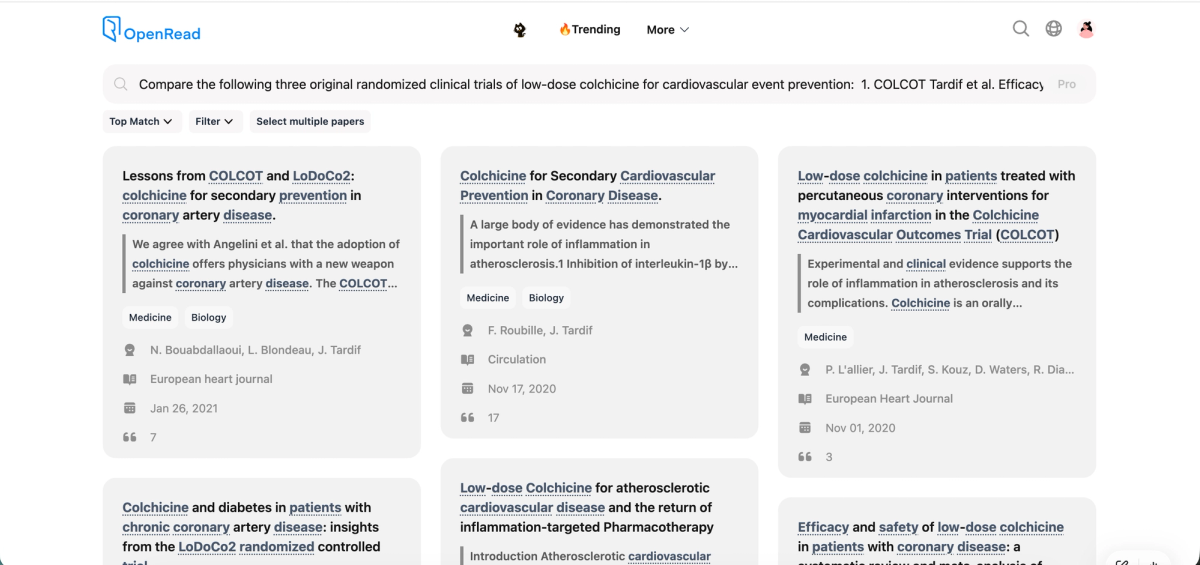
Figure 1. Actual OpenRead search results for the colchicine topic. The visible cards include related publications and commentary; the screenshot is not an output from Paper Compare.
Some visible hits are review, commentary, or other related papers rather than the three requested original trial reports. That does not establish that OpenRead failed a full comparison: the captured page is a discovery stage, and no completed selection or Paper Compare output is available. A careful researcher would confirm each paper's title, authors, original trial identity, and PMID before including it in a clinical evidence matrix.
OpenRead's official Paper Compare feature may support the next stage of the workflow, but its output and limits were not observed in the supplied screenshots. This article therefore makes no claim that OpenRead produced incorrect trial estimates, missed CLEAR SYNERGY, or lacks the ability to compare these studies.
Noah AI in the Captured Workflow: A Clinical Paper Comparison Task
The Noah AI prompt was more constrained than an unrestricted literature search. It named COLCOT, LoDoCo2, and CLEAR SYNERGY; requested original randomized evidence; and instructed the model to preserve exact primary outcomes, treatment timing, and statistical uncertainty. This setup is particularly useful for preventing a summary from conflating different trials with similar keywords.
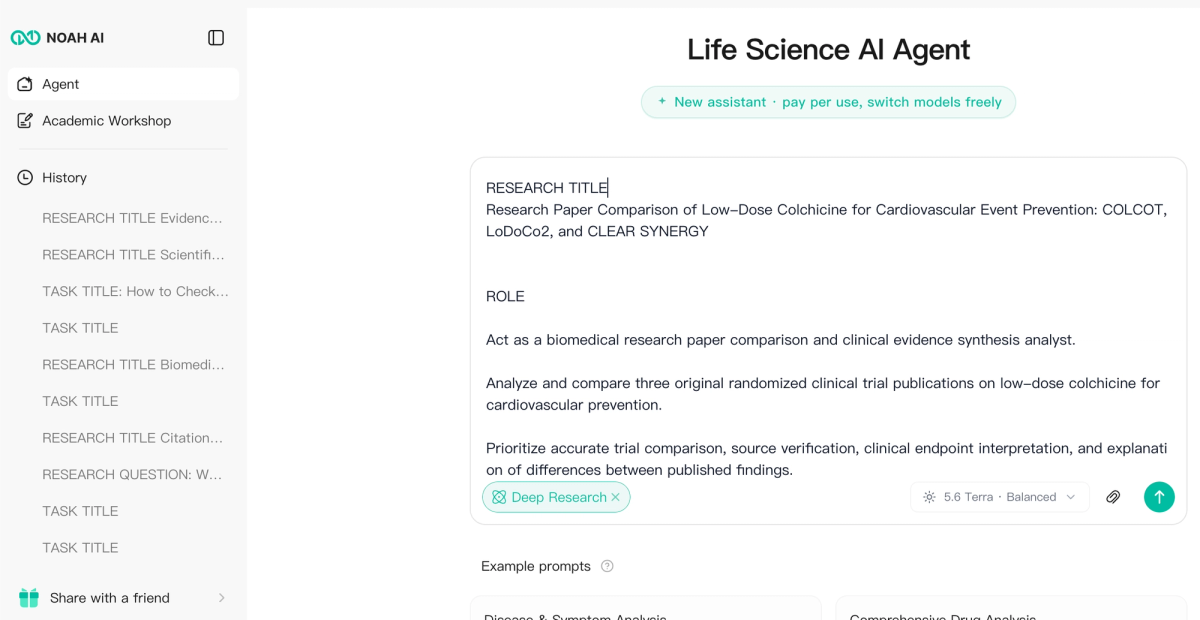
Figure 2. Noah AI Deep Research input with the defined three-trial comparison question.
The generated matrix then placed each randomized trial alongside its population, comparator, original primary endpoint, main effect estimates, and PMID. Such a matrix allows a researcher to inspect the evidence before drafting a narrative interpretation.
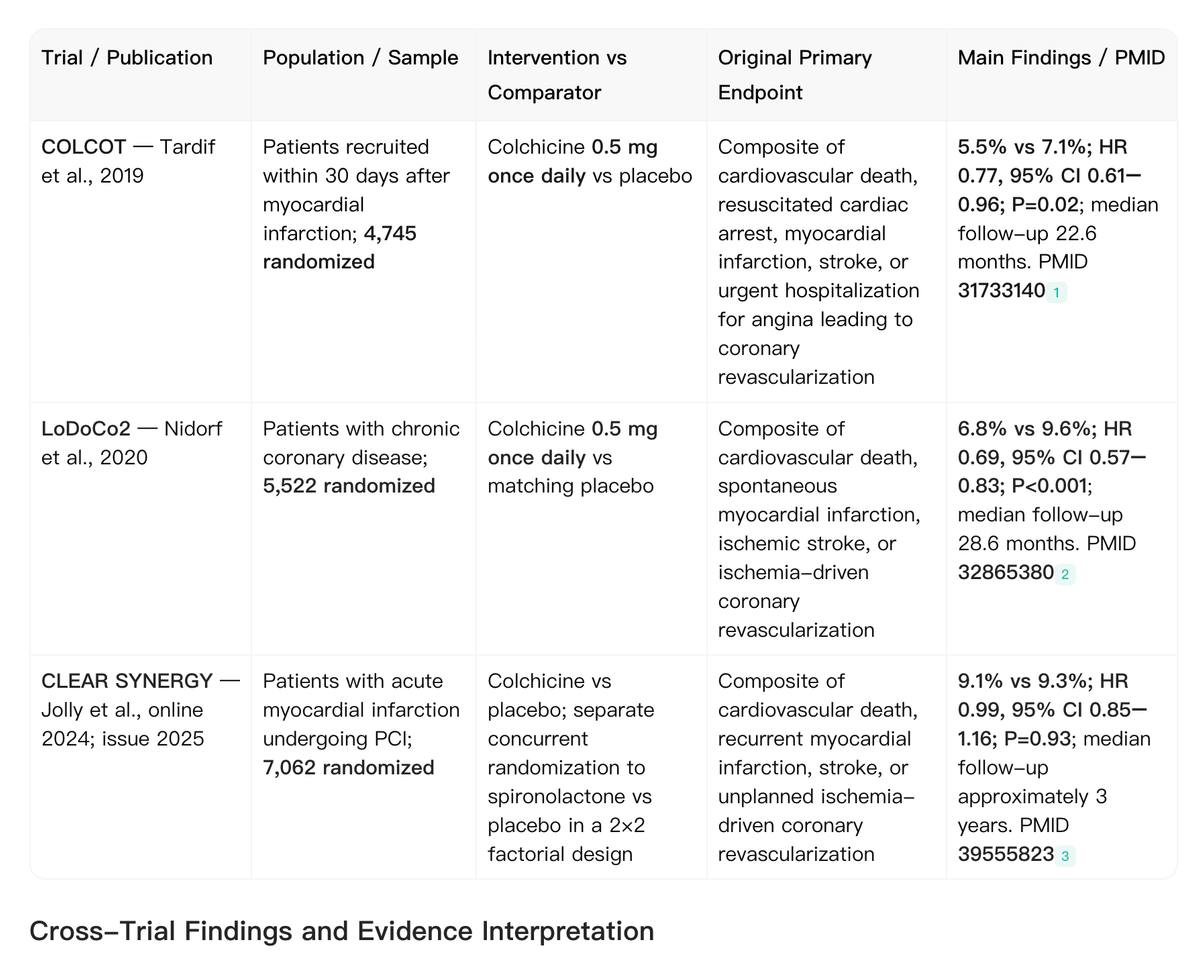
Figure 3. The observed Noah clinical trial comparison table. The original primary endpoints remain tied to their respective study populations and sources.
One point deserves emphasis: CLEAR SYNERGY's primary result was not statistically significant (HR 0.99; 95% CI 0.85–1.16; P=0.93). This is not mathematical proof of an exactly zero effect. The confidence interval reflects uncertainty, and the comparison also took place in a different clinical and treatment setting.
Compare Clinical Research with Traceable Sources
Use Noah AI to organize original trial populations, outcomes, and interpretation limits within a structured biomedical research workflow.
Cross-Paper Interpretation: Where the Studies Differ
The second captured Noah result moves beyond extraction to interpretation. Its cross-trial table covers recent versus chronic coronary disease, initiation timing, randomization design, endpoint definitions, follow-up, main treatment effects, safety, and limitations.
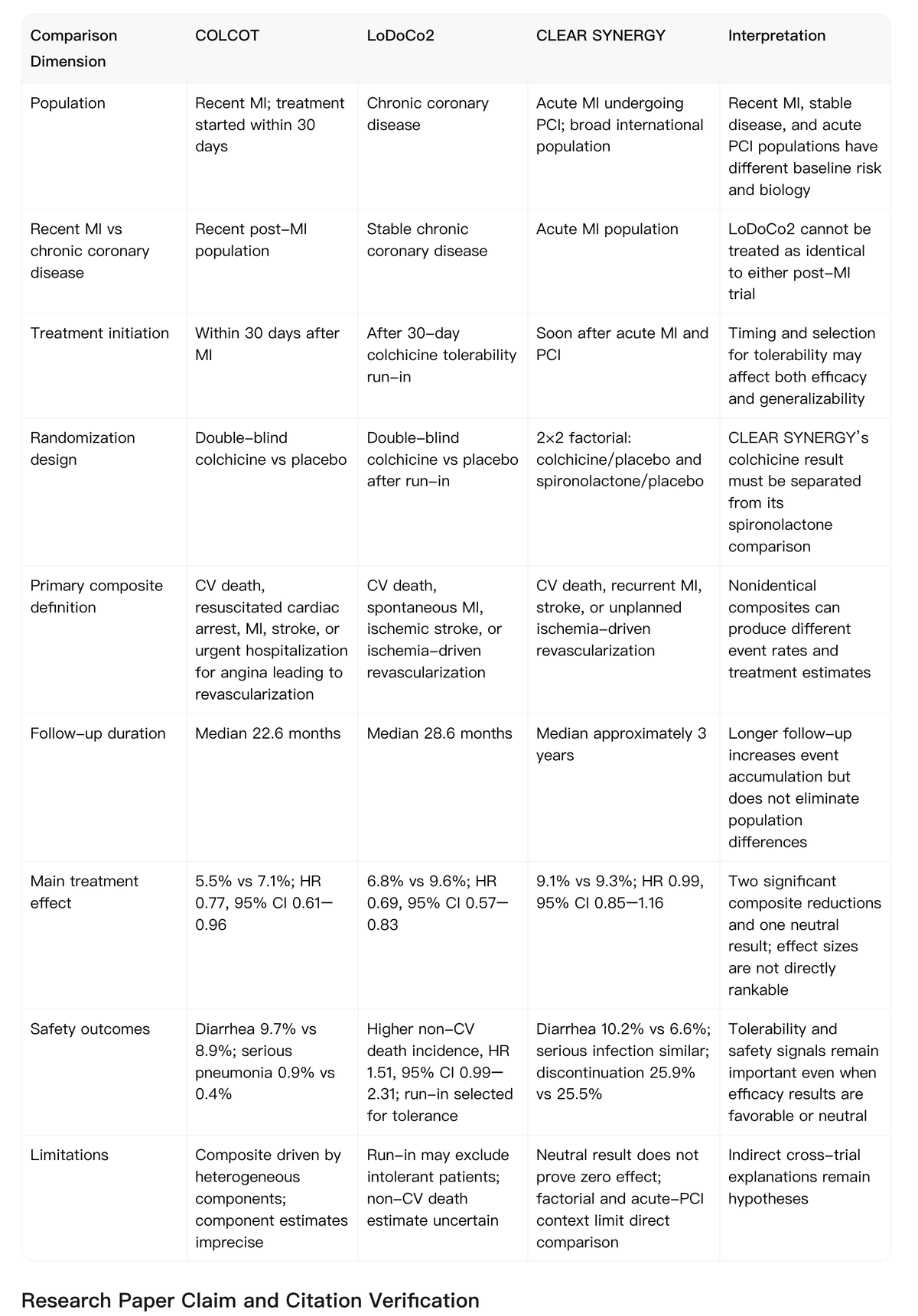
Figure 4. Noah cross-paper comparison including an interpretation column. It highlights why the three trials should not be treated as interchangeable.
Patient population and treatment timing
COLCOT enrolled people within 30 days after myocardial infarction, while LoDoCo2 studied chronic coronary disease and randomized patients who tolerated an initial colchicine run-in. CLEAR SYNERGY investigated acute myocardial infarction in PCI-treated patients and used a 2×2 factorial design with a separate spironolactone comparison. These distinctions affect the clinical questions each trial can answer. They are potential explanations for differing outcomes, not proven causal explanations derived from cross-trial comparison alone.
Composite outcomes and cardiovascular death
Both COLCOT and LoDoCo2 reported statistically significant reductions in their prespecified primary composite endpoints. That does not mean every component, including cardiovascular mortality, showed statistically significant benefit. CLEAR SYNERGY reported a neutral primary composite result despite measuring relevant anti-inflammatory activity. A sound review should separate observed clinical events from mechanistic explanations and from claims about individual endpoint components.
Safety, tolerability, and uncertainty
COLCOT reported serious pneumonia in 0.9% of patients receiving colchicine and 0.4% receiving placebo. LoDoCo2 reported a higher estimated incidence of noncardiovascular death with colchicine (HR 1.51; 95% CI 0.99–2.31), an imprecise signal that does not establish causation. CLEAR SYNERGY reported diarrhea in 10.2% versus 6.6%. Safety considerations belong in the comparison even when a researcher's primary interest is efficacy.
Five Checks for AI-Assisted Paper Comparison
- Confirm original paper identity. Search results can include editorials, systematic reviews, related subgroup analyses, and the pivotal randomized report. Verify the citation rather than accepting a title match.
- Match population to outcome. Recent myocardial infarction and stable chronic coronary disease are not identical clinical settings.
- Preserve each original composite endpoint. Compare the precise definitions instead of treating all cardiovascular composites as the same outcome.
- Keep statistical uncertainty. An HR without its confidence interval, time horizon, or trial context is insufficient for careful interpretation.
- Distinguish observation from explanation. Differences in treatment timing or trial design may help generate hypotheses, but separate trials do not isolate a causal explanation for conflicting findings.
Which Tool Fits Your Workflow?
| Research need | Relevant workflow | Important qualification |
|---|---|---|
| Search for research papers and explore related literature. | OpenRead paper search and its reading tools. | Verify that a result is an original study before including it in a comparison. |
| Compare multiple papers through a dedicated paper-reading workspace. | OpenRead Paper Compare, according to official product documentation. | Not executed in the captured session; account access and result quality were not assessed here. |
| Start with named original medical trials and require a clinical evidence matrix. | Noah AI Deep Research, as demonstrated in the supplied report. | The output still requires review against original publications and study-specific methods. |
| Determine whether divergent findings invalidate one another. | Critical reading of the original trials, supported by either tool. | Different endpoints and populations prevent simple cross-trial superiority rankings. |
Neither tool replaces a systematic review protocol, full risk-of-bias assessment, or clinical judgment. This illustrative example lacks the equal-task observations necessary to rank the platforms on clinical accuracy, citation fidelity, completeness, or speed.
Frequently Asked Questions
Does OpenRead support research paper comparison?
Yes. OpenRead's official homepage lists Paper Compare among its features and describes it as a way to compare findings across papers and flag agreement or contradiction. This article did not capture a completed Paper Compare report, so the feature's output quality and limits remain untested here.
What does the OpenRead screenshot actually show?
It shows an academic search-results page generated after a long colchicine comparison instruction was entered, with sorting and filtering controls and a Select multiple papers option. That is a discovery and selection stage, not an output from Paper Compare, and several visible cards are reviews or commentary rather than the three original trial reports.
What did Noah AI produce in the supplied research example?
A three-trial evidence matrix that tied each study's population, comparator, original primary endpoint, effect estimates, and PubMed identifier together, followed by a cross-trial interpretation table covering timing, design, endpoints, follow-up, safety, and limitations. It is one completed task, not evidence of universal accuracy.
Why did COLCOT and LoDoCo2 show benefit while CLEAR SYNERGY did not?
The trials studied different populations and used different composite endpoints: COLCOT enrolled patients early after myocardial infarction, LoDoCo2 enrolled chronic coronary disease after a tolerability run-in, and CLEAR SYNERGY tested acute myocardial infarction in PCI-treated patients with a factorial design. Those differences can help explain divergent results, but a cross-trial comparison cannot prove which factor caused them.
Can the hazard ratios be used to rank colchicine efficacy across trials?
No. HR 0.77, 0.69, and 0.99 come from different composite endpoints, populations, follow-up periods, and statistical margins, so placing them in a league table would compare non-equivalent outcomes. Compare each estimate against its own prespecified endpoint and confidence interval instead.
Is a linked PMID sufficient to verify a medical claim?
A PMID confirms which publication is being cited, not that the cited number, endpoint, or population interpretation is correct. Verification still requires opening the paper, checking the prespecified endpoint and analysis population, and confirming that the claim matches what the authors reported.
Final Assessment
OpenRead and Noah AI can occupy related but distinct parts of the research process. The captured OpenRead session demonstrates literature discovery and paper selection; its official Paper Compare feature offers a documented route to multi-paper analysis, but that output was not tested here. Noah AI's supplied Deep Research report demonstrates a structured, citation-marked three-trial comparison and an interpretation table for discordant evidence.
The practical lesson of the COLCOT, LoDoCo2, and CLEAR SYNERGY case is that credible paper comparison requires source identification, endpoint preservation, and careful handling of uncertainty. A fluent AI answer is not a substitute for those steps.
Build a Source-Grounded Research Comparison
Explore Noah AI for biomedical trial evidence tables and clinically qualified synthesis across original research papers.
Original Sources and Product Documentation
- Tardif JC et al. Efficacy and Safety of Low-Dose Colchicine after Myocardial Infarction. New England Journal of Medicine, 2019. PMID 31733140; DOI 10.1056/NEJMoa1912388.
- Nidorf SM et al. Colchicine in Patients with Chronic Coronary Disease. New England Journal of Medicine, 2020. PMID 32865380; DOI 10.1056/NEJMoa2021372.
- Jolly SS et al. Colchicine in Acute Myocardial Infarction. New England Journal of Medicine; online 2024, print issue 2025. PMID 39555823; DOI 10.1056/NEJMoa2405922.
- OpenRead. Official product homepage and Paper Compare description.
Method disclosure: OpenRead's actual captured screen shows paper search, not a completed Paper Compare report. Noah's captured report describes source checking using original PubMed records and accessible abstracts; complete supplementary appendices were not independently inspected. This article is an illustrative workflow comparison, not a systematic review, medical recommendation, or controlled benchmark.