10 Late-Stage Drugs to Watch in 2026: Phase III Results and Clinical Outlook
Linda
Track 10 late-stage drugs to watch in 2026 across Phase III results, approvals, regulatory reviews, safety, and upcoming clinical milestones.
Data cutoff: October 9, 2026.
Ten high-impact programs show how pivotal evidence, safety, regulatory review, approval decisions, and clinical differentiation are reshaping late-stage drug development in 2026.
Late-stage development is where a promising mechanism must survive the harder tests of drug development: pivotal randomized evidence, clinically meaningful endpoints, a defined safety profile, regulatory scrutiny, and—in some cases—the transition from investigational asset to approved therapy.
This review tracks retatrutide, survodutide, orforglipron, icotrokinra, sibeprenlimab, tozorakimab, depemokimab, fenebrutinib, mezigdomide, and gedatolisib.
The drugs are not ranked. Each is assessed using the same framework: mechanism, lead indication, pivotal evidence, efficacy, safety, development status, and the main unresolved question.
To make fast-moving development status easier to interpret, every asset is assigned one of four labels at the October 9, 2026 cutoff:
- APPROVED
- UNDER REVIEW
- SPONSOR-REPORTED PHASE III
- TRIAL ONGOING
1. Late-Stage Drugs to Watch in 2026
The first view is a high-level development tracker.
The ten assets differ substantially in evidence maturity. Some have already crossed into FDA approval, several are under regulatory review, one remains defined primarily by sponsor-reported Phase III results, and another continues through an active late-stage clinical-development program.
| Drug | Lead Area | Key 2026 Evidence | Status as of Oct 9, 2026 |
|---|---|---|---|
| Retatrutide | Obesity / cardiometabolic disease | Positive TRIUMPH Phase III readouts | **SPONSOR-REPORTED PHASE III** |
| Survodutide | Obesity / metabolic liver disease | Published SYNCHRONIZE Phase III evidence | **TRIAL ONGOING** |
| Orforglipron | Obesity / overweight | FDA approval for chronic weight management | **APPROVED** |
| Icotrokinra | Plaque psoriasis | Phase III program followed by FDA approval | **APPROVED** |
| Sibeprenlimab | IgA nephropathy | Accelerated approval based on proteinuria reduction | **APPROVED** |
| Tozorakimab | COPD | Positive Phase III OBERON/TITANIA; BLA under Priority Review | **UNDER REVIEW** |
| Depemokimab | Severe eosinophilic asthma | SWIFT pivotal program; FDA approval | **APPROVED** |
| Fenebrutinib | Multiple sclerosis | Three positive Phase III studies; NDA under Priority Review | **UNDER REVIEW** |
| Mezigdomide | Multiple myeloma | Positive SUCCESSOR-2 Phase III; NDA accepted | **UNDER REVIEW** |
| Gedatolisib | HR+/HER2− breast cancer | Positive VIKTORIA-1 evidence followed by FDA approval | **APPROVED** |
2. Individual Drug Profiles
Retatrutide — Eli Lilly
Status: SPONSOR-REPORTED PHASE III
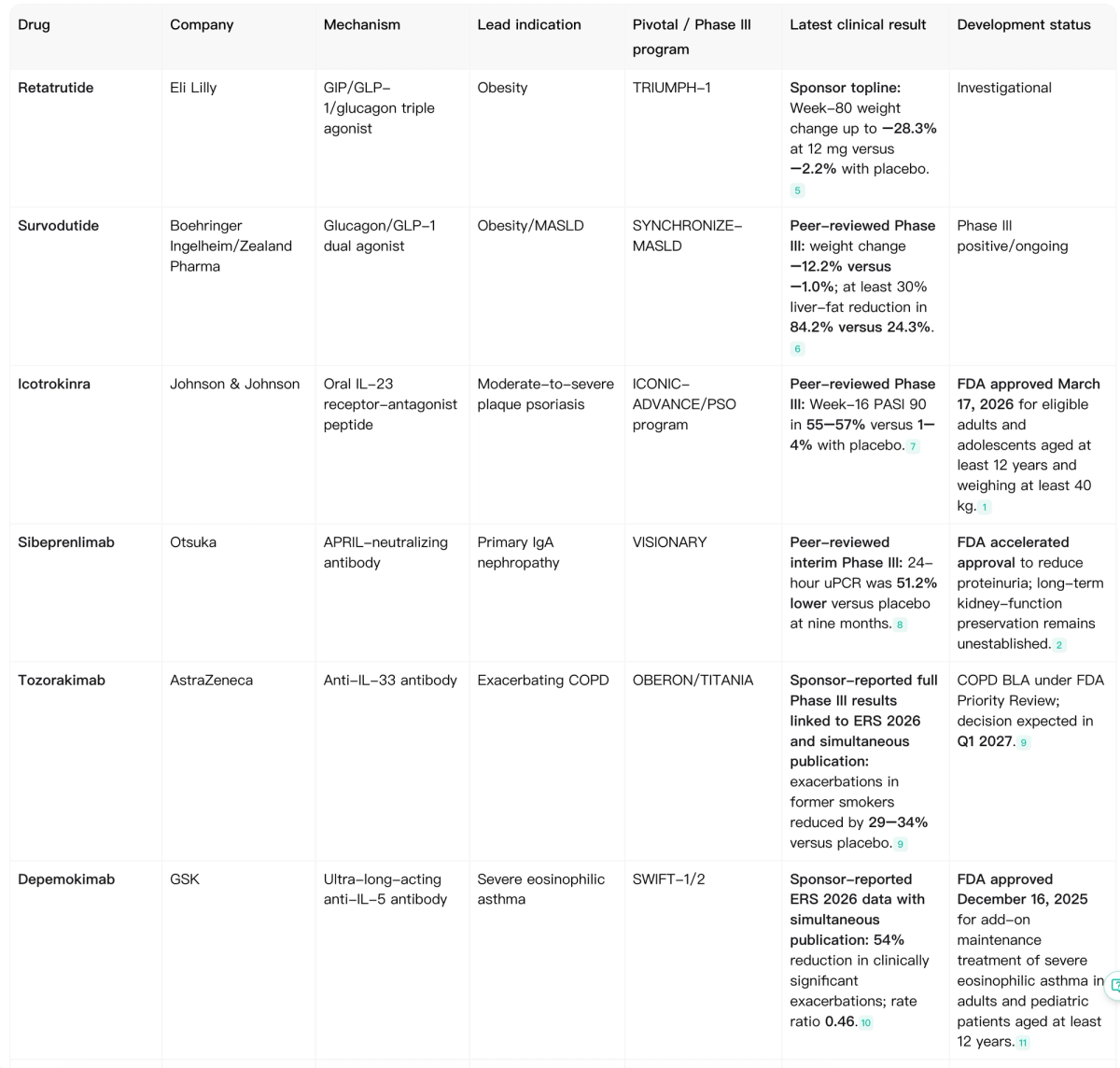
Mechanism. Retatrutide is a once-weekly GIP/GLP-1/glucagon triple agonist designed to combine incretin-mediated appetite and glycemic effects with glucagon-mediated effects on energy expenditure and hepatic metabolism.
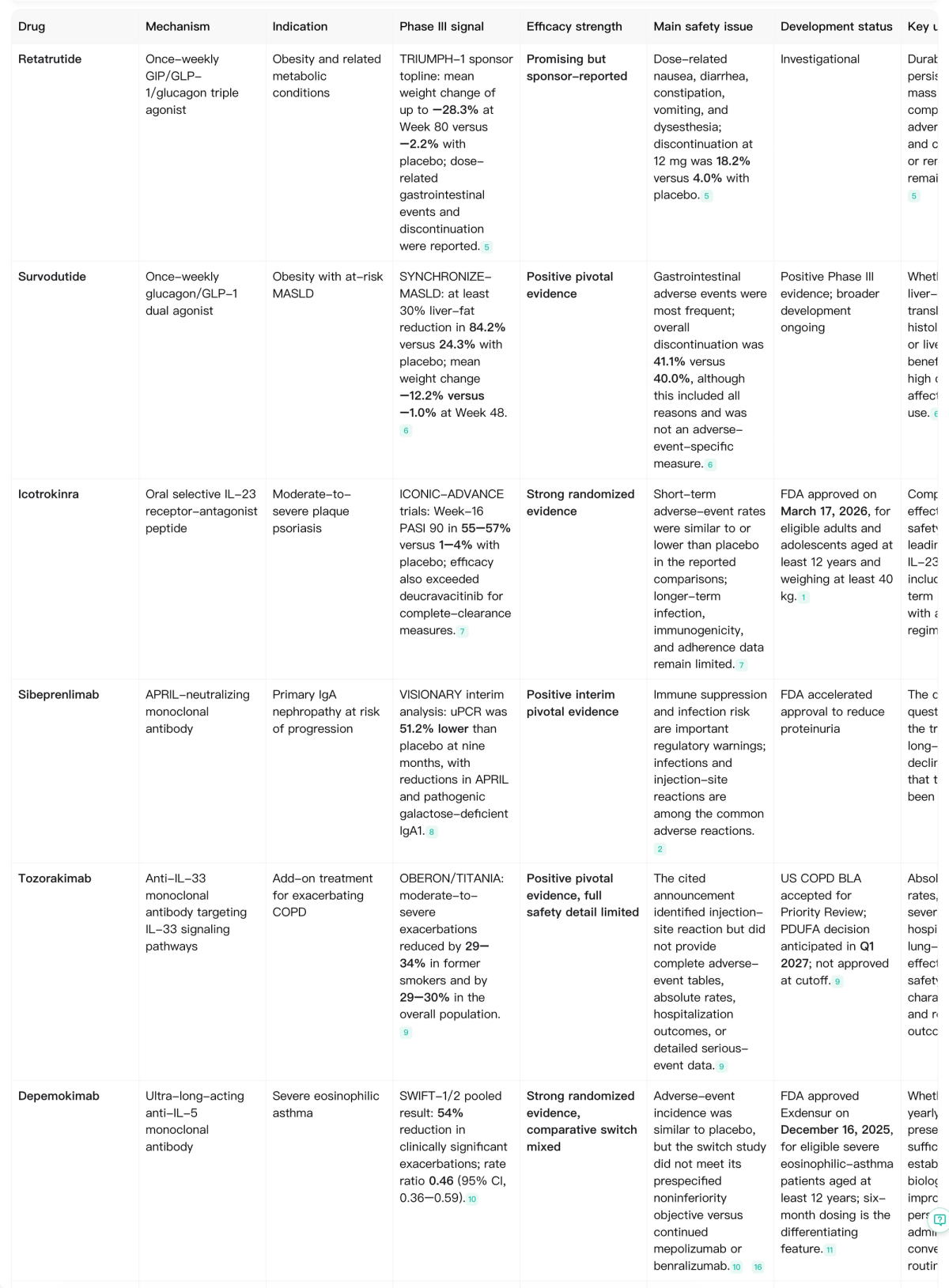
Lead indication and pivotal evidence. The lead program is chronic weight management. Lilly reported positive Phase III results across the TRIUMPH program. In TRIUMPH-1, mean body-weight change at Week 80 reached up to 28.3% at the 12 mg dose versus 2.2% with placebo.
Additional positive TRIUMPH-2 and TRIUMPH-3 topline results expanded the late-stage package into populations with type 2 diabetes and established cardiovascular disease.
Safety and uncertainty. Gastrointestinal adverse events and treatment discontinuation increased with dose. The key questions are durability, persistence outside clinical trials, complete long-term safety characterization, regulatory review after submission, and whether cardiovascular or renal outcomes ultimately reinforce the magnitude of the weight-loss signal.
Status as of October 9, 2026: SPONSOR-REPORTED PHASE III
Survodutide — Boehringer Ingelheim / Zealand Pharma
Status: TRIAL ONGOING
Mechanism. Survodutide is a once-weekly glucagon/GLP-1 dual agonist being developed for obesity and metabolic liver disease.
Phase III evidence. In the published Phase III SYNCHRONIZE-MASLD trial, at least a 30% reduction in liver fat occurred in 84.2% of participants receiving survodutide versus 24.3% with placebo.
Mean body-weight change was −12.2% with survodutide versus −1.0% with placebo at Week 48 using the efficacy estimand.
The study supports activity across both metabolic weight reduction and liver-fat reduction.
Key uncertainty. The more important development question is whether improvements in liver fat, weight, and noninvasive liver markers translate into durable histologic, fibrosis, liver-event, and broader cardiometabolic benefits.
Long-term tolerability and treatment persistence also remain important as the broader SYNCHRONIZE program continues.
Status as of October 9, 2026: TRIAL ONGOING
Orforglipron — Eli Lilly
Status: APPROVED
Mechanism. Orforglipron is an oral, nonpeptide GLP-1 receptor agonist developed for chronic weight management and related metabolic indications.
Late-stage and regulatory evidence. Following its Phase III development program, the FDA approved orforglipron on April 1, 2026 for chronic weight management in adults with obesity or adults with overweight and at least one weight-related comorbid condition, in combination with reduced-calorie diet and increased physical activity.
The approval is important strategically because it brings an oral small-molecule treatment format into a market that has been reshaped by injectable incretin therapies.
Clinical outlook and uncertainty. The key questions now shift from whether the drug can clear regulatory review to:
- real-world persistence;
- gastrointestinal tolerability;
- access and reimbursement;
- comparative effectiveness;
- and whether oral administration translates into a meaningful adherence or treatment-experience advantage versus injectable incretin therapies.
Status as of October 9, 2026: APPROVED
Icotrokinra — Johnson & Johnson
Status: APPROVED
Mechanism. Icotrokinra is an oral selective IL-23 receptor-antagonist peptide developed for moderate-to-severe plaque psoriasis.
Phase III evidence. In the ICONIC-ADVANCE studies, Week-16 PASI 90 responses reached approximately 55–57% versus 1–4% with placebo. Reported comparisons also showed stronger complete-clearance measures than deucravacitinib.
Development status. The FDA approved icotrokinra on March 17, 2026 for moderate-to-severe plaque psoriasis in eligible patients aged 12 years and older who weigh at least 40 kg.
The remaining competitive question is whether oral administration can produce durable adherence and treatment-experience advantages without sacrificing longer-term effectiveness or safety relative to leading injectable IL-23 biologics.
Status as of October 9, 2026: APPROVED
Sibeprenlimab — Otsuka
Status: APPROVED
Mechanism. Sibeprenlimab is an APRIL-neutralizing monoclonal antibody developed for primary IgA nephropathy.
Clinical and regulatory evidence. In the VISIONARY program, treatment produced a substantial reduction in proteinuria relative to placebo.
The FDA granted accelerated approval to sibeprenlimab for reducing proteinuria in adults with primary IgA nephropathy at risk for disease progression.
Key uncertainty. Proteinuria is a surrogate endpoint.
The decisive longer-term question is whether the treatment slows kidney-function decline and whether confirmatory evidence supports conversion from accelerated to traditional approval.
This makes sibeprenlimab a useful example of why APPROVED does not necessarily mean that every clinically important outcome has already been established.
Status as of October 9, 2026: APPROVED
Tozorakimab — AstraZeneca
Status: UNDER REVIEW
Mechanism. Tozorakimab is an anti-IL-33 monoclonal antibody being developed for patients with COPD who continue to experience exacerbations despite inhaled standard-of-care therapy.
Phase III evidence. The OBERON and TITANIA Phase III trials reported statistically significant reductions in moderate-to-severe COPD exacerbations.
Full results subsequently showed approximately 29–34% reductions in exacerbations in former smokers, with favorable directional effects in the broader population.
Additional positive Phase III evidence was generated in MIRANDA.
Development status. The U.S. Biologics License Application for tozorakimab in COPD has been accepted under FDA Priority Review.
Key uncertainty. Important questions remain around:
- absolute event reduction;
- hospitalization;
- lung-function effects;
- longer-term safety;
- real-world patient selection;
- and the final regulatory decision.
Status as of October 9, 2026: UNDER REVIEW
Depemokimab — GSK
Status: APPROVED
Mechanism. Depemokimab is an ultra-long-acting anti-IL-5 monoclonal antibody designed for twice-yearly administration.
Clinical evidence. SWIFT-1 and SWIFT-2 showed a pooled 54% reduction in clinically significant exacerbations versus placebo in severe eosinophilic asthma.
Development status and uncertainty. The FDA approved depemokimab in December 2025 as an add-on maintenance treatment for severe asthma with an eosinophilic phenotype in eligible patients aged 12 years and older.
Its most visible practical differentiation is the six-month dosing interval.
However, dosing convenience does not eliminate questions around comparative effectiveness. The NIMBLE switch study did not meet its prespecified noninferiority objective versus continued mepolizumab or benralizumab, leaving treatment switching, comparative effectiveness, and real-world persistence as important questions.
Status as of October 9, 2026: APPROVED
Fenebrutinib — Roche
Status: UNDER REVIEW
Mechanism. Fenebrutinib is an oral, reversible, non-covalent, CNS-penetrant BTK inhibitor designed to target both peripheral B-cell biology and CNS-compartmentalized inflammatory activity in multiple sclerosis.
Phase III evidence. The Phase III FENhance 1 study showed a 51.1% reduction in annualized relapse rate versus teriflunomide, while FENhance 2 reported a 58.5% reduction.
FENtrepid also generated positive Phase III evidence in primary progressive multiple sclerosis.
Development status. On September 30, 2026, Roche announced that the FDA had accepted the fenebrutinib NDA under Priority Review for both relapsing multiple sclerosis and primary progressive multiple sclerosis.
Key uncertainty. The benefit-risk assessment will depend on the complete safety package, interpretation of previously reported mortality and adverse-event imbalances, and whether efficacy across both relapsing and progressive MS supports a differentiated regulatory profile.
Status as of October 9, 2026: UNDER REVIEW
Mezigdomide — Bristol Myers Squibb
Status: UNDER REVIEW
Mechanism. Mezigdomide is an oral CELMoD / cereblon E3-ligase modulator for relapsed or refractory multiple myeloma.
Phase III evidence. In SUCCESSOR-2, median progression-free survival was 18.0 months with mezigdomide plus carfilzomib and dexamethasone versus 8.3 months with carfilzomib and dexamethasone alone.
The hazard ratio was 0.48, representing a substantial reduction in the risk of disease progression or death.
Safety and status. Grade 3–4 neutropenia and infections were more common with the mezigdomide-containing regimen.
The FDA accepted the NDA in July 2026, with a PDUFA target action date of May 13, 2027.
Overall survival remains immature, making longer-term efficacy and hematologic toxicity management important parts of the eventual benefit-risk assessment.
Status as of October 9, 2026: UNDER REVIEW
Gedatolisib — Celcuity
Status: APPROVED
Mechanism. Gedatolisib is an intravenous dual PI3K/mTOR inhibitor developed for HR-positive/HER2-negative advanced breast cancer.
Phase III evidence. In the PIK3CA-wild-type VIKTORIA-1 population, median progression-free survival reached 9.3 months for the triplet versus 2.0 months with fulvestrant, with a hazard ratio of 0.24.
Additional randomized data in PIK3CA-mutant disease also supported activity relative to alpelisib plus fulvestrant.
Development status and uncertainty. The FDA approved gedatolisib on July 14, 2026 in combination with fulvestrant, with or without palbociclib, for eligible adults with HR-positive/HER2-negative locally advanced or metastatic breast cancer without a detected PIK3CA mutation.
Mature overall survival, quality of life, treatment complexity, and potential expansion into additional molecular populations remain important questions.
Status as of October 9, 2026: APPROVED
3. Late-Stage Drug Comparison
A second view puts the ten programs side by side by pivotal signal, evidence maturity, safety burden, regulatory status, and unresolved risk.
This is the more decision-oriented comparison because positive Phase III evidence alone does not determine clinical value.
| Drug | Pivotal Signal | Evidence Maturity | Main Remaining Risk | Status |
|---|---|---|---|---|
| Retatrutide | Very large weight-loss effect | Multiple positive sponsor-reported Phase III studies | Long-term safety, regulatory review, durability | **SPONSOR-REPORTED PHASE III** |
| Survodutide | Liver-fat and weight reduction | Published Phase III evidence | Histology, fibrosis, long-term outcomes | **TRIAL ONGOING** |
| Orforglipron | Positive obesity Phase III program | Regulatory approval | Persistence, tolerability, access, injectable competition | **APPROVED** |
| Icotrokinra | Strong psoriasis clearance responses | Regulatory approval | Long-term oral-vs-biologic positioning | **APPROVED** |
| Sibeprenlimab | Major proteinuria reduction | Accelerated approval | Confirmatory kidney-function benefit | **APPROVED** |
| Tozorakimab | Reduced COPD exacerbations | Published Phase III + regulatory filing | Final benefit-risk and approval outcome | **UNDER REVIEW** |
| Depemokimab | Reduced severe asthma exacerbations | Regulatory approval | Comparative effectiveness and switching | **APPROVED** |
| Fenebrutinib | Reduced RMS relapses; PPMS activity | Three positive Phase III studies + filing | Safety and final regulatory assessment | **UNDER REVIEW** |
| Mezigdomide | Large PFS improvement | Phase III + NDA accepted | Hematologic toxicity and immature OS | **UNDER REVIEW** |
| Gedatolisib | Large PFS improvement in selected breast cancer | Regulatory approval | OS maturity, complexity, broader positioning | **APPROVED** |
4. What the 2026 Late-Stage Pipeline Is Telling Us
Several development themes cut across these assets.
Route of Administration Is Becoming a Competitive Variable
Oral convenience is increasingly important, but route alone does not replace efficacy.
Orforglipron and icotrokinra demonstrate how oral therapies can create differentiated treatment formats once late-stage evidence translates into approval.
Retatrutide, by contrast, illustrates that injectable therapies can still create large clinical signals when efficacy is sufficiently differentiated.
Lower Treatment Burden Still Needs Comparative Evidence
Depemokimab shows the appeal of substantially less frequent dosing.
But a six-month dosing interval does not automatically establish better overall treatment value than established therapies.
Comparative effectiveness, switching data, adherence, persistence, and patient preference still matter.
Biomarker-Defined Development Is Producing Narrower Regulatory Identities
Gedatolisib illustrates how late-stage oncology development can generate highly specific regulatory positioning defined by:
- disease subtype;
- molecular status;
- prior treatment;
- and combination regimen.
A large pivotal effect may therefore lead to an important approval without producing a broad all-comer indication.
Surrogate Endpoints Can Accelerate Access Before the Clinical Story Is Complete
Sibeprenlimab highlights the distinction between regulatory access and complete clinical validation.
Accelerated approval based on proteinuria reduction creates earlier patient access, but long-term kidney-function preservation remains a critical confirmatory question.
Large Clinical Effects Still Have to Survive Safety Scrutiny
Retatrutide, fenebrutinib, mezigdomide, and other late-stage programs show why efficacy magnitude is only one part of late-stage evaluation.
A strong pivotal signal must still be interpreted alongside:
- treatment discontinuation;
- serious adverse events;
- hematologic or organ-specific toxicity;
- longer-term safety;
- and regulatory benefit-risk assessment.
Approval Does Not Remove Uncertainty
At the October 9, 2026 cutoff:
APPROVED
- Orforglipron
- Icotrokinra
- Sibeprenlimab
- Depemokimab
- Gedatolisib
UNDER REVIEW
- Tozorakimab
- Fenebrutinib
- Mezigdomide
SPONSOR-REPORTED PHASE III
- Retatrutide
TRIAL ONGOING
- Survodutide
The status label therefore answers only one question:
Where is the asset in development or regulation?
It does not answer:
How differentiated, durable, safe, or commercially important will the therapy ultimately be?
5. What to Watch Next
Retatrutide
Watch for regulatory submission, additional full Phase III publications, complete safety datasets, and longer-term cardiometabolic outcomes.
Survodutide
Watch for additional SYNCHRONIZE results and evidence linking liver-fat and metabolic improvements to histology, fibrosis regression, liver events, and longer-term outcomes.
Orforglipron
Watch post-approval uptake, gastrointestinal tolerability, persistence, payer access, and comparative effectiveness versus injectable incretin therapies.
Icotrokinra
Watch longer-term safety, adherence, persistence, and real-world positioning relative to injectable IL-23 therapies and other oral systemic options.
Sibeprenlimab
Watch confirmatory eGFR and kidney-function data needed to establish whether proteinuria reduction translates into durable clinical benefit.
Tozorakimab
Watch the FDA review outcome, additional hospitalization and lung-function analyses, longer-term safety, and eventual positioning within COPD treatment.
Depemokimab
Watch post-approval persistence, uptake of twice-yearly dosing, switching behavior, and interpretation of the NIMBLE comparative evidence.
Fenebrutinib
Watch the FDA Priority Review, complete benefit-risk evaluation, safety scrutiny, and whether one oral BTK inhibitor can achieve regulatory positioning across both relapsing and primary progressive MS.
Mezigdomide
Watch the FDA review ahead of the May 13, 2027 PDUFA date, mature overall survival, and management of neutropenia and infection risk.
Gedatolisib
Watch mature overall survival, quality-of-life evidence, treatment complexity, real-world adoption, and possible expansion into PIK3CA-mutant disease.
6. Bottom Line
The most important late-stage drug stories in 2026 are not simply about whether a pivotal endpoint was positive.
They are about whether the magnitude of benefit survives closer examination of:
- toxicity;
- durability;
- comparator choice;
- regulatory scope;
- implementation burden;
- and competitive positioning.
A large treatment effect can coexist with substantial toxicity.
An approved drug can still have unresolved confirmatory or comparative questions.
A convenient dosing schedule can remain clinically uncertain relative to an established comparator.
A surrogate endpoint can support accelerated access while leaving the decisive long-term outcome unresolved.
And an investigational therapy can generate striking Phase III results while remaining months away from regulatory submission.
That is why late-stage drug tracking requires more than reading headline trial results.
The most useful workflow keeps clinical evidence, evidence maturity, regulatory status, safety, and next milestones visible at the same time.
Track Late-Stage Assets and Upcoming Milestones with Noah AI
Use Noah AI to track Phase III readouts, regulatory reviews, approvals, safety updates, competitive programs, and upcoming clinical milestones across late-stage drug development.
Build source-linked biopharma research workflows that keep evidence maturity and development status visible as programs change.
Free to use · Free credits included · No credit card required
Track Late-Stage Drug Programs with Noah AI →