Is There an AI Search Engine for PubMed?
Linda
Yes, AI search engines for PubMed exist. Learn what they are, how they work, and how AI tools can help you search and analyze biomedical literature faster.
Yes. Several AI-powered tools can now search PubMed — or databases that include PubMed content — and go beyond returning a list of papers. They can understand natural-language questions and synthesize findings from multiple papers into structured summaries.
This article is for researchers who are new to the idea of AI-powered literature search. We'll explain the problem these tools solve, how they work, and what options are available.
The Problem: Why PubMed Search Is Hard
PubMed contains a very large biomedical literature database. Finding the right papers often requires Boolean operators, MeSH terms, field tags, filters, and repeated query refinement.
Even experienced searchers can struggle with the trade-off between a query that is too broad and one that is too narrow. After retrieval, researchers still need to screen and synthesize the evidence.
For researchers who search PubMed occasionally or outside their primary specialty, this learning curve can become a real barrier. This is the problem AI search engines try to reduce.
How AI Search Engines for PubMed Work
AI-powered PubMed search tools generally follow a three-stage process:
- Stage 1: Query understanding. You type a research question in plain English. The system interprets the main concepts in your question.
- Stage 2: Search-term construction and search. The system converts the question into a more focused PubMed search term and retrieves matching biomedical literature.
- Stage 3: Results synthesis. Instead of returning only a list of titles, the tool can organize the retrieved evidence into a structured answer or brief with citations.
Noah AI: A Purpose-Built Example
Noah AI is one example of a biomedical literature-search workflow built around PubMed. A typical flow is:
Agent → Search → PubMed Search
You enter a research question in natural language. Noah then shows the PubMed search process and returns a structured evidence summary with linked citations that can be checked against the original papers.
Demo: Robotic vs Laparoscopic Colorectal Surgery
Query to enter in Noah AI (Agent → Search → PubMed Search)
What does the evidence show about robotic-assisted versus conventional laparoscopic surgery for colorectal cancer in terms of oncological outcomes, conversion rates, and postoperative recovery?
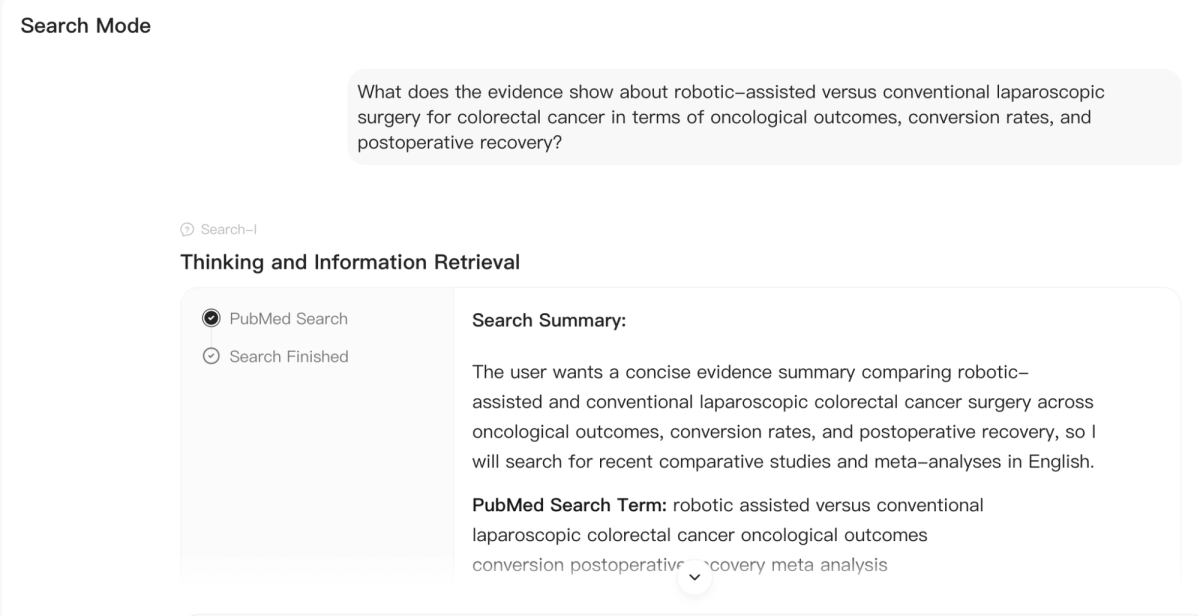
Figure 1. Noah AI processing a natural-language question on robotic versus laparoscopic colorectal surgery and generating a focused PubMed search term.
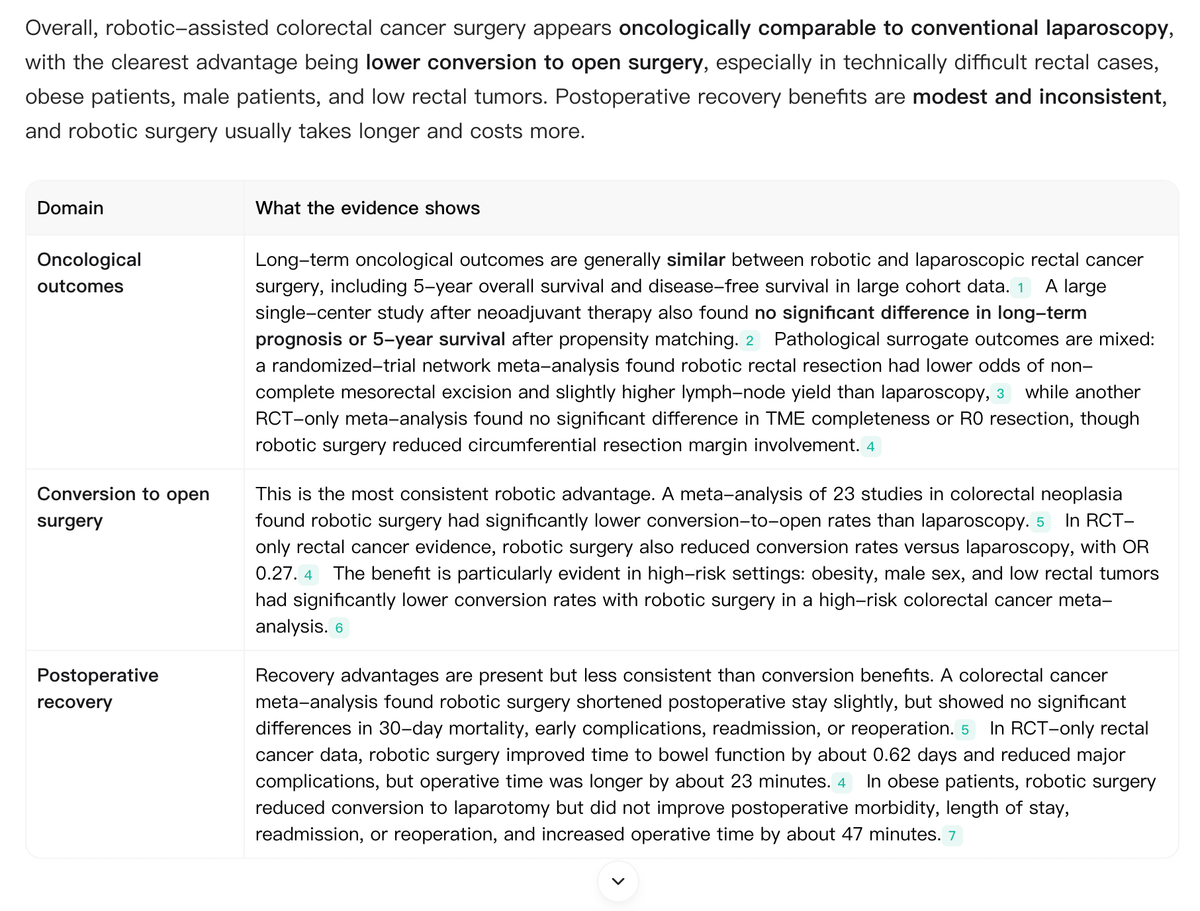
Figure 2. Noah AI structured evidence summary comparing robotic and laparoscopic colorectal surgery across oncological outcomes, conversion to open surgery, and postoperative recovery.
Other AI Tools That Work with PubMed Content
Consensus focuses on answering research questions with literature-backed directional summaries.
Elicit is useful for extracting structured information from papers into evidence tables.
Semantic Scholar supports academic discovery with related-paper and citation-based exploration.
For a more detailed comparison, see Best AI PubMed Search Tools in 2026 or Best PubMed AI Search Engines in 2026.
What AI Search Engines Can and Cannot Do
What they can do: Understand natural-language questions, generate focused search terms, retrieve biomedical literature, synthesize findings across multiple papers, and provide citations that can be checked.
What they cannot do: Replace careful reading of primary sources, guarantee complete retrieval of all relevant papers, replace formal reproducible search strategies for systematic reviews, or eliminate the need for critical appraisal.
AI search engines are best treated as tools that reduce manual work in literature search and initial synthesis, not as replacements for researcher judgment.
Try Noah AI for Free
Use Noah AI to search, compare, and analyze biomedical evidence with AI-powered research workflows.
Free credits are available, and no credit card is required to get started.
FAQ
Are AI PubMed search engines free?
Some tools offer free access or free tiers, while others use paid plans or usage limits. Pricing and feature access can change over time.
Do AI search engines replace PubMed itself?
No. They add an AI layer on top of PubMed or broader academic databases. PubMed remains important for direct database searching and reproducible search workflows.
Can I trust AI-generated summaries of medical literature?
Use them as a starting point, then verify important findings against the cited original papers. AI summaries can omit nuance or incompletely represent study limitations.
How are these different from using a general AI assistant?
Purpose-built literature tools are designed around research retrieval and citation workflows, while general AI assistants are broader and may be better suited to brainstorming, drafting, or general analysis.