How to Identify Unsupported Causal Claims with AI (2026)
Linda
Learn how to identify unsupported causal claims in observational medical studies with AI. Explore real study evidence, causal language, and safer conclusions.
A three-prompt Noah AI workflow for reviewing observational research, separating association from causation, and revising conclusions without misrepresenting the evidence.Research methodology · Case study: UK Biobank step count and incident dementia · Source-grounded exampleIt can take just one verb to change the interpretation of a scientific finding. A paper may report that an exposure was associated with an outcome, while a summary of the same work declares that the exposure prevents the outcome. Those sentences make different claims, even if they refer to the same statistical estimate.For medical researchers, the challenge is not to eliminate strong conclusions. It is to make every conclusion proportionate to the study design, the data, and the remaining uncertainty. An AI-assisted claim audit can help organize that review, provided the underlying paper is checked and an author retains responsibility for the edits.Key distinction: This workflow audits the language of a published observational study. It does not claim that the original authors made unsupported statements throughout the paper, and it does not establish whether walking causally prevents dementia.
What Is an Overclaim in Medical Research?
An overclaim occurs when a statement implies more than the available evidence justifies. In observational medicine, it often involves causal wording, extending findings beyond the studied population, or presenting model-dependent results as certain recommendations.
- Causal overclaim: Turning an observed exposure–outcome association into an assertion that changing the exposure produces the outcome.
- Overgeneralization: Assuming results from a selected cohort directly apply to all patients, age groups, or care settings.
- Overstated certainty: Treating a model estimate or single-study finding as a proven threshold, clinical prescription, or universal rule.
Not every mention of a possible preventive implication is an overclaim. Expressions such as may, suggest, and associated with matter, and an audit should preserve the exact context rather than search for trigger words alone.
Why Study Design Sets the Limit on Your Claims
Consider a real JAMA Neurology cohort study of 78,430 UK Biobank adults. Participants wore wrist accelerometers, and dementia outcomes were subsequently ascertained through linked health records. Over a median 6.9 years, 866 participants developed dementia. The investigators used adjusted Cox models with restricted cubic splines to examine daily step counts and stepping intensity.(1)The fitted model identified approximately 9,826 steps per day as the exposure value with the strongest inverse association with incident dementia, with a reported hazard ratio of 0.49 (95% CI 0.39–0.62). That is a model-based observational estimate—not evidence that instructing someone to walk 9,826 steps will prevent 51% of dementia cases.Randomized studies can provide stronger support for certain causal effects because intervention assignment is controlled, although they too have design and generalizability limits. Observational studies can contribute to causal inference under suitable methods and assumptions, but an adjusted cohort association alone does not settle unmeasured confounding or reverse causation.
What the cohort can and cannot establish
| Supported by this study | Not established by this study |
|---|---|
| Daily steps were associated with subsequent recorded dementia incidence. | A prescribed daily-step intervention causally prevents dementia. |
| The association varied across measured step volume and intensity. | A unique, clinically optimal preventive dose has been validated. |
| Associations persisted in reported sensitivity analyses. | All residual confounding or preclinical reverse causation was eliminated. |
| Results describe the analyzed UK Biobank cohort. | The same estimates necessarily apply to every population or patient. |
Relevant limits include activity measured during a short baseline interval, possible preclinical cognitive change influencing mobility, outcome identification through records, and the selected nature of UK Biobank participation. The researchers themselves discuss important qualifications; a fair audit must acknowledge those statements.(1)
Why Causal Language Slips Into Conclusions
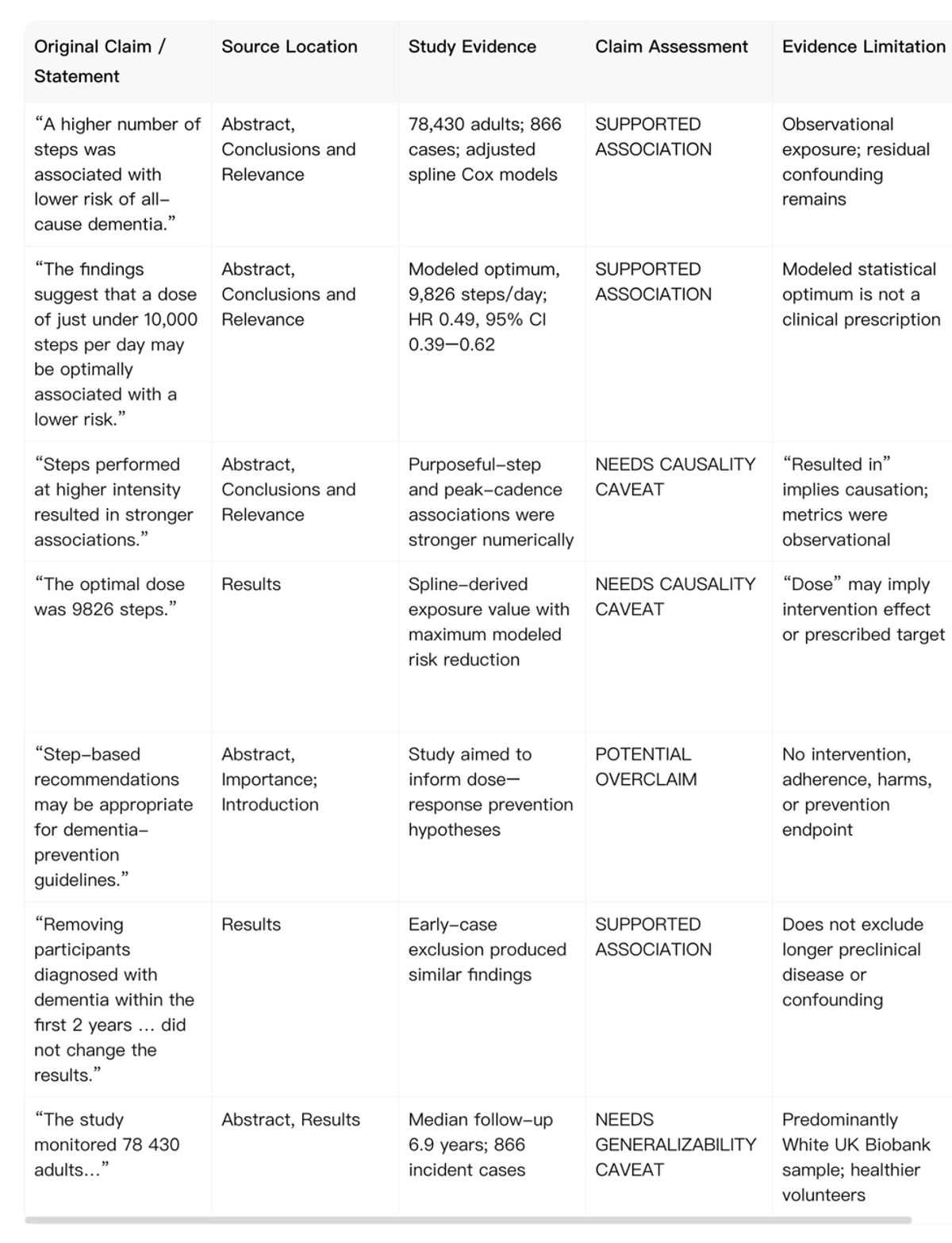
Medical writing often moves from a technical Results section into a shorter, more accessible Abstract or Conclusion. During compression, the distinction between an observed association and a causal effect can become less visible.In the step-count paper, the authors' principal conclusion is already appropriately cautious. One sentence, however, uses the phrase “Steps performed at higher intensity resulted in stronger associations.” The object of that sentence remains associations, so it is not proof that the authors claimed walking intensity prevents dementia. Still, resulted in may sound causal to readers. A clearer alternative is to say that higher-intensity measures showed stronger inverse associations in the adjusted models.The report also uses the expression “The optimal dose was 9826 steps” in a model-specific context. The paper defines this statistically, but an isolated excerpt can sound like a prescribed treatment target. The responsible fix is to retain the numerical estimate and explain that it represents the modeled exposure value, not an intervention-tested recommendation.Replacing every mention of association with weaker language would be a mistake. The goal is precise alignment, not blanket hedging.
How to Reframe Conclusions With Noah AI: A Three-Prompt Workflow
This example uses Noah AI to help audit a publicly available medical paper. The workflow separates three tasks: identify possible inference problems, develop evidence-based revisions, and check consistency across manuscript sections. It is a review aid, not an automated causal-inference validation system.
Step 1. Identify Potentially Overstated Claims
Start with the paper's PMID or DOI and a specific research question. Ask Noah to read the actual Abstract, Results, Discussion, and Conclusion; quote only verified source wording; and distinguish clearly supported association language from statements requiring a causal or generalizability caveat.
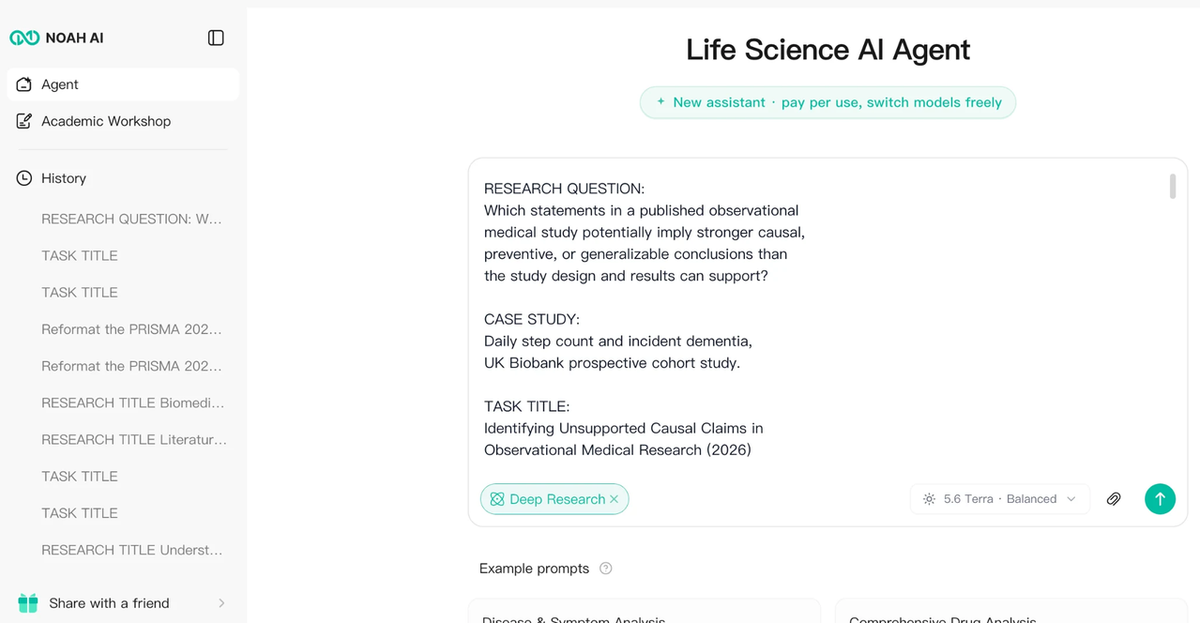
The audit should capture each claim's location and the statistics that may—or may not—support it. In this case, Noah returned both statements that were already defensibly worded and phrases that warranted closer interpretation. That distinction matters more than the number of flags.
Step 2. Reframe Each Flagged Sentence Without Changing the Finding
For every genuinely questionable phrase, request a revision that preserves the study's design, numerical results, and reported uncertainty. If a sentence already expresses an association accurately, a valid outcome is no change needed.
| Finding in the original report | Editorial action | Why |
|---|---|---|
| Higher daily steps were associated with lower recorded dementia incidence. | Keep associational wording. | The statement accurately reflects the cohort design. |
| Higher-intensity steps were described using causal-sounding language. | Say the metrics showed stronger adjusted associations. | Intensity was observed rather than randomly assigned. |
| Roughly 9,826 steps was called an optimal dose. | Identify it as a modeled exposure value. | No clinical preventive step target was tested. |
| The study reported 78,430 participants. | Keep the factual sample statement. | Generalizability needs separate discussion; the count is not itself an overclaim. |
In the Noah analysis, one generalizability flag attached to a straightforward sample-size description. That should not be treated as a proven error in the published sentence. The scientifically relevant question is whether any later conclusion extrapolates beyond the sampled participants.
Review research claims with Noah AI
Get 200 free credits when you sign up. No credit card required. Use the Agent to organize source evidence and review possible inference gaps.Try Noah AI — 200 Free Credits
Step 3. Check the Abstract, Results, Discussion, and Conclusion Together
A careful revision should not create a new contradiction. The same finding may appear in the Abstract, the end of the Discussion, a plain-language summary, and a manuscript Conclusion. Ask Noah to map those occurrences and list only changes that the source evidence justifies.In the study examined here, the main association language was largely consistent. The areas most worth editorial attention were the meaning of a modeled “optimal” value, the phrase “resulted in,” and how far prevention-oriented statements could reasonably extend. The article did not demonstrate a randomized effect of assigning participants a step target.An effective cross-section audit therefore produces both revised sentences and a record of wording that should remain unchanged. Researchers should compare those proposals against the original PDF and relevant supplementary analyses before accepting them.
What the Statistical Evidence Actually Means
The reported hazard ratio of 0.49 should be read as a relative hazard estimate from an adjusted model at a specific modeled exposure level. It is not an absolute reduction in dementia incidence, nor the percentage of dementia cases a walking program would prevent.Although the study adjusted for measured covariates and excluded early dementia diagnoses in sensitivity analyses, relevant alternatives remain possible: healthier participants may walk more, prodromal neurological changes may reduce activity before diagnosis, and baseline device readings may not represent activity throughout years of follow-up.The STROBE reporting checklist recommends a cautious overall interpretation that considers limitations and generalizability. STROBE is a reporting aid; it does not independently validate causation or certify a study's methodological quality.(2)
What This Workflow Helps Researchers Do
- Find wording worth checking: Locate statements that may imply intervention effects, generalized risk reductions, or an established prescription.
- Trace each claim to evidence: Link a sentence to the relevant paper section, estimate, study population, and limitations.
- Make targeted revisions: Preserve legitimate findings while clarifying the inference level or statistical definition.
- Maintain manuscript consistency: Check whether the Abstract and Conclusion communicate the same level of certainty as the Results.
- Support human editorial review: Record which edits are evidence-based, which are optional, and which require author clarification.
AI may misclassify a harmless sentence, lose context from the original paragraph, or overstate a limitation. That is why an editorially useful report should include accurate no-change outcomes and a clear path back to the original source, rather than automatically rewriting every sentence.
A Short Checklist Before You Submit
- Identify the study design and the actual exposure and outcome measurement methods.
- Check causal verbs against what the design and analyses support.
- Distinguish a hazard ratio from an absolute risk reduction or intervention benefit.
- Preserve all uncertainty, population restrictions, and reported sensitivity analyses.
- Verify original wording in context before classifying it as an overclaim.
- Ensure every revised sentence agrees with the Abstract, Results, Discussion, and Conclusion.
Conclusion: Strong Findings Need Accurate Language
The UK Biobank study offers an example of how a useful observational association can be misread as a preventive prescription if its study design is lost in summary. Most of its central conclusions appropriately describe associations; the more nuanced editorial task is to clarify a few phrases that sound stronger when detached from their statistical context.Noah AI can help researchers organize those concerns into a reviewable claim–evidence matrix and generate possible revisions. It cannot determine causal truth from wording alone, replace careful appraisal of the original paper, or authorize changes on behalf of the study authors.
Check your claims against their sources
Start with 200 free credits and no credit card required. Review observational evidence, extract key limitations, and keep the final scientific judgment with the researcher.Get 200 Free Credits