How to Use AI for Literature Review in Biomedical Research (2026)
Linda
Learn how to use AI for biomedical literature review in 2026, from research planning and PubMed search strategy to evidence comparison, synthesis, and citation auditing.
AI can make a literature review faster without turning it into a one-click writing exercise. The useful version is a controlled workflow: researchers define the question and method, while AI helps with terminology, discovery, organization, comparison, and evidence checks.
A literature review is not a long AI-generated summary and it is not a list of papers returned by a chatbot. It is an analysis of what is known, how the evidence was produced, where findings agree or conflict, and what remains uncertain.
This guide shows how to use Noah across the literature-review process while keeping methodological decisions, source verification, appraisal, interpretation, and final writing under researcher control.
The AI-Assisted Literature Review Workflow
An effective AI-assisted review is a controlled workflow, not a single request to “find and summarize the literature.” The review purpose determines the method. A systematic review, scoping review, and narrative review have different methodological requirements even if all three use AI at some point.
| Stage | What AI can help with | What the researcher must decide |
|---|---|---|
| Define | Clarify terminology, suggest possible boundaries, and help structure the question. | Review purpose, final question, eligibility criteria, scope, study designs, and protocol. |
| Discover | Suggest terminology, candidate papers, recurring concepts, and source paths. | Which databases and sources to search, and which records are genuinely relevant. |
| Evaluate | Locate study details, summarize methods, and compare reported findings. | Credibility, applicability, risk of bias, and whether the study answers the review question. |
| Organize | Group records by theme, population, intervention, outcome, or study type. | Final inclusion or exclusion, duplicate handling, categories, and audit trail. |
| Stress-test | Surface possible missing evidence, contradictions, and underrepresented perspectives. | Whether a gap is real, whether searching is sufficient, and what must be rerun. |
| Synthesize | Draft comparison tables, group studies, and flag unsupported generalizations. | Evidence weighting, interpretation, argument, and final synthesis. |
| Audit | Flag missing citations, mismatched details, inconsistent terminology, and unsupported claims. | Final source verification, methodological reporting, disclosure, and manuscript content. |
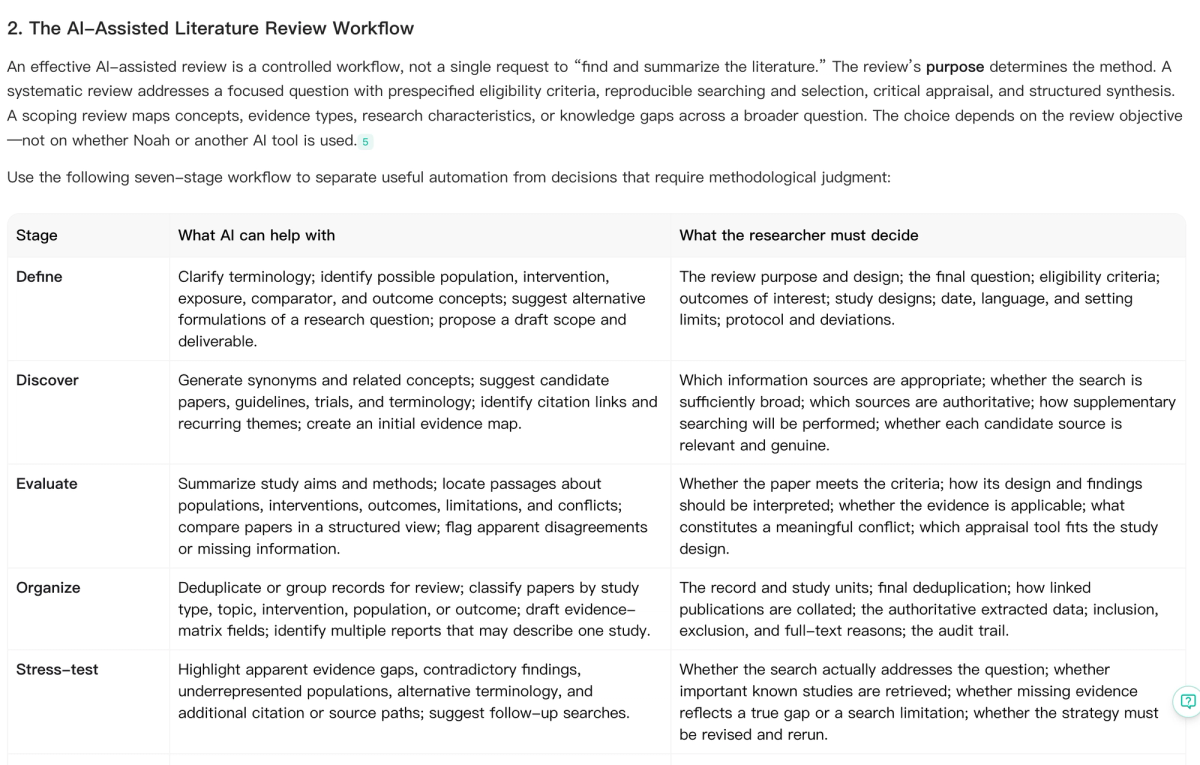
Noah output showing a seven-stage AI-assisted literature review workflow.
The workflow is a loop rather than a straight line. Evaluating one paper may reveal a new term. A conflicting result may send the team back to search. A weak synthesis may expose a missing evidence stream. AI is most useful when it helps make these returns faster and more visible.
Start With a Review Plan, Not an AI Prompt
Before opening Noah, define the rules of the review. At minimum, write down the research question, review type, scope, inclusion and exclusion criteria, date limits, study-design limits, databases or other sources to search, and the information to extract from each included study.
For systematic or scoping work, AI should support the process rather than silently create the method. A polished search result does not make the search comprehensive, and a generated evidence table does not make extraction correct.
Free to use · Free credits included · No credit card required
Start Biomedical Research with Noah AI →
Propose the likely research question, review type, scope, inclusion and exclusion criteria, date limits, eligible study designs, databases and supplementary sources, and evidence-extraction fields.
For every proposed decision, state the assumption behind it and identify what is uncertain. Do not search for or exclude studies yet. Clearly label all items as drafts requiring confirmation by the researcher.
Step 1: Map the Field With AI
Start with orientation, not exhaustive retrieval. A field map should help you learn how the literature describes the question before you turn that knowledge into a formal search strategy.
Useful outputs include synonyms and older terminology, major concepts, foundational papers, recent reviews, common study designs, outcome measures, and unresolved debates. For biomedical questions, it is also useful to separate clinical terminology from laboratory, translational, or disease-mechanism terminology.
Example Noah prompt
Map the biomedical literature on GLP-1 receptor agonists and cardiovascular outcomes in adults with type 2 diabetes.
Organize the response into:
alternative terminology and synonyms;
major concepts and possible search blocks;
foundational papers;
recent reviews;
common study designs; and
unresolved debates or evidence gaps.
For every paper or factual statement, provide the original source. Separate verified source-backed findings from hypotheses or candidate leads requiring database verification. Do not make inclusion or exclusion decisions.
The goal is to improve the next search, not to treat an AI-generated map as a completed review. Open the important papers and records, verify what they actually say, and preserve useful terminology for the search log.
Step 2: Turn Discovery Into a Structured Search Plan
Conversational discovery should lead to a documented search strategy. Do not paste a natural-language question into one search box and assume that the returned records represent the literature.
Build concept groups
For many biomedical questions, start with population or condition, intervention or exposure, comparator when needed, outcome, and setting or study-design terms only when justified. Connect synonyms within a concept group with OR, then connect distinct concepts with AND.
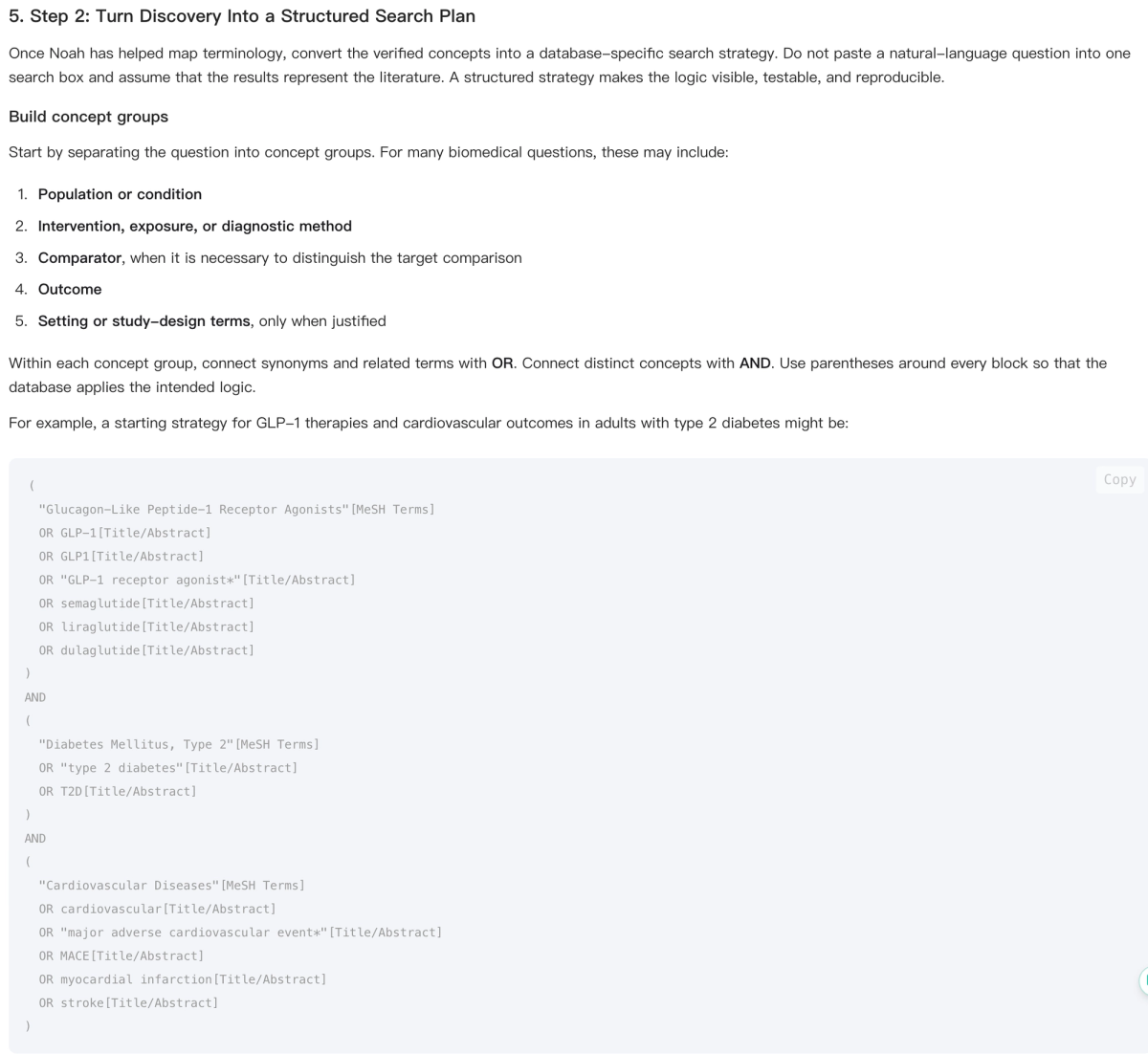
Noah output showing a structured PubMed search plan built from concept groups.
This is a draft search strategy, not proof of complete retrieval. Review each term, controlled-vocabulary heading, field tag, date limit, and filter. Test the query against known relevant papers, and adapt the concept structure to each database instead of copying PubMed syntax unchanged.
Search-planning prompt
Using this approved review question and scope: [insert question and criteria], create a search plan without making inclusion or exclusion decisions.
Separate the question into concept groups.
List controlled-vocabulary terms, free-text synonyms, abbreviations, spelling variants, and intervention-specific names.
Draft a PubMed strategy using OR within concept groups and AND between groups.
Mark each term as verified, plausible, or requiring testing.
Explain major assumptions and possible sources of missed evidence.
Keep AI suggestions separate from researcher-approved search terms.
Step 3: Evaluate Important Papers
Finding a paper establishes potential relevance, not quality. Use Noah to accelerate close reading, but keep appraisal separate from summarization.
For each potentially important study, verify the study design, population and setting, sample size, intervention or exposure, comparator, outcomes, follow-up, methods, limitations, and relevance to the exact review question. Distinguish topical relevance from methodological relevance: a paper can discuss the right disease and still answer the wrong question.
Keep these three questions separate: risk of bias, certainty of the body of evidence, and applicability to the review question are related but not interchangeable.
AI can help locate the passages needed for an appraisal framework, but it should not silently assign the final judgement. For example, for a randomized trial, Noah can surface passages relevant to a RoB 2 domain while the researcher verifies those passages and makes the final risk-of-bias decision.
Step 4: Build a Focused Working Corpus
After discovery and initial evaluation, organize potentially relevant records into a controlled working corpus. Grouping can be based on theme, study type, relevance, inclusion status, intervention, population, or outcome.
Keep eligibility status separate from evidence strength. An included study may still provide weak or indirect evidence, while an excluded study may be methodologically strong but address a different question.
Organization prompt
Create a structured table for these candidate records with columns for study design, population, intervention or exposure, comparator, outcome, setting, publication type, likely relevance, and information requiring full-text verification.
Do not assign final inclusion or exclusion decisions. Preserve the source for every field and mark missing information as “not reported” rather than inferring it.
For formal reviews, preserve identifiers, database origin, search version, screening decisions, exclusion reasons, duplicate handling, and the final record-to-study mapping outside the generated report as part of the audit trail.
Step 5: Stress-Test Literature Coverage
A plausible working corpus can still miss important evidence. Ask Noah to challenge the corpus rather than asking whether it is “complete.” Useful stress tests include missing seminal papers, recent evidence, contrasting findings, underrepresented populations, methodological differences, and apparent evidence gaps.
Every suggested gap should become a follow-up action rather than a conclusion. Expand the relevant database search, check reference lists and cited-by records, conduct backward and forward citation chasing, search trial registries, and inspect relevant guidelines or grey literature where the review plan requires it.
Coverage stress-test prompt
Stress-test this working corpus against the approved review question, eligibility criteria, and search log.
Identify:
potentially missing seminal papers;
recent studies or follow-up reports;
contrasting, null, or negative findings;
underrepresented populations or settings;
methodological differences that could explain variation; and
apparent evidence gaps or areas supported only indirectly.
For every item, provide the source and state whether it is verified, a candidate lead, or an inference. Do not declare the search complete and do not make inclusion or exclusion decisions.
Step 6: Build an Evidence Matrix Before Outlining
Build the evidence matrix before drafting the review. The matrix forces comparison across studies and reduces the tendency to summarize one paper per paragraph.
| Field | What to record |
|---|---|
| Citation | Stable identifier and verified bibliographic details. |
| Review theme | The question or section this study informs. |
| Study design | How the study generated its evidence. |
| Population | Eligibility characteristics, setting, and sample definition. |
| Sample size | Recruited, analyzed, and outcome-specific counts where they differ. |
| Main finding | The result relevant to the review question, including comparison and time point. |
| Limitations | Bias, uncertainty, missing data, applicability, or other constraints. |
| Relevance | Exactly which part of the review question the paper informs. |
Noah can help draft these fields, but every important value should be verified against the full text. If information is absent, record “not reported” rather than asking AI to infer it. Once verified, use the matrix to group evidence by themes, competing explanations, methodological differences, changes over time, and remaining uncertainty.
Step 7: Write With the Researcher in Control
Once the evidence matrix is verified, AI can help organize the argument—but it should not decide what the evidence means. Researchers still determine which findings deserve the most weight, whether disagreement is substantive or methodological, how limitations affect interpretation, and what the literature establishes versus merely suggests.
Use AI as a critic. Give Noah a draft section and ask it to identify claims that need evidence, places where the cited paper may not support the wording, and relevant contrasting evidence. Then verify every flag in the original sources.
Claim-checking prompt
Check this draft against the attached evidence matrix and original sources.
For each substantive claim:
identify the supporting source and passage, table, figure, or section;
state whether support is direct, partial, absent, or unclear;
check that population, intervention or exposure, comparator, outcome, time point, and study design match;
flag wording that overstates causation or certainty; andidentify relevant conflicting evidence.
Do not resolve disagreements by choosing a preferred study. Mark uncertainty and anything requiring researcher verification.
Step 8: Run a Final Citation and Evidence Audit
A manuscript can contain many citations and still be poorly supported. Before submission, audit each substantive claim against the original source rather than assuming that a generated citation must be accurate.
Verify that every source exists. Remove references that cannot be located or identified reliably.
Match the metadata. Check title, authors, year, journal, DOI, PMID, and version.
Read the original support. Confirm that the cited paper supports the exact nearby claim.
Distinguish primary evidence from reviews. Use primary studies for claims about their participants, methods, or results.
Check publication status. Look for corrections, retractions, withdrawals, later versions, or final publications.
Test population and setting. Avoid generalizing across different disease definitions, biological models, age groups, or care settings without qualification.
Check inference language. Preserve the distinction between association, prediction, causation, surrogate outcomes, and hypotheses.
Remove merely related citations. Topic similarity is not claim support.
Audit the whole conclusion. Include null, negative, and conflicting findings where they materially affect interpretation.
A Responsible AI Checklist for Literature Reviews
- Did I define the review question and review type before searching?
- Are inclusion and exclusion criteria explicit and prespecified?
- Can another researcher understand where and how the search was run?
- Did researchers make the final inclusion and exclusion decisions?
- Did I open and verify the original sources used in the synthesis?
- Did I assess study methods rather than relying on AI summaries or citation counts?
- Did I investigate null, negative, and conflicting evidence?
- Did I preserve exact search strings, filters, dates, and human modifications?
- Does every substantive claim have a source that supports the exact wording?
- Did I distinguish AI-generated suggestions from researcher-approved decisions?
- Did I document AI use according to the relevant journal, funder, institution, or employer policy?
- Have human authors accepted responsibility for the final evidence, citations, methods, and conclusions?
Frequently Asked Questions
Can AI write a literature review?
AI can help draft a structure, summarize verified papers, compare studies, identify recurring themes, and flag claims that need support. That is not the same as conducting a rigorous review. The question, search method, eligibility decisions, appraisal, synthesis, and final interpretation still require human responsibility.
What is the best way to use AI for literature review?
Use AI for targeted assistance inside a documented workflow: terminology expansion, search planning, candidate discovery, paper organization, evidence matrices, cross-study comparison, gap checks, and citation audits. Avoid handing the entire review to a single open-ended prompt.
Can AI find biomedical research papers?
Yes. AI-assisted research tools can help discover papers, guidelines, clinical-trial records, and related terminology. Discovery should complement the databases and other sources appropriate to the review question rather than being treated as comprehensive retrieval by itself.
Can AI replace a systematic review?
No. AI can assist with selected tasks, but it does not replace a protocol, reproducible search strategy, researcher-controlled screening, design-appropriate appraisal, data verification, or defensible synthesis.
How can Noah help with biomedical literature review?
Noah can support focused question clarification, terminology mapping, structured evidence discovery, study comparison, cited tables, source-linked synthesis, and follow-up checks for possible gaps or conflicts. Use those outputs as working research materials that still require source verification and researcher judgement.
Start With One Research Question
The most useful AI-assisted literature review is not the one produced with the fewest clicks. It is the one where the question, search, source trail, decisions, and conclusions can still be inspected and defended.
Use Noah to move faster through terminology, discovery, comparison, organization, and checking—but keep methodological responsibility with the research team.
Try Noah for Biomedical Research
Use Noah to explore biomedical literature, organize evidence, compare studies, and build source-linked research outputs.
Free to use · Free credits included · No credit card required
Start Biomedical Research with Noah AI →