How to Search PubMed Without MeSH Terms
Linda
Don't know MeSH terms? Learn how AI tools like Noah AI automatically map your everyday language to PubMed's controlled vocabulary, so you can search effectively without learning MeSH.
What MeSH Does (and Why You're Missing Papers Without It)
MeSH Example: The Same Drug, Many Names
The cancer immunotherapy drug pembrolizumab has multiple names in the literature: pembrolizumab, Keytruda (brand name), MK-3475 (trial identifier), anti-PD-1 antibody (mechanism class). A search for just "pembrolizumab" in Title/Abstract misses papers using any of the other names. The MeSH term for pembrolizumab groups all these variants under one controlled entry — search the MeSH term, and you capture all of them.
This is the core value of MeSH: it normalizes terminology. Medical literature uses different words for the same concepts — drug names change between development and approval, diseases have multiple synonyms, and authors in different countries use different terminology. MeSH bridges these gaps.
The challenge is that MeSH is enormous (30,000+ terms), hierarchical (searching a broader term includes all narrower terms below it), and not always intuitive. This is where AI tools can help.
Approach 1: Let AI Handle MeSH Expansion (Noah AI)
The most straightforward solution is to use an AI tool that handles MeSH expansion automatically. Noah AI does this as part of its search process: when you enter a natural-language query, the platform identifies key concepts and maps them to relevant MeSH terms and synonyms before searching PubMed.
For the pembrolizumab example above, you would simply type your question in plain English — mentioning "pembrolizumab" — and Noah AI would automatically expand the search to include related MeSH entries and synonyms like Keytruda and anti-PD-1 antibody.
This handles the MeSH problem transparently: you get the benefit of MeSH-level vocabulary coverage without needing to know any MeSH terms yourself. The output is a structured evidence brief with inline citations linked to PubMed papers.
Demo: Pembrolizumab for First-Line NSCLC
Query to enter in Noah AI (Agent → Search → PubMed Search)
What is the evidence on pembrolizumab as first-line treatment for advanced non-small cell lung cancer (NSCLC), including overall survival, progression-free survival, and PD-L1 expression as a biomarker for response, based on KEYNOTE trial data?
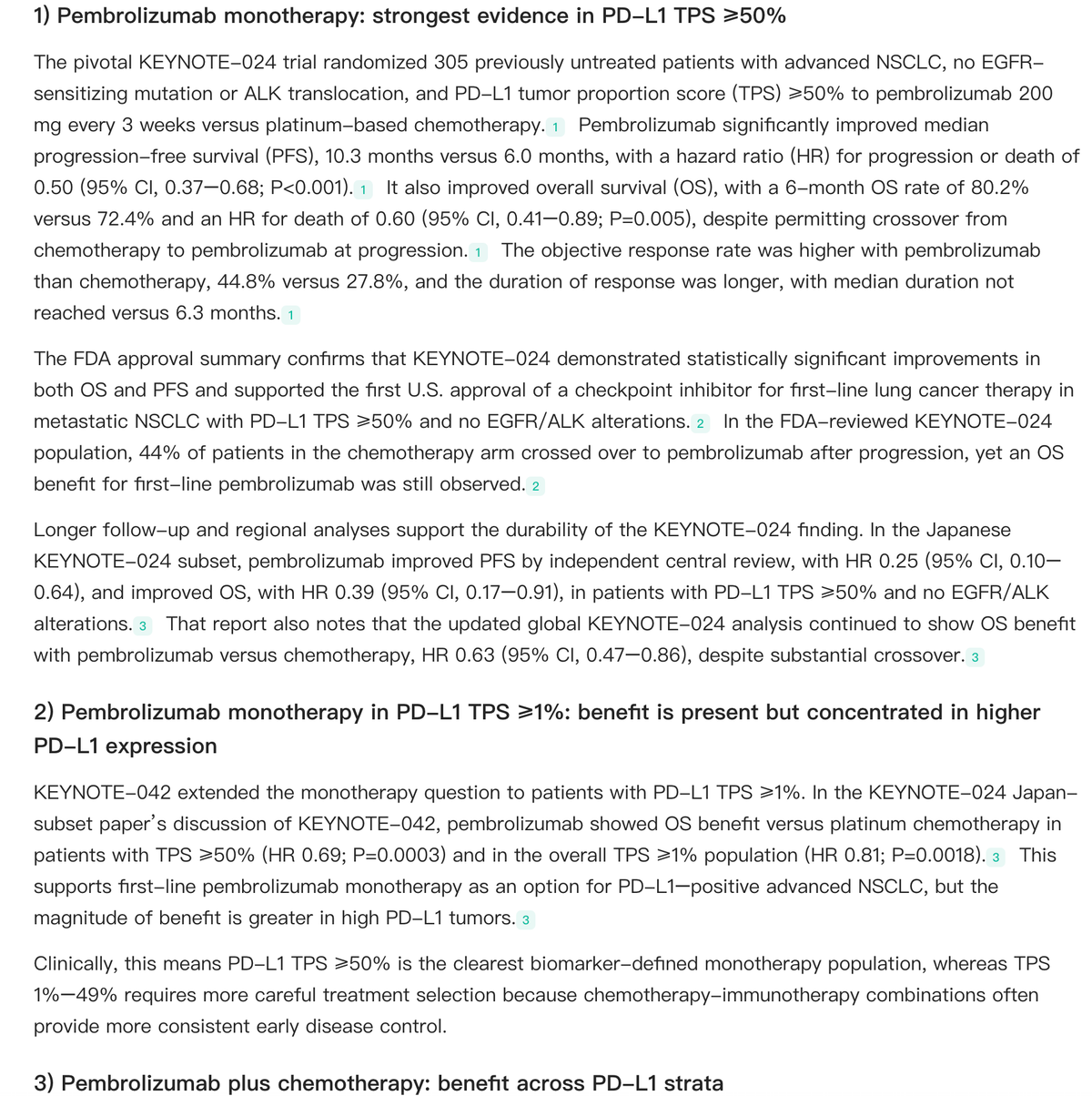
Figure 1. Noah AI evidence brief on first-line pembrolizumab for NSCLC, showing KEYNOTE-024 and KEYNOTE-042 findings with inline citations and PD-L1 biomarker context.
Try Noah AI for Free
Use Noah AI to search, compare, and analyze biomedical evidence with AI-powered research workflows.
Free credits are available, and no credit card is required to get started.
Approach 2: PubMed's Automatic Term Mapping (ATM)
PubMed itself has a built-in feature called Automatic Term Mapping (ATM). When you type a term without field tags, PubMed checks it against a translation table: first against MeSH terms, then journal names, then author names. If it matches a MeSH term, PubMed automatically searches both the MeSH term and the text word.
How to use it: Simply type your search terms in PubMed without any field tags or brackets. PubMed will attempt to map your terms to MeSH automatically. You can check what mapping was applied by clicking "Search details" under your results.
Limitation: ATM is basic — it maps individual terms but does not understand context, does not identify synonyms not in its translation table, and may not map multi-word phrases correctly. It is much less comprehensive than AI-powered MeSH expansion, but it is built into PubMed and requires no additional tools.
Approach 3: Use the MeSH Browser as a Lookup Tool
If you want to use MeSH but don't want to memorize the vocabulary, the NLM's MeSH Browser lets you look up terms before searching. Type a concept (e.g., "lung cancer") and the browser shows you the correct MeSH term ("Carcinoma, Non-Small-Cell Lung" or "Lung Neoplasms"), its position in the hierarchy, and available subheadings.
This is a middle ground: you use MeSH for precision, but look it up as needed rather than memorizing it. It's more effort than AI-powered search but gives you more control and produces documentable search strings.
Comparing the Three Approaches
| Approach | MeSH Knowledge Required | Vocabulary Coverage | Results Synthesis | Best For |
|---|---|---|---|---|
| Noah AI | None | Comprehensive (auto MeSH + synonyms) | Structured evidence brief | Most researchers — no MeSH expertise needed |
| PubMed ATM | None (basic mapping) | Moderate (single-term mapping only) | None — result list | Quick searches where ATM mapping is sufficient |
| MeSH Browser lookup | Lookup per search | Precise (you choose exact terms) | None — result list | Systematic reviews requiring documented MeSH strategy |
Why This Matters: The Cost of Missing MeSH
Without MeSH or equivalent expansion, a PubMed search for "pembrolizumab NSCLC first-line" in Title/Abstract only finds papers using those exact words. Papers indexed under the MeSH term but using "Keytruda" or "anti-PD-1 monoclonal antibody" in their titles would be missed. For comprehensive evidence review, this gap can be significant — especially for drugs with multiple names or conditions with multiple synonyms.
AI-powered MeSH expansion closes this gap automatically. For manual searches, using the MeSH Browser to identify the correct terms before searching achieves the same result but requires more effort.
FAQ
Do I need to learn MeSH if I'm using AI tools?
Not necessarily. AI tools like Noah AI handle MeSH expansion automatically. However, understanding the basic concept of MeSH — that it standardizes medical terminology for more precise searching — helps you evaluate and trust the AI's work.
Is PubMed's Automatic Term Mapping as good as AI MeSH expansion?
ATM is more limited. It maps individual terms to MeSH entries when there's a direct match, but it doesn't understand query context, doesn't identify synonyms comprehensively, and doesn't handle multi-concept questions well.
Will MeSH still matter in the future?
Yes — MeSH remains the foundation of PubMed's indexing system. What's changing is how researchers access it.
What about searching without Boolean operators too?
For a practical guide to AI-assisted PubMed searching, see PubMed Search with AI: How Life Science Professionals Find and Analyze Biomedical Evidence Faster.