How to Search PubMed Without Boolean Operators
Linda
Don't know Boolean operators? Here are 3 ways to search PubMed without AND/OR/NOT: AI-powered natural language search (Noah AI), PubMed Best Match, and Clinical Queries.
Boolean operators — AND, OR, NOT — are the traditional building blocks of PubMed searches. They let you combine concepts precisely, but they also create a barrier for researchers who do not use PubMed daily.
The good news: you do not have to use Boolean operators for every PubMed search. Here are three methods that work without manually writing Boolean syntax.
What Boolean Operators Actually Do (and Why They're Hard)
("SGLT2 inhibitors"[MeSH Terms] OR "sodium-glucose transporter 2 inhibitors"[Title/Abstract] OR "empagliflozin"[Title/Abstract] OR "dapagliflozin"[Title/Abstract]) AND ("heart failure"[MeSH Terms] OR "cardiac failure"[Title/Abstract]) NOT ("diabetes mellitus, type 2"[MeSH Terms] OR "type 2 diabetes"[Title/Abstract])
Building this kind of query requires quotation marks, field tags, parentheses, and Boolean logic. For occasional users, that can be a significant obstacle.
Method 1: AI-Powered Natural Language Search (Noah AI)
An AI-assisted workflow lets you start from a normal research question rather than manually constructing the full Boolean query.
Natural-language query for Noah AI (Agent → Search → PubMed Search)
What is the evidence on SGLT2 inhibitors (empagliflozin, dapagliflozin) for heart failure outcomes in patients who do not have type 2 diabetes, based on clinical trial evidence?
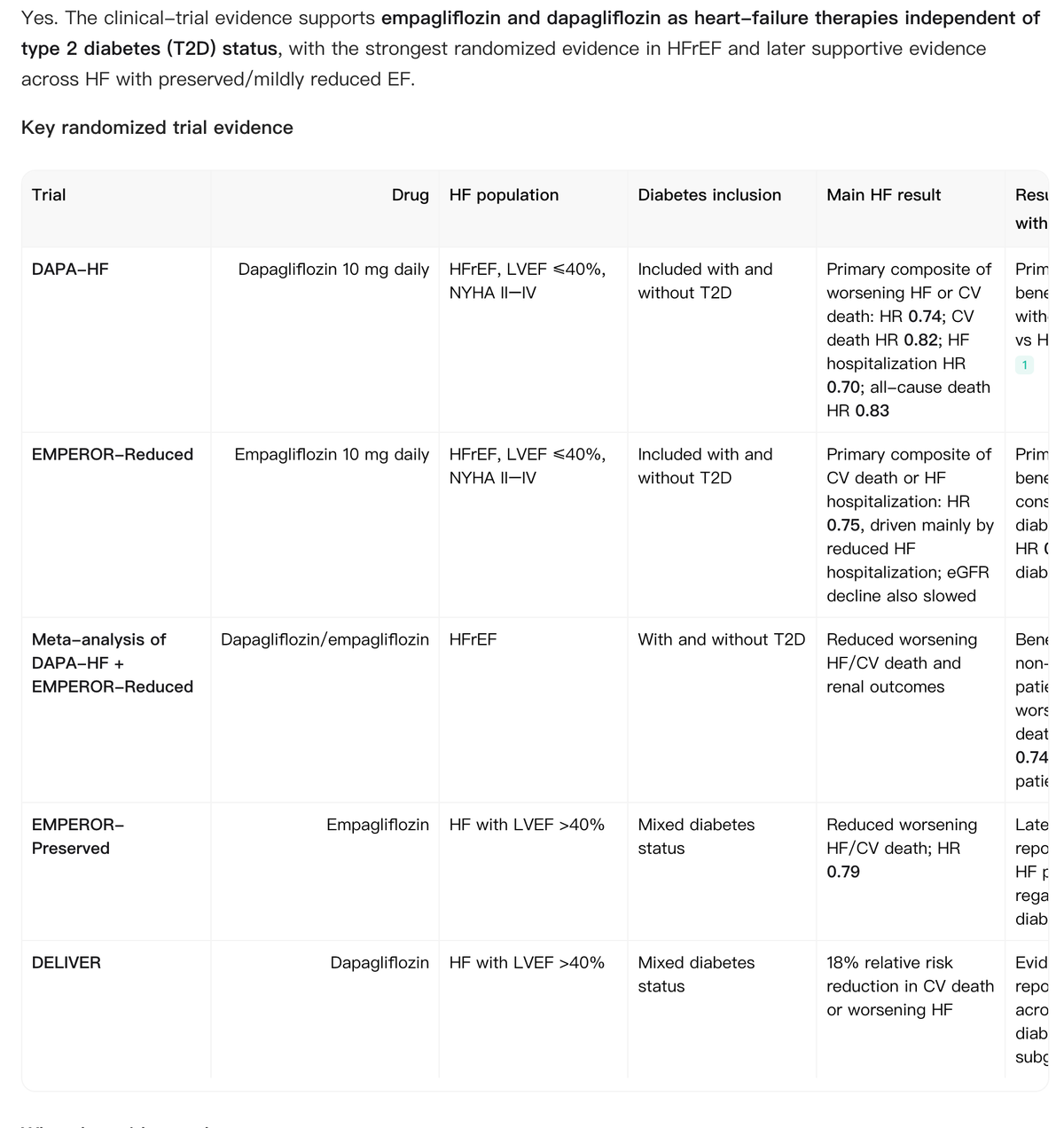
Figure 1. Noah AI structured evidence summary on SGLT2 inhibitors for heart failure in patients without type 2 diabetes, highlighting key randomized trial evidence.
For a full walkthrough, see PubMed Search with AI.
Method 2: PubMed Best Match
PubMed can rank non-Boolean searches with Best Match. Type a phrase such as SGLT2 inhibitors heart failure without diabetes clinical trials and review the ranked results.
What it does well: lets you search without manually constructing Boolean syntax.
What it does not do: it still returns a paper list that you must screen and synthesize yourself.
Method 3: PubMed Clinical Queries
PubMed Clinical Queries applies pre-built clinical filters. You choose a category such as therapy or diagnosis, then enter your topic terms.
What it does well: saves you from manually building study-type filters.
What it does not do: it does not synthesize the retrieved evidence into a structured answer.
Comparing the Three Methods
| Feature | Noah AI | PubMed Best Match | Clinical Queries |
|---|---|---|---|
| Boolean required? | No | No | No |
| Input style | Natural-language question | Keywords / phrase | Keywords + clinical filter |
| Results synthesis | Structured evidence brief | No | No |
| Citation handling | Linked citations | Original PubMed records | Original PubMed records |
| Best for | Question-driven evidence review | Quick exploratory search | Clinical evidence by study type |
Try Noah AI for Free
Use Noah AI to search, compare, and analyze biomedical evidence with AI-powered research workflows. Free credits are available, and no credit card is required to get started.
FAQ
Will I miss important papers by not using Boolean operators?
Possibly. For formal systematic reviews, a documented and reproducible Boolean strategy remains important.
Is Boolean search still worth learning?
Yes, especially when exact control and reproducibility matter.
Can I combine these methods?
Yes. Use AI for initial synthesis, then use PubMed directly for follow-up and formal documentation.