How to Search PubMed Using Natural Language — No Boolean Required
Linda
Learn how to search PubMed using plain English instead of Boolean operators or MeSH terms. See how natural-language AI tools like Noah AI translate your questions into effective PubMed searches.
PubMed was built for structured queries: Boolean operators (AND, OR, NOT), MeSH terms, field tags, and carefully nested parentheses. This syntax is powerful but it creates a significant barrier for researchers who search PubMed occasionally, work outside their specialty, or simply want to ask a question the way they'd ask a colleague.
Natural-language search flips this: you type your question in plain English, and the software translates it into something PubMed can execute. This article explains how natural-language PubMed search works, what's happening behind the scenes, and how to write queries that get better results.
The Same Question, Two Ways
Here is the same research question expressed as a traditional Boolean PubMed query and as a natural-language query:
Traditional Boolean PubMed Query
("continuous glucose monitoring"[MeSH Terms] OR "continuous glucose monitor*"[Title/Abstract]) AND ("glycated hemoglobin A"[MeSH Terms] OR "HbA1c"[Title/Abstract]) AND ("diabetes mellitus, type 2"[MeSH Terms] OR "type 2 diabetes"[Title/Abstract]) AND ("randomized controlled trial"[Publication Type] OR "RCT"[Title/Abstract])
Natural-Language Query (for Noah AI)
Does continuous glucose monitoring improve HbA1c control in patients with type 2 diabetes compared to standard self-monitoring, based on randomized controlled trial evidence?
Both queries ask the same question. The Boolean version requires knowledge of MeSH terms, field tags, wildcards, and nested logic. The natural-language version reads like a normal sentence.
How Natural-Language PubMed Search Works Behind the Scenes
When you type a plain-English question into an AI-powered PubMed search tool like Noah AI, the system interprets the research intent, maps the question into a focused PubMed search, retrieves relevant papers, and then organizes the evidence into a structured answer.
- Query understanding. The system identifies the key concepts in your question, such as the population, intervention, comparison, outcome, and preferred study type.
- Search-term construction. Noah converts the natural-language question into a focused PubMed search term that reflects the concepts in the original query.
- PubMed search execution. The generated search term is used to retrieve relevant PubMed-indexed literature.
- Results synthesis. Noah then organizes findings from the retrieved papers into a readable evidence summary with inline citations.
Demo: CGM and HbA1c in Type 2 Diabetes
Enter this query in Noah AI (Agent -> Search -> PubMed Search)
Does continuous glucose monitoring improve HbA1c control in patients with type 2 diabetes compared to standard self-monitoring, based on randomized controlled trial evidence?
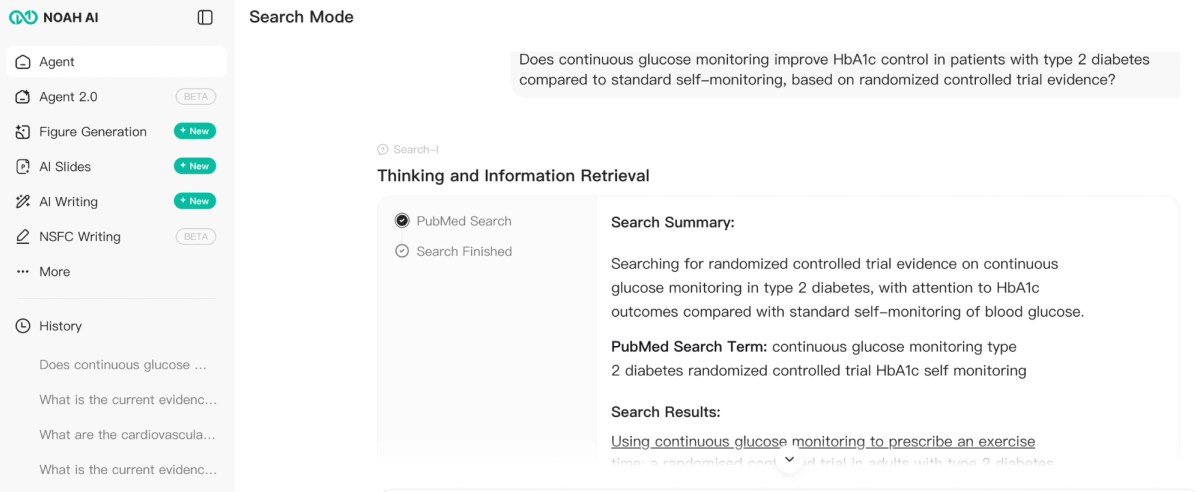
Figure 1. Noah AI translating a natural-language CGM research question into a focused PubMed search term.
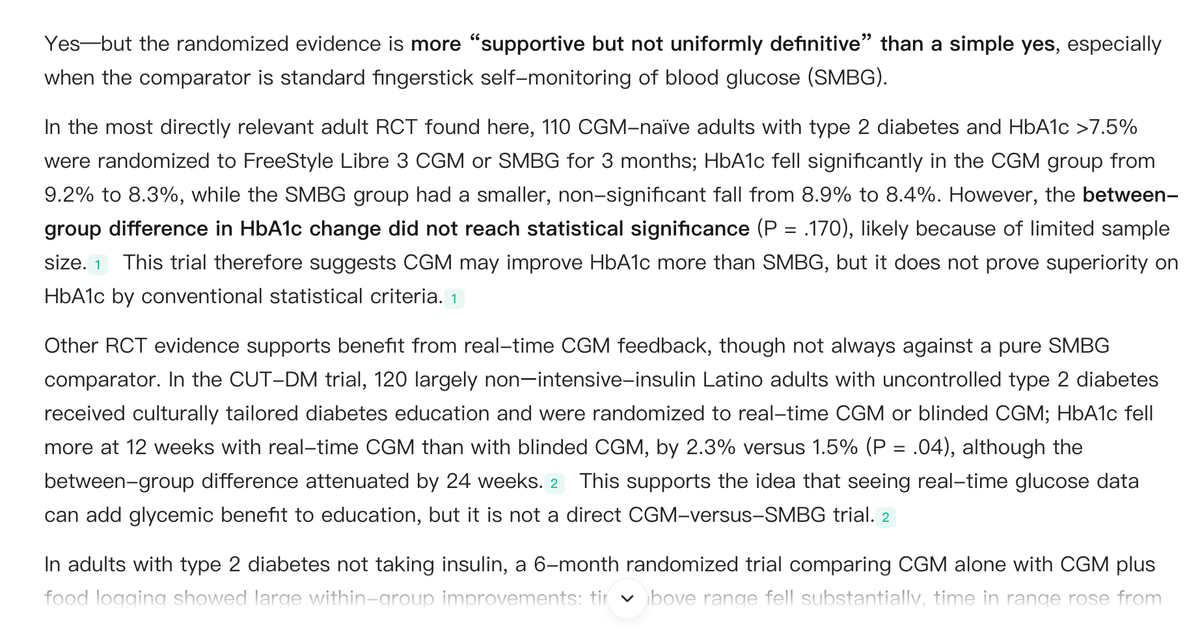
Figure 2. Noah AI evidence synthesis summarizing randomized trials of CGM versus standard monitoring for HbA1c control in type 2 diabetes, with inline PubMed citations.
Tips for Writing Better Natural-Language Queries
Tip 1: Include All Key Concepts in One Sentence
Write your query so it contains the population, intervention, comparison (if applicable), and outcome. "Does CGM work?" is too vague. "Does CGM improve HbA1c in type 2 diabetes compared to standard monitoring?" gives the system a much clearer research question.
Tip 2: Specify Study Type If You Have a Preference
Adding "based on randomized controlled trial evidence" or "from systematic reviews and meta-analyses" helps narrow the search toward the evidence type you want.
Tip 3: Use Clinical Terms When You Know Them
Natural-language search works with everyday terms, but using precise terminology such as "HbA1c" instead of "blood sugar control" can make the research question more specific.
Tip 4: Ask Focused Follow-Up Questions
If the first evidence brief is too broad, narrow the next query. For example: "What do RCTs show specifically for CGM in insulin-treated type 2 diabetes patients over 60?"
Tip 5: Keep the Query Natural
If you're using a natural-language interface, write the question as a sentence rather than mixing Boolean syntax into the prompt.
When Natural Language Works Well - and When It Doesn't
Natural language works well for: Clinical questions with clear population/intervention/outcome elements, exploratory literature scans, initial topic overviews, and questions where you want to start from plain English.
Natural language may not be enough for: Systematic reviews requiring documented, reproducible search strategies; highly specific field restrictions; or searches that require exact control over Boolean logic and database syntax. In those cases, PubMed Advanced Search remains important.
PubMed's Own Natural-Language Support: Best Match
PubMed itself can rank non-structured searches by relevance using Best Match. That can help users who type ordinary keywords or phrases, but it is still different from an AI workflow that converts a research question into a focused search and then synthesizes evidence across retrieved papers.
Try Noah AI for Free
Use Noah AI to search, compare, and analyze biomedical evidence with AI-powered research workflows.
Free credits are available, and no credit card is required to get started.
FAQ
Is natural-language search as thorough as a Boolean search?
It depends on the question and the tool. Natural-language search is useful for exploratory research, initial scoping, and focused clinical questions. For formal systematic reviews, a documented Boolean strategy remains important.
Can I see what search term Noah used?
Yes. In the demo shown above, Noah displays a PubMed Search Term after interpreting the natural-language question.
What if the AI misunderstands my question?
Review the generated search term and the final evidence summary. If the output is off-target, rephrase the question with more specific clinical terms or split a complex question into smaller sub-questions.
Do I need to know medical terminology?
No, but more precise terminology can improve specificity when you know it.