How to Search PubMed for a Literature Review with AI: Step-by-Step Guide
Linda
Learn how to search PubMed for a literature review with AI, from MeSH terms and Boolean queries to search refinement and study selection using a real Noah AI workflow.
PubMed is one of the most important databases for biomedical literature, but a good PubMed search is not just a sentence typed into the search box.
Researchers need to translate a clinical question into searchable concepts, identify appropriate MeSH terms and free-text synonyms, combine them with Boolean operators, test whether the query retrieves known key papers, and refine the search without accidentally filtering out relevant evidence.
For this guide, we tested Noah AI, a life-science-focused AI Agent, on a real PubMed literature-search task:
In adults with resected colorectal cancer, how is postoperative circulating tumor DNA (ctDNA) used to predict recurrence risk and guide adjuvant treatment decisions?
The goal was not to ask AI to write the literature review for us. It was to use AI to make the PubMed search itself more systematic, transparent, and reproducible.
Step 1: Start With a Searchable Research Question
PubMed performs better when the research question is broken into concepts rather than submitted as one long natural-language sentence.
Our question contained several distinct ideas:
| Concept | What We Need to Capture |
|---|---|
| Disease | Colorectal, colon, and rectal cancer |
| Biomarker | Circulating tumor DNA, ctDNA, liquid biopsy |
| Disease state | Molecular residual disease, MRD |
| Treatment setting | Postoperative, resected, after curative-intent surgery |
| Clinical question | Recurrence risk, prognosis, and adjuvant treatment guidance |
Separating the question this way makes it much easier to identify synonyms and build a Boolean search.
Step 2: Use Both MeSH Terms and Free-Text Keywords
One of the most important PubMed search principles is that MeSH terms and free-text keywords are complementary.
MeSH terms provide standardized indexing, while title-and-abstract keywords help retrieve papers that use newer terminology, alternative wording, abbreviations, or recently indexed concepts.
For example, the colorectal cancer concept may include:
- "Colorectal Neoplasms"[mh]
- "Colonic Neoplasms"[mh]
- "Rectal Neoplasms"[mh]
- colorectal cancer[tiab]
- colon cancer[tiab]
- rectal cancer[tiab]
The ctDNA concept can similarly include the indexed term alongside terms such as ctDNA[tiab] and circulating tumor DNA[tiab].
Step 3: Set Up the Search in Noah AI
In Noah's refreshed Agent interface, we used:
- Agent
- Medical & Academia
- Deep Research
- 5.6 Terra · Balanced
The prompt did not simply ask for relevant colorectal cancer papers. It asked Noah to:
- break the question into PubMed concept groups,
- identify MeSH terms and free-text synonyms,
- build multiple PubMed-ready search strategies,
- explain when each strategy should be used,
- identify relevant PubMed-indexed studies,
- and explain how to refine the search if results were too broad or too narrow.
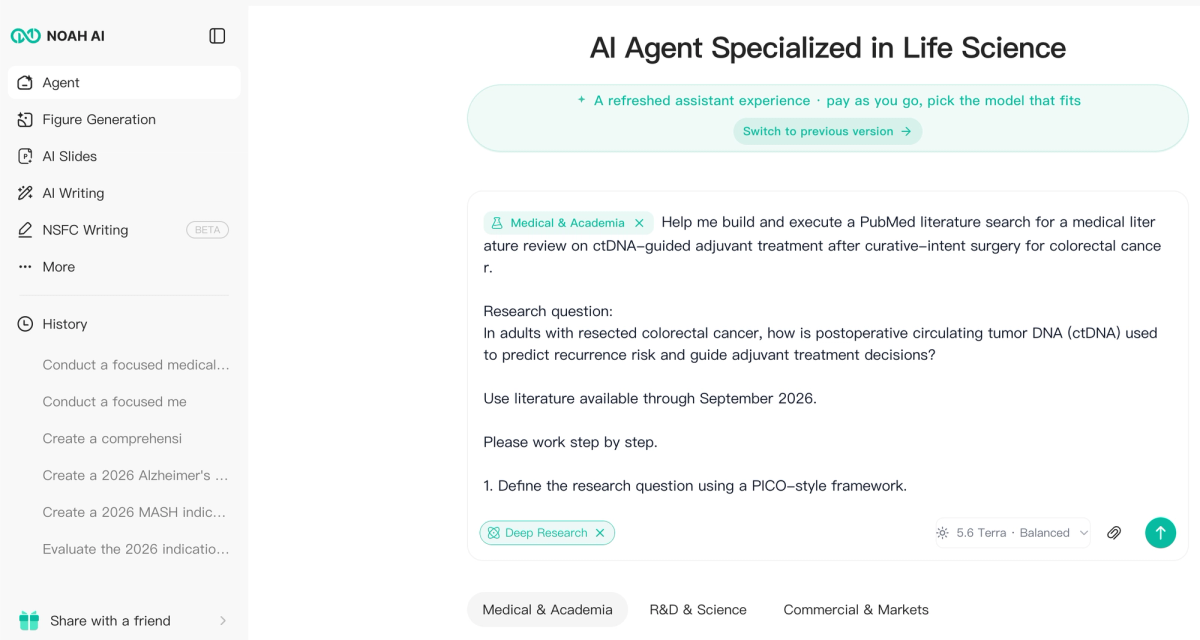
Noah AI input for a focused PubMed literature-search task in colorectal cancer.
Step 4: Build More Than One PubMed Search
There is rarely one perfect PubMed query.
For this case, Noah separated the search into three complementary strategies:
| Strategy | Purpose | When to Use It |
|---|---|---|
| A. Broad discovery | Maximize sensitivity and discover terminology, cohorts, protocols, and reviews. | Use early in the review when you do not yet know all of the relevant vocabulary. |
| B. Focused clinical evidence | Require the main clinical concepts needed for postoperative MRD, recurrence, and adjuvant decisions. | Use as the primary literature-review search. |
| C. Trial-focused | Concentrate on randomized or prospective treatment-guidance evidence. | Use when the research question specifically concerns clinical utility or treatment selection. |
This is preferable to trying to create one query that simultaneously maximizes sensitivity and specificity.
Step 5: Build a Focused Clinical-Evidence Query
The focused strategy is the most useful starting point for this particular literature-review question.
Noah combined the major concepts with OR inside each concept group and AND between different concepts.
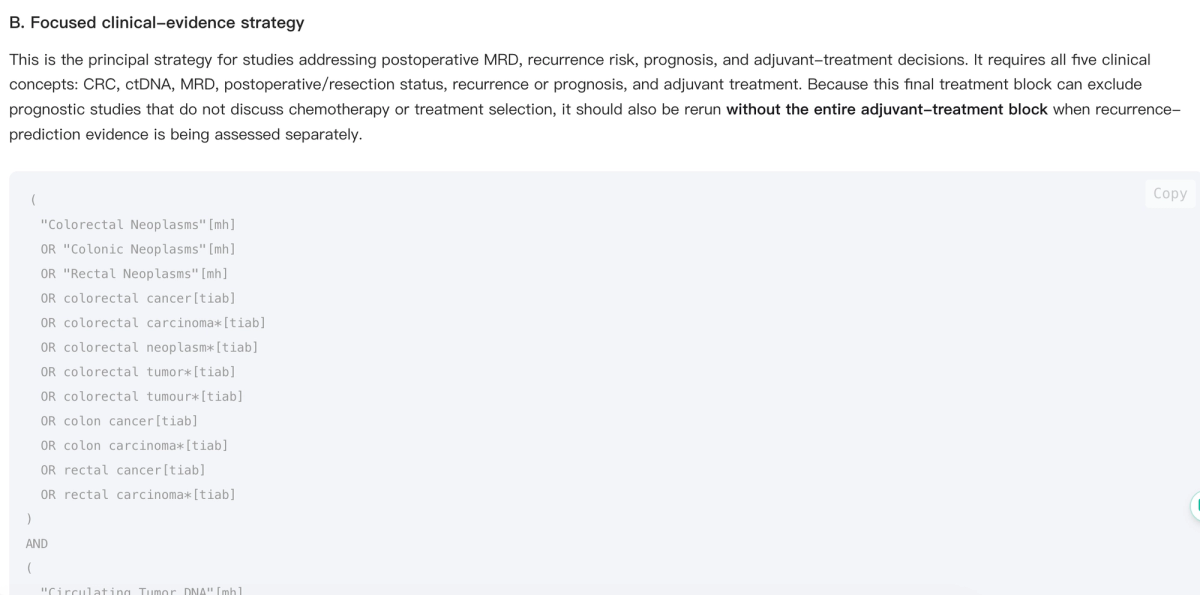
Noah AI builds a focused PubMed-ready clinical-evidence strategy using MeSH terms, title/abstract terms, and Boolean operators.
A simplified version of the structure looks like this:
This is a readable example of the query structure used in the workflow. Researchers should still inspect PubMed's search translation and verify the terminology before using a query in a formal review.
Step 6: Do Not Over-Filter the First Search
It is tempting to immediately add:
- humans,
- adults,
- English,
- randomized controlled trial,
- last five years,
- and free full text.
Doing all of that at the start can remove useful studies before the researcher has had a chance to understand the evidence base.
A better approach is:
build the concept logic first,
run the search broadly enough to inspect what is being retrieved,
then add filters when they correspond to a real inclusion criterion.
Step 7: Check Whether Known Key Studies Appear
Search validation should not depend only on the number of results.
If you already know that an important trial belongs in the review, check whether your search retrieves it.
For this case, key studies included DYNAMIC and later randomized or interventional ctDNA programs.
If a known landmark paper is missing, inspect:
- the terminology used in its title and abstract,
- its PubMed MeSH indexing,
- how the biomarker is described,
- whether the postoperative setting is explicit,
- and whether one of your AND blocks is too restrictive.
Step 8: Build a Selected PubMed Literature Set
After developing and refining the search, the next step is not to summarize every result.
Papers should first be classified by study design and relevance.
In the Noah output, randomized and interventional evidence was separated from prospective observational evidence and reviews.
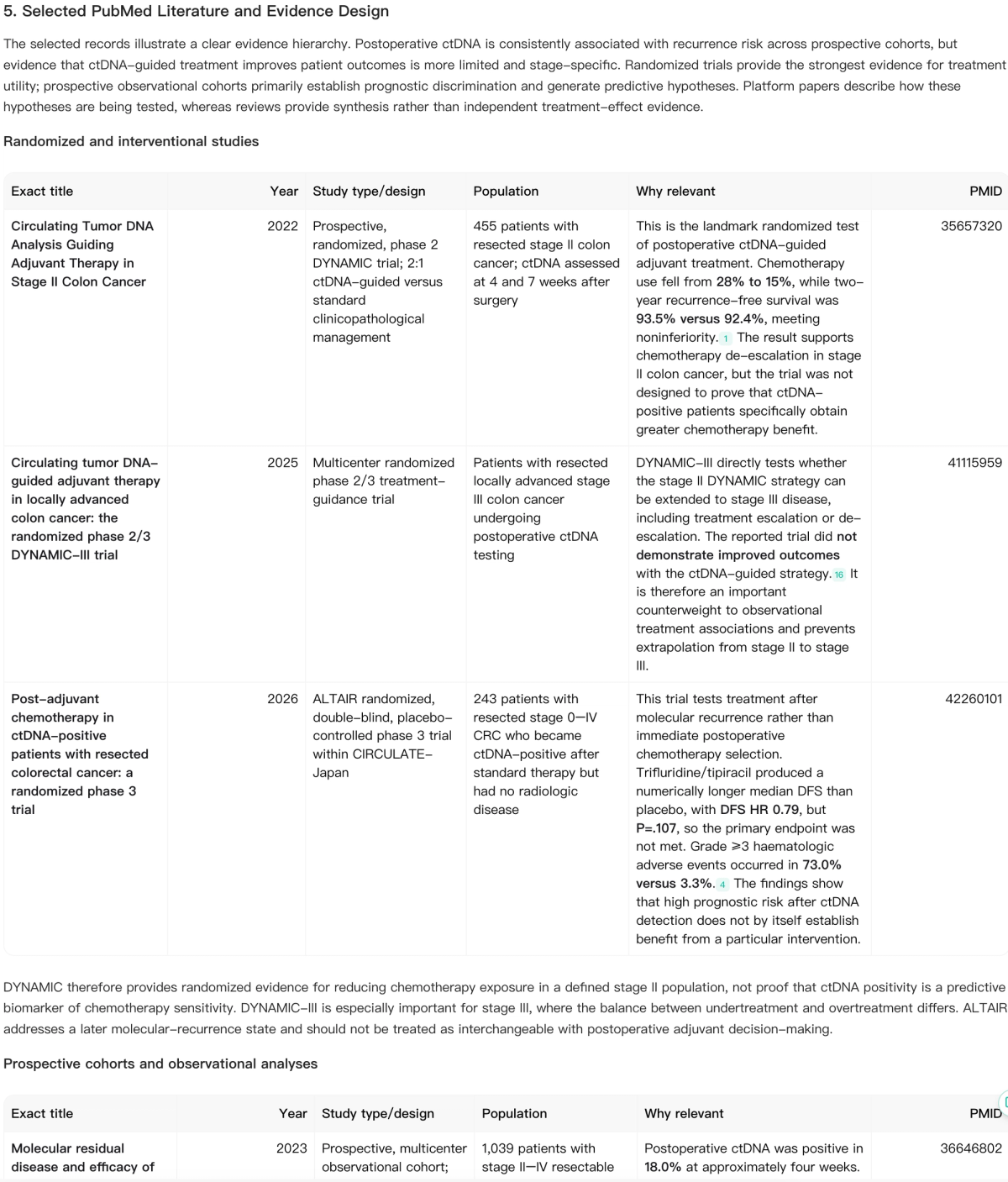
Noah AI organizes selected PubMed literature by title, year, study design, population, relevance, and PMID.
Free to use · Free credits included · No credit card required
Search PubMed Literature with Noah AI →
What the Selected Studies Tell Us About Search Quality
The literature set also illustrates why a PubMed search should retrieve more than papers that support a single narrative.
DYNAMIC
The DYNAMIC trial provides randomized evidence that a ctDNA-guided strategy can reduce adjuvant chemotherapy use in a defined stage II colon-cancer population without compromising recurrence-free survival within the trial's noninferiority framework.
DYNAMIC-III
DYNAMIC-III is important because the stage II result should not automatically be extrapolated to more advanced disease.
Noah's selected evidence explicitly retained the study because the reported trial did not demonstrate improved outcomes with the ctDNA-guided strategy in stage III disease.
ALTAIR
ALTAIR asks another question again: whether intervention after molecular recurrence improves outcomes.
The reported primary endpoint was not met, illustrating an important distinction between:
ctDNA identifying a high-risk patient
and:
proving that a particular treatment triggered by that ctDNA result improves clinical outcome.
Step 9: Refine the Search Based on What You See
If the Search Is Too Broad
If the results include large numbers of metastatic, preoperative, non-colorectal, or assay-development papers:
- strengthen the postoperative or resection concept,
- require colorectal terminology in the title or abstract,
- add MRD terminology,
- or add the treatment-decision concept when appropriate.
If the Search Is Too Narrow
If key papers are missing:
- remove one restrictive AND block,
- add additional ctDNA or MRD synonyms,
- remove unnecessary filters,
- or run a broader discovery query alongside the focused query.
If a Known Trial Is Missing
Use the missing article as a diagnostic tool.
Open its PubMed record and inspect the terminology used by the authors and the indexing assigned to the article.
Then update the query and rerun it.
This is often more useful than blindly adding more search terms.
Step 10: Save the Search Exactly as You Ran It
A literature-review search should be reproducible.
At minimum, record:
- Database: PubMed
- Date searched
- Complete search query
- Filters applied
- Number of records retrieved
- Any supplementary or validation searches
If you later change the query, save the new version rather than silently replacing the original one.
A Practical PubMed Search Workflow
| Step | Action | Output |
|---|---|---|
| 1 | Define the research question | Focused clinical question |
| 2 | Break the question into concept groups | Disease, intervention, setting, outcome concepts |
| 3 | Identify MeSH and free-text terms | Synonym list for each concept |
| 4 | Combine synonyms with OR | Concept blocks |
| 5 | Combine concepts with AND | PubMed-ready Boolean query |
| 6 | Run broad and focused versions | Candidate literature set |
| 7 | Check known key papers | Search sensitivity check |
| 8 | Review titles and abstracts | Relevant study set |
| 9 | Refine if necessary | Improved search strategy |
| 10 | Save query, date, filters, and result count | Reproducible search record |
Where AI Helps — and Where PubMed Still Matters
AI is particularly useful for the parts of PubMed searching that require translation between a human research question and database logic.
It can help researchers:
- identify missing synonyms,
- separate concepts,
- draft Boolean logic,
- create broad and focused search versions,
- organize retrieved studies,
- and identify reasons a known study may have been missed.
But the researcher should still verify:
- whether a proposed MeSH term actually exists,
- how PubMed translates the query,
- whether the field tags behave as intended,
- whether key studies are retrieved,
- and whether filters match the review protocol.
The useful goal is not to replace PubMed. It is to reduce the trial-and-error involved in constructing, testing, and documenting the search.
Frequently Asked Questions
Can AI search PubMed for a literature review?
AI can help researchers formulate PubMed searches, identify relevant concepts and synonyms, organize literature, and refine search strategies. Important terms, indexing, and retrieved studies should still be verified directly in PubMed.
What is the difference between MeSH and keywords?
MeSH is PubMed's standardized biomedical indexing vocabulary. Free-text keywords search the words authors use in titles and abstracts. Strong searches often use both.
Should I use AND or OR in PubMed?
Use OR between synonyms or alternative terms describing the same concept, and use AND between different concepts that must all be represented in the result.
Should I start with a very specific PubMed query?
Usually not. Starting too narrowly can hide important terminology and exclude relevant studies. A broad discovery search followed by a more focused clinical-evidence search is often more useful.
How do I know whether my PubMed search is good?
One practical test is whether the query retrieves known relevant studies. If an important landmark paper is missing, investigate why before proceeding with the review.
Should I use PubMed filters immediately?
Only when they correspond to genuine inclusion criteria. Applying many filters at the start can reduce sensitivity and cause useful studies to disappear.
Final Takeaway
A good PubMed literature search is not a single clever query.
It is an iterative process:
define the question → separate the concepts → identify MeSH terms and synonyms → build Boolean logic → run the search → check known papers → refine → save the exact strategy.
In our colorectal cancer example, Noah AI helped turn a clinical question about postoperative ctDNA into a structured PubMed search strategy and then organize selected randomized and interventional studies into a review-ready evidence set.
The most useful role for AI here is not replacing PubMed. It is helping researchers get from a biomedical question to a more disciplined, testable, and reproducible search.
Find Relevant PubMed Literature with Noah AI
Use Noah AI to search biomedical literature, identify relevant studies, compare evidence, and organize source-linked research findings.
Free to use · Free credits included · No credit card required
Search PubMed Literature with Noah AI →