How to Conduct a Medical Literature Review with AI: Step-by-Step Guide
Linda
Learn how to conduct a medical literature review with AI step by step, using a real Noah AI workflow from research question to evidence table and synthesis.
A medical literature review is more than asking an AI model to summarize a few papers.
A useful review starts with a focused research question, defines the population and outcomes clearly, searches appropriate biomedical evidence, distinguishes stronger from weaker study designs, extracts the same fields consistently, compares studies without flattening important differences, and keeps major conclusions traceable to their original sources.
For this guide, we tested Noah AI, a life-science-focused AI Agent designed for medical and biopharma research, using one real clinical question:
In adults with chronic kidney disease, do SGLT2 inhibitors reduce kidney disease progression and major kidney outcomes compared with placebo or standard care?
The goal was not to generate a generic summary. We wanted to see whether AI could help move from the research question to a structured evidence review and a defensible synthesis.
Step 1: Start With a Focused Medical Question
One of the fastest ways to produce a weak literature review is to start with a question that is too broad.
Instead of:
Do SGLT2 inhibitors help the kidney?
we used a more specific question:
In adults with CKD, do SGLT2 inhibitors reduce kidney disease progression and major kidney outcomes compared with placebo or standard care?
A simple PICO-style framework helps make the review scope explicit.
| PICO Element | Definition |
|---|---|
| Population | Adults with CKD, with or without type 2 diabetes |
| Intervention | An SGLT2 inhibitor added to standard care |
| Comparator | Placebo or standard care |
| Outcomes | CKD progression, kidney failure, sustained eGFR decline, kidney-related outcomes, cardiovascular outcomes, and safety |
Step 2: Define the Scope Before Searching
A literature review becomes much easier to control when the evidence rules are defined before the search begins.
For this case, we asked Noah to prioritize:
- PubMed-indexed peer-reviewed studies,
- randomized controlled trials,
- major kidney-outcome trials,
- meta-analyses where useful,
- KDIGO guidance,
- and other authoritative clinical sources.
We also asked the system to distinguish randomized trials, meta-analyses, guidelines, subgroup analyses, and secondary analyses rather than merging them into a single evidence tier.
Step 3: Run the Question in a Medical Research Workflow
Noah's refreshed Agent interface lets the user define the task, choose a professional domain, select a research mode, and choose the model configuration appropriate for the task.
For this literature review, we used:
- Agent
- Medical & Academia
- Deep Research
- 5.6 Terra · Balanced
The prompt explicitly asked Noah to conduct the review step by step, identify pivotal studies, extract comparable fields, preserve differences between kidney endpoint definitions, and cite major claims.
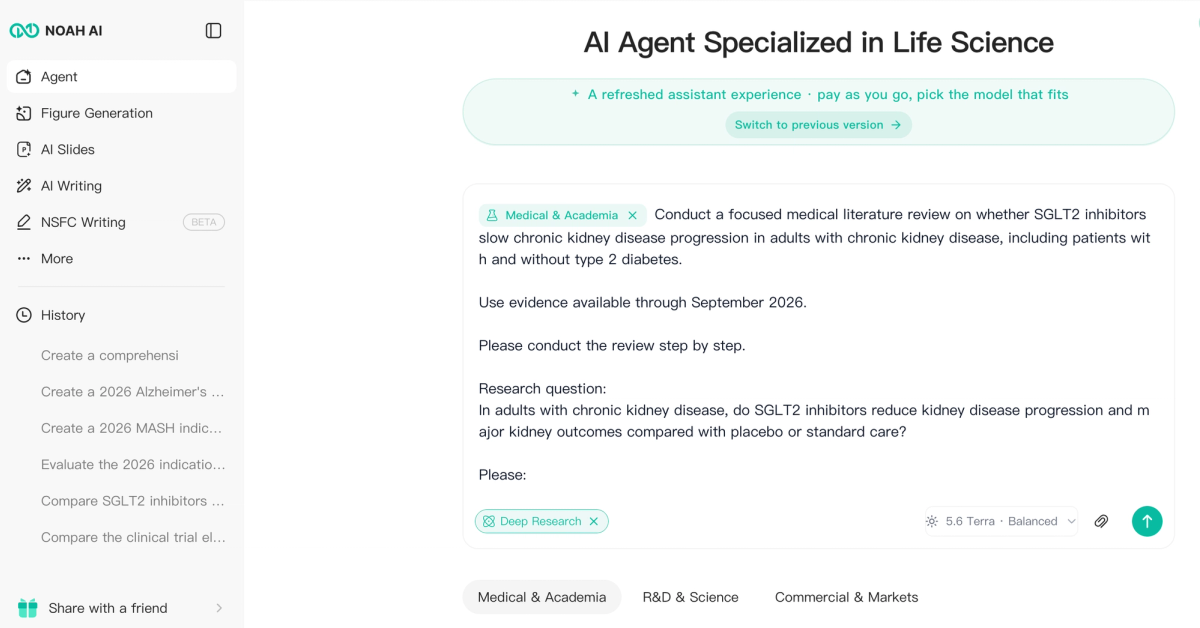
Noah AI was asked to conduct a focused medical literature review on SGLT2 inhibitors and CKD using Medical & Academia and Deep Research.
Step 4: Identify the Evidence That Actually Matters
Medical literature searches can return dozens or hundreds of papers. The challenge is not finding every paper. It is identifying the evidence most directly capable of answering the question.
For this review, three pivotal kidney-outcome trials became central:
- CREDENCE
- DAPA-CKD
- EMPA-KIDNEY
They all evaluated SGLT2 inhibition in CKD, but they did not study identical populations or use identical kidney endpoints.
That difference is important. A literature review should preserve those distinctions instead of treating every CKD composite endpoint as the same outcome.
Step 5: Build a Structured Evidence Table
A useful evidence table forces the same questions to be asked of every study.
In this case, the review extracted:
- study design,
- sample size,
- diabetes status,
- baseline kidney function,
- albuminuria,
- intervention and comparator,
- exact kidney endpoint,
- follow-up,
- main outcome,
- safety findings,
- and major limitations.
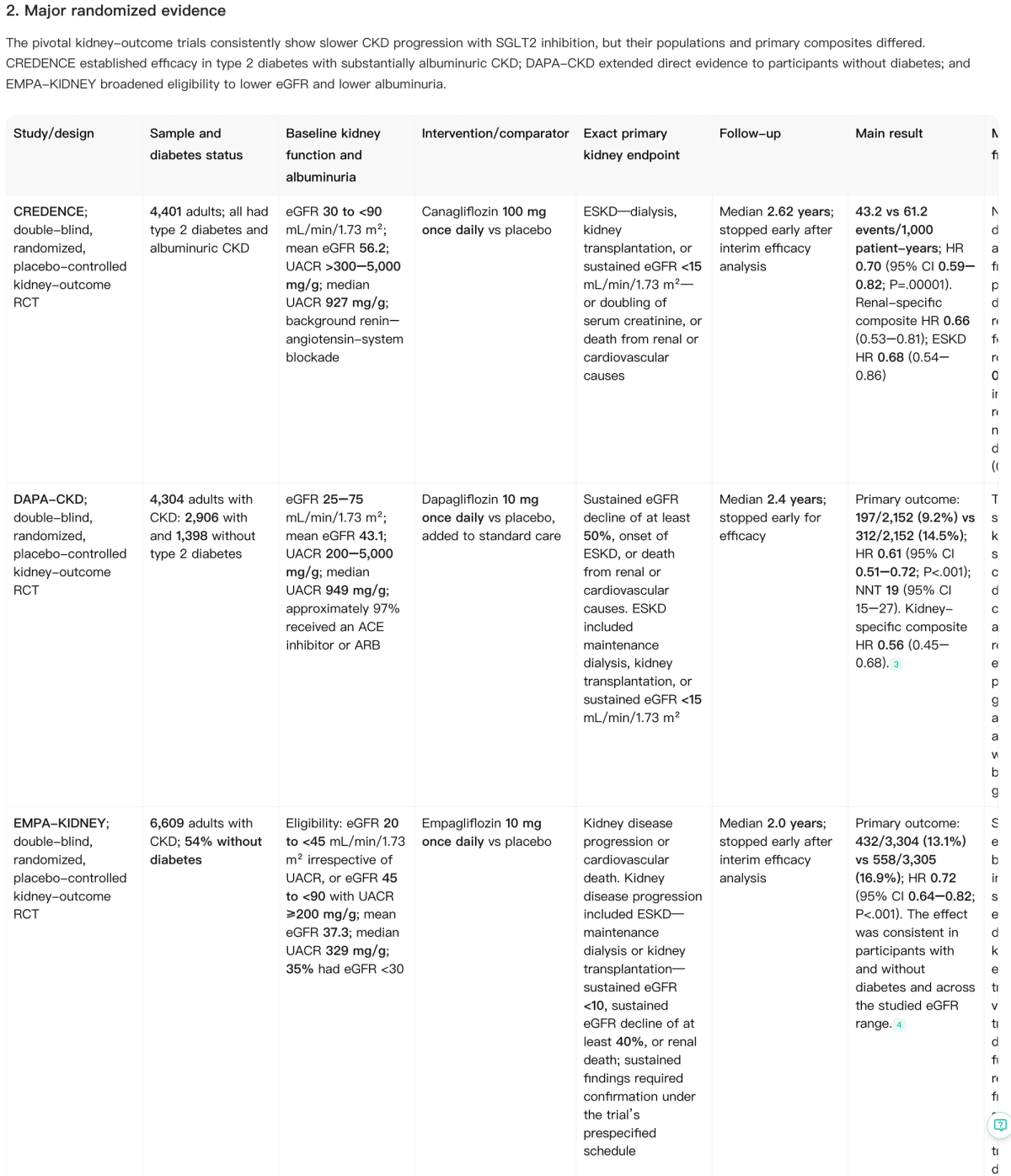
Noah AI structured the major randomized kidney-outcome trials into a common evidence table rather than returning disconnected paper summaries.
Step 6: Compare Study Populations Before Comparing Results
The three pivotal trials point in the same general direction, but they answer related rather than identical questions.
| Trial | Population Difference | Why It Matters |
|---|---|---|
| CREDENCE | Type 2 diabetes with substantially albuminuric CKD | Provides strong evidence in diabetic kidney disease, but does not directly answer the non-diabetic CKD question. |
| DAPA-CKD | Included adults with and without type 2 diabetes | Extended randomized evidence beyond diabetic CKD. |
| EMPA-KIDNEY | 54% of participants did not have diabetes and eligibility extended to broader kidney-function and albuminuria ranges | Broadened the evidence base substantially. |
Step 7: Do Not Treat Different Endpoints as Identical
This is another common failure point in AI-generated medical reviews.
CREDENCE, DAPA-CKD, and EMPA-KIDNEY did not use the same primary composite.
For example:
- CREDENCE included ESKD, doubling of serum creatinine, and renal or cardiovascular death.
- DAPA-CKD included sustained ≥50% eGFR decline, ESKD, or renal/cardiovascular death.
- EMPA-KIDNEY defined kidney disease progression partly through sustained ≥40% eGFR decline, sustained very low eGFR, ESKD, or renal death, combined with cardiovascular death.
These outcomes overlap, but they are not interchangeable. A proper review should describe the exact endpoint instead of placing three hazard ratios in one column and pretending they estimate precisely the same thing.
Step 8: Move From Paper Summaries to Evidence Synthesis
A literature review should not read like this:
CREDENCE found X.
DAPA-CKD found Y.
EMPA-KIDNEY found Z.
That is paper-by-paper summarization, not evidence synthesis.
The more useful question is:
What conclusion is supported across the studies, and where are the boundaries of that conclusion?
In this case, the major randomized trials were directionally concordant: SGLT2 inhibitors reduced CKD progression and major kidney outcomes compared with placebo or standard care in appropriately selected adults.
Evidence also supported broadly consistent benefit in adults with and without type 2 diabetes, while still preserving uncertainty in narrower subgroups and populations not well represented in the trials.
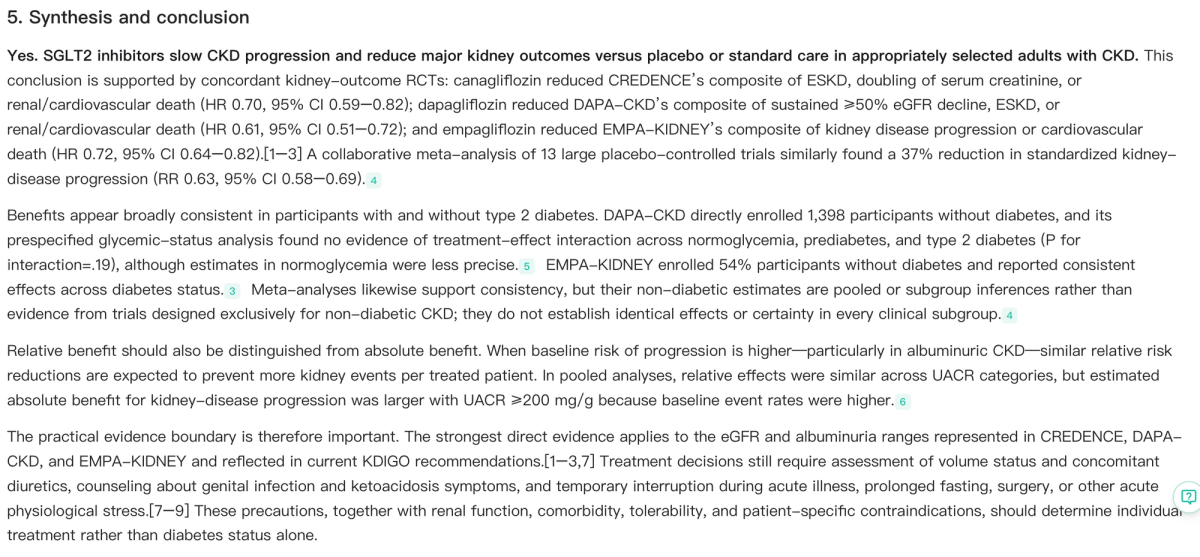
Noah AI's final synthesis connects the pivotal trials, diabetes-status evidence, and the distinction between relative and absolute treatment benefit.
Try Noah AI for Free
Use Noah AI to search, compare, and analyze biomedical evidence with AI-powered research workflows.
Free credits are available, and no credit card is required to get started.
Step 9: Distinguish Relative Benefit From Absolute Benefit
A statistically similar relative treatment effect does not mean every patient gains the same absolute benefit.
Patients with a higher baseline risk of kidney progression can experience more preventable kidney events even when the relative risk reduction is similar to that observed in a lower-risk population.
Albuminuria is a useful example. Higher UACR generally identifies higher kidney-event risk, so similar relative effects can translate into larger absolute benefit.
This distinction is easy to lose when AI systems summarize only hazard ratios.
Step 10: Verify the Sources Behind Major Claims
AI-assisted medical literature review should still end with source verification.
Before using the review in a manuscript, research report, medical-affairs document, or clinical evidence summary, check:
- the original PMID or DOI,
- the randomized population,
- the exact endpoint definition,
- the hazard ratio and confidence interval,
- whether a result is primary, secondary, or subgroup evidence,
- whether a guideline is current and finalized,
- and whether the wording in the review is stronger than the source supports.
In this Noah output, the system also explicitly flagged that the identified KDIGO 2026 diabetes-and-CKD update was available as a draft/public-review document rather than confirmed final guidance.
That kind of uncertainty should remain visible rather than being silently converted into a finalized recommendation.
What AI Should Not Do in a Medical Literature Review
AI can reduce the mechanical workload of evidence review, but several practices remain unacceptable.
- Do not invent references.
- Do not merge different endpoint definitions without qualification.
- Do not present subgroup analyses as though they were primary trials.
- Do not exclude negative studies simply because they complicate the narrative.
- Do not confuse guideline recommendations with randomized efficacy evidence.
- Do not treat pooled estimates as proof of identical effects in every subgroup.
- Do not turn AI output into a final medical conclusion without source checking.
A Practical AI-Assisted Literature Review Workflow
| Step | What to Do | Output |
|---|---|---|
| 1 | Define the clinical question | PICO or another structured question |
| 2 | Set evidence scope | Study types, population, cutoff, source rules |
| 3 | Search biomedical evidence | Candidate literature set |
| 4 | Prioritize the most relevant evidence | Core RCTs, reviews, guidelines |
| 5 | Extract the same fields across studies | Evidence table |
| 6 | Compare populations and endpoints | Comparability assessment |
| 7 | Synthesize findings | Evidence-based answer |
| 8 | Identify uncertainty and limitations | Qualified conclusion |
| 9 | Verify citations | Traceable final review |
Where Different Tools Fit
| Research Task | Tool or Source | Best Use |
|---|---|---|
| Biomedical question to structured review | Noah AI | Useful for domain-specific research workflows that connect medical search, evidence organization, synthesis, and cited output. |
| Verify biomedical publications | PubMed | Primary source for checking indexed publications, metadata, abstracts, and PMIDs. |
| Structured evidence extraction | Elicit | Useful for repeated extraction and systematic-review-style workflows. |
| Read full papers and PDFs | SciSpace | Useful when methods, supplementary data, and detailed eligibility criteria need closer inspection. |
| Check citation context | Scite | Useful for seeing whether later publications support, contrast with, or mention a cited study. |
| Broad multi-source research | ChatGPT Deep Research | Useful for research spanning publications, web sources, uploaded files, and other information types. |
Frequently Asked Questions
Can AI conduct a medical literature review?
AI can assist with question framing, literature discovery, evidence extraction, study comparison, and synthesis. Researchers should still verify important claims against the original sources.
Can AI replace PubMed?
No. AI can make biomedical search and synthesis easier, but PubMed remains an important source for verifying indexed medical literature and publication details.
What should be included in a medical literature review evidence table?
Common fields include study design, population, sample size, intervention, comparator, baseline characteristics, endpoints, follow-up, major results, safety findings, and limitations.
Should meta-analyses and RCTs be treated equally?
No. They provide different forms of evidence. Randomized trials provide direct treatment comparisons, while meta-analyses pool multiple studies to improve precision and assess consistency across populations.
Why is study population comparison important?
Similar treatment effects can have different clinical meaning when studies enroll different disease stages, risk groups, baseline kidney function, albuminuria levels, or diabetes populations.
How do you reduce hallucination risk in an AI literature review?
Use a tightly defined research question, prioritize authoritative biomedical sources, preserve study-level citations, distinguish evidence types, and verify major claims against the original source.
Final Takeaway
The main advantage of AI in medical literature review is not that it can generate a long summary faster.
The useful workflow is:
define the question → identify the evidence → structure the studies → compare populations and endpoints → synthesize the findings → verify the sources.
In our CKD case, Noah AI helped turn a focused biomedical question into a structured review of CREDENCE, DAPA-CKD, EMPA-KIDNEY, meta-analytic evidence, guidance, limitations, and a final cited synthesis.
The final conclusion was not simply that “SGLT2 inhibitors work.” It preserved the more important qualifications: benefit was supported across major kidney-outcome trials, appeared broadly consistent with and without diabetes, and still needed to be interpreted according to patient risk, albuminuria, kidney function, trial eligibility, and exact endpoint definitions.