How to Evaluate Grey Literature in Medical Research with AI (2026)
Linda
Learn how to evaluate grey literature in medical research with AI. Compare preprints, theses, technical reports, and peer-reviewed evidence with a real case study.
A preprint, a doctoral thesis, an institutional scientific brief, and a peer-reviewed article can all inform a medical literature review. But they do not necessarily represent four independent studies. The important questions are what each document actually reports, which claims can be verified, and how its evidence should be used.Grey literature in medical research can reveal relevant evidence that conventional journal searches miss. It also creates practical challenges: incomplete reporting, changing publication status, restricted full texts, and the possibility of counting the same participants more than once. This guide shows how to organize an evidence appraisal with Noah AI, using a real Long COVID case involving persistent musculoskeletal pain and rehabilitation needs.
Key Takeaways
- Assess evidence, not labels. Publication type alone does not prove that a source is valid or invalid.
- Verify access and provenance. A repository record or PDF filename is not proof that the full text was retrieved and reviewed.
- Identify overlapping reports. The Khoja medRxiv preprint and its later journal article describe the same 30-participant study.
- Keep humans responsible. AI can help structure source comparisons, but eligibility decisions and risk-of-bias judgments require reviewer verification.
What Is Grey Literature in Medical Research?
Grey literature generally refers to research and other materials produced outside conventional commercial journal publishing. Depending on the review question, it may include dissertations, preprints, technical reports, institutional publications, conference proceedings, clinical study documents, and public-health guidance. A peer-reviewed journal article is not usually classified as grey literature, but it makes a valuable comparator when assessing a related preprint or thesis.These document types serve different purposes. A preprint can make research visible before journal peer review; a doctoral thesis may describe extensive methods or additional analyses; a scientific brief can synthesize evidence for health-system decisions; and a journal article may present a more formal, peer-reviewed account of primary research. None should be treated as automatically interchangeable.The Cochrane Handbook recommends considering relevant grey literature sources to reduce the risk of publication bias and improve study identification. The search strategy must still be tailored to the review's objectives and eligibility criteria.
Why Grey Literature Matters for Medical Evidence Reviews
Reviews limited to published journal papers may overlook unpublished findings, graduate research, early results, and institutional evidence syntheses. This matters when a field develops quickly or when a clinical problem has limited established research. Long COVID is an example: different research outputs have addressed symptom characterization, functional limitations, and rehabilitation needs from different perspectives.Including more document types does not necessarily mean acquiring more independent evidence. A thesis chapter may later become a journal paper. A preprint may be published after revision. A public-health report may summarize studies already included elsewhere. Reviewers therefore need to distinguish documents, reports of studies, and unique underlying studies.
Challenges in Assessing Non-Peer-Reviewed Evidence
- Unclear version and review status
A DOI identifies a document but does not establish that it has been peer reviewed. The reviewer should record the posting date, version number, publication venue, and whether a later journal article exists. If a preprint has been superseded, the journal article is generally preferable when citing the final published study, while the preprint can remain useful for publication-history analysis.
- Incomplete or inaccessible methods
A university repository may expose a title and abstract even when a thesis PDF is restricted. Similarly, a public report may summarize conclusions without publishing patient-level data. Record precisely what was accessible: bibliographic metadata, abstract, full text, supplementary files, or underlying data.
- Methodological limitations
Weaknesses can arise in any publication category. Small samples, selection bias, uncontrolled comparisons, missing data, and an observational design may constrain conclusions even after peer review. An institutional logo, an accepted manuscript, or a polished PDF is not a substitute for examining the methods.
- Duplicate evidence
The most consequential error can be counting different reports of the same study as independent clinical datasets. Cross-check authors, study dates, participants, recruitment sites, outcome measures, and explicit links between versions before pooling or narratively comparing findings.
How Noah AI Supports Grey Literature Appraisal
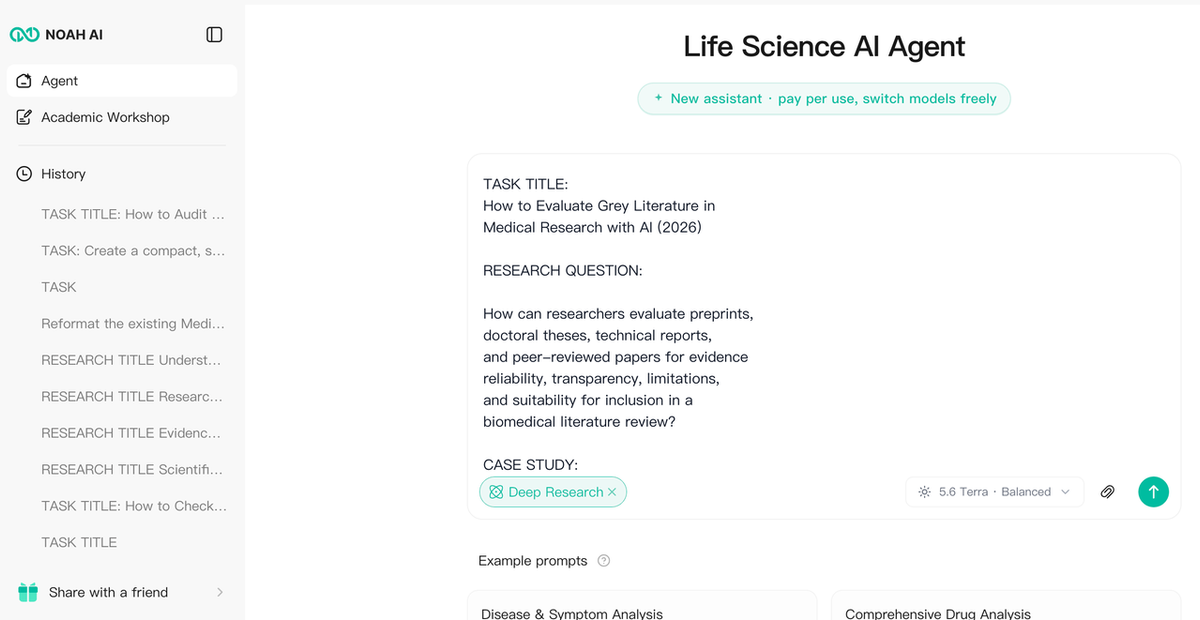
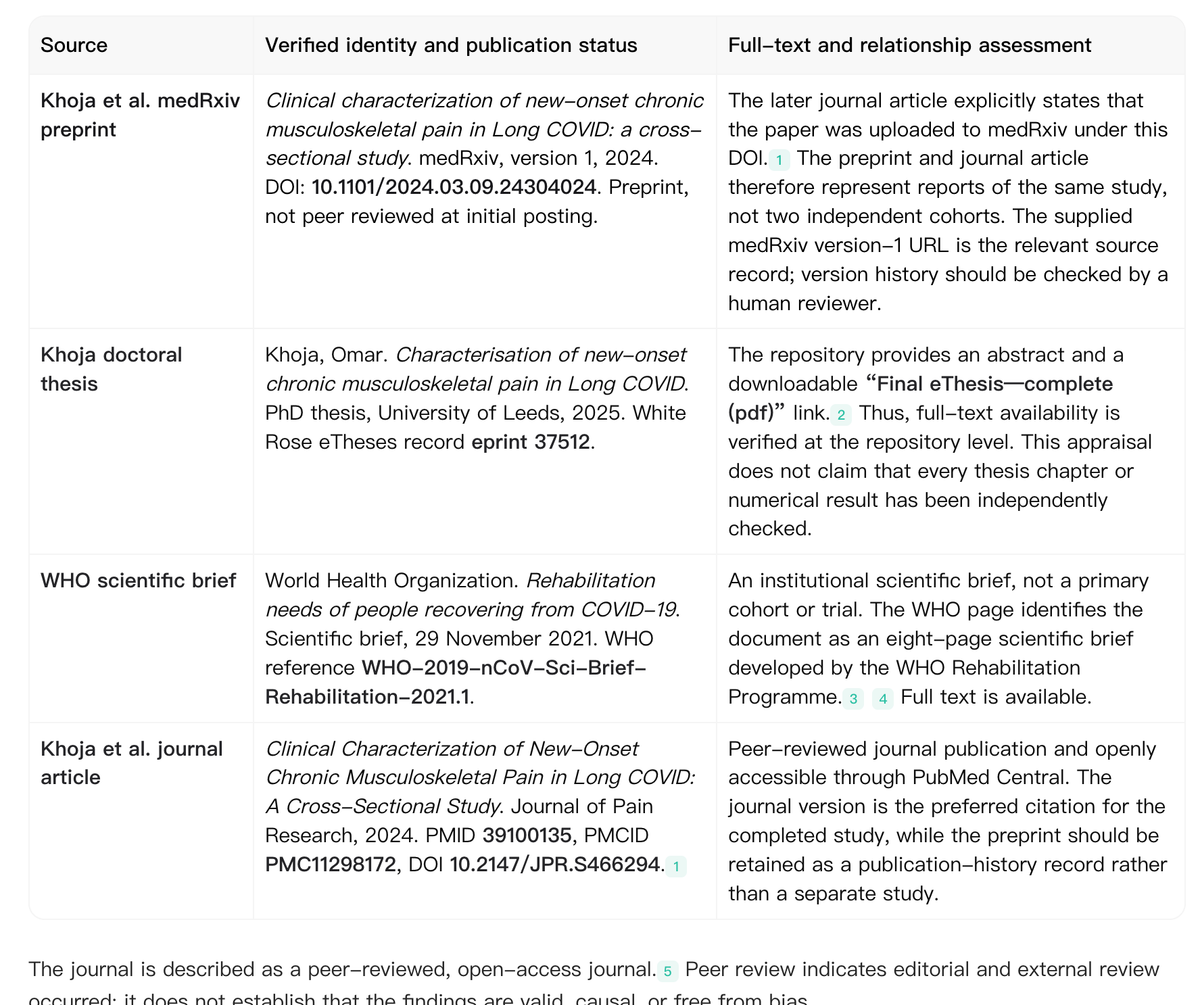
Noah AI can be used to frame a focused biomedical research question and organize a source-by-source review. In this Long COVID exercise, the prompt requested source identity checks, publication relationships, evidence accessibility, methodological limitations, and human-review actions. Its visible output organized four named sources into a comparison of publication status and their relationship to one another.The workflow is deliberately source-grounded. Researchers supply identifiable records and ask for traceable findings rather than a generic ranking of source types. Any AI-generated statement about full-text access, patient characteristics, or overlap should be checked against the original source before it is accepted into a review.
Five-Step Evidence Review Workflow
Step 1: Define the review question
Start with a clinical question that specifies the population, phenomenon, and intended evidence use. For this example: What can research sources tell us about persistent musculoskeletal pain, functional limitations, and rehabilitation needs in adults with Long COVID? A clear scope prevents an institutional rehabilitation brief from being interpreted as if it were a new trial.
Step 2: Identify and verify each record
Search appropriate databases and repositories. Record titles, authors, dates, DOI or repository identifiers, URLs, document types, and version history. Verify these fields on the source site, not from an AI answer alone. Note when a source is discoverable but its full text remains unavailable.
Step 3: Extract evidence and limitations
For each primary study, capture the design, population, recruitment, sample size, measures, principal findings, and reported limitations. For a synthesis or guidance document, identify its purpose, evidence period, target audience, and underlying references instead. If only an abstract is accessible, restrict the extraction to what the abstract supports.
Step 4: Detect reports of the same study
Compare preprints with published articles and examine whether a dissertation includes the same cohort or additional phases of a study. Treat confirmed duplicate reports as linked records, not separate patient samples. If exact participant overlap cannot be verified, label that uncertainty and request manual review.
Step 5: Document a review action
Assign a provisional action such as consider as primary evidence, retain as background context, link to published version, or full-text verification required. These are workflow decisions, not numerical quality scores. Final eligibility and synthesis decisions remain with the human review team.
Best Practices and Common Pitfalls
- Use AACODS as a source-appraisal checklist. Consider Authority, Accuracy, Coverage, Objectivity, Date, and Significance, while applying a design-appropriate risk-of-bias tool separately when needed.
- Maintain a verification trail. Log links, versions, access dates, and exactly which materials were read.
- Separate primary findings from contextual summaries. A technical brief can inform the rationale for a review without adding another independent cohort.
- Avoid unsupported certainty. Do not convert a publication label into a 0–100 reliability score or imply that peer review proves causation.
- Keep the search reproducible. When conducting a real systematic review, preserve search strings, dates, screening reasons, and links among related reports.
Long COVID Evidence Reliability Case Study
The case compares four identifiable sources related to persistent musculoskeletal pain and rehabilitation in Long COVID: a 2024 medRxiv preprint, a 2025 University of Leeds doctoral thesis, a 2021 WHO scientific brief, and a 2024 peer-reviewed study in the Journal of Pain Research.The peer-reviewed study reported data from 30 adults experiencing new-onset chronic musculoskeletal pain with Long COVID. Participants underwent clinical examinations, quantitative sensory testing, inflammatory-marker testing, functional measures, and patient-reported questionnaires. The authors reported widespread pain and associations with reduced function and quality of life. Because the analysis is observational and the sample is small, the findings do not establish that any single biological mechanism caused the pain.The earlier medRxiv record describes the same 30-participant study and should not be counted as another cohort. The doctoral thesis record describes broader research, including longitudinal work, but overlap between its chapters and published reports needs study-level verification. The WHO brief addresses rehabilitation needs at a policy and evidence-synthesis level; it is not a new clinical cohort.
Medical Grey Literature Evidence Reliability Table
| Source / Type | Verified Evidence | Reliability / Limitation | Review Action |
|---|---|---|---|
| "Khoja et al. medRxiv preprint, 2024" | Initial report of a 30-participant Long COVID cross-sectional study. | Not peer reviewed when posted; same underlying study as the later journal article. | Link as a preprint version; do not count as an independent cohort. |
| "Khoja Doctoral thesis, 2025" | University of Leeds record and abstract describe cross-sectional and longitudinal research. | Complete PDF is listed, but the available repository page says it cannot be downloaded; current access and chapter-level overlap need verification. | Use verified metadata and abstract cautiously; seek full text and confirm any sample overlap. |
| "WHO Scientific brief, 2021" | Institutional synthesis discussing persistent symptoms, functioning, and rehabilitation needs. | Not a primary clinical study; evidence reflects its historical publication period. | Use for background and rehabilitation context, not as a new patient dataset. |
| "Khoja et al. Journal article, 2024" | Peer-reviewed, open-access cross-sectional report of the 30-participant study. | Small observational sample; findings and biological associations are not proof of causality. | Consider as the primary published report, subject to review eligibility and bias assessment. |
The central finding: four source records do not equal four independent patient datasets. The preprint and journal paper are linked reports of one study; the thesis may encompass related and additional work; and the WHO brief provides secondary context.Full-text verification caveat: The White Rose eTheses entry names a “Final eThesis - complete (pdf)” file and gives an embargo date of 1 November 2026. However, the repository page retrieved for this article still displayed a notice that the file could not be downloaded or requested. Because the embargo date has passed, recheck live access before publication. The file listing alone should not be represented as confirmed full-text access or a completed chapter-by-chapter appraisal.
How to Review Grey Literature with Noah AI
A reproducible Noah-supported workflow begins with a clear request and identifiable sources, rather than asking an AI model which type of document is “most trustworthy.” Enter the review objective and supply source URLs, identifiers, and any accessible primary files. Ask for a table that keeps verification separate from interpretation.
- State the research question. Name the Long COVID population, chronic musculoskeletal pain, functional outcomes, and rehabilitation context.
- Provide the records. Include the medRxiv DOI, thesis repository URL, WHO brief URL, and journal article PMID or DOI.
- Request an evidence audit. Compare document identities, original study designs, publication status, full-text availability, source overlap, and limitations.
- Request actionable outputs. Use separate columns for verified evidence, limitations, and proposed reviewer actions rather than one quality score.
- Check the originals. Correct any misleading access claim or citation, inspect the underlying study, and document disagreements before using the table in a manuscript.
The two screenshots show a real research prompt and a source-relationship comparison. They do not establish that Noah completed a comprehensive database search, read inaccessible files, independently evaluated every thesis chapter, or made final systematic-review inclusion decisions.
Documenting Grey Literature Under PRISMA 2020
In a genuine systematic review, PRISMA 2020 provides guidance for reporting information sources, search strategies, selection processes, and study inclusion. Review teams should document how repository records, preprints, and published articles were found; why records were excluded; and which reports correspond to the same study.This four-document exercise is a targeted source appraisal, not a completed systematic review. It has no documented exhaustive database strategy, complete screening log, or validated PRISMA flow counts. Inventing records identified, duplicates removed, or studies included would misrepresent the method. A review team should construct those counts only from its actual search and screening records.
Final Grey Literature Review Checklist
- Is the review question and intended role of each source clear?
- Have titles, authors, publication dates, identifiers, and versions been checked?
- Is full-text access verified rather than inferred from a repository entry?
- Are original studies distinguished from summaries, guidance, and institutional reports?
- Have preprints, journal publications, and thesis chapters been checked for participant overlap?
- Are methodological weaknesses documented without assigning unsupported scores?
- Are the source's findings relevant to the population and outcomes in the review?
- Are evidence-use decisions and unresolved questions recorded for human review?
- If claiming a systematic review, is there a real search and screening log to support PRISMA reporting?
Conclusion and Next Steps
Grey literature in medical research is valuable because relevant information does not always begin or end in a peer-reviewed journal. Yet better coverage requires careful appraisal. The Long COVID example shows why researchers must verify publication identity, assess evidence in context, and distinguish multiple documents from independent clinical studies.Noah AI can help organize this work by bringing source details, limitations, and publication relationships into one reviewable structure. The decisive step remains human validation: checking original records, confirming access, evaluating study methods, and making transparent inclusion decisions.
Review biomedical evidence with Noah AI
Start with a focused research question, examine source relationships, and build a structured evidence table for human verification.