How to Detect Duplicate Literature Records Across PubMed and Crossref with AI (2026)
Linda
Learn how to identify duplicate biomedical records using DOI, PMID, title, and author comparisons. Explore a real Noah AI pilot audit and verification workflow.
Search results from PubMed, Crossref, journal websites, and preprint servers often describe overlapping publications. Some are duplicate records for exactly the same article; others are different reports from the same clinical study. This guide shows a source-aware Noah AI workflow for distinguishing them using DOI, PMID, titles, author groups, and publication history—without automatically deleting important evidence.Key takeaways
- A matching DOI supported by title and publication metadata is strong evidence that two database records identify the same publication.
- A shared clinical-trial platform or a similar title is not sufficient evidence of a duplicate publication.
- Preprints and journal articles may report the same study, but they remain separate publication objects with different identifiers.
- The Noah AI example below usednine manually curated public-source records, not direct PubMed or Crossref API exports.
- Keep original source records and document any merge, link, or retain decision for human review.
What Is Literature Record Deduplication?
Literature record deduplication is the process of recognizing when search results from different sources point to the same bibliographic publication. If PubMed and a publisher both index one journal article, a review team generally needs one canonical publication entry for screening, even though it may preserve multiple original search records for provenance.That is different from grouping multiple reports of one study. A protocol, preprint, primary trial report, extended follow-up, and secondary analysis can belong to the same research project while containing different information. Removing these records indiscriminately could discard relevant methods or outcomes. The Cochrane Handbook, Chapter 4 distinguishes removing duplicate records for a report from collating multiple reports that belong to a study.There are therefore three levels to track: source record, publication/report, and underlying study or treatment comparison. An accurate workflow does not treat them as interchangeable.
Why Duplicate Record Checks Matter in Medical Reviews
When researchers combine PubMed, Crossref, publisher websites, and additional databases, the same DOI may appear several times, often with slightly different titles, capitalization, punctuation, author presentations, and publication dates. Without consistent review, duplicate search hits can inflate the screening workload and distort the count of unique reports.The opposite mistake can be more consequential: mistakenly merging distinct reports can hide changes in results over time or omit outcome details that appear in only one publication. In systematic reviews and meta-analyses, study-level synthesis must avoid double-counting participants while retaining relevant reports. PRISMA 2020 also expects reviewers to document how many duplicate records were removed before screening.
Common Problems in PubMed, Crossref, and Publisher Metadata
| Metadata problem | Why it matters | Reasonable response |
|---|---|---|
| Same DOI, slightly different title punctuation | Exact-string comparisons can miss the match. | Normalize punctuation, then confirm DOI and article identity. |
| PMID missing from one source | Cross-source records may have different available identifiers. | Use DOI, title, journal and authors; do not invent a PMID. |
| Different online and issue publication years | Year discrepancies do not always mean distinct articles. | Inspect online-publication versus issue dates. |
| Preprint and final article have different DOIs | They may report the same trial without being one publication. | Link related versions; review before merging or excluding. |
| Several reports from a platform trial | Shared platform or group authorship can appear similar. | Check treatments, outcomes and trial comparisons separately. |
| Incomplete export provenance | It is unclear whether metadata came from an API or a curated file. | Preserve source labels and describe the actual retrieval method. |
How Noah AI Supports Duplicate Record Review
In the illustrated workflow, Noah AI was given a CSV with nine bibliographic rows assembled from publicly available metadata. The task asked it to align identifiers, compare normalized titles and author information, distinguish exact publication matches from related versions, and propose actions in a Duplicate Record Audit Table.
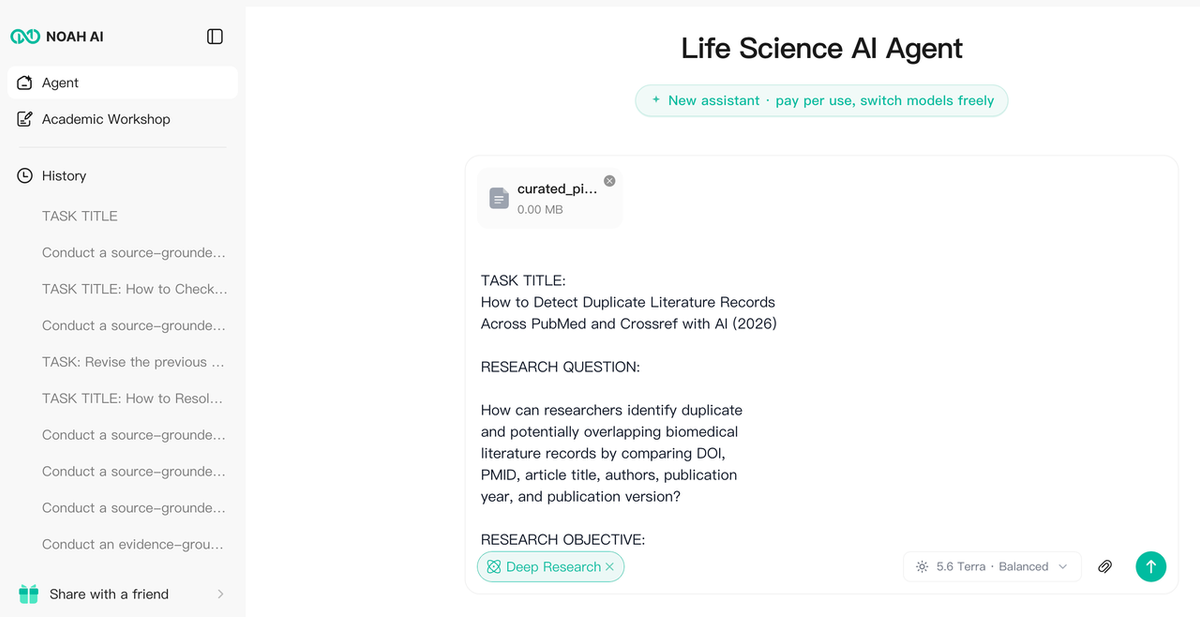
The visible result demonstrates AI-assisted comparison of supplied records. It does not establish that Noah automatically exported PubMed data, queried Crossref's REST API, removed records from a citation manager, or completed a large-scale reproducible deduplication pipeline. Those would require additional source files and a separately documented process.For a true PubMed–Crossref audit, supply original PubMed .nbib records and corresponding Crossref API JSON responses. For a pilot like this one, clearly label manually assembled records as curated input and retain links to their source pages.
Five-Step Workflow for Reviewing Duplicate Literature Records
- Collect and label original records.Export relevant results from PubMed, Crossref or other bibliographic sources. Assign a unique ID to every raw record, along with its source and retrieval date. Never overwrite the input set.
- Normalize comparison fields.Standardize DOI case and prefixes, title whitespace and punctuation, journal naming and author formatting. Keep original text alongside the normalized values.
- Flag likely same-publication pairs.Compare DOIs first, then inspect compatible titles, authors, journals, years and source links. A match is a candidate until identity has been verified.
- Classify versions and distinct reports.Investigate records with different DOIs but overlapping trial titles or registrations. Identify preprints, final publications, subgroup reports and distinct treatment comparisons.
- Document a human-reviewed decision.Record whether to consolidate publication identity, link related reports, retain separate publications, or request further verification. Report counts only for records actually processed.
Real Biomedical Literature Deduplication Case Study
The pilot used nine curated records: four PubMed–publisher pairs for journal articles, plus a separate medRxiv preprint. The two source labels identify where the manually assembled bibliographic entries came from; they do not represent nine original native database exports or a completed Crossref API pull.The four journal publications cover a RECOVERY dexamethasone comparison, a BNT162b2 vaccine trial, the remdesivir final report, and a RECOVERY hydroxychloroquine comparison. Their source identities can be checked using PubMed and publisher records.
| Journal report | PMID | Publication DOI |
|---|---|---|
| RECOVERY: Dexamethasone | 32678530 | 10.1056/NEJMoa2021436 |
| BNT162b2: Vaccine trial | 33301246 | 10.1056/NEJMoa2034577 |
| Remdesivir: Final report | 32445440 | 10.1056/NEJMoa2007764 |
| RECOVERY: Hydroxychloroquine | 33031652 | 10.1056/NEJMoa2022926 |
Duplicate Record Audit Table from Noah AI
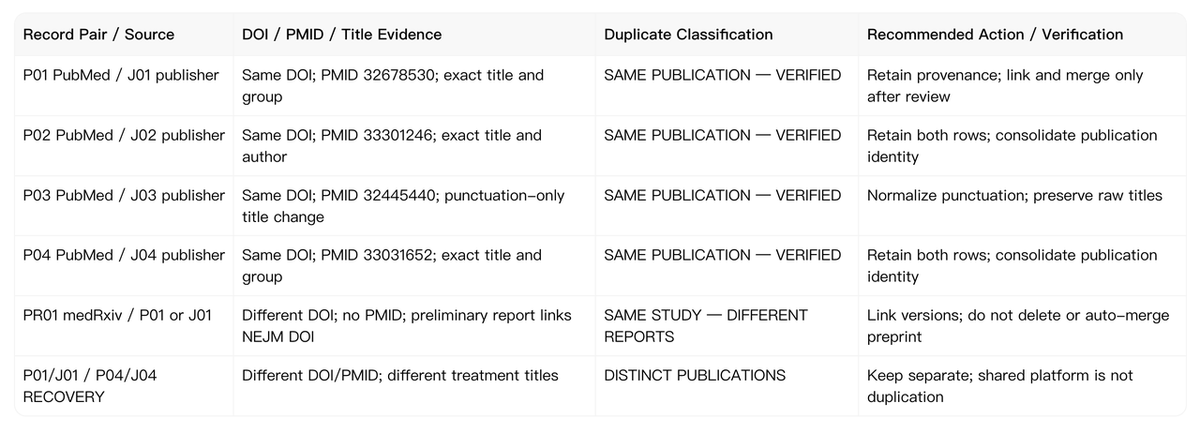
The six-row output below shows four same-publication pairings, one related preprint–journal relationship, and one comparison of distinct RECOVERY treatment reports. These classifications represent the model's analysis of the curated input; the decisions still call for appropriate source review.
What the six audit rows mean
P01/J01, P02/J02, P03/J03 and P04/J04: Each pair presents a PubMed-source entry and a publisher-source entry for the same journal publication. Their DOI and article identities align in the curated dataset. The remdesivir title includes a punctuation-only difference; normalizing the dash helps matching, but the raw original titles should remain intact.PR01 versus P01/J01: The 2020 medRxiv preliminary dexamethasone report has DOI 10.1101/2020.06.22.20137273, distinct from the journal DOI. It describes the same underlying dexamethasone comparison in the RECOVERY trial, so it should be linked as a related report, not automatically treated as a duplicate publication to delete.RECOVERY dexamethasone versus RECOVERY hydroxychloroquine: The publications share the trial platform and a collaborative group but concern different treatment comparisons, have different DOIs and PMIDs, and must remain separate publication records. A platform-trial label is not a reliable deduplication key.How to interpret the pilot counts: Nine curated source rows contain four pairs that point to four journal publications, together with one additional preprint record linked to one of those publications. This is not a count of unique clinical studies, automatically deleted rows, or true PubMed–Crossref API match rates. The six table rows are comparisons, not six unique publications.
Best Practices and Common Deduplication Mistakes
- Do: keep exact record IDs and source timestamps; avoid: losing provenance during normalization.
- Do: use DOI plus compatible bibliographic details; avoid: declaring duplicates solely from title similarity.
- Do: link multiple reports of one study; avoid: deleting preliminary or follow-up publications automatically.
- Do: retain separate platform-trial treatment reports; avoid: merging them because they share a registration or collaborator group.
- Do: document any DOI backfilling from actual registries; avoid: presenting guessed identifiers as verified metadata.
- Do: report exactly what was checked; avoid: calling a curated nine-record pilot a validated PubMed–Crossref pipeline.
How to Preserve Citation Provenance and Publication Versions
A final review library should usually hold a canonical citation for each relevant publication while retaining references to the database records that identified it. If multiple reports describe one study, connect their identities rather than collapsing their contents. This makes it easier to detect changed outcomes, updated participant counts, or additional follow-up details before extracting study-level evidence.Publication DOI, database identifiers such as PMID, trial-registration number, and preprint DOI each identify different kinds of objects. A shared identifier can be powerful evidence of overlap, but it is not a substitute for reading the methods and trial comparison when the relationship is uncertain.When reporting a systematic review, keep the deduplication audit trail alongside the search log so that the numbers in the PRISMA flow diagram can be supported by actual record-level decisions.
Final Checklist Before Removing Duplicate Literature Records
- Save original database exports with source and retrieval date.
- Confirm that every record retains a unique source identifier.
- Normalize DOI, titles and author names without changing raw fields.
- Check DOI matches against title, journal and publication version.
- Identify preprints, protocols, updates and follow-up reports.
- Distinguish duplicate source records from distinct reports of one study.
- Escalate uncertain cases to a human reviewer.
- Document each merge, retain, or related-version decision.
- Count unique records, reports and studies separately.
- Reconcile record removals with the reported PRISMA flow.
Frequently Asked Questions
Are records with the same DOI automatically duplicates?
They are strong same-publication candidates, but metadata should still be checked for conflicts, corrections, or version distinctions. A record-pair match is not the same as permission to discard provenance.
Should a preprint be deleted when a journal article exists?
Not automatically. The two reports may be linked to the same study, but each is a separate publication object. Whether a review uses one or both as sources depends on its protocol and the information each report contains.
Can Noah AI calculate a deduplication accuracy score from this pilot?
No validated accuracy score follows from the screenshot. Demonstrating sensible classifications on a small curated dataset is not an independent accuracy benchmark. Formal evaluation requires a reference standard and a defined sample.
Does this case show Crossref API deduplication?
No. This case used manually curated PubMed and publisher-source records. Crossref API export is described as a recommended input for a fuller reproducible workflow, not as a completed part of this pilot.
Conclusion: Verify Identity Before Removing Records
A reliable duplicate-record workflow separates three questions: Are these two search records for the same publication? Are these different reports of one study? Or are these distinct studies or treatment comparisons? The Noah AI pilot demonstrates how a structured audit table can make those decisions visible and easier to review, provided its data provenance and verification limits remain clear.Start with trustworthy identifiers, preserve original records, and leave uncertain publication relationships open for human assessment. The goal is not the largest possible number of removed records—it is a traceable evidence library.
Flag Potential Duplicate Literature Records for Human Review with Noah AI
Use Noah AI to compare bibliographic records by DOI, PMID, article title, authors, and publication history. Generate a source-linked Duplicate Record Audit Table that flags potential duplicate records and distinguishes related publications, preprints, and separate study reports.Review candidate matches, preserve original source records, and confirm which records should be merged, linked, or retained.
Noah AI helps identify potential duplicates for manual verification. It does not automatically delete records or replace researcher judgment.
Try Noah AI for Free →