How to Turn Biomedical Evidence into R&D Recommendations with AI
Linda
Learn what makes a biomedical evidence workflow decision-ready: directional conclusions, contradictory evidence, material gaps, and AI-assisted R&D review.
What Makes a Biomedical Evidence Workflow Decision-Ready?
Decision-readiness depends on whether an output takes a qualified position, surfaces the contradictions that matter, and names the gaps that would change the conclusion — not simply on how much evidence it contains.
AI-assisted biomedical evidence synthesis · Human-in-the-loop review
A biomedical evidence workflow is decision-ready when it does more than retrieve and organize relevant studies. It must establish what is known, how reliably it is known, what remains uncertain, and whether the evidence is sufficient for the decision at hand.
For R&D teams, the output should connect evidence to a defined action: advancing a biomarker strategy, changing a clinical-development plan, selecting a validation experiment, or declining a proposed indication. A long evidence summary may still fail if it does not make the assumptions, contradictions, and failure points visible.
This workflow is designed for R&D portfolio teams, translational biomarker researchers, and target/indication strategy teams that need to turn biomedical evidence into actionable development recommendations.
Rather than producing another literature summary, the goal is to answer three questions: What should the team do now? What evidence supports that recommendation? What new evidence could change it?
TROP2 provides a useful test case. The relevant question is not only whether TROP2 is expressed in tumors, or whether TROP2-directed antibody–drug conjugates have clinical activity. The more decision-ready question is whether a measured feature of TROP2 can predict response to a particular TROP2 ADC in a defined disease and treatment setting.
Completeness Is Not the Same as Decision-Readiness
A complete TROP2 evidence summary can be scientifically extensive and still fail at the point where an R&D team must act. It may describe TROP2 biology, expression across tumor types, clinical trials, assay performance, resistance mechanisms, and safety signals. But the decision remains unresolved if the output does not answer whether TROP2 IHC should guide patient selection, stratification, or further biomarker development.
The current evidence supports a qualified position rather than a simple yes-or-no answer. TROP2 expression can contribute to response probability, but conventional TROP2 IHC alone is not yet a validated universal treatment-selection gate across ADCs, diseases, and treatment lines.
Decision-ready synthesis should arrive somewhere. For the TROP2 biomarker case, the review should not stop at "TROP2 is expressed" or "more research is needed." It should state what can be acted on now, what should remain investigational, and what evidence would justify changing the recommendation.
Three Elements Distinguish a Decision-Ready Biomedical Output
1. A directional statement
A decision-ready output must take a position that is specific enough to guide development while remaining proportionate to the evidence. For TROP2, the current position is not that TROP2 is irrelevant. It is that TROP2 IHC should be treated as an exploratory stratification or enrichment variable unless a locked, molecule-specific, prospectively validated assay demonstrates predictive treatment interaction.
TROP2 expression and IHC support biological plausibility and may be useful for exploratory stratification or enrichment, but TROP2 should not currently serve as the sole primary selection gate across diseases or ADC designs.
2. Contradictory or weak evidence must be characterized
Contradictions should not be listed and left for a senior reviewer to interpret. A decision-ready output should explain whether the conflict reflects an unvalidated biomarker, a model limitation, disease-context dependence, assay variation, lack of replication, or true biological uncertainty.
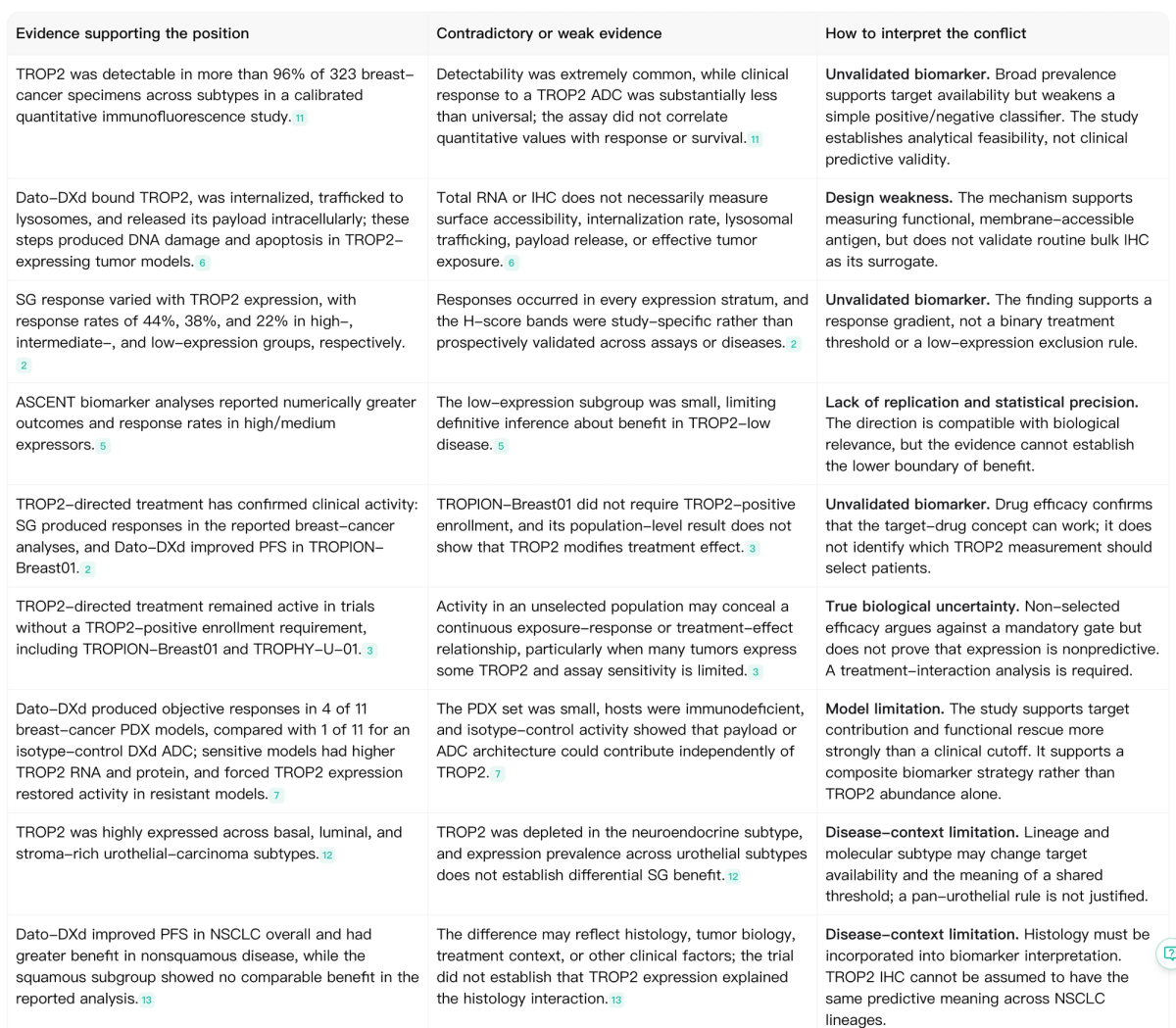
3. Material gaps must be named
Not all evidence gaps are equal. Some are interesting limitations; others would change the direction of the recommendation. For TROP2, decision-changing gaps include prospective treatment interaction, assay harmonization, membrane localization and internalization, intrapatient heterogeneity, lineage state, payload sensitivity, and post-ADC resistance.
Naming these gaps converts uncertainty into a structured development plan. Instead of ending with an open-ended limitation, the output should identify which experiment, assay validation step, or clinical analysis would strengthen, narrow, or reverse the current position.
Why Outputs That Surface Their Own Limitations Earn More Trust
Senior scientists are often wary of outputs that look unusually clean. Biomedical evidence is rarely uniform: studies differ in model system, disease lineage, treatment history, assay, endpoint, statistical power, and follow-up. A summary that presents one coherent answer without showing these differences can appear decisive while removing the information needed to judge whether the conclusion will survive translation.
For TROP2, a polished statement such as "higher expression predicts response to TROP2 ADCs" hides the difference between a response gradient, a validated treatment-selection biomarker, and a mechanistic hypothesis. A credible evidence workflow should identify what is established, what is inferred, what is weak, what is unresolved, and what is decision-changing.
| Evidence status | How it should be used |
|---|---|
| Established | Supported by fit-for-purpose clinical or regulatory evidence in a defined context. |
| Inferred | A reasoned interpretation supported by multiple findings but not directly demonstrated. |
| Weak | Based on small samples, post hoc subgrouping, limited models, or incomplete measurements. |
| Unresolved | Competing explanations remain plausible and should be made visible. |
| Decision-changing | A gap whose resolution could alter the recommendation, trial design, or biomarker strategy. |
What Decision-Readiness Looks Like Across Biomedical Workflow Types
Safety assessment
A decision-ready safety output is not an adverse-event catalog. It delivers a risk characterization: how often the signal occurs, how severe it is, whether it is molecule-specific or class-wide, which patients are most exposed, how it is detected and managed, and when it should alter development or treatment.
Indication expansion
An indication-expansion review should not ask only whether the target is expressed in the proposed disease. It should test whether the full intervention — antibody, linker, payload, dosing, comparator, treatment line, disease biology, and safety profile — has sufficient evidence in that setting.
Biomarker analysis
A biomarker workflow should distinguish analytical feasibility, biological relevance, clinical association, and predictive validity. In the TROP2 case, the decision-ready strategy is not a single IHC cutoff. It is a ranked development plan: retain standardized quantitative membrane-accessible TROP2 as a leading stratification or enrichment variable, avoid IHC-only gating, and add lineage, payload sensitivity, and resistance biology to capture the full ADC response mechanism.
Coverage-Based Workflow vs Decision-Ready Workflow
A coverage-based workflow is optimized to find and summarize relevant information. A decision-ready workflow is optimized to support a defined action under a defined context of use.
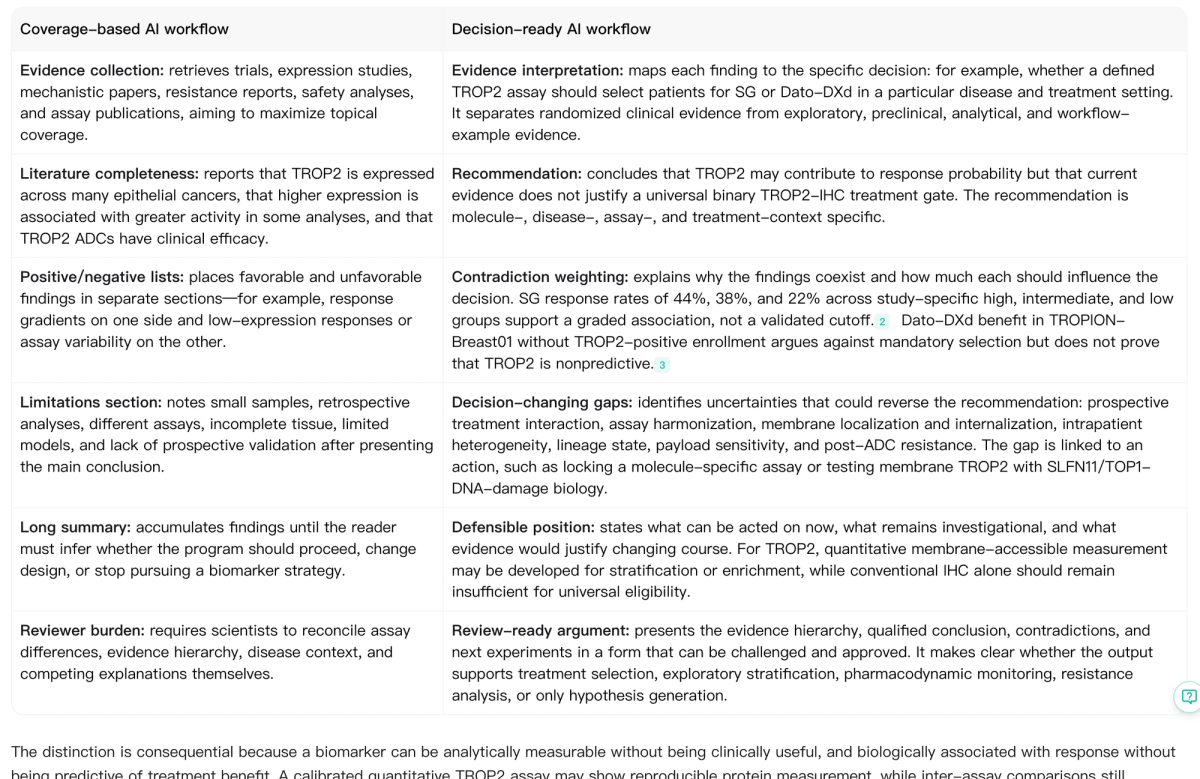
The distinction is consequential because a biomarker can be analytically measurable without being clinically useful, and biologically associated with response without being predictive of treatment benefit. A decision-ready workflow defines the proposed context of use before interpreting the literature: the ADC, tumor type, treatment line, specimen, assay method, measured feature, and intended clinical action.
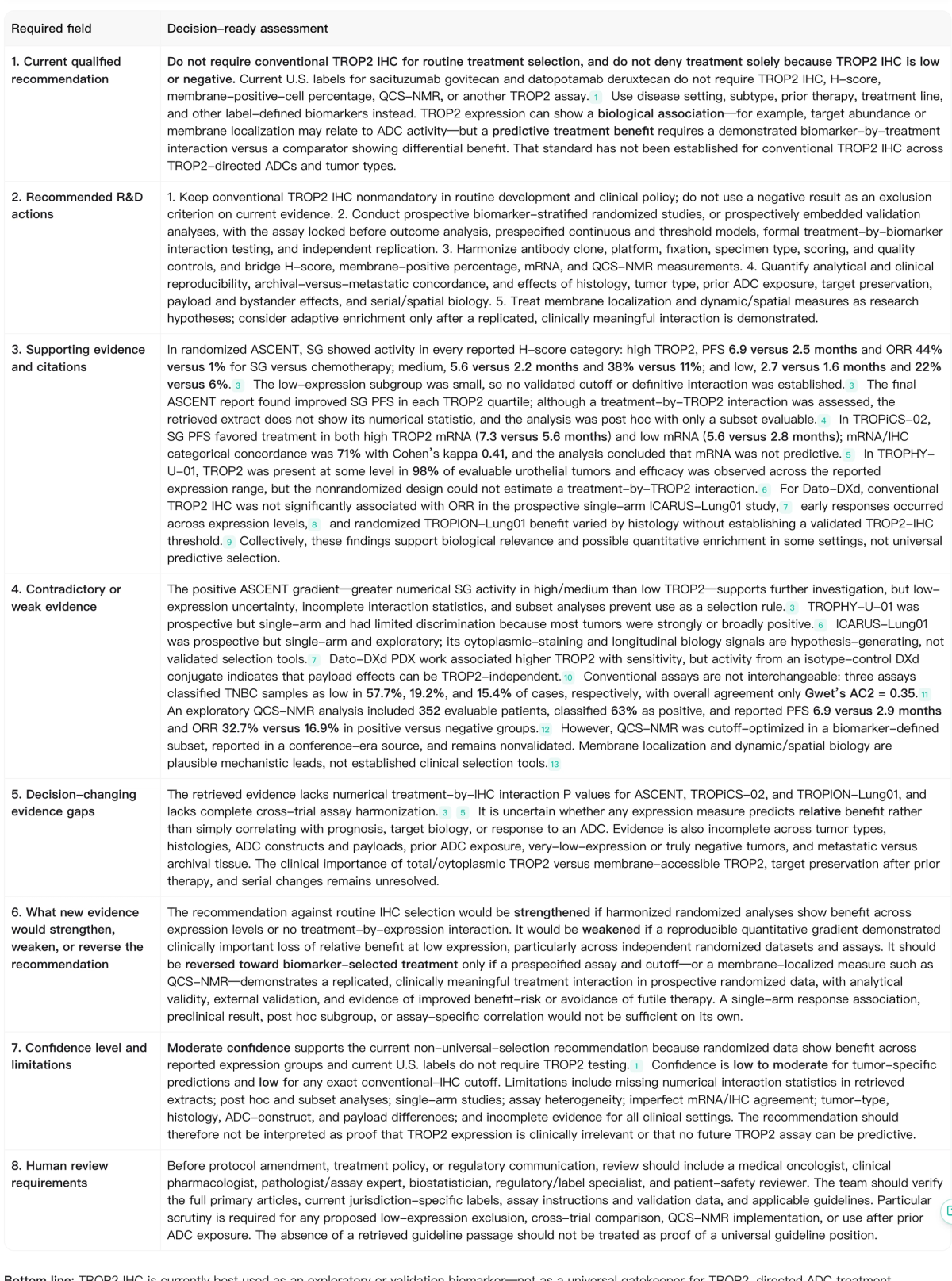
Decision-Ready Output Template
A decision-ready biomedical review should be organized around a small set of reviewable fields:
- Decision question: What decision must the evidence support?
- Directional statement: What is the current qualified position?
- Evidence supporting the position: Which findings directly support it, and at what evidence level?
- Contradictory or weak evidence: Which findings limit, qualify, or challenge the position?
- Material gaps: Which missing evidence could change the recommendation?
- Recommended next action: What should the R&D team do now?
- Confidence level: How strongly does the evidence support the directional statement?
- Human review required: Which judgments cannot be delegated to automated synthesis?
TROP2 Case: From Evidence Review to a Qualified Recommendation
The purpose of the TROP2 evidence review is to determine whether TROP2 expression should guide patient selection for a specific TROP2-directed ADC in a defined disease and treatment setting.
Current Recommendation
REFINE THE BIOMARKER STRATEGY — DO NOT USE TROP2 IHC ALONE AS A UNIVERSAL PATIENT-SELECTION GATE.
Based on the evidence reviewed, TROP2 remains a clinically relevant ADC target, but conventional TROP2 IHC expression has not been established as a universal predictive biomarker across ADC molecules, tumor types, and treatment lines.
Recommended actions:
- Retain standardized TROP2 expression assessment as an exploratory stratification variable.
- Define the intended ADC, disease population, treatment line, assay, and biomarker context of use.
- Investigate membrane-accessible TROP2, internalization, tumor heterogeneity, payload sensitivity, and resistance biology.
- Avoid restricting patient eligibility using a universal TROP2 IHC cutoff without prospective predictive validation.
What Evidence Would Change This Recommendation?
| Decision-Changing Evidence | Potential Impact on Recommendation |
|---|---|
| Prospective randomized evidence demonstrating a reproducible treatment-by-biomarker interaction | Could support biomarker-guided patient selection for the tested ADC and clinical setting |
| Analytically validated assay and reproducible cutoff across laboratories | Could support implementation of a defined biomarker strategy |
| Independent validation in the intended patient population | Could increase confidence in clinical applicability |
| Evidence that TROP2 expression alone does not meaningfully predict relative treatment benefit | Would further weaken an IHC-only selection strategy |
| Functional evidence linking membrane localization, internalization, or payload sensitivity to response | Could support a more informative biomarker model for prospective testing |
Final Decision
- Current direction: Refine and prospectively validate the biomarker strategy.
- Not recommended: Universal patient selection using TROP2 IHC expression alone.
- Decision-changing gap: Whether a defined, analytically validated biomarker can prospectively predict incremental treatment benefit from a specific TROP2 ADC in a specific disease and treatment setting.
- Human review required: R&D and translational biomarker teams must verify the supporting studies, assay performance, treatment interaction evidence, and clinical applicability before making a development decision.
How Noah AI Supports Decision-Ready Biomedical Reviews
Noah AI can support researchers by helping transform a broad literature search into a structured, reviewable argument: what the evidence shows, how reliable it is, where studies disagree, and what remains unknown. For a TROP2 ADC review, this means organizing clinical, translational, mechanistic, resistance, and assay-validation evidence while keeping the final judgment human-in-the-loop.
Noah can help separate randomized clinical results from exploratory subgroup analyses, mechanistic models, analytical studies, resistance case reports, and workflow examples. It can also help draft decision-ready summaries using a defined structure: decision question, directional conclusion, supporting evidence, contradictory evidence, material gaps, next action, and confidence level.
Noah AI does not make final R&D decisions and does not replace senior biomedical scientists. It supports their work by making the evidence trail more searchable, comparable, explicit, and auditable. Learn more about Noah AI's human-in-the-loop approach at Noah AI Human-in-the-Loop.
Conclusion
Completeness is necessary for biomedical R&D, but it is insufficient for decision-making. A comprehensive evidence set can describe target biology, clinical activity, assay performance, safety findings, and resistance mechanisms without answering the question that matters most: what should the team do next?
A decision-ready output must take a qualified position, characterize contradictory or weak evidence, and name the gaps that could change the recommendation. In the TROP2 case, the evidence supports TROP2 as a biologically relevant contributor to ADC delivery and response probability, but it does not establish a universal TROP2 IHC cutoff or justify using expression alone as a treatment-selection gate across ADCs, diseases, and treatment settings.
The value of an AI-assisted biomedical workflow is not that it produces the longest or most confident summary. Its value is that it helps teams move from evidence coverage to an auditable decision: what is established, what is inferred, what remains unresolved, what could change the conclusion, and which action is justified now.
Turn Biomedical Evidence into a Qualified Recommendation with Noah AI
Use Noah AI to turn a biomedical evidence review into a qualified R&D recommendation with decision-changing gaps.
Connect supporting evidence, contradictory findings, unresolved uncertainties, and practical next steps in a source-linked research workflow.
Free to use · Free credits included · No credit card required
Build a Decision-Ready Evidence Review with Noah AI →