How to Identify Conflicting Evidence in Medical Literature with AI
Linda
Learn how to use AI to identify and analyze conflicting evidence in medical literature by comparing study design, populations, interventions, endpoints, and uncertainty.
Medical studies do not always point in the same direction. One randomized trial may report a clinically meaningful benefit, while another study examining an apparently similar treatment reports little or no effect.
The difficult part is not finding two papers with different conclusions. The real research task is determining whether the studies are sufficiently comparable for their findings to represent genuinely conflicting evidence.
Differences in population, intervention formulation, comparator, endpoint definitions, follow-up, or study design can make results appear contradictory even when the studies are not answering exactly the same question.
In this guide, we use Noah AI in a real biomedical research workflow to examine the apparently discordant cardiovascular findings from the REDUCE-IT and STRENGTH trials.
Rather than asking AI which trial is “correct,” we use it to:
- align the study characteristics;
- identify where the findings diverge;
- separate observed differences from possible explanations;
- organize the disagreement using a practical working framework;
- and preserve uncertainty in the final synthesis.
Noah does not make the final methodological judgement about whether two studies are genuinely conflicting. Researchers still need to verify the original studies and determine whether the evidence is sufficiently comparable.
Testing note: We tested Noah AI directly in the workflow shown below.
What Does Conflicting Evidence Actually Mean?
Two studies should not be labeled contradictory simply because one result is statistically significant and another is not.
Before interpreting disagreement, researchers first need to determine whether the studies are sufficiently aligned across the clinical question.
For this article, we use the following working framework to organize different types of disagreement. It is a practical research structure rather than a formal validated taxonomy.
| Relationship | What It Means |
|---|---|
| Direct conflict | Closely comparable studies evaluate substantially similar populations, interventions, comparators, and outcomes but produce materially different findings. |
| Partial conflict | Studies overlap on the main clinical question but differ in one or more important dimensions that may affect interpretation. |
| Apparent conflict | Headline conclusions look inconsistent, but the studies are addressing meaningfully different clinical questions. |
| Insufficiently comparable | Differences in design, treatment, population, endpoint, or context are too large to interpret the results as a meaningful conflict. |
The purpose of this framework is not to let AI assign a definitive label.
It is to force the researcher to make comparability explicit before interpreting disagreement.
If you are still at the evidence-discovery stage, see PubMed Search with AI for a broader workflow covering biomedical search, narrowing, and evidence analysis.
Real Example: REDUCE-IT vs STRENGTH
REDUCE-IT and STRENGTH provide a useful case because their headline findings appear very different.
REDUCE-IT evaluated icosapent ethyl, a purified EPA ethyl ester, in statin-treated patients at elevated cardiovascular risk.
Its primary composite cardiovascular endpoint occurred in 17.2% of the treatment group and 22.0% of the comparator group, with a hazard ratio of 0.75.
STRENGTH evaluated a different omega-3 formulation containing EPA and DHA.
Its primary endpoint occurred in 12.0% of the active-treatment group and 12.2% of the comparator group, with a hazard ratio of 0.99.
At first glance, a researcher might reduce the evidence to:
- REDUCE-IT: positive cardiovascular result.
- STRENGTH: neutral cardiovascular result.
But that does not yet tell us whether the evidence is truly contradictory.
The studies used different active formulations, different comparator oils, different eligibility criteria, and different follow-up conditions.
The appropriate research question is therefore not simply:
Does omega-3 therapy work?
A more useful question is:
Do REDUCE-IT and STRENGTH provide genuinely conflicting evidence, or is the apparent disagreement partly explained by differences in intervention, comparator, population, follow-up, or trial design?
How We Used Noah AI to Analyze the Conflict
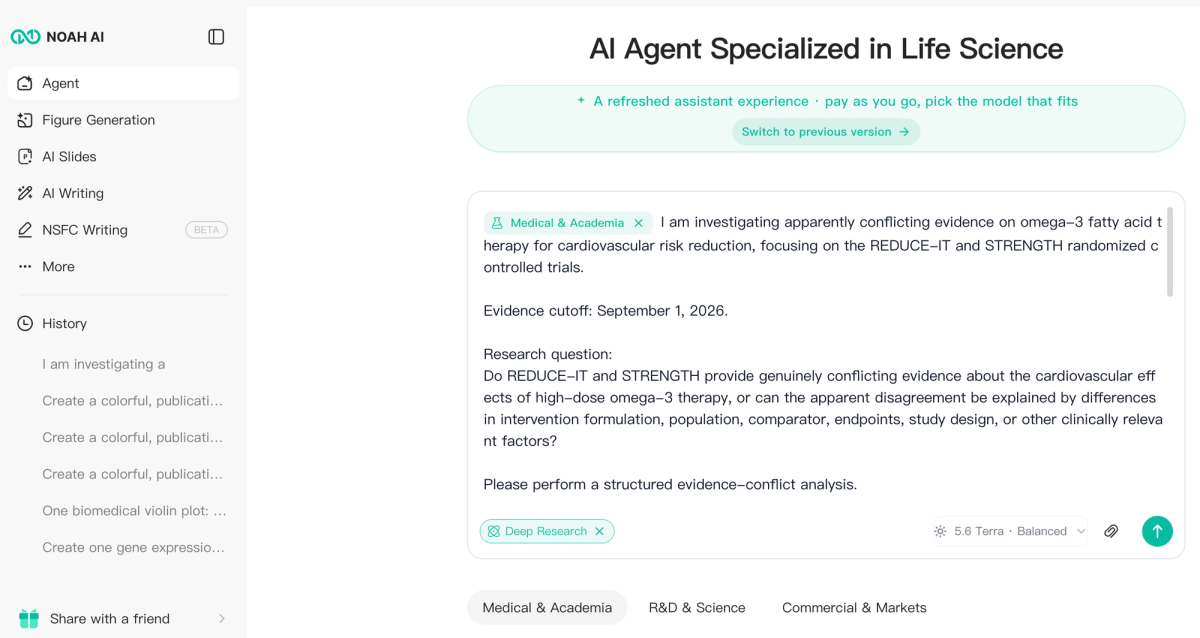
For this case, we used:
Agent → Medical & Academia → Deep Research → 5.6 Terra · Balanced
Rather than asking Noah for a generic literature summary, we gave it a constrained research task.
The prompt specified:
- the two trials;
- the evidence cutoff;
- the comparison dimensions;
- the desired structured tables;
- and the distinction between direct evidence, indirect evidence, and unproven explanations.
In this workflow, we used Noah as a biomedical research agent performing structured analysis from a clearly defined prompt—not as an automatic “conflict detector.”
For a broader step-by-step literature review workflow, see How to Use Noah for Medical Literature Review.
Step 1: Define the Clinical Question Precisely
Conflict analysis starts with scope.
A broad question such as:
Do omega-3 fatty acids prevent cardiovascular events?
can hide meaningful treatment differences.
A better question specifies the exact evidence being compared and the dimensions that must be aligned.
In our prompt, we asked Noah to examine:
- population;
- intervention formulation;
- EPA and DHA exposure;
- comparator;
- primary endpoint;
- follow-up;
- study design;
- primary versus follow-up evidence;
- and remaining uncertainty.
This prevents the final synthesis from flattening both studies into the same generic “omega-3” category.
Step 2: Separate Primary Evidence From Later Interpretation
One reason conflicting evidence becomes difficult to interpret is that original trial findings are often mixed together with:
- secondary analyses;
- biomarker studies;
- reviews;
- follow-up publications;
- and later mechanistic explanations.
In this workflow, Noah was instructed to prioritize the original randomized publications first.
Later evidence was used only where it helped interpret the disagreement.
This distinction matters because a later analysis can add context without replacing the original randomized result.
If your workflow starts with finding and organizing the underlying studies, see Best AI Tools for PubMed Literature Review (2026).
Step 3: Align the Studies Before Comparing the Results
The next step is comparability.
We asked Noah to build a structured evidence-alignment matrix rather than immediately deciding whether the studies contradicted each other.
The comparison exposed several clinically relevant differences.
Equal total product dose does not mean the interventions were equivalent.
This is exactly why evidence alignment should happen before numerical comparison.
Step 4: Characterize the Disagreement
After aligning the studies, we used the working framework above to organize the apparent disagreement.
For REDUCE-IT and STRENGTH, the structured comparison suggested that partial conflict was a more useful description than direct conflict.
The reason is straightforward.
The studies overlap in several ways:
- both studied statin-treated patients at elevated cardiovascular risk;
- both evaluated high-dose omega-3-based interventions;
- and both examined major cardiovascular outcomes.
But they did not test the same active formulation against the same comparator in identical populations.
REDUCE-IT evaluated icosapent ethyl, a purified EPA ethyl ester.
STRENGTH evaluated an EPA+DHA carboxylic-acid formulation.
The comparators also differed:
- REDUCE-IT used mineral oil;
- STRENGTH used corn oil.
These differences establish that the studies were not identical.
They do not establish why the results diverged.
The trials should therefore not be interpreted as if they were a randomized head-to-head comparison between the two active products.
The classification should also be treated as a research interpretation based on explicit comparability criteria, not an automatic AI-generated diagnostic label.
Step 5: Separate Observed Differences From Possible Explanations
Once a disagreement is identified, it is tempting to immediately explain why it happened.
That is where overinterpretation often begins.
We instructed Noah to keep documented study differences separate from causal explanations.
| Observation or Explanation | Evidence Status | How to Interpret It |
|---|---|---|
| REDUCE-IT used purified EPA, while STRENGTH used EPA+DHA | Directly documented | The active interventions were different |
| EPA/DHA composition explains the divergent outcomes | Directly documented | Comparator conditions were different |
| Mineral oil explains the REDUCE-IT treatment effect | Plausible but not established by these trials | Requires additional evidence |
| Population differences contributed to discordant findings | Plausible but unproven as a complete explanation | Comparator differences should be considered without assuming causality |
| Population differences contributed to discordant findings | Possible / indirect | Requires analysis of eligibility, baseline characteristics, and effect modification |
| Different achieved EPA exposure explains the results | Possible / indirect | Requires additional pharmacologic and clinical evidence |
This distinction is one of the most important safeguards in evidence synthesis.
A documented difference between two studies is evidence that the studies were not identical.
It is not automatically evidence that the difference caused the divergent outcomes.
Step 6: Build an Evidence Conflict Matrix
The most useful final deliverable was a structured evidence-conflict matrix.
Rather than reducing the literature to “positive” and “negative” trials, the matrix preserves several layers at once:
- what each study found;
- whether the findings are directly comparable;
- where the disagreement occurs;
- possible explanations;
- the strength of evidence behind those explanations;
- and what remains uncertain.
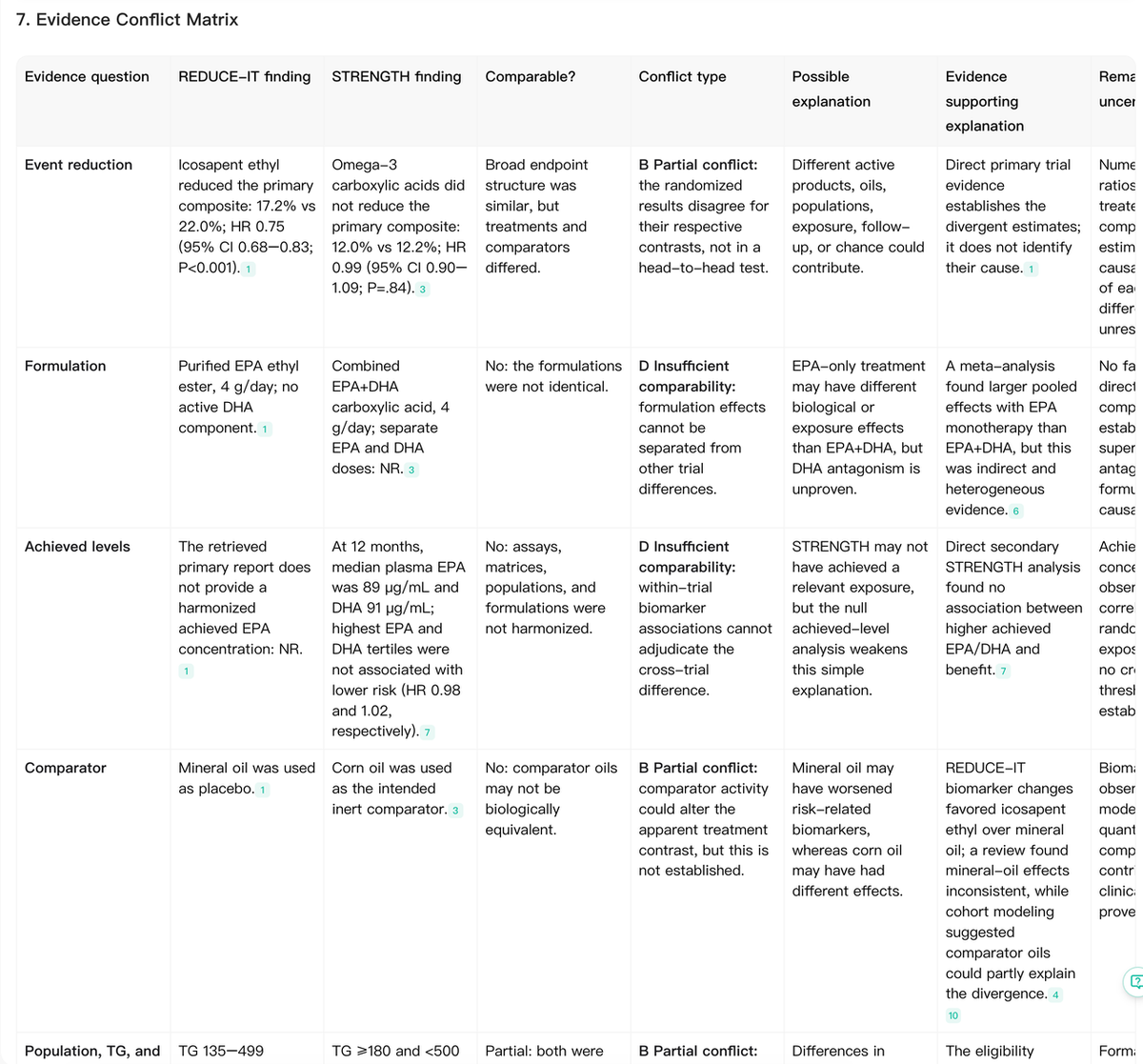
A simplified version looks like this:
| Question | REDUCE-IT | STRENGTH | Interpretation |
|---|---|---|---|
| Primary result | Cardiovascular benefit reported | Neutral primary result | Headline findings differ |
| Same intervention? | Purified EPA | EPA+DHA | No |
| Same comparator? | Mineral oil | Corn oil | No |
| Directly head-to-head? | No | No | Cross-trial superiority cannot be established |
| Can formulation differences explain the result? | Possible hypothesis | Possible hypothesis | Not proven by the randomized trials alone |
| Can comparator choice explain the result? | Possible hypothesis | Different comparator | Requires additional evidence |
| Final relationship | — | — | Partial rather than simple direct conflict |
| Remaining uncertainty | Mechanism of discordance unresolved | Mechanism of discordance unresolved | Preserve uncertainty |
This type of structured output is useful because the researcher can inspect the reasoning before turning it into a narrative conclusion.
For another trial-level evidence workflow, see How to Analyze Clinical Trial Results with AI Using Noah AI.
What Noah Surfaced in This Case
The workflow produced several concrete findings.
Observed disagreement
REDUCE-IT reported a substantial cardiovascular benefit, while STRENGTH did not show a significant reduction in its primary cardiovascular endpoint.
Key comparability issue
The trials did not test the same omega-3 formulation or the same comparator.
Interpretive limit
Their hazard ratios cannot be used to establish that one active formulation is superior to the other because the products were not randomized directly against each other.
Remaining uncertainty
Differences in formulation, EPA/DHA exposure, comparator choice, eligibility, population characteristics, and other trial factors may contribute to the discordance.
However, the two randomized trials alone cannot establish which factor caused the different outcomes.
This is the key value of the workflow: it converts a vague “these studies disagree” observation into a structured research problem.
Step 7: Write the Synthesis Without Creating a False Head-to-Head Comparison
Once the evidence is organized, the final synthesis needs to stay within the limits of the study designs.
The appropriate conclusion is not that one omega-3 formulation has been proven superior to another.
REDUCE-IT directly supports the result of icosapent ethyl versus its comparator in the population studied.
STRENGTH directly supports the result of its EPA+DHA formulation versus its own comparator.
The trials were not a randomized head-to-head comparison.
Their hazard ratios should therefore not be interpreted as if the two active products were directly tested against each other.
Similarly, later hypotheses involving:
- formulation;
- EPA/DHA exposure;
- comparator oils;
- patient selection;
- or other trial-level differences
can help interpret the evidence landscape.
But those explanations should remain clearly separated from what the randomized trials directly established.
A Practical Workflow for Analyzing Conflicting Evidence
The same method can be applied to many medical literature questions.
1. Define the Exact Question
Specify:
- population;
- intervention or exposure;
- comparator;
- endpoint;
- and time horizon.
2. Identify the Primary Studies
Keep original randomized or primary evidence separate from:
- reviews;
- follow-up analyses;
- secondary studies;
- and post hoc explanations.
3. Align the Evidence
Compare:
- populations;
- interventions;
- comparators;
- endpoints;
- study design;
- and follow-up
before comparing conclusions.
4. Identify the Disagreement
State exactly which findings appear inconsistent.
Avoid vague labels such as:
Study A was positive and Study B was negative.
5. Characterize the Disagreement
Use explicit comparability criteria to determine whether the evidence is best described as:
- direct conflict;
- partial conflict;
- apparent conflict;
- or insufficiently comparable.
6. Evaluate Possible Explanations
Separate directly documented study differences from hypotheses about why the results diverged.
7. Preserve Uncertainty in the Final Synthesis
Report:
- what is known;
- what differs between studies;
- what remains unresolved;
- and what cannot be inferred from cross-study comparison.
Common Mistakes When Using AI for Conflicting Medical Evidence
Comparing P Values Instead of Evidence
A statistically significant result in one study and a nonsignificant result in another do not automatically establish conflict.
Researchers should also examine:
- effect estimates;
- confidence intervals;
- population;
- intervention;
- comparator;
- endpoint;
- follow-up;
- and study design.
Treating a Broad Treatment Class as One Intervention
Labels such as:
- “omega-3”;
- “immunotherapy”;
- “targeted therapy”;
- or “GLP-1 therapy”
may contain clinically and pharmacologically different interventions.
Evidence should be interpreted at the level actually tested.
Mixing Primary and Secondary Evidence
A post hoc analysis can add context.
It does not become the original randomized result.
Publication type and evidence maturity should remain visible throughout the synthesis.
Assuming a Study Difference Explains the Outcome
Two trials may differ in:
- comparator;
- population;
- formulation;
- follow-up;
- or exposure.
That establishes a difference.
It does not necessarily establish a causal explanation for the divergent outcomes.
Comparing Effect Estimates as if the Trials Were Head-to-Head
Cross-trial numerical comparisons can be useful descriptively.
They should not be converted into claims of treatment superiority without direct comparative evidence.
Asking AI Which Study Is “Correct”
This is usually the wrong question.
A more useful question is:
Are the studies addressing sufficiently similar clinical questions, and what differences must be preserved when interpreting their results?
Treating an AI Classification as a Final Methodological Judgement
AI can help organize comparability dimensions and generate a structured interpretation.
The final judgement about whether evidence is genuinely conflicting still requires review of the underlying studies and human methodological reasoning.
What Noah AI Contributed to This Workflow
In this test, Noah was useful because one focused research prompt could organize a multi-step biomedical analysis around a clearly defined clinical question.
The workflow produced:
- a structured definition of the research question;
- identification and organization of relevant medical evidence;
- comparison of trial characteristics;
- an evidence-alignment matrix;
- a structured characterization of the apparent disagreement;
- separation of documented differences from possible explanations;
- an evidence-conflict matrix;
- and a source-linked synthesis that could be reviewed against the underlying literature.
These outputs still require human review.
Noah can accelerate evidence organization and analysis, but methodological judgement remains important when conclusions depend on:
- comparability;
- causal interpretation;
- indirect evidence;
- or cross-trial inference.
For a broader comparison of trial-level research workflows, see Best AI Tools for Clinical Trial Results Analysis (2026).
Frequently Asked Questions
What Is Conflicting Evidence in Medical Literature?
Conflicting evidence refers to sufficiently comparable studies that support materially different conclusions.
Different results alone are not enough.
Researchers first need to evaluate whether the studies address comparable:
- populations;
- interventions;
- comparators;
- outcomes;
- and study contexts.
Can AI Identify Conflicting Medical Evidence?
AI can help organize evidence, extract study characteristics, compare studies, highlight disagreements, and structure possible explanations.
The final judgement still depends on the quality and comparability of the underlying evidence.
Can Noah AI Compare Medical Studies?
Noah can be prompted to compare medical and life-science evidence in structured formats, including tables and narrative synthesis.
In this case, we used its Medical & Academia Deep Research workflow to compare REDUCE-IT and STRENGTH, organize their study characteristics, and structure the apparent disagreement.
Does a Significant Result and a Nonsignificant Result Mean Two Studies Conflict?
No.
Statistical significance should not be used as the sole definition of conflicting evidence.
Researchers also need to consider:
- effect estimates;
- uncertainty;
- populations;
- interventions;
- comparators;
- endpoints;
- follow-up;
- and study design.
How Should Primary and Follow-Up Publications Be Handled?
Start with the primary publication when interpreting the main trial result.
Use follow-up, secondary, or post hoc analyses to add context while clearly labeling their evidence status.
Can AI Determine Why Two Clinical Trials Produced Different Results?
AI can help identify plausible sources of discordance, such as differences in:
- treatment formulation;
- population;
- comparator;
- exposure;
- endpoint;
- or follow-up.
However, identifying a difference does not prove that the difference caused the divergent outcomes.
Can AI Decide Which Study Is Correct?
Not reliably as a standalone judgement.
Two apparently discordant studies may be answering slightly different clinical questions.
The more useful role for AI is to help researchers determine:
- where the studies align;
- where they differ;
- which findings are directly comparable;
- what explanations are supported;
- and what uncertainty remains.
Final Takeaway
The hardest part of conflicting medical evidence is usually not finding two studies that disagree.
It is determining whether the studies were comparable enough for the disagreement to mean what it appears to mean.
In the REDUCE-IT and STRENGTH case, Noah AI produced the structured comparison matrix shown above, aligning the two trials across intervention formulation, comparator, outcomes, comparability, possible explanations, and remaining uncertainty.
The output made several distinctions visible in one place:
- REDUCE-IT tested purified EPA, while STRENGTH tested EPA+DHA;
- the trials used different comparator oils;
- the headline cardiovascular findings diverged;
- the studies were not randomized head-to-head against each other;
- and several proposed explanations for the discordance remained plausible rather than proven.
This moved the analysis beyond a simple “positive trial versus neutral trial” framing.
The evidence could instead be organized around:
- differences in active formulation;
- comparator choice;
- population and eligibility;
- trial context;
- effect estimates;
- and the distinction between observed differences and unproven causal explanations.
The appropriate conclusion is not that Noah can decide which trial is “correct.”
It is that Noah can help researchers structure the disagreement, trace the underlying evidence, identify where studies are and are not comparable, and preserve uncertainty before the researcher makes the final methodological interpretation.
That is the more useful role for AI in evidence-conflict analysis:
study finding → evidence alignment → identified disagreement → possible explanations → uncertainty → human interpretation
Analyze Conflicting Biomedical Evidence with Noah AI
Use Noah AI to compare study populations, interventions, comparators, endpoints, trial designs, and source-linked evidence across biomedical studies while keeping observed differences separate from unproven explanations.
Free to use · Free credits included · No credit card required
Analyze Conflicting Biomedical Evidence with Noah AI →