How to Compare Medical Preprints with Published Papers Using AI (2026)
Linda
Learn how to compare medical preprints with published papers using AI. Check changes in study design, sample sizes, results, conclusions, and citations.
An evidence-grounded workflow for checking what changed between a medical preprint and its peer-reviewed journal article—from population definitions and effect estimates to corrected Methods and reference details.Research workflow guide · Real-world biomedical case study · Sources linked throughout
Key Takeaways
- A preprint and a journal article may report the same study without reporting identical evidence.
- Verify the preprint version and the final DOI before comparing methods, samples or results.
- Compare endpoints, denominators, effect estimates and confidence intervals—not just titles or citation metadata.
- Use Noah AI to organize a source-grounded version comparison, then review both original documents yourself.
- A changed estimate is not automatically an error or proof of a peer-review-driven correction.
On this page
- Why Preprint Updates Matter
- Key Challenges
- Preprint vs Published Citations
- How Noah AI Supports Comparison
- Step-by-Step Workflow
- Best Practices & Pitfalls
- Real Medical Study Walkthrough
- Final Checklist
- FAQs & Conclusion
Introduction: Why Updating Preprint Citations Matters
Preprints help researchers share findings before journal peer review. In biomedicine, this speed can be useful when evidence is emerging rapidly. But a reference list that still points to an early manuscript may no longer reflect the data, analysis or wording that readers find in the subsequently published article.Updating a citation is more than an exercise in formatting. A journal article can report a larger analytic sample, revised confidence intervals, updated Methods or qualifications that did not appear in the early manuscript. A preprint may itself have several versions. It is therefore important to establish which version supported the original claim and whether the final publication supports that claim in the same way.For the original research question, cite the version of record when appropriate. Retain the preprint citation when the purpose is to analyze the history of the study, a claim unique to an earlier version, or a specific difference between drafts. In either situation, the source should be identified unambiguously.
Key Challenges in Comparing Preprints with Published Studies
- One study, two identifiers—and sometimes many versions
A medRxiv manuscript receives a preprint DOI that differs from the DOI assigned to a journal publication. The landing page may default to a later version even if the original reviewer or author cited v1. Matching an unchanged title is useful but not sufficient: verify authorship, study setting, outcomes and linked publication metadata.
- The denominator may change without a study-design change
New cases, revised eligibility windows and updated exclusions can change the number of observations analyzed. A descriptive count of sequenced cases must not be confused with the total test-negative case-control analysis population. Always note what was counted and where the value appears.
- Numerical changes require statistical context
A difference of several percentage points may reflect updated data, statistical adjustment or analysis rules. Reviewing both point estimates and confidence intervals is more informative than comparing rounded headlines. The cause of the difference still requires documentary evidence; AI should not invent an explanation.
- A corrected journal article adds a third source
Publication does not end a paper’s history. A publisher may later correct the Methods, tables or textual details. A transparent comparison distinguishes the early preprint, the original journal article and any subsequently corrected version, instead of silently blending the three.
How Noah AI Supports Preprint-to-Publication Comparison
For this workflow, Noah AI can be prompted to examine two identified documents and organize the reported information into a comparison table. The useful output is not a claim that one version is “better,” but a structured record of what is the same, what differs and what remains unverified.Start with the exact preprint version and published DOI. Ask for corresponding Methods sections, sample definitions, endpoint estimates, confidence intervals, conclusion language and a citation action. Require the result to distinguish independently verified source evidence from values supplied in a prompt.
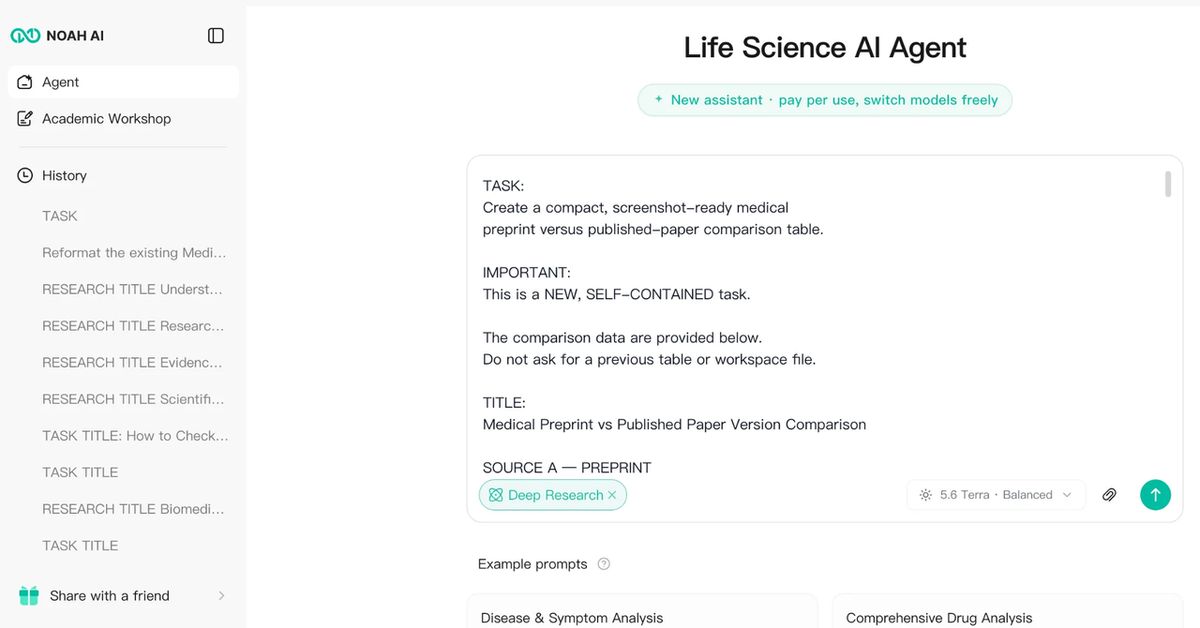
Noah’s role here is AI-assisted research organization and comparison. This demonstration does not establish continuous publication monitoring, bulk DOI replacement, automated reference-manager synchronization, or independent statistical reanalysis of individual-level data.
Step-by-Step Workflow: From Preprint to Verified Journal Citation
Step 1. Identify the exact preprint version
Record the title, first author, server, preprint DOI and version-specific link. If the article has v1 and v2, decide which version appeared in the existing bibliography. For this example, the comparison baseline is medRxiv v1.
Step 2. Confirm the journal article and correction history
Find the published article using its DOI or PubMed record. Match the study, not merely the title. Check the publisher’s page for an erratum or other status notice. Our NEJM case has a subsequent correction of data-extraction dates.
Step 3. Extract comparable methods, population and results
Build a worksheet that preserves each source’s own terms and denominators. For effect estimates, write the outcome, exposure, dose, variant, percentage, 95% confidence interval and source section. Do not mix Alpha and Delta estimates or one-dose and two-dose populations.
Step 4. Compare and classify the changes
Mark each row as unchanged, numerically revised, definition-dependent, wording refined or not verified. Calculate arithmetic differences in percentage points when comparing effectiveness percentages, but do not infer clinical or statistical significance from the size of that difference alone.
Step 5. Update the citation—and revisit the manuscript claim
Replace an outdated reference with the journal citation where appropriate, then re-read the sentence that the reference supports. If the updated estimate, population or conclusion changes its meaning, revise the sentence too. Keep a record of any version differences that matter to the interpretation.Organize research evidence with Noah AICompare published sources, trace numerical findings and build structured evidence tables before final human verification.Try Noah AI for Free
Best Practices and Common Pitfalls
- Do not treat a generic preprint DOI as proof you inspected v1. Use a version-specific URL and preserve the original document.
- Do not label an increased case count as a contradiction. First verify the data window, inclusion rules and analysis set.
- Do not omit confidence intervals. Point estimates alone obscure uncertainty, especially when the early sample is relatively small.
- Do not attribute every revision to peer review. Data updates and editorial corrections are separate possibilities.
- Do not confuse a correction with a retraction. Read the publisher’s notice and record exactly what was changed.
- Do not automatically delete the preprint citation. Retain it when a version-history discussion or historical claim specifically requires that source.
- Do not present a prompted comparison table as independent live verification. Trace its cells back to original source pages and report what was actually checked.
Example: Comparing a Delta-Variant Vaccine Preprint with Its NEJM Publication
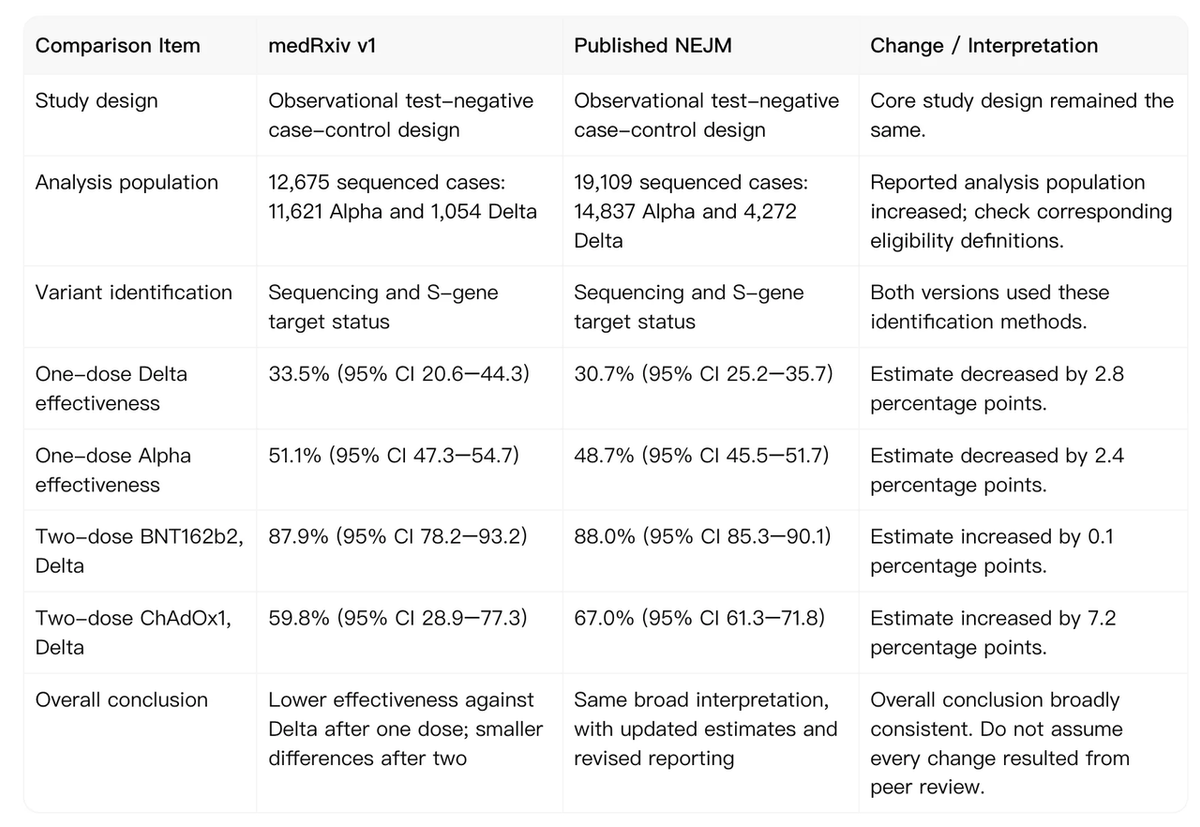
Lopez Bernal and colleagues studied vaccine effectiveness against symptomatic COVID-19 associated with the Alpha and Delta variants in England. Their medRxiv v1 and NEJM article both used an observational test-negative case-control approach. Their principal interpretation was broadly consistent: one-dose estimates were lower for Delta, while the differences following two doses were more modest.
What changed in the reported results?
The v1 descriptive sequencing analysis included 12,675 cases: 11,621 Alpha and 1,054 Delta. The NEJM article reported 19,109 sequenced cases: 14,837 Alpha and 4,272 Delta. These refer to the corresponding sequenced-case descriptive samples—not all participants or test records used in the larger effectiveness analyses.The estimates shown below are for corresponding outcome, dose and variant categories in the two publications. The difference is expressed in percentage points, not as a new efficacy estimate.
Why the result changes matter
The sample increased, and some effectiveness estimates shifted materially more than others. The two-dose ChAdOx1 estimate against Delta changed by 7.2 percentage points, while the corresponding BNT162b2 estimate changed by only 0.1 percentage points. Confidence intervals also differ, so a responsible summary must preserve both estimates and their uncertainty.The observed revisions do not establish that the earlier report was erroneous. Nor can they establish that peer review caused each change. The comparison shows the published evidence changed; identifying the exact contribution of data updates or modeling changes would require close examination of both full Methods, supplements and revision history.
A publisher correction changes the reference trail again
The journal later published a correction to the Methods. It clarified that vaccination data through May 30, 2021 were extracted on June 1, 2021, rather than the earlier dates printed in the original article. It also corrected the end date for the positive PCR test data to May 30, 2021. The notice does not state that this was a retraction or that the vaccine-effectiveness estimates were revised by the correction.Interpretation boundary: This is a historical analysis of Alpha/Delta-era observations. It should not be used as an estimate of vaccine performance against present-day variants or as individualized vaccination advice.
Final Checklist Before Updating a Preprint Citation
- Confirm the preprint’s exact version, DOI and authors.
- Confirm the journal article is the same study, not a related analysis.
- Record the published DOI, PMID and journal citation.
- Compare study design, endpoints, selection criteria and data windows.
- Keep denominator definitions explicit when sample sizes differ.
- Check numerical results and matching confidence intervals.
- Compare the wording and strength of the conclusions.
- Look for corrections, expressions of concern or retractions.
- Update the supporting claim as well as its bibliography entry.
- Document uncertainties and have a researcher review the final changes.
Frequently Asked Questions
Is a peer-reviewed journal article always identical to its preprint?
No. A journal version may contain updated observations, analytical adjustments or more qualified interpretation. Compare the corresponding results before reusing the evidence.
Should I automatically replace every preprint citation with the published paper?
Not always. The published article is generally the right source for the finalized findings, but a version-history analysis may need both citations, and a claim specific to the preprint should still cite that version.
Does a difference in numerical estimates prove an error?
No. Examine definitions, source dates, inclusion criteria and statistical methods before classifying a difference. Preserve the original values and relevant uncertainty intervals.
Can Noah AI update an entire bibliography automatically?
This demonstration supports document comparison and organized evidence review. It does not establish automatic full-library monitoring, reference-manager synchronization or one-click bibliography replacement.
Does a publisher correction mean the article was retracted?
No. A correction, expression of concern and retraction are different publication events. Use the publisher notice and updated bibliographic record to understand the actual status.
Conclusion: Update the Evidence, Not Just the DOI
A preprint-to-publication comparison is useful only when it connects citation metadata to the scientific evidence behind the reference. The Lopez Bernal example shows a study whose overall interpretation remained similar even as its reported sequenced-case sample and several vaccine-effectiveness estimates changed. Its later publisher correction adds another reason to maintain an explicit source trail.Use Noah AI to structure the comparison, then verify original source pages, numerical estimates and publication notices before revising a manuscript. An accurate reference list is important; an accurate statement supported by the right version is more important.Review scientific evidence with Noah AIBring together publication versions, research methods and cited results in a structured research workflow.Try Noah AI for Free
Original Sources and References
- Lopez Bernal J, et al. Effectiveness of COVID-19 vaccines against the B.1.617.2 variant. medRxiv (v1). Preprint DOI: 10.1101/2021.05.22.21257658.
- Lopez Bernal J, et al. Effectiveness of Covid-19 Vaccines against the B.1.617.2 (Delta) Variant. N Engl J Med. 2021;385:585–594. DOI: 10.1056/NEJMoa2108891; PMID 34289274.
- Effectiveness of Covid-19 Vaccines against the B.1.617.2 (Delta) Variant [correction]. N Engl J Med. 2023;388:672. DOI: 10.1056/NEJMx210015; PMID 36791182.
- medRxiv FAQ, guidance on manuscript versioning and linked publication records.
Methodology: publicly available article and preprint records were compared for this case study. The Noah screenshot is a formatted comparison based on supplied values; the article independently cross-checks selected figures against original sources. This article is for research methodology and citation management, not clinical guidance.