10 Biopharma Drugs to Watch in 2026: Regulatory Milestones, Phase 3 Readouts and What Comes Next
Linda
Track 10 biopharma drugs shaping 2026 through FDA and EC approvals, regulatory reviews, sponsor-reported Phase 3 topline results, launch milestones, and the next major catalysts.
Regulatory status, clinical-development stage, and reported trial results in this article reflect publicly available information through this date. Later approvals, filings, regulatory decisions, or clinical updates are not included unless otherwise stated.A mid-year look at the therapies crossing meaningful regulatory, clinical, and commercial thresholds in 2026—and the catalysts that could reshape their position next.The 2026 biopharma story is no longer just about promising pipelines. It is about which assets have crossed a meaningful threshold—and which are approaching one.This update tracks ten therapies across oncology, immunology, metabolic disease, respiratory medicine, renal disease, and rare disease, focusing on concrete events: approvals, regulatory reviews, Phase 3 readouts, launches, confirmatory evidence, and the next major catalysts.Approval status is only one part of the picture. Some products are already commercially prescribable; others remain under regulatory review, have delivered sponsor-reported Phase 3 topline results, or are still generating pivotal evidence.Those differences matter for teams assessing evidence maturity, competitive positioning, launch risk, and the timing of the next value inflection.
Status Labels Used in This Report
To keep evidence maturity and regulatory status consistent across the article, every asset is assigned one of four standardized status labels:
- APPROVED — the therapy has received regulatory approval in at least one market discussed in this report.
- UNDER REVIEW — a marketing application has been formally accepted and is undergoing regulatory review.
- SPONSOR-REPORTED TOPLINE — the sponsor has announced key late-stage results, but the tracked indication has not yet reached approval or completed regulatory review.
- TRIAL ONGOING — a pivotal or strategically important clinical trial remains in progress without a qualifying approval, active regulatory review, or sponsor-reported topline result.
These labels represent materially different levels of regulatory validation and evidence maturity and should not be interpreted as equivalent stages of development.
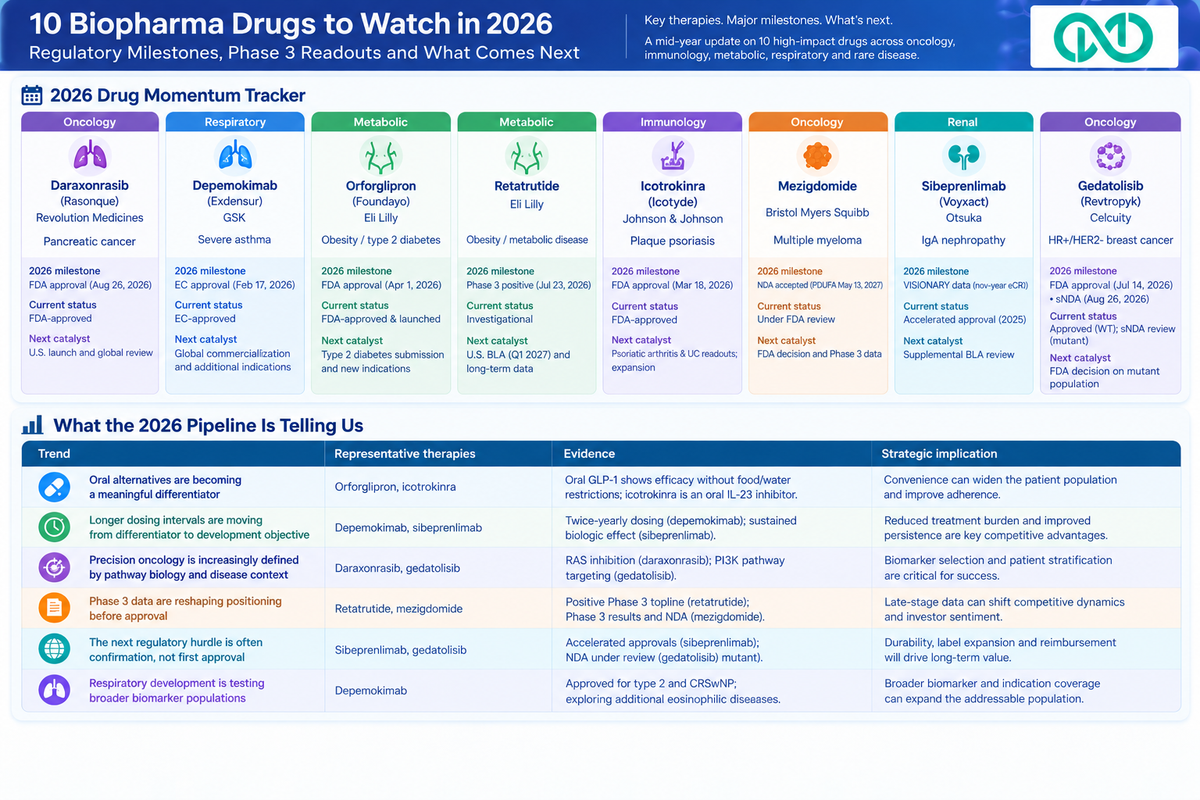
2026 Drug Momentum Tracker
The fastest way to understand the 2026 landscape is to separate completed regulatory decisions from active reviews, sponsor-reported clinical readouts, and ongoing trials.The tracker below is designed as a status snapshot as of September 10, 2026, not as a forecast of commercial success.
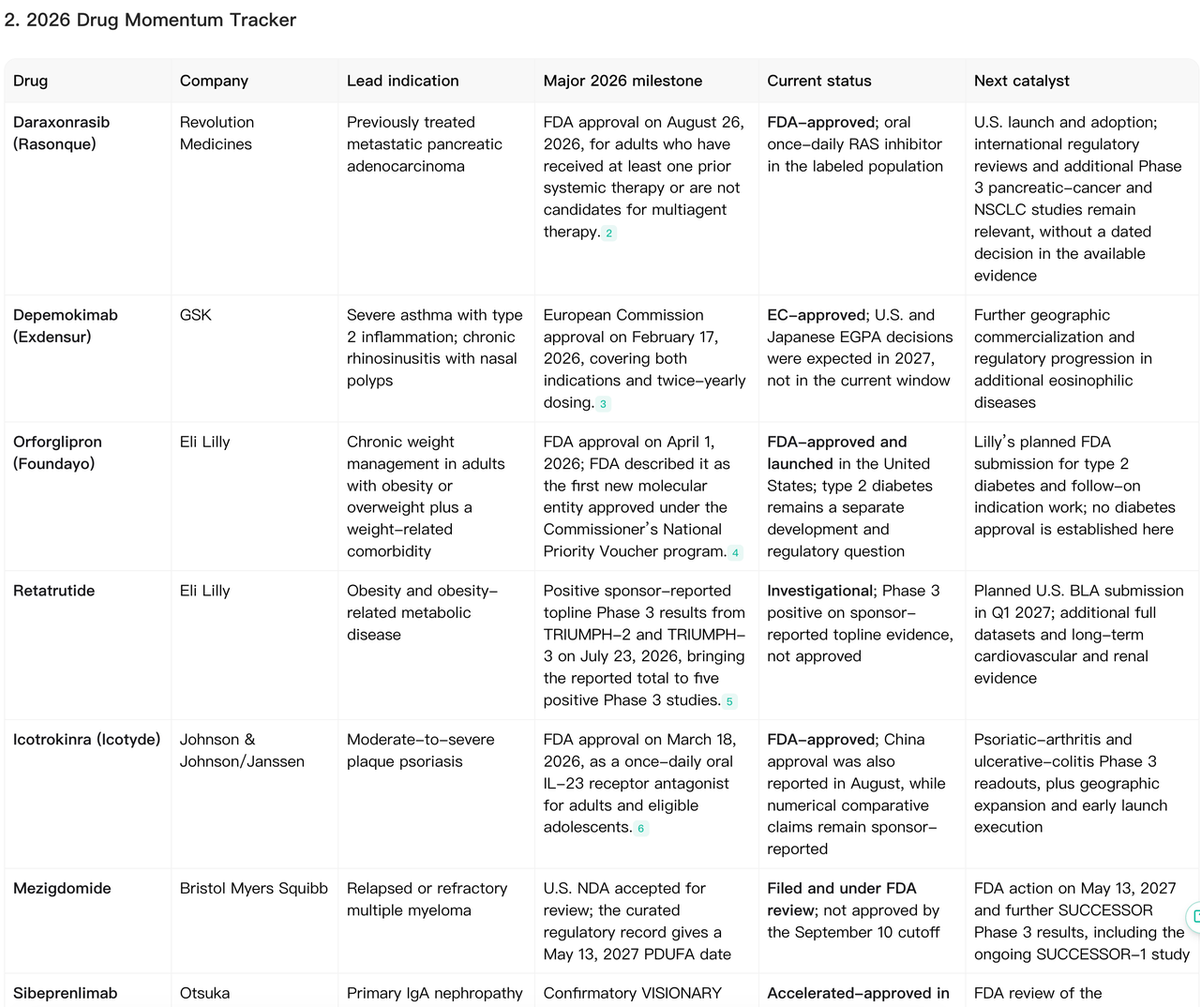
| Drug | Company | Major 2026 milestone | Current status | Next catalyst |
|---|---|---|---|---|
| Daraxonrasib | Revolution Medicines | FDA approval in metastatic pancreatic adenocarcinoma | APPROVED | U.S. launch, international expansion, earlier-line studies |
| Depemokimab | GSK | European Commission approval in severe asthma and CRSwNP | APPROVED | Geographic expansion and real-world uptake |
| Orforglipron | Eli Lilly | FDA approval for chronic weight management | APPROVED | Diabetes submission and launch execution |
| Retatrutide | Eli Lilly | Positive Phase 3 TRIUMPH topline results | SPONSOR-REPORTED TOPLINE | Additional Phase 3 data and planned filing |
| Icotrokinra | Johnson & Johnson | FDA approval in plaque psoriasis | APPROVED | Psoriatic arthritis, ulcerative colitis, and launch data |
| Mezigdomide | Bristol Myers Squibb | NDA accepted for review after Phase 3 results | UNDER REVIEW | FDA decision and additional SUCCESSOR data |
| Sibeprenlimab | Otsuka | Confirmatory VISIONARY data after accelerated approval | APPROVED | Supplemental regulatory review and potential traditional approval |
| Gedatolisib | Celcuity | FDA approval in a biomarker-defined breast-cancer population | APPROVED | Supplemental filing and first-line development |
| Zilganersen | Ionis / Recordati | FDA approval for Alexander disease | APPROVED | Launch, access, and ex-U.S. filings |
| Tozorakimab | AstraZeneca | BLA accepted under Priority Review after Phase 3 results | UNDER REVIEW | FDA decision and international regulatory reviews |
Individual Drug Updates
Daraxonrasib for Previously Treated Metastatic Pancreatic Adenocarcinoma — Revolution Medicines
Current status: APPROVED
What changed in 2026
Daraxonrasib received FDA approval on August 26, 2026 for adults with metastatic pancreatic adenocarcinoma who had received at least one prior systemic therapy, or who were not candidates for multiagent systemic therapy.
In the reported randomized Phase 3 study, median overall survival was 13.2 months with daraxonrasib versus 6.7 months with standard chemotherapy.
Why it matters
The approval establishes a targeted RAS option in a disease historically dominated by cytotoxic therapy.
The multi-selective RAS strategy also gives the asset broader mechanistic relevance than a single-allele approach, although the approved use remains specific to the labeled pancreatic-cancer population.
What to watch next
Near-term attention shifts to U.S. launch, adoption, international regulatory progression, and execution of earlier-line and combination studies.
Depemokimab for Severe Asthma and CRSwNP — GSK
Current status: APPROVED
What changed in 2026
The European Commission approved depemokimab for severe asthma with type 2 inflammation and for severe chronic rhinosinusitis with nasal polyps.
The product is differentiated by twice-yearly dosing.
Why it matters
Longer dosing intervals are becoming a competitive feature in respiratory biologics.
The strategic question is whether convenience translates into better persistence, access, and real-world use rather than simply a more attractive dosing schedule.
What to watch next
Geographic expansion, additional eosinophilic indications, and real-world uptake will determine how durable that differentiation becomes.
Orforglipron for Obesity and Overweight — Eli Lilly
Current status: APPROVED
What changed in 2026
Orforglipron received FDA approval on April 1, 2026 for chronic weight management in adults with obesity, or overweight with a weight-related comorbidity.
It is a once-daily non-peptide oral GLP-1 receptor agonist.
Why it matters
An oral option changes the administration proposition in a market led by injectable incretin therapies.
Convenience may widen the addressable patient population, but approval does not establish better efficacy, adherence, reimbursement, or persistence than injectable competitors.
What to watch next
Type 2 diabetes submission, follow-on indications, launch execution, and comparative real-world use are the next major questions.
Retatrutide for Obesity and Metabolic Disease — Eli Lilly
Current status: SPONSOR-REPORTED TOPLINE
What changed in 2026
Lilly reported positive topline Phase 3 results from TRIUMPH-2 and TRIUMPH-3.
Retatrutide remains investigational and had not been approved as of the September 10, 2026 data cutoff.
Why it matters
The triple GLP-1/GIP/glucagon agonist continues to set high expectations for weight-loss efficacy.
However, sponsor-reported topline results should not be treated as equivalent to a complete peer-reviewed evidence package or regulatory approval.
Full interpretation still requires detailed efficacy, tolerability, discontinuation, cardiovascular-outcome, and subgroup data.
What to watch next
Additional Phase 3 datasets and the planned U.S. filing in 2027 are the key catalysts.
Icotrokinra for Plaque Psoriasis — Johnson & Johnson
Current status: APPROVED
What changed in 2026
Icotrokinra received FDA approval on March 18, 2026 for moderate-to-severe plaque psoriasis in adults and eligible adolescents.
The drug is a once-daily oral IL-23 receptor antagonist.
Why it matters
The product brings targeted oral therapy into a market where injectable biologics are deeply established.
Its success will depend on whether oral convenience meaningfully changes treatment sequencing without sacrificing efficacy or durability.
What to watch next
Psoriatic-arthritis and ulcerative-colitis programs, geographic expansion, and early launch persistence are the main follow-on signals.
Mezigdomide for Relapsed or Refractory Multiple Myeloma — Bristol Myers Squibb
Current status: UNDER REVIEW
What changed in 2026
Phase 3 SUCCESSOR-2 reported median progression-free survival of 18.0 months with mezigdomide plus carfilzomib and dexamethasone versus 8.3 months with the control regimen.
The U.S. NDA was accepted for review.
As of the September 10, 2026 data cutoff, mezigdomide had not received FDA approval for the tracked indication.
Why it matters
Mezigdomide extends the cereblon E3-ligase-modulator strategy into heavily pretreated multiple myeloma.
The efficacy signal is meaningful, but its eventual treatment role will depend on the complete benefit-risk profile, including hematologic and infectious toxicity.
What to watch next
The FDA review and further SUCCESSOR Phase 3 results will determine the breadth of the franchise.
Sibeprenlimab for IgA Nephropathy — Otsuka
Current status: APPROVED
What changed in 2026
Sibeprenlimab already held accelerated U.S. approval based on proteinuria reduction.
In 2026, Otsuka reported confirmatory VISIONARY kidney-function data and said a rolling supplemental BLA was underway.
Why it matters
The key value inflection is no longer first approval.
The central question is whether the confirmatory evidence demonstrates that an initial surrogate-endpoint approval translates into durable kidney-function benefit.
Its current status remains APPROVED because the therapy already has an approved indication, even while confirmatory regulatory work continues.
What to watch next
FDA review of the confirmatory package and potential conversion to traditional approval are the central catalysts.
Gedatolisib for HR-Positive/HER2-Negative Advanced Breast Cancer — Celcuity
Current status: APPROVED
What changed in 2026
Gedatolisib received FDA approval in July 2026 for a PIK3CA-wild-type advanced breast-cancer population, followed by a supplemental filing for the PIK3CA-mutant population.
Why it matters
The approval expands pathway-directed treatment into a biomarker-defined group that is not served by some narrower PI3K strategies.
The regimen, however, is operationally more complex than an oral monotherapy.
What to watch next
The mutant-population sNDA, first-line VIKTORIA-2 development, and launch execution are the next strategic milestones.
The existence of a supplemental filing does not change the product's headline current status: it remains APPROVED for its existing approved population.
Zilganersen for Alexander Disease — Ionis / Recordati
Current status: APPROVED
What changed in 2026
Zilganersen received FDA approval on September 3, 2026 for pediatric and adult Alexander disease, becoming the first approved disease-targeted treatment for the disorder.
Why it matters
Its importance is primarily first-in-disease rather than displacement of an established competitor.
The approval also provides a notable validation point for antisense therapy in an ultra-rare neurologic disease.
What to watch next
U.S. launch, specialist access, long-term effectiveness, and ex-U.S. regulatory filings will define the next phase.
Tozorakimab for COPD — AstraZeneca
Current status: UNDER REVIEW
What changed in 2026
AstraZeneca reported positive Phase 3 OBERON and TITANIA results, and the FDA accepted a BLA under Priority Review.
As of the September 10, 2026 data cutoff, tozorakimab had not yet been approved.
Why it matters
Tozorakimab could broaden the role of biologics in COPD and test whether an IL-33 strategy can reach a wider biomarker population than some existing targeted respiratory approaches.
However, an accepted BLA and Priority Review remain regulatory-review milestones rather than completed approval.
What to watch next
The FDA decision expected in 2027, EU and China reviews, and longer-term durability and safety evidence remain the key catalysts.
What the 2026 Pipeline Is Telling Us
The most important 2026 signals are strategic rather than purely regulatory.
Competition is shifting toward usability, pathway breadth, evidence maturity, confirmatory data, and durable labels.
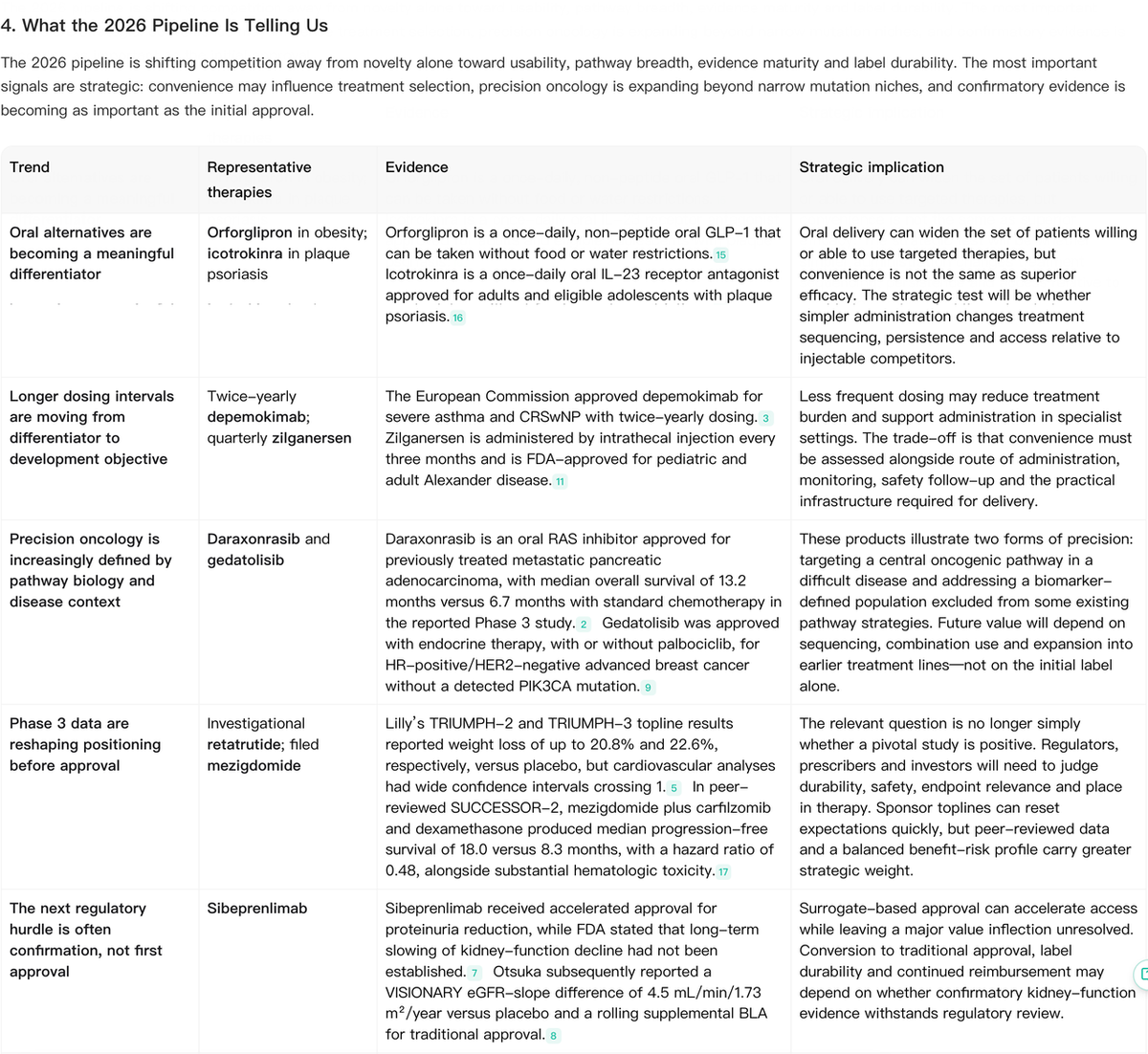
Five Themes Stand Out
1. Oral alternatives are becoming a meaningful differentiator.
Administration route is increasingly part of the competitive profile, especially in markets dominated by injectable biologics or incretin therapies.
2. Longer dosing intervals are becoming a development objective.
Convenience may influence treatment burden and persistence, although dosing frequency alone does not establish superior real-world outcomes.
3. Precision oncology is increasingly defined by pathway biology and disease context.
Mechanistic breadth is valuable only when it translates into a clinically and regulatorily defensible patient population.
4. Phase 3 data can reshape positioning before approval.
But SPONSOR-REPORTED TOPLINE evidence must remain clearly separated from an UNDER REVIEW program or an APPROVED therapy.
5. Confirmatory evidence is often the next regulatory hurdle after accelerated approval.
An approved product can still face an important future catalyst if continued approval or label evolution depends on confirmatory evidence.
What to Watch Next
For newly approved products, the next test is launch execution rather than the approval headline itself.
Reimbursement, treatment logistics, physician adoption, safety management, and patient persistence will determine whether regulatory momentum becomes durable clinical use.
For programs under regulatory review, the key catalyst is the regulator's decision. An accepted application is meaningful, but it should not be presented as equivalent to approval.
For assets with sponsor-reported topline results, evidence quality remains central. Topline announcements can rapidly change expectations, but full datasets, balanced safety interpretation, peer-reviewed publication, and regulator-accepted endpoints carry more strategic weight.
For ongoing trials, the key question remains whether the pivotal study can generate evidence strong enough to support a filing or materially change competitive positioning.
Throughout this report, the distinction between APPROVED, UNDER REVIEW, SPONSOR-REPORTED TOPLINE, and TRIAL ONGOING remains explicit.
These labels represent different levels of evidence maturity, regulatory validation, commercial readiness, and development risk.
Bottom Line
The defining biopharma themes of 2026 are becoming clearer.
Modality and convenience are increasingly competitive assets, biomarker and pathway precision are expanding into harder-to-treat disease settings, and regulatory sequencing is becoming as important as the original approval event.
But the headline status of an asset matters.
An APPROVED therapy has crossed a regulatory threshold.
An asset UNDER REVIEW still faces regulatory uncertainty.
A SPONSOR-REPORTED TOPLINE result may be important but is not equivalent to a completed evidence package or regulatory decision.
A TRIAL ONGOING program remains dependent on future clinical evidence.
Approval alone is also not commercial success.
Durable value will depend on the strength of the evidence package, practicality of treatment, reimbursement and launch execution, safety management, and whether follow-on development expands the product beyond its initial use without weakening the benefit-risk profile.
Research the Next Biopharma Catalyst with Noah AI
Use Noah AI to investigate clinical programs, regulatory milestones, competitive landscapes, and the evidence behind emerging drug-development signals.
Free to use · Free credits included · No credit card required
Research Biopharma Catalysts with Noah AI →