Best SciSpace Alternatives for Medical Research (2026)
Linda
Compare the best SciSpace alternatives for medical research in 2026, including Noah AI, Elicit, Consensus, and Scite, based on the research task each tool handles best.
SciSpace is already a capable academic research workspace, so the reason to look for an alternative is rarely that it cannot find or analyze papers. The real question is whether another tool fits a specific medical research task better.A medical researcher may need a rigorous systematic review, a trial-level comparison, a fast literature synthesis, or a way to check whether later studies support or challenge a claim. Those tasks place different demands on an AI research platform.This guide therefore compares SciSpace alternatives by the job the researcher needs to complete, rather than treating every product as a generic academic AI replacement.
Quick Answer
Noah may be a better fit when the task is specifically biomedical and requires structured comparison of clinical evidence or a medical research output. Choose Elicit when the project is a formal systematic review with reproducible screening and extraction. Choose Consensus when the main goal is a fast, broad literature review from a research question. Choose Scite when citation context and claim verification are the main bottlenecks. Stay with SciSpace when you want a broad literature-and-PDF workspace across disciplines.We tested Noah AI directly. Other tools were evaluated based on their official documentation and published workflow
Start With the Research Bottleneck, Not the Brand
| If your main problem is... | Best fit | Why it differs from SciSpace | Typical output |
|---|---|---|---|
| Biomedical trial or evidence comparison | Noah AI | More directly oriented around life-science research questions and structured medical evidence outputs | Trial comparison, evidence synthesis, research summary |
| Formal systematic review | Elicit | Stronger emphasis on protocol, screening, extraction, PRISMA-auditable review steps, and synthesis | Systematic review, extraction table, cited report |
| Fast literature review from a question | Consensus | Deep Review is optimized for decomposing a question and synthesizing a structured review across a large academic corpus | Structured literature review |
| Citation context and claim checking | Scite | Smart Citations show how later research supports, contrasts with, or mentions a paper or claim | Citation-context evidence |
| Broad paper search, PDF reading, and literature analysis | SciSpace | Already well suited to document-centered academic research across topics | Paper analysis, literature synthesis |
When Noah may be a better fit for biomedical evidence comparison for Medical Research
The strongest reason to choose a SciSpace alternative is not that another interface looks more medical. It is that the alternative can handle the specific biomedical task you need to complete.To illustrate this workflow in practice, we used Noah AI for a real clinical-evidence comparison: monarchE versus NATALEE in HR-positive, HER2-negative early breast cancer.er. The task was to compare trial design, population, regimen, follow-up, endpoint context, and the limitations of indirect cross-trial interpretation.
What the Structured Comparison Makes Visible
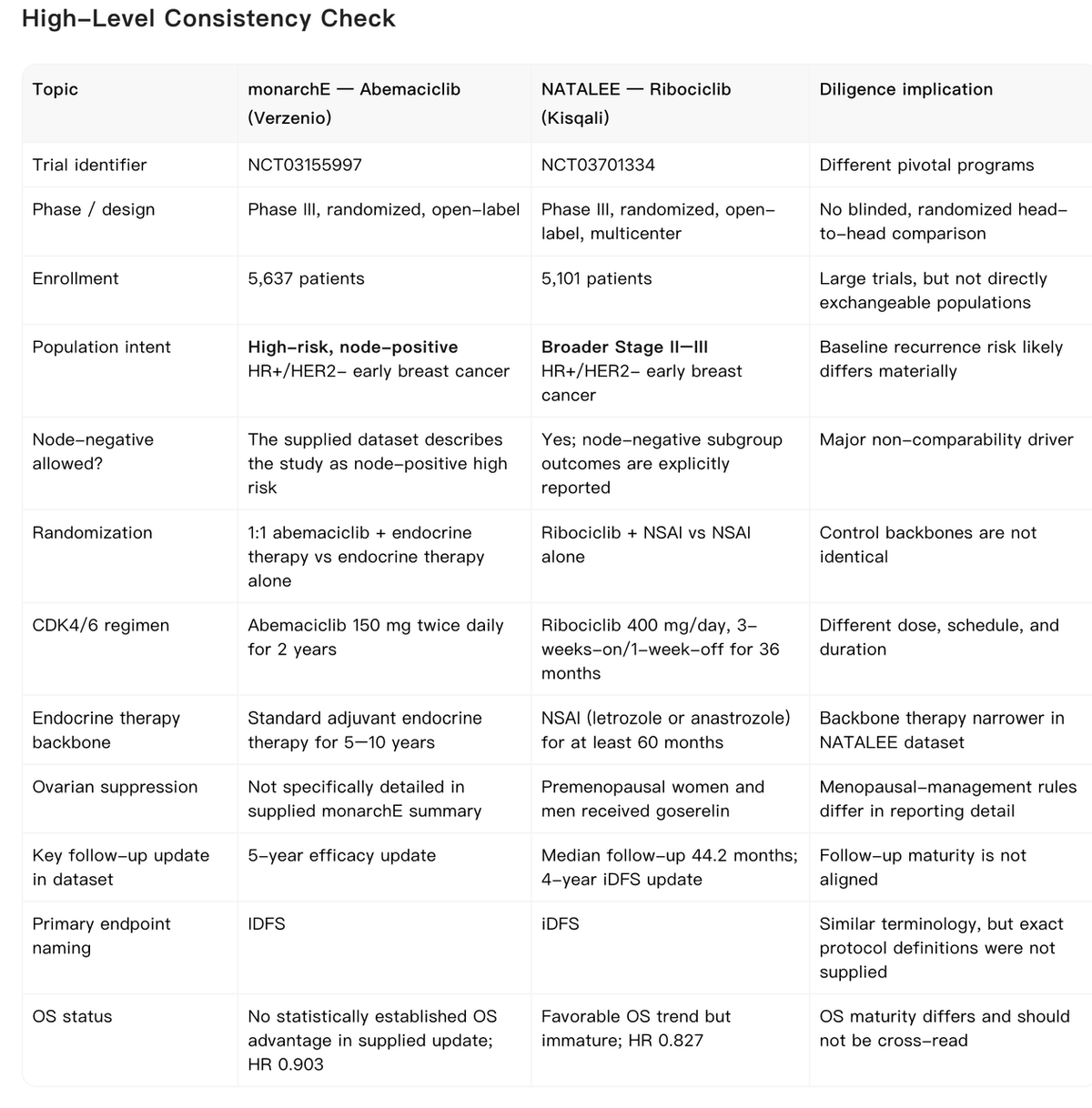
Figure 1. Noah AI compares monarchE and NATALEE across trial design, enrollment, population, regimen, follow-up, endpoint context, and cross-trial implications.Note: The ovarian-suppression entry reflects information available in the supplied summary used for this Noah AI example and should not be interpreted as evidence that monarchE did not specify ovarian-suppression requirements. This detail requires verification against the original trial protocol or publication.The value of the output is not simply that the two trials appear in the same table. The comparison exposes the factors that determine whether their results can be interpreted side by side.The visible differences include a high-risk, node-positive monarchE population versus the broader Stage II-III population in NATALEE; different dosing schedules and treatment durations; different endocrine-therapy backbones; and different follow-up maturity.For a medical researcher, those distinctions are more useful than a generic summary of each paper because they show where a cross-trial comparison can become misleading.If your task is specifically cross-paper comparison, see Best AI Tools for Cross-Paper Comparison in Medical Research (2026).
Does the Final Conclusion Preserve the Limits of the Evidence?
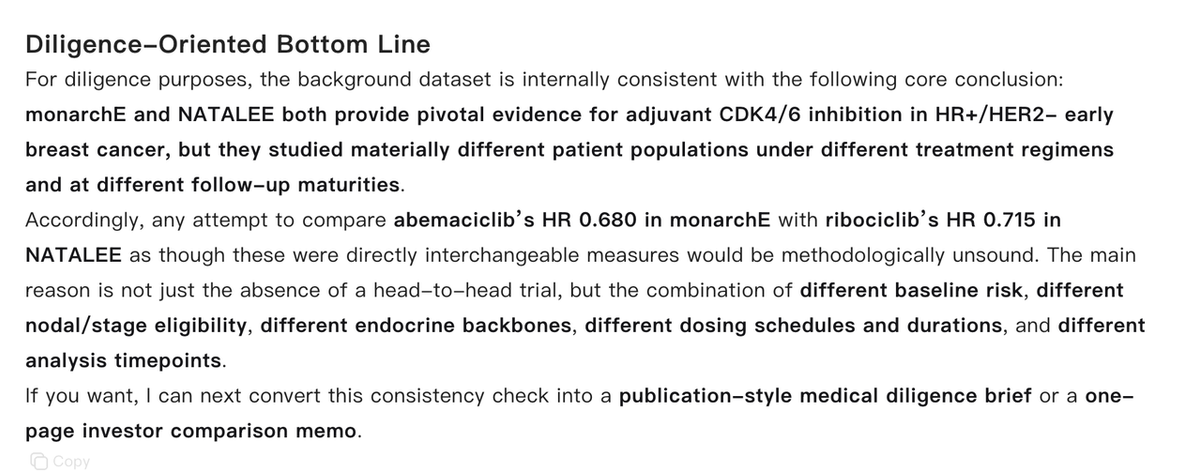
Figure 2. Noah AI summarizes why monarchE and NATALEE can be compared descriptively but should not be used for direct comparative efficacy ranking.The final conclusion keeps the major limitations of direct cross-trial efficacy comparison visible: baseline recurrence risk, nodal and stage eligibility, endocrine backbones, dosing schedules and durations, and analysis timepoints.It also avoids treating the hazard ratios from monarchE and NATALEE as interchangeable measures of comparative efficacy. These differences do not prevent descriptive cross-trial comparison, but they do prevent a simple head-to-head efficacy ranking of abemaciclib versus ribociclib.That matters because an AI research tool can produce a polished answer while still losing the methodological boundary that makes the answer scientifically defensible.This is the specific advantage demonstrated by the Noah case: a biomedical research question is converted into a structured clinical-evidence comparison and a cautious research conclusion that preserves the differences between the underlying trials.For a more structured evidence-table workflow, see Best AI Tools for Turning Research Questions into Evidence Tables (2026).
Choose Elicit Instead of SciSpace When the Review Process Must Be Reproducible
Elicit is the better alternative when the project is a formal systematic review rather than a broad literature-analysis task. Its current systematic-review workflow covers protocol refinement, source gathering, screening, structured extraction, and evidence synthesis, with auditable review steps and support for PRISMA-oriented workflows.Compared with SciSpace, Elicit is more suitable when the core problem is not reading papers but running a repeatable review process across a defined evidence set.
Choose Consensus Instead of SciSpace When You Need a Fast Structured Literature Review
Consensus is useful when the starting point is a research question and the desired result is a structured literature review rather than detailed PDF-by-PDF analysis. Its Deep Review workflow breaks a question into subquestions, runs multiple targeted searches, and synthesizes a review from the selected literature.Compared with SciSpace, Consensus is a better fit when speed of question-to-synthesis matters more than document-centered exploration.
Choose Scite Instead of SciSpace When You Need to Verify How a Claim Is Cited
Scite solves a different research problem. Its Smart Citations show the context in which a paper is cited and classify citations as supporting, contrasting, or mentioning.Compared with SciSpace, Scite is more useful when the key question is not 'What does this paper say?' but 'How has the wider literature treated this finding or claim?'
When Staying With SciSpace Makes More Sense
SciSpace remains a practical choice when the main workflow is broad literature discovery, PDF analysis, and synthesis across many academic subjects. Its Deep Review workflow is designed to gather and organize insights from multiple papers and provide a more comprehensive view of a research topic.If that document-centered academic workflow already matches your needs, switching tools may add complexity without solving a real bottleneck. An alternative becomes more compelling when the task is more specialized: biomedical evidence comparison, formal systematic review, rapid question-to-review synthesis, or citation-context verification.
Which SciSpace Alternative Should You Choose?
Choose Noah AI for a biomedical research question that needs structured trial-level comparison or a medical evidence synthesis.
Choose Elicit when the project needs a reproducible systematic-review workflow with screening and structured extraction.
Choose Consensus when you want to turn a research question into a structured literature review quickly.
Choose Scite when citation context and claim verification are more important than full literature-workflow automation.
Stay with SciSpace when broad literature discovery, PDF analysis, and cross-disciplinary academic work remain the main use case.
FAQ
What is the best SciSpace alternative for medical research?
There is no single best replacement for every workflow. Noah AI is a strong fit for structured biomedical evidence work; Elicit for systematic reviews; Consensus for fast literature-review synthesis; and Scite for citation-context verification.
Which SciSpace alternative is best for systematic reviews?
Elicit is the more natural fit when the workflow depends on explicit screening criteria, structured extraction, auditable review decisions, and evidence synthesis.
Is Consensus a direct replacement for SciSpace?
Not exactly. Consensus is better understood as a question-to-literature-review tool, while SciSpace places more emphasis on paper and PDF-centered research workflows.
When is Scite more useful than SciSpace?
Scite is particularly useful when you need to see whether later papers support, contrast with, or simply mention a claim or publication.
Final Takeaway
A SciSpace alternative should be chosen around the research task, not around a generic feature comparison.In the Noah case, the useful difference is visible in the output: a medical research question becomes a structured trial-level comparison and a conclusion that keeps important cross-trial limitations intact.Noah may be a better fit when your main requirement is structured biomedical evidence comparison and synthesis rather than a broader academic literature workflow.