Best Iris.ai Alternatives for Biomedical Literature Analysis (2026)
Linda
Compare five Iris.ai alternatives for biomedical literature analysis, including Noah AI, Elicit, SciSpace, Rayyan, and ResearchRabbit, with a clinical trial example.
Scientific research tools · Comparative guide
Biomedical literature analysis involves more than finding papers or generating readable summaries. Researchers need to identify which populations were studied, extract the exact outcomes reported, preserve statistical uncertainty, and explain why apparently similar trials may not support interchangeable conclusions.
Iris.ai offers established literature exploration, document analysis, multi-document summarization, and data extraction capabilities. Depending on the research task, Noah AI, Elicit, SciSpace, Rayyan, and ResearchRabbit are also worth considering. This guide compares their practical roles and uses a real Noah AI workflow on antibiotic treatment duration in bloodstream infections to show what evidence-aware analysis can look like.
How this guide was prepared. The Noah AI section is based on three actual screenshots from a single Deep Research task. The other products were not tested in this exercise; their descriptions are grounded in official product documentation. This is a workflow comparison, not an independent accuracy, speed, or search-coverage benchmark.
What Is Iris.ai?
Iris.ai develops tools for scientific knowledge processing. Its Researcher Workspace documentation describes modules for exploring related literature, analyzing concepts, filtering collections, summarizing research documents, and extracting structured information. The Summarize tool supports single- and multi-document summaries using abstracts or accessible full texts. Its Extract workflow is designed to turn information in research documents into organized data.
Those capabilities make Iris.ai relevant to biomedical researchers who need to work with collections of papers. It would be inaccurate to describe Iris.ai as a keyword-only search engine or to claim that it lacks cross-paper summarization or extraction. The alternatives below reflect different workflow preferences, rather than features that Iris.ai necessarily lacks.
Official sources: Iris.ai Researcher Workspace training and Summarize documentation.
Five Iris.ai Alternatives Worth Considering
Noah AI — For Clinical Evidence Interpretation
Noah AI is useful to evaluate when the starting point is a biomedical research question rather than a document library. In the observed Deep Research task, it produced a clinical trial matrix, compared three different noninferiority designs, and identified where findings should not be generalized. The example demonstrates the output of one specified clinical task; it does not establish universal performance across topics.
Best suited to: clinical trial comparisons, evidence synthesis, source-aware research reports, and interpretation of endpoint differences.
Elicit — For Search, Screening, and Data Extraction
Elicit combines literature search, research questions, and structured extraction. Its current Research Agent incorporates capabilities that were previously separate Find Papers, Extract Data, and Chat with Papers tools. For a formal review, Elicit also provides a dedicated Systematic Review workflow on eligible paid plans.
Best suited to: discovering relevant publications, building extraction columns, comparing findings, and managing more methodical review pipelines.
SciSpace — For Reading and Comparing Papers
SciSpace provides academic search, paper-focused question answering, literature review tables, and writing assistance. Its paper-reading features are particularly relevant when researchers need to understand methods or terminology in individual publications before building a multi-paper analysis.
Best suited to: paper comprehension, literature search, comparing research findings, and assisting with academic drafting.
Rayyan — For Structured Review Screening
Rayyan is oriented toward the review process: importing records, deduplicating references, applying inclusion and exclusion criteria, supporting reviewer collaboration, and extracting data from included studies. Its AI-supported screening and analysis features depend on the plan. It is a different kind of alternative from a general-purpose document summarizer.
Best suited to: systematic or scoping review screening, reproducible selection decisions, and team-based review management.
ResearchRabbit — For Exploring Connected Research
ResearchRabbit helps researchers move from seed papers into networks of related studies, references, and citing articles. Its citation visualization can reveal research connections that may be missed by a narrowly phrased keyword query. It complements extraction tools rather than replacing a detailed clinical evidence audit.
Best suited to: expanding a reading list, following citation networks, and mapping the development of a research area.
Quick Comparison: Which Tool Fits Which Task?
| Tool | Primary workflow emphasis | When to consider it | Important boundary |
|---|---|---|---|
| Noah AI | Biomedical question-to-report analysis | Trial-level clinical evidence interpretation and cited synthesis | Verify original sources and numerical results before publication |
| Elicit | Research Agent, structured extraction and reviews | Collecting and comparing evidence across studies | Formal systematic-review features depend on plan and workflow |
| SciSpace | Literature search, paper Q&A and research tables | Understanding articles and comparing selected papers | Paper explanations still require source checking |
| Rayyan | Screening, review organization and collaboration | Managing eligibility decisions across many records | Not a direct substitute for clinical interpretation |
| ResearchRabbit | Citation-network and related-paper exploration | Finding connected literature from seed studies | Discovery does not itself validate treatment claims |
Descriptions reflect documented use cases, not comparative test scores. See the official documentation linked above and in the references below for current workflow and plan details.
Real Biomedical Literature Analysis: Antibiotic Duration in Bloodstream Infection
To illustrate cross-paper analysis, a Noah AI Deep Research task examined three randomized trials comparing shorter and longer antibiotic treatment strategies in bloodstream infection: Yahav et al., von Dach et al., and BALANCE. Although all address treatment duration, they differ substantially in patient eligibility, design, primary endpoint, and statistical margin.
The research task asked Noah to preserve study-specific definitions, distinguish clinical failure from all-cause mortality, identify how clinical stability and source control shaped eligibility, and avoid treating noninferiority results as universally applicable.
The Noah AI Research Input
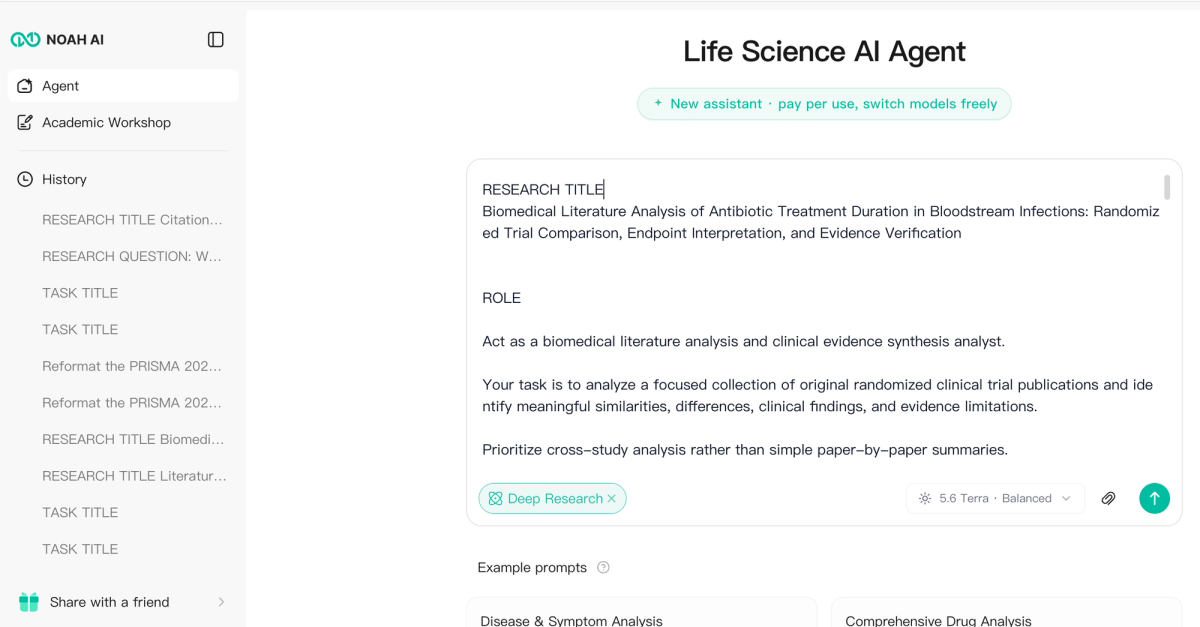
Figure 1. The actual Noah AI prompt, requesting randomized-trial comparison, endpoint interpretation, and evidence verification.
What the Three Original Trials Studied
| Original study | Population and design | Primary endpoint | Selected reported result |
|---|---|---|---|
| Yahav et al. — 604 randomized | Clinically stable adults with uncomplicated Gram-negative bacteremia; 7 vs 14 days | 90-day composite of death, relapse or complications, and readmission or extended hospitalization; 10-point noninferiority margin | 45.8% vs 48.3%; risk difference −2.6 percentage points, 95% CI −10.5 to 5.3 |
| von Dach et al. — 504 randomized | Uncomplicated Gram-negative bacteremia; CRP-guided, fixed 7-day, and fixed 14-day treatment arms | Clinical failure at day 30; 10-point noninferiority margin | Clinical failure among analyzed patients: 2.4%, 6.6%, and 5.5%, respectively |
| BALANCE — 3,608 randomized | Broader hospitalized bloodstream infection population, including ICU patients; 7 vs 14 days | 90-day all-cause mortality; 4-point noninferiority margin | 14.5% vs 16.1%; difference −1.6 points, 95.7% CI −4.0 to 0.8 |
Original reports: Yahav et al., PMID 30535100; von Dach et al., PMID 32484534; BALANCE, PMID 39565030.
Evidence Extraction and Endpoint Verification
The Noah output organized the randomized trials into a five-column clinical evidence matrix, reporting study population, intervention and comparator, primary endpoint and noninferiority margin, and principal findings with PubMed identifiers. The matrix kept von Dach's third CRP-guided arm and recognized that BALANCE was not restricted to uncomplicated Gram-negative bacteremia.
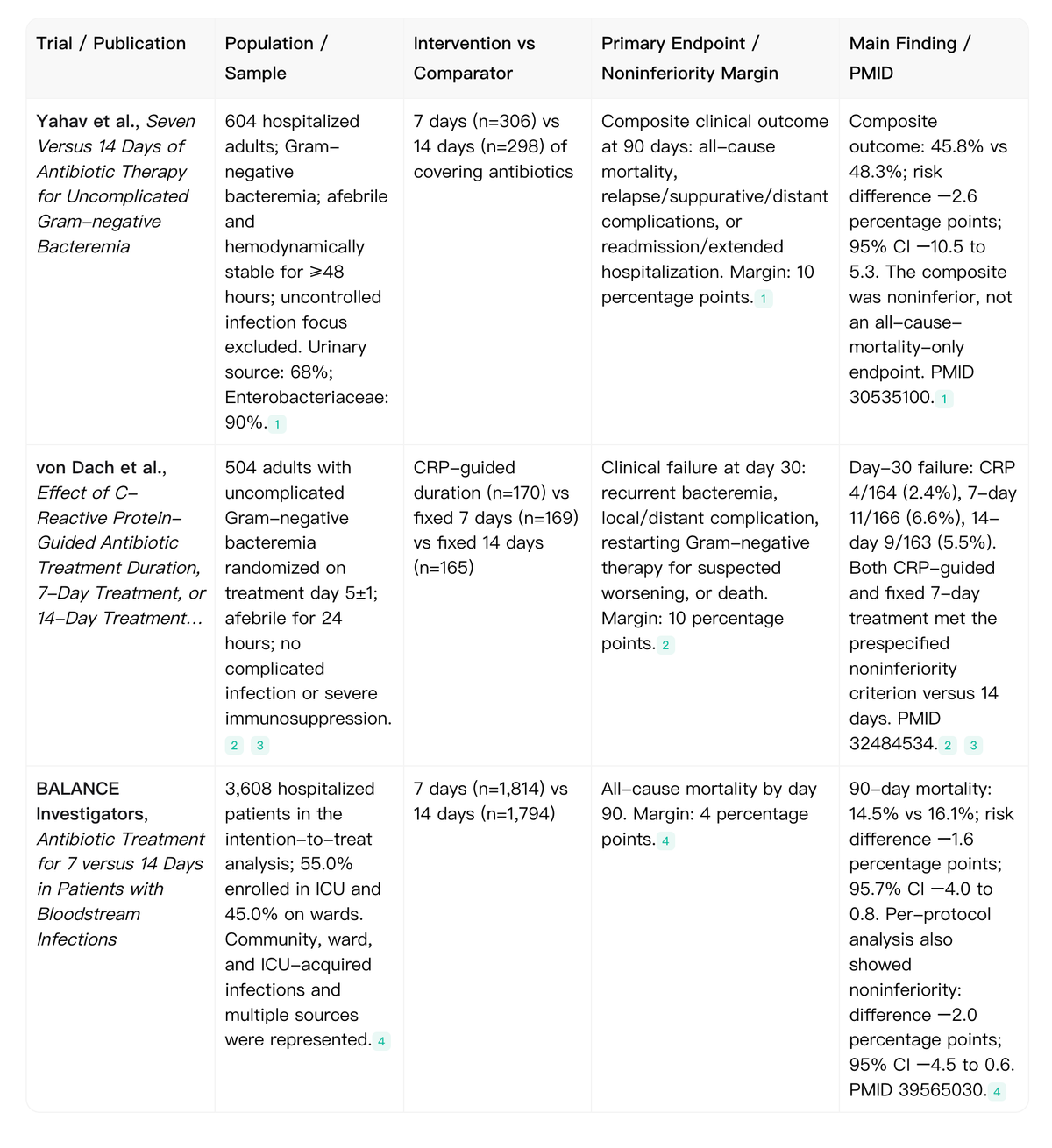
Figure 2. A real clinical trial evidence matrix showing three original studies, their distinct primary endpoints, noninferiority margins, and citation identifiers.
The primary outcomes should not be merged into a single unqualified figure. Yahav measured a broad composite at 90 days, von Dach measured day-30 clinical failure, and BALANCE measured day-90 all-cause mortality. Each noninferiority conclusion belongs to the endpoint and population tested in that trial.
Analyze Biomedical Evidence with Noah AI
Start with a clinical research question, organize original studies, and inspect how endpoints and evidence limitations affect the interpretation.
Why Cross-Study Heterogeneity Matters
In biomedical research, three studies can be directionally consistent and still answer different questions. A well-supported analysis should identify those differences explicitly instead of assuming that similar conclusions mean identical study conditions.
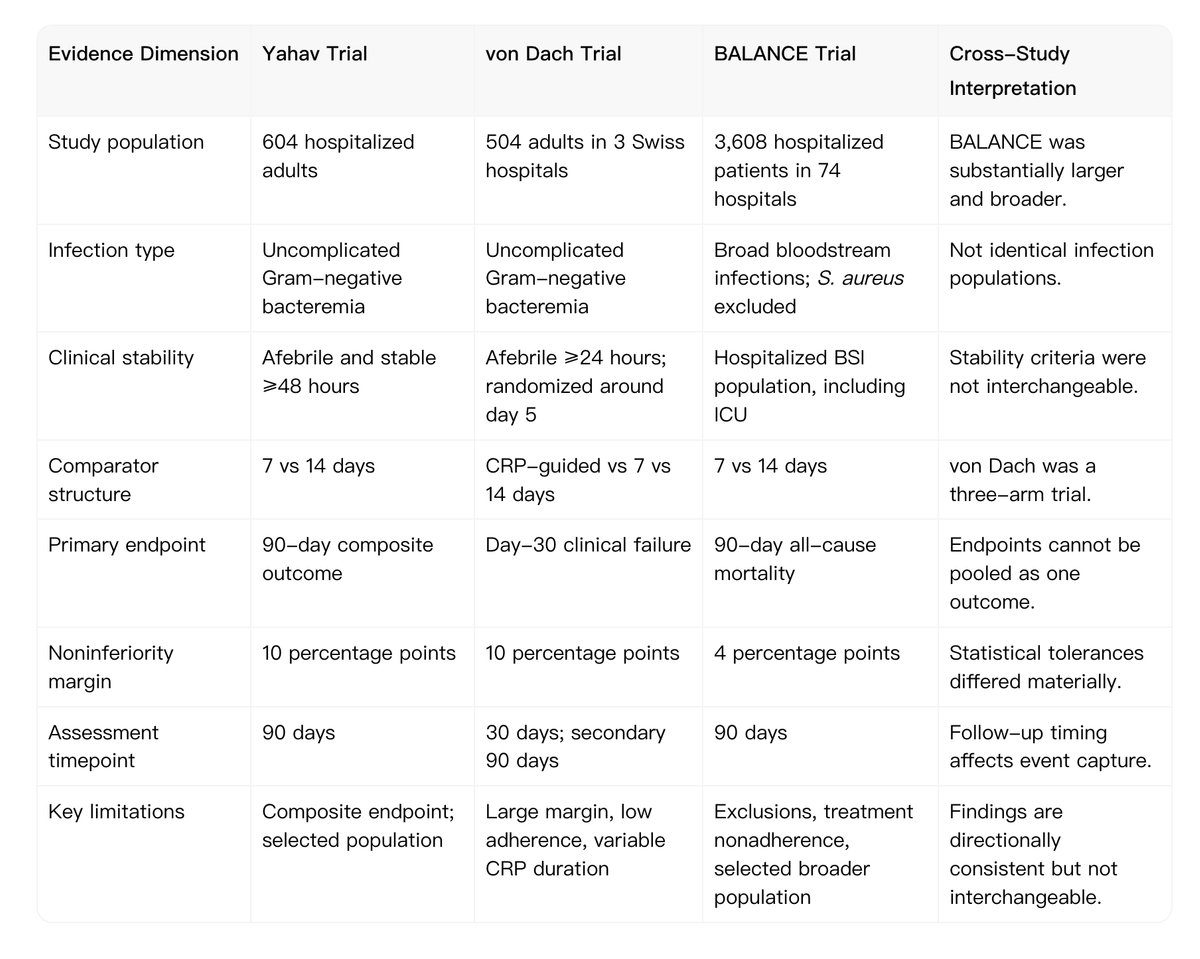
Figure 3. The Noah AI heterogeneity matrix contrasts study populations, infection types, treatment arms, endpoints, margins, assessment periods, and interpretation caveats.
Different infection populations
Yahav and von Dach enrolled selected patients with uncomplicated Gram-negative bacteremia who met clinical stability requirements. BALANCE included a wider hospitalized population, including ICU patients and multiple bloodstream-infection sources, but excluded several conditions requiring prolonged therapy, including Staphylococcus aureus bacteremia and severe immunosuppression. It was broader, not unrestricted.
Different comparison structures
Yahav and BALANCE compared fixed seven- and fourteen-day durations. Von Dach included a third, CRP-guided group. Treating the three-arm trial as a standard two-arm study would erase an important part of its design and potentially misattribute its results.
Different noninferiority margins
The two uncomplicated Gram-negative bacteremia trials used margins of 10 percentage points. BALANCE used a four-point margin. The acceptable degree of possible inferiority was therefore defined differently. Noninferiority does not mean two strategies are identical, and a result for mortality does not automatically establish the same conclusion for relapse or other components.
Different follow-up and reported uncertainty
Yahav assessed its composite at 90 days; von Dach assessed the primary clinical-failure endpoint at 30 days; BALANCE assessed death by 90 days. BALANCE reported a 95.7% confidence interval for its primary result, not a conventional 95% interval. Maintaining that detail matters when reproducing the published statistical analysis.
What the Clinical Evidence Supports—and What It Does Not
Across these selected randomized trials, shorter antibiotic treatment met each study's prespecified noninferiority criterion compared with a longer strategy for its respective primary endpoint. This provides meaningful evidence for shorter courses in populations resembling the enrolled patients, while retaining important boundaries.
- Supported in the studied contexts: A seven-day strategy can meet predefined noninferiority criteria for the endpoints assessed in eligible, managed bloodstream infection populations.
- Not established: That every bloodstream infection, organism, source, or patient requires only seven days of therapy.
- Not interchangeable: Composite clinical failure and all-cause mortality, 10-point and four-point margins, or patients with and without complicated infections.
- Still requires review: Full trial methods, source-control conditions, treatment adherence, excluded populations, and applicability to a specific clinical question.
The Noah report also distinguished source-access levels: its stated verification used PubMed records for Yahav and BALANCE and accessible original full text for von Dach. It did not claim full-text inspection of every paper or a completed systematic-review search.
Interpretation note: This three-trial exercise is an illustrative literature analysis. It is not an exhaustive evidence search, a meta-analysis, a formal risk-of-bias assessment, or a treatment recommendation for an individual patient.
How to Choose an Iris.ai Alternative
Choose based on the research step you need to accomplish rather than assuming that one tool is best at every stage.
| Your task | Reasonable starting point | Why | Important boundary |
|---|---|---|---|
| Interpret a set of biomedical randomized trials | Noah AI | The observed example combines evidence extraction with endpoint and heterogeneity interpretation. | Verify original sources and numerical results before publication |
| Build structured extraction columns across a paper set | Elicit or Iris.ai | Both document workflows for organizing and extracting information from papers. | Formal systematic-review features depend on plan and workflow |
| Understand challenging individual papers | SciSpace | Paper-oriented explanations and question answering are central to its workflow. | Paper explanations still require source checking |
| Screen many studies against eligibility criteria | Rayyan | Supports study selection, deduplication, collaboration, and review management. | Not a direct substitute for clinical interpretation |
| Find related work and follow citation links | ResearchRabbit | Seed-paper networks and references help expand literature discovery. | Discovery does not itself validate treatment claims |
No tool's marketing description is a substitute for checking source provenance and reproducibility. Researchers should confirm which papers were searched, which full texts were available, what was extracted, and whether the cited results support the written conclusions.
Final Takeaway
The best Iris.ai alternative depends on the work you need to complete. Iris.ai itself offers substantial multi-document research capabilities. Elicit is relevant to structured research extraction, SciSpace to paper reading, Rayyan to review screening, and ResearchRabbit to citation-network exploration.
For a biomedical question requiring cross-trial interpretation, the documented Noah AI example shows a useful sequence: define the research question, extract trial-level evidence, compare populations and statistical endpoints, and state what the underlying evidence cannot establish. That is a meaningful illustration of one workflow—not a claim that Noah has been proven superior to the other platforms.
Explore Biomedical Literature Analysis in Noah AI
Use an evidence-focused research workflow to compare clinical studies, trace original sources, and inspect interpretation limitations.