Best Humata Alternatives for Clinical Research Document Analysis (2026)
Linda
Explore 6 best Humata alternatives for clinical research in 2026. Compare Noah AI, Elicit, SciSpace, and more for PDF analysis and evidence extraction.
Humata can help users summarize technical PDFs, ask questions across files, compare documents, and follow citations back to source material. Those are useful capabilities for research. Yet clinical trial appraisal can also require structured extraction of patient populations, outcome definitions, event counts, effect estimates, and explicit documentation of what could not be verified.
This guide compares six alternatives according to the research task they support. Only Noah AI was tested for this article. The other products are discussed by their published workflows and positioning, not by a controlled head-to-head test.
Explore Noah AI Literature Review
What should clinical researchers look for?
The right PDF assistant depends on whether you need to read one document quickly or reconcile evidence across publications and records. Useful evaluation criteria include:
- Source traceability: Can the researcher verify a claim against an identifiable source?
- Clinical structure: Can outputs preserve the study population, comparator, endpoint definition, event counts, hazard ratios, and confidence intervals?
- Document boundaries: Can the workflow distinguish a journal publication, trial registry, sponsor report, and secondary summary?
- Extraction transparency: Does it identify missing full text, inaccessible supplementary tables, or unverified registry fields?
- Researcher review: Can a human check the source and revise interpretations before using the results?
These criteria do not imply that Humata lacks citation or multi-file features; its official website describes both.
Six Humata alternatives at a glance
| Tool | Best-fit workflow | When to consider it |
|---|---|---|
| Noah AI | Biomedical evidence synthesis | Structured trial findings with explicit references and verification limits |
| Elicit | Literature discovery and extraction | Finding and organizing evidence across multiple papers |
| SciSpace | Scientific paper reading | Explaining technical passages and interacting with research PDFs |
| Scholarcy | Paper summarization | First-pass reading and structured research summaries |
| ChatPDF | PDF question answering | Asking targeted questions about uploaded documents |
| NotebookLM | Source-based notebook synthesis | Organizing notes and questions across a source collection |
Noah AI — for biomedical evidence synthesis
Noah AI offers research workflows intended for medical and life-science topics. For this article, its Deep Research agent was given a source-grounded document analysis task about the SELECT randomized trial (NCT03574597), which investigated semaglutide 2.4 mg versus placebo in adults with established cardiovascular disease and overweight or obesity without diabetes.
The instruction asked Noah to verify the original publication, examine the ClinicalTrials.gov record, attempt to retrieve a sponsor synopsis, and prepare a structured clinical evidence extraction and narrative synthesis. This was a real Noah run, not a reconstruction of its interface.
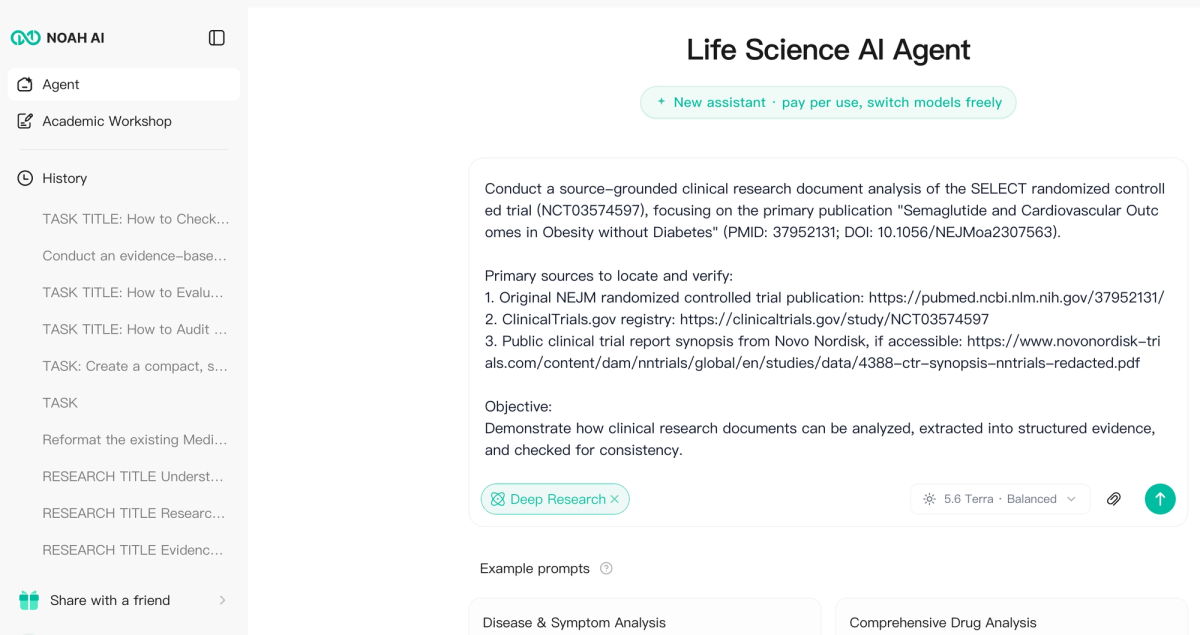
Figure 1. Original Noah AI Deep Research input for the SELECT clinical trial (NCT03574597).
What Noah extracted in the SELECT example
Noah identified the original trial publication, Semaglutide and Cardiovascular Outcomes in Obesity without Diabetes (PMID: 37952131; DOI: 10.1056/NEJMoa2307563), and produced a structured summary of the study design, population, intervention, comparator, primary outcome and key results.
In the tested report, the principal trial details were:
- Participants: 17,604 randomized — 8,803 assigned to semaglutide and 8,801 to placebo.
- Primary endpoint: First occurrence of cardiovascular death, nonfatal myocardial infarction, or nonfatal stroke.
- Primary result: 6.5% versus 8.0%; hazard ratio 0.80 (95% CI 0.72–0.90).
- Follow-up: Mean 39.8 months.
These values were reported in the primary publication, not independently established by comparing treatment arms across different trials.
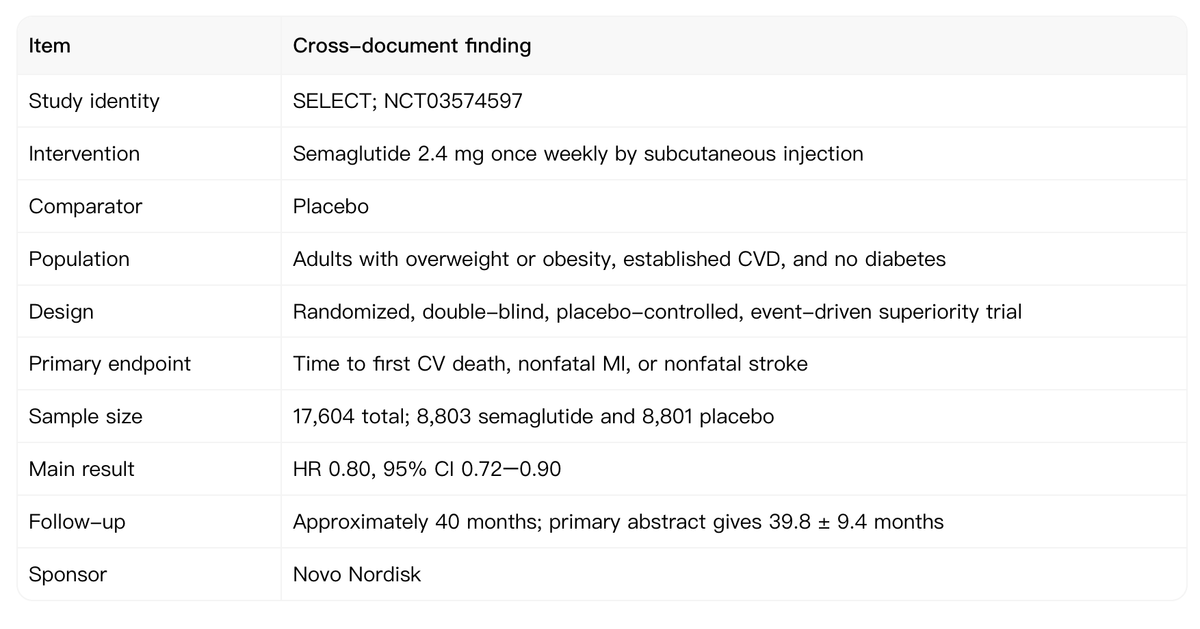
Figure 2. Noah AI cross-document findings summary for SELECT. This is the compact findings table, not a screenshot of the full structured extraction matrix.
Why the evidence boundary matters
The report also stated where its verification was incomplete. It could access the original publication's abstract and readable article text, but not all full-text tables, protocol materials, or supplementary files. The ClinicalTrials.gov identity was verified, while some structured fields and registry history could not be reliably extracted. The linked sponsor synopsis PDF was not retrieved.
That means this case demonstrates a source-aware partial document review, not completed full-PDF extraction across every listed source. The source-concordance summary also should not be interpreted as independent verification of unavailable registry fields or sponsor-report content.
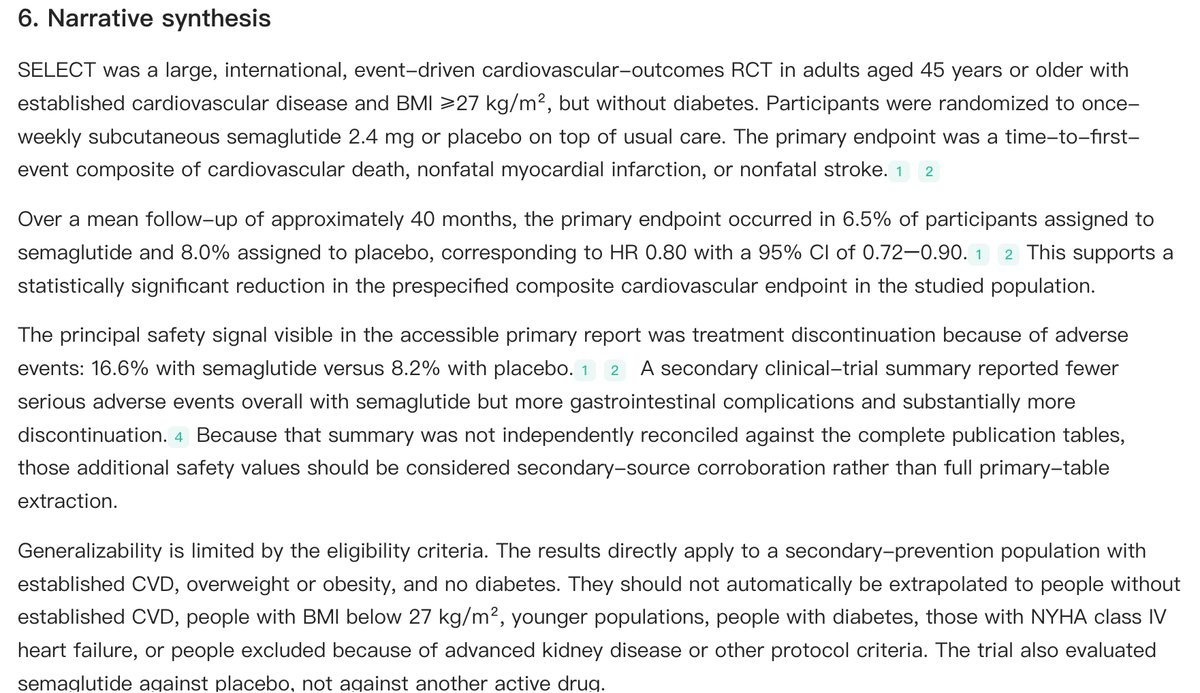
Figure 3. Noah AI's narrative synthesis reports the SELECT primary result and discusses safety and limits of generalizability.
When to choose Noah: Consider this workflow when you want a structured biomedical research response that keeps primary data, source identity, interpretation, and uncertainties visible. Its performance relative to the other products listed here was not benchmarked.
Elicit — for literature review and study extraction
Elicit is oriented toward finding research papers, gathering evidence, and organizing results in research-oriented workflows. It may be a better starting point than a PDF-only chat tool when the immediate challenge is finding multiple eligible studies or preparing an evidence extraction set.
Consider it when: Your first task is literature discovery, screening, or comparison across a body of papers. Verify extracted numerical fields against original reports before using them in a clinical review.
SciSpace — for reading scientific papers
SciSpace focuses on helping researchers search, read, and understand scientific literature. Its paper-reading and PDF question-answering workflows can be useful when methods, statistics, or technical terminology need explanation.
Consider it when: You spend substantial time interpreting individual publications. Do not assume an explanation constitutes a verified extraction of every clinical result.
Scholarcy — for concise paper summaries
Scholarcy is positioned around summarizing research papers into more digestible formats. This makes it relevant to initial reading, literature triage, and notes prepared before deeper appraisal.
Consider it when: You need a quick overview of long papers. Any secondary analysis, outcome definition, or numerical conclusion should still be checked in the source.
ChatPDF — for targeted PDF questions
ChatPDF is useful for direct questions about uploaded PDFs, such as asking where inclusion criteria are specified or requesting a summary of a paper section.
Consider it when: Your immediate need is lightweight question answering from a document rather than a broader, structured biomedical evidence synthesis.
NotebookLM — for source-based research notes
NotebookLM provides a source-focused environment for collecting documents and asking questions across them. It may be useful for assembling context, keeping notes, and revisiting a group of source materials.
Consider it when: Your research process depends on an organized collection of source documents. A source-based notebook does not, by itself, replace formal critical appraisal or systematic review methods.
How to choose the right Humata alternative
Choose based on the next research step, not a generic AI accuracy ranking. For structured biomedical evidence synthesis, start with Noah. For study discovery and extraction, explore Elicit. For paper comprehension, evaluate SciSpace; for rapid summaries, Scholarcy. For simple document questions, ChatPDF may be sufficient. For a multi-source research notebook, NotebookLM is worth assessing.
Humata itself remains an option for PDF summarization, document comparison, and source-linked question answering. No equivalent-prompt performance comparison was performed among these products, and this article does not claim that any one product has more accurate citations or better clinical extraction accuracy overall.
Frequently asked questions
Is Humata useful for clinical research PDFs?
It can be useful for navigating uploaded documents, obtaining summaries, comparing files, and following source citations. The suitability of its outputs for a particular protocol, trial, or regulated workflow must be evaluated by the research team.
Can AI check a trial publication against ClinicalTrials.gov?
AI can assist in extracting and organizing comparable fields. A trustworthy discrepancy assessment still requires access to the exact registry version, dates, outcomes, and primary documents. The SELECT run here did not fully retrieve all of those materials.
Can an AI-generated summary replace clinical evidence appraisal?
No. Researchers remain responsible for verifying numerical claims and citations, distinguishing prespecified from exploratory outcomes, reviewing methods and limitations, and documenting the process used.
Was Humata tested against Noah AI in this article?
No. This article includes an observed Noah AI case and descriptive information about other tools. It is a workflow guide, not a controlled accuracy or speed benchmark.
Conclusion
The best Humata alternative for clinical research depends on whether your priority is reading PDFs, discovering studies, organizing source materials, or preparing a traceable evidence synthesis. The tested SELECT example illustrates how Noah can structure a biomedical question, summarize accessible clinical trial evidence, and identify where verification was incomplete. Those limits should remain visible in any downstream review.
Ready to Simplify Clinical Research with Noah AI?
Go beyond basic PDF summaries with Noah AI. Explore biomedical literature, extract clinical trial evidence, compare study outcomes, and generate structured research summaries with traceable references.
Start for free with 200 signup credits. No credit card required. Explore AI-assisted literature review and evidence synthesis while keeping your research organized and source-grounded.
Start Exploring Noah AI for Free!
Free credits are limited, and usage varies by task. Research findings should be verified against original sources.