Best Explainpaper Alternatives for Understanding Biomedical Studies (2026)
Linda
Compare Explainpaper alternatives for biomedical study reading, including Noah AI, SciSpace, Scholarcy, ChatPDF, and Elicit, with a SELECT trial example.
Research tools / Biomedical paper understanding
A biomedical paper can be difficult for reasons that a quick summary cannot resolve: unfamiliar terminology, complicated eligibility criteria, time-to-event statistics, composite clinical outcomes, and uncertainty about what the data actually establish. Explainpaper is one option for reading difficult studies, but several alternatives support different parts of the research workflow.
This guide compares Noah AI, SciSpace, Scholarcy, ChatPDF, and Elicit as alternatives to Explainpaper. It also presents a documented Noah AI exercise on the original SELECT randomized trial of semaglutide. The purpose is to show how an AI-assisted workflow can explain a clinical paper without confusing statistical significance, absolute effects, and generalizability.
Testing disclosure: Only the Noah AI workflow shown below was run and captured for this article. The other products are discussed using their published feature documentation. This is a task-fit comparison, not a same-prompt benchmark or an accuracy ranking.
What Does Explainpaper Do?
Explainpaper is designed around reading and understanding research papers. Its official site describes highlighting a difficult passage to obtain an in-context explanation, choosing a more accessible or advanced explanation level, asking follow-up questions about a paper, and viewing key points or outlines. That makes it useful when the immediate obstacle is a sentence, concept, or section of a paper rather than a broad evidence review.
Explainpaper therefore should not be described as a product that cannot explain study methods or answer questions. What differs across alternatives is the surrounding workflow: interactive PDF reading, structured study extraction, question-led biomedical research, or discovery and synthesis across publications.
Five Explainpaper Alternatives for Biomedical Studies
Noah AI — For question-led clinical evidence interpretation
Noah AI can be used to formulate an evidence-focused biomedical research task. In the captured example, its Agent in Deep Research mode was asked to explain one original randomized clinical trial, extract a PICO-oriented study design table, interpret the primary result and hazard ratio, and classify potentially misleading claims against original study sources.
Useful when: the reader needs more than a plain-language paraphrase, such as the exact population to which a trial applies, the distinction between a primary composite and a component endpoint, or a traceable explanation of a questionable conclusion.
Limitation: A source-linked AI response still requires checking the original paper. The screenshots are one task example, not proof that all claims are automatically verified or that every journal source is fully accessible.
SciSpace — For explanations while reading a PDF
SciSpace Chat with PDF supports asking questions about uploaded scientific PDFs, obtaining explanations of highlighted passages, and using references to document sections. SciSpace also offers research-discovery and literature-review features beyond the PDF reader.
Useful when: a biomedical reader wants to remain close to the article text while unpacking jargon, methods, tables, or difficult passages. It is an especially relevant Explainpaper alternative for interactive reading.
Limitation: The quality and scope of an explanation depend on the accessible source material. Source-linked responses should still be checked against the actual methods and results.
Scholarcy — For structured study summaries
Scholarcy organizes papers into structured summaries or flashcards and offers library management, research quality information, limitations, and comparisons with related studies. Its workflow is oriented toward turning long papers into reusable research notes.
Useful when: the goal is to extract key findings and methodological details into a consistent reading or literature-review record.
Limitation: A structured card is a starting point. It should not replace checking the original statistical methods, study denominators, or subgroup qualifications.
ChatPDF — For direct questions about an uploaded paper
ChatPDF provides a conversational interface for PDFs, including document summaries and source-linked answers. Readers can ask targeted questions while keeping the source document available.
Useful when: a researcher already has the relevant PDF and wants a straightforward way to ask, for example, “What was the primary endpoint?” or “Where are the exclusion criteria?”
Limitation: Asking a PDF good questions is not the same as validating all inferences. Statistical estimates and clinical claims still need manual scrutiny.
Elicit — For study understanding within a broader evidence workflow
Elicit is relevant when the task extends beyond one document to identifying research, extracting data, and building literature-based tables or reports. Its current Research Agent incorporates the functionality formerly offered as separate Find Papers, Extract Data, and Chat with Papers tools. Dedicated systematic-review capabilities are also documented for eligible plans.
Useful when: understanding the focal biomedical paper is part of screening, evidence extraction, or comparing related studies.
Limitation: Broader automated research workflows still need review of search scope, article selection, extracted data, and source provenance.
Feature Comparison: Choose the Workflow, Not an Accuracy Score
| Tool | Primary workflow in this guide | Relevant features | Best question to bring |
|---|---|---|---|
| Noah AI | Question-led biomedical analysis | Focused task prompts, study extraction, cited interpretation in the observed run | “What does this clinical trial establish, and which interpretations overreach?” |
| SciSpace | Interactive paper reading | PDF chat, highlighted-text explanation, linked source sections | “Explain this paragraph, table, or method in context.” |
| Scholarcy | Structured paper notes | Summary cards, key findings, analysis, limitations, research library | “What are the paper's main methods and findings?” |
| ChatPDF | PDF question-answering | Document chat, summaries, source-linked answers | “Where does this PDF answer my specific question?” |
| Elicit | Evidence discovery and extraction | Research Agent, paper discovery, study extraction, reports | “How does this study fit into the available literature?” |
These are task-fit descriptions based on the products' documented capabilities and the single observed Noah exercise. Availability varies by plan. No comparative speed, citation-accuracy, or quality scores were measured.
A Real Biomedical Reading Case: The SELECT Randomized Trial
To make “understanding a study” concrete, the Noah AI exercise focused on Semaglutide and Cardiovascular Outcomes in Obesity without Diabetes, published by Lincoff and colleagues in the New England Journal of Medicine. The original publication is indexed at PubMed, PMID 37952131 (DOI: 10.1056/NEJMoa2307563).
SELECT enrolled 17,604 adults aged at least 45 years with BMI at least 27, established cardiovascular disease, and no history of diabetes. It randomized participants to once-weekly subcutaneous semaglutide 2.4 mg or placebo. The primary outcome was the first occurrence of cardiovascular death, nonfatal myocardial infarction, or nonfatal stroke.
That detail about established cardiovascular disease matters: this was a secondary-prevention population. SELECT did not establish the same outcome for all adults with obesity or for people without established cardiovascular disease.
Noah AI Research Workflow: From Prompt to Interpretation
The actual Noah test began in Agent → Deep Research. The prompt specified the original SELECT article, required a study design and PICO explanation, asked for separation of relative and absolute treatment effects, and requested a claim-checking table that would identify conclusions not supported by the trial.
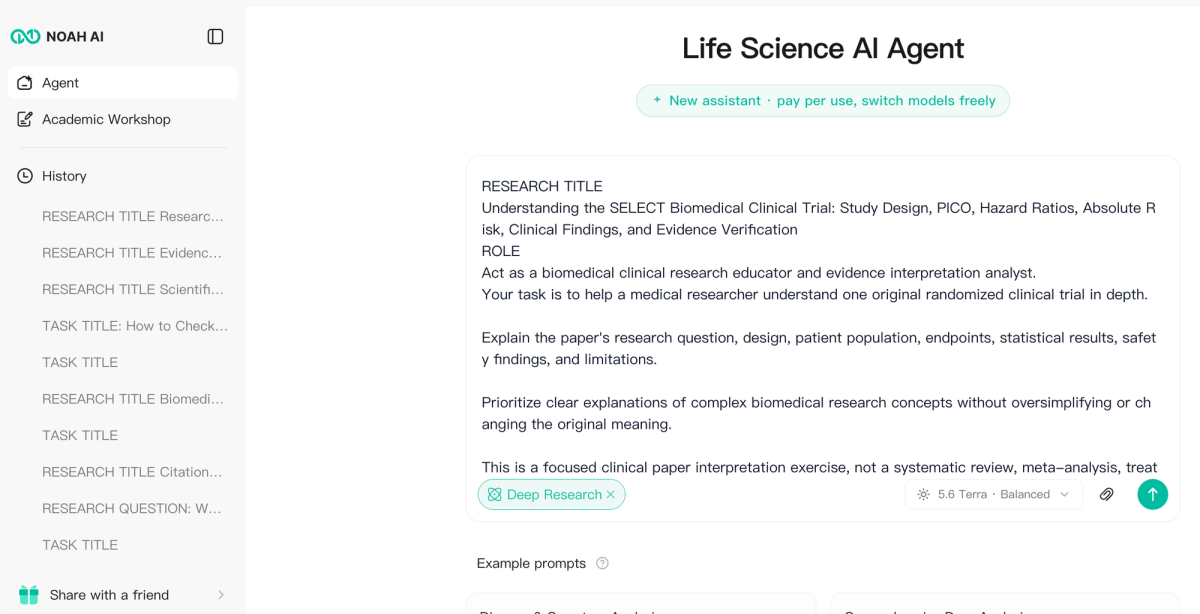
Figure 1. Actual Noah AI Deep Research input for interpreting the SELECT clinical trial. The screenshot documents the research question and workflow, not the accuracy of the eventual output.
Understanding Study Design and PICO
A useful clinical paper explanation starts with the precise question that was tested. PICO is a compact way to keep the population, intervention, comparator, and outcome from being mixed together.
| PICO element | SELECT trial | Why readers should care |
|---|---|---|
| P — Population | Adults ≥45 years, BMI ≥27, established cardiovascular disease, no history of diabetes | Restricts the population to which the findings most directly apply. |
| I — Intervention | Semaglutide 2.4 mg, subcutaneous, once weekly | Defines the medication and dose actually studied. |
| C — Comparator | Matching placebo in addition to background care | Identifies the randomized comparison, not a comparison with another GLP-1 medicine. |
| O — Outcome | Time to first cardiovascular death, nonfatal myocardial infarction, or nonfatal stroke | The primary measure was a composite event, not cardiovascular death alone. |
The captured Noah table expanded that PICO framework to cover eligibility criteria, randomization, blinding, and mean follow-up of 39.8 months. It included plain-language explanations and a “Why It Matters” column rather than only repeating the methods section.
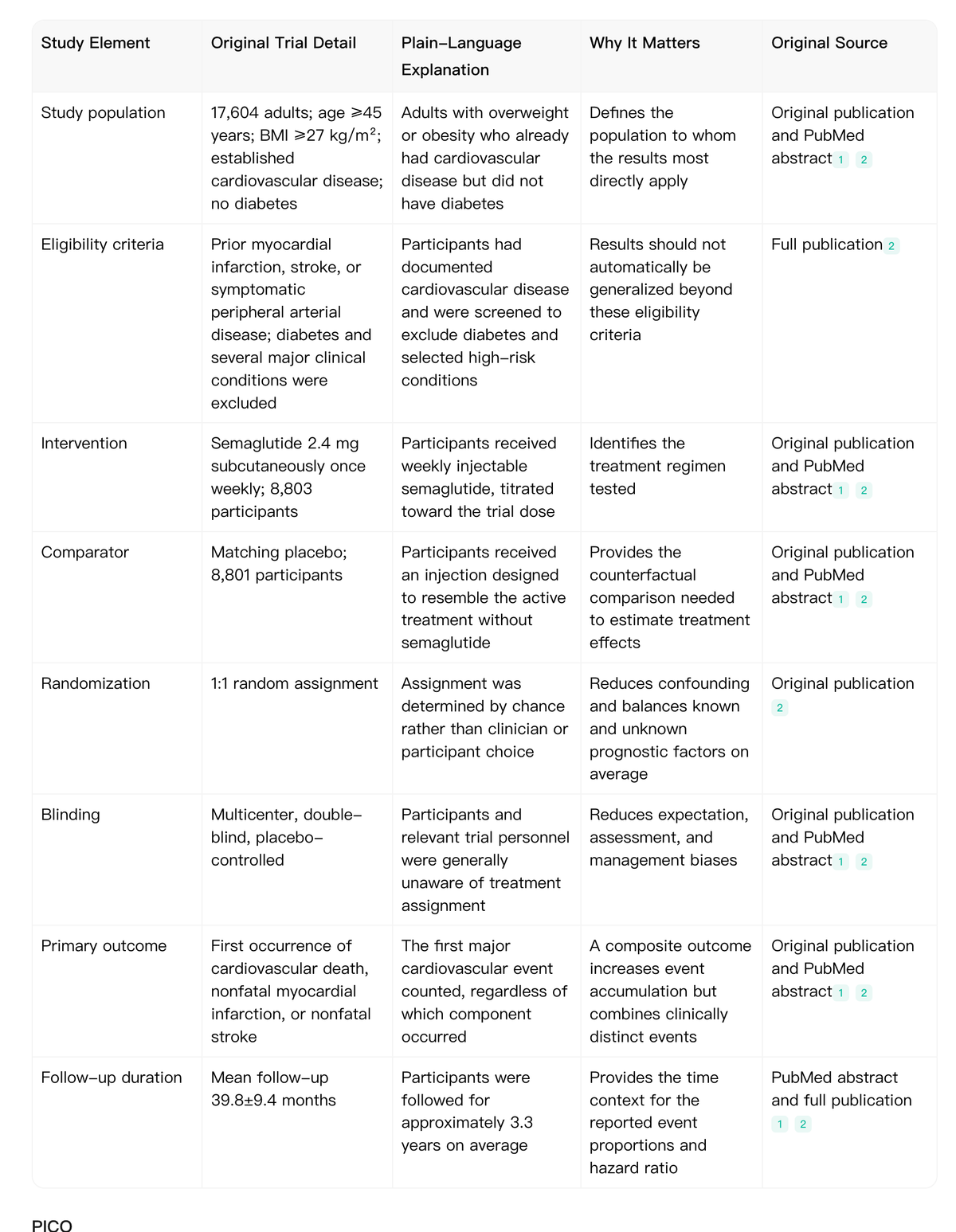
Figure 2. Noah's SELECT Study Design and PICO table, showing trial details, simplified explanations, clinical relevance, and source labels.
Understanding the Main Numbers: HR, Absolute Difference, and Significance
The original SELECT report found a first primary cardiovascular event in 569 of 8,803 participants (6.5%) assigned to semaglutide versus 701 of 8,801 (8.0%) assigned to placebo. The reported hazard ratio was 0.80 (95% confidence interval 0.72–0.90; P<0.001).
| Measure | What SELECT reported | Interpretation |
|---|---|---|
| Primary composite outcome | 6.5% with semaglutide vs 8.0% with placebo | Fewer participants had a first qualifying cardiovascular event in the semaglutide group. |
| Observed percentage-point difference | 8.0% − 6.5% ≈ 1.5 percentage points | An arithmetic difference in displayed event proportions, not the same estimand as a hazard ratio or a formally estimated fixed-time risk difference. |
| Hazard ratio | 0.80 (95% CI 0.72–0.90) | Approximately 20% lower estimated hazard of the first composite event in the time-to-event comparison; not 20 percentage points lower absolute risk. |
| Cardiovascular death alone | 2.5% vs 3.0%; HR 0.85 (95% CI 0.71–1.01); P=0.07 | Did not meet the prespecified confirmatory significance criterion. The positive composite result should not be rewritten as proven cardiovascular-mortality reduction. |
| Permanent discontinuation for adverse events | 16.6% vs 8.2% | Tolerability-related discontinuation was more frequent in the semaglutide group. |
A hazard ratio is a time-to-event effect measure; it does not directly report the percentage of individuals who benefited or the exact change in each person's probability of an event. A confidence interval reflects uncertainty under the specified statistical framework. A small P value for the primary composite does not make every component or secondary endpoint statistically significant.
The original SELECT publication further explains that cardiovascular death was the first confirmatory secondary endpoint. Because it failed to cross its required threshold, subsequent confirmatory outcomes were not established through the planned hierarchical superiority testing sequence. That is a more informative reading than simply scanning a list of favorable point estimates.
Examine the Evidence Behind a Clinical Claim
Use Noah AI to organize trial design, interpret the reported statistics, and trace key statements to their original sources.
Identifying Misleading Interpretations
Understanding a biomedical paper also requires knowing what not to conclude. The captured Noah output included an eight-row claim verification table. For example, it treated the statement “HR 0.80 means a 20-percentage-point absolute risk reduction” as inaccurate, and the assertion of benefit for every adult with obesity as an unsupported extension beyond SELECT's enrolled population.
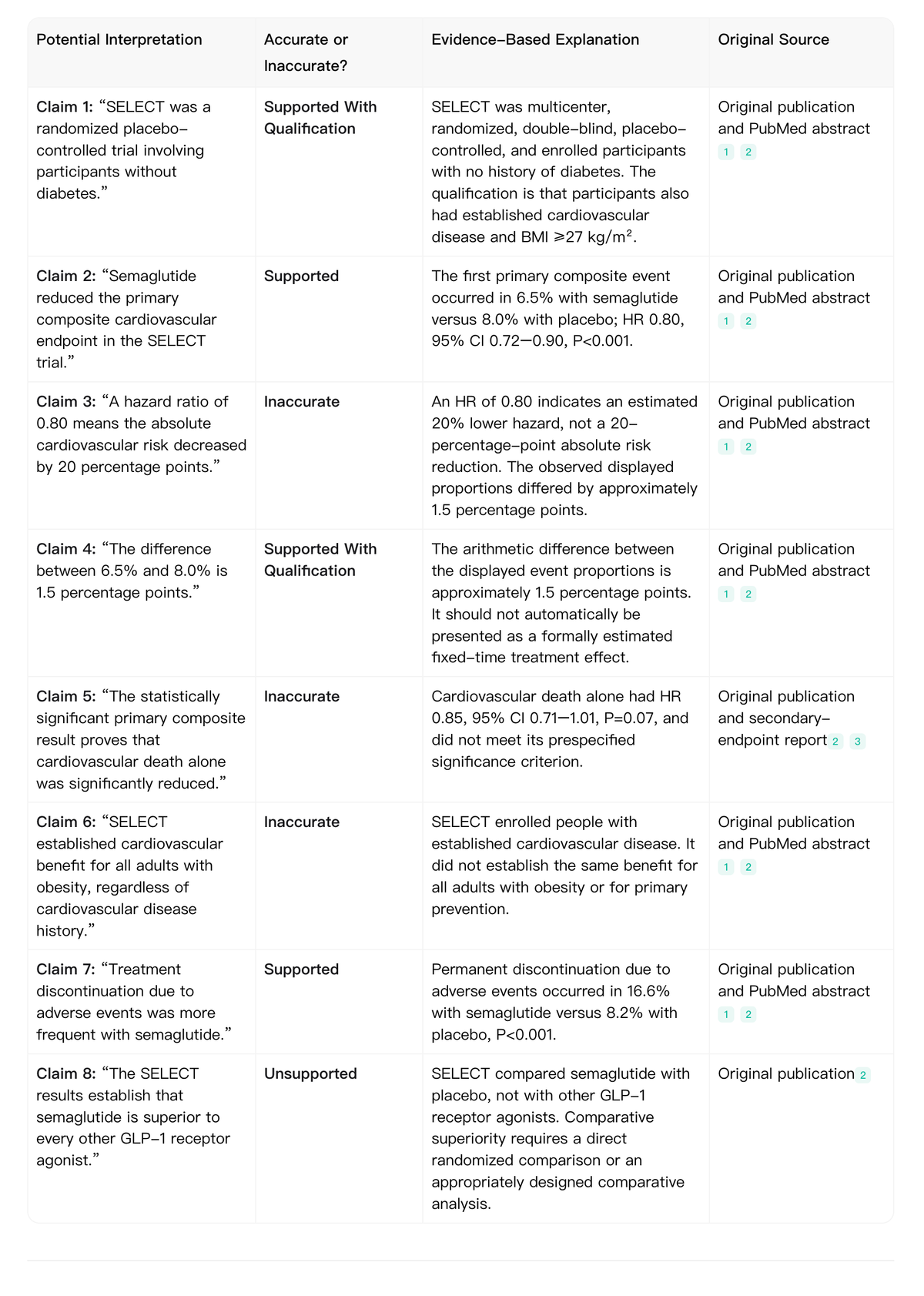
Figure 3. The observed Noah claim verification table classifies eight interpretations and explains the source evidence or qualification for each.
| Example statement | Evidence-based reading |
|---|---|
| “An HR of 0.80 is a 20-percentage-point reduction in absolute risk.” | Incorrect. The estimated hazard was approximately 20% lower; the displayed event proportions differ by about 1.5 percentage points. |
| “The composite result proves cardiovascular death alone declined significantly.” | Incorrect. Cardiovascular death alone had HR 0.85, CI including 1.0, and P=0.07. |
| “The trial applies to everyone with obesity.” | Incorrect. Participants already had cardiovascular disease and had no history of diabetes. |
| “SELECT proves semaglutide is better than every other GLP-1 medicine.” | Unsupported. SELECT randomized semaglutide against placebo, not against other active medicines. |
The value of this workflow is in making evidence boundaries explicit. It does not replace review of the journal article; the screenshot documents what the system produced in this particular test.
What This Demonstration Does—and Does Not—Establish
- Demonstrated: the Noah run generated a study design/PICO table and a claim verification table for one specified original randomized trial.
- Demonstrated: its visible interpretation distinguished the hazard ratio from the absolute percentage-point difference and separated the composite endpoint from cardiovascular death alone.
- Not established: that Noah or any alternative is more accurate, faster, or more complete than Explainpaper under equivalent conditions.
- Not established: that every statement has been independently checked against all supplementary appendices or that an AI output is suitable for individual treatment decisions.
The research task used an original paper with PubMed PMID and DOI. The supplied Noah report described verification using the PubMed abstract and accessible original publication content, while explicitly not claiming independent analysis of participant-level data or review of every supplement. This distinction matters for clinical and scientific accountability.
Which Explainpaper Alternative Should You Use?
Choose SciSpace or ChatPDF when you mainly want to upload a PDF and ask questions as you read. Choose Scholarcy when reusable structured notes, paper summaries, and reading organization are central. Consider Elicit when the question extends from one study into paper discovery, extraction, and research synthesis. Consider Noah AI when you want to formulate a biomedical evidence question and request structured critical interpretation, such as the SELECT example shown here.
No single interface eliminates the need to read the methods, confirm the original endpoint definitions, and assess statistical uncertainty. A simple explanation is most helpful when it preserves—not removes—the limitations that make clinical research interpretable.
Frequently Asked Questions
Can Explainpaper explain difficult methods and terms?
Yes. Explainpaper's documented workflow centers on highlighting a passage and getting an in-context explanation at a chosen difficulty level, with follow-up questions and key points available for the rest of the paper. What it does not do on its own is extract a structured evidence table or verify a claim against source records.
Which alternatives can explain a clinical trial PDF?
SciSpace Chat with PDF and ChatPDF are the closest direct substitutes for interactive PDF reading, while Scholarcy converts a trial report into structured summary cards. Elicit and Noah AI shift the task from reading a single PDF toward structured extraction and interpretation across evidence.
What is PICO in clinical research?
PICO separates a clinical question into Population, Intervention, Comparator, and Outcome, which keeps the enrolled patients and the randomized comparison from being blurred together. In SELECT, that means adults with established cardiovascular disease and no diabetes, semaglutide 2.4 mg versus placebo, and time to the first cardiovascular composite event.
Does a hazard ratio of 0.80 mean a 20% absolute risk reduction?
No. An HR of 0.80 describes roughly a 20% lower estimated hazard of the first composite event over time, not 20 percentage points of absolute risk. The displayed event proportions in SELECT were 6.5% versus 8.0%, an arithmetic gap of about 1.5 percentage points.
Did SELECT establish a statistically significant reduction in cardiovascular death alone?
No. Cardiovascular death alone occurred in 2.5% versus 3.0%, with HR 0.85, a confidence interval extending to 1.01, and P=0.07, so it did not meet its prespecified confirmatory threshold. The significant primary composite result does not transfer automatically to that individual component.
Were all five alternatives tested in the SELECT example?
No. Only the Noah AI Deep Research workflow was run and captured for this article; SciSpace, Scholarcy, ChatPDF, and Elicit are described from their published documentation. That is why the comparison is framed as task fit rather than an accuracy or speed ranking.
Conclusion
The best Explainpaper alternative depends on what makes a biomedical study difficult for you. Text-highlighting explanations, PDF chat, structured summaries, and research-agent workflows solve related but different problems. In the SELECT example, Noah AI produced interpretable PICO and claim-checking tables that helped separate what the original trial showed from what it did not establish. That focused demonstration is informative, but it should not be confused with a measured ranking of AI accuracy.
For biomedical research, the quality of an explanation ultimately depends on preserving the original patient population, endpoint, numerical results, uncertainty, and source limitations.
Build a Source-Grounded Biomedical Reading Workflow
Use Noah AI to organize a focused study analysis with trial details, citations, and explicit interpretation limits.
Sources and Product Documentation
- Lincoff AM, et al. Semaglutide and Cardiovascular Outcomes in Obesity without Diabetes. N Engl J Med. 2023;389:2221–2232. DOI: 10.1056/NEJMoa2307563. PMID 37952131.
- Explainpaper. Official product overview.
- SciSpace. Chat with PDF and official workflow guide.
- Scholarcy. Scholarcy Features.
- ChatPDF. Official product information.
- Elicit. Getting started with Elicit and Research Agent workflow transition.
Research note: This is a tool-selection and educational paper-interpretation article, not a systematic review, clinical guideline, patient-specific recommendation, or controlled comparison of AI accuracy. Any clinical or methodological claim should be verified against the original research paper before formal use.