Best EvidenceHunt Alternatives for Evidence-Based Medical Research (2026)
Linda
Compare five EvidenceHunt alternatives for evidence-based medical research, with a real Noah AI clinical trial review and citation verification example.
Evidence-based medical research depends on more than finding plausible answers. Researchers need to locate original studies, evaluate study populations and endpoints, trace clinical claims to sources, and describe uncertainty accurately. The right research tool depends on whether the work begins with a clinical question, a systematic review protocol, a guideline search, or a citation to investigate.
This guide compares five EvidenceHunt alternatives—Noah AI, Elicit, Consensus, Trip Database, and Scite—by research workflow rather than unverified accuracy rankings. It also documents a real Noah AI Deep Research exercise examining three randomized trials of endovascular thrombectomy for large-core ischemic stroke.
What Is EvidenceHunt?
EvidenceHunt is a medical evidence research platform providing literature and guideline search, conversational evidence retrieval, structured data extraction, and systematic-review-oriented workflows. Its official product materials also describe source-linked provenance, human validation, and auditable review processes for organizations.
EvidenceHunt therefore should not be characterized as a basic search tool lacking screening, extraction, or citation features. A suitable alternative depends on the specific task: synthesizing a clinical question, building evidence tables, searching guidelines, organizing an evidence review, or examining how a publication has been cited.
Source: EvidenceHunt official product description. Product capabilities and plan access can change; this article does not report an independent EvidenceHunt product test.
Five EvidenceHunt Alternatives Worth Considering
Noah AI — Biomedical Research Questions and Clinical Evidence Synthesis
Noah AI offers an Agent-based research workflow. In the documented example below, Deep Research produced a comparison of three original randomized trials and classified clinical claims against their reported evidence. The output preserved trial-specific functional endpoints, statistical uncertainty, and source identifiers.
Best suited to: Research tasks that begin with a defined biomedical question and require an interpretable evidence matrix or citation-marked clinical synthesis. Users should still verify primary-source claims and distinguish an illustrative research report from a formal systematic review.
Elicit — Literature Discovery, Screening, and Structured Extraction
Elicit supports research literature searches, paper-based extraction, and evidence reports. Its Research Agent now incorporates capabilities previously presented as separate Find Papers and Extract Data tools. Elicit also provides a guided Systematic Review workflow with screening, extraction, and PRISMA-style reporting for eligible plans.
Best suited to: Researchers who need to find papers, define extraction fields, screen candidate studies, and work toward a reproducible review workflow. Software assistance does not remove the need for reviewer-defined eligibility criteria and validation.
Consensus — Research Questions and Medical Literature Search
Consensus searches scholarly literature and provides citation-linked research answers, evidence summaries, study details, and follow-up research tools. Its Medical Mode narrows searching to a curated medical corpus that includes journals and clinical guidelines.
Best suited to: Exploring a focused medical question, locating relevant articles, and comparing what the retrieved literature reports. A synthesized answer should be checked against the actual study designs and endpoints before being used in formal scientific writing.
Trip Database — Clinical Guidelines and Evidence-Type Search
Trip Database is a clinical evidence search engine with PICO-oriented search and filtering by evidence type, including guidelines, systematic reviews, and primary research. It is particularly useful when a user wants to find established evidence resources efficiently rather than begin with an open-ended AI-generated report.
Best suited to: Locating guidelines, systematic reviews, and relevant primary studies. The site's PICO search is designed for targeted relevance, not exhaustive systematic-review retrieval.
Scite — Understanding Citation Context
Scite focuses on contextual citation analysis through Smart Citations, which label citation statements as supporting, contrasting, or mentioning the cited work. It also offers research-question tools grounded in indexed literature.
Best suited to: Investigating how a published finding has been discussed in later papers or identifying potentially contrasting evidence. Citation classifications are aids to investigation, not definitive adjudications of clinical truth or full-text methodological quality.
EvidenceHunt Alternatives Compared
| Tool | Core workflow | Where it fits a medical research project | Important qualification |
|---|---|---|---|
| Noah AI | Question-led biomedical research and synthesis | Cross-study evidence matrices, claim checks, and clinical interpretation | One documented case here; not a systematic accuracy benchmark |
| Elicit | Research Agent and structured extraction | Paper finding, screening, extraction, and systematic review workflows | Access to advanced review features depends on the plan |
| Consensus | Citation-linked research search and synthesis | Medical question exploration and study-level comparison | Generated conclusions still require primary-source inspection |
| Trip Database | Clinical evidence search | Guideline, review, trial, and PICO-oriented searches | Focused PICO search is not an exhaustive systematic search |
| Scite | Contextual citation analysis | Discovering supporting, contrasting, and mentioning citation statements | A citation classification does not itself prove a claim |
Tool descriptions are drawn from official product documentation, not a side-by-side test of the five products. See the product references at the end of this article.
A Real Evidence-Based Medical Research Example
To illustrate source-aware medical research, Noah AI was given a question about endovascular thrombectomy (EVT) for selected patients with a large ischemic core after acute ischemic stroke. The exercise focused on three original randomized trial reports: SELECT2, ANGEL-ASPECT, and TESLA.
These publications are relevant to the same clinical area but do not define the same patient population or use identical primary outcomes. SELECT2 and ANGEL-ASPECT evaluated shifts in the conventional modified Rankin Scale (mRS) distribution. TESLA analyzed a utility-weighted mRS outcome under a Bayesian design. That difference creates a useful test of whether a research output preserves uncertainty rather than flattening all results into a single conclusion.
Scope: This is a focused illustration based on three selected original trials, not an exhaustive systematic review. Other large-core EVT trials, such as RESCUE-Japan LIMIT, TENSION, and LASTE, contribute to the broader evidence landscape.
Noah AI Research Workflow
The test began in Noah's Agent interface using Deep Research. The research instructions asked for original-trial verification, a concise evidence matrix, and a claim-by-claim assessment. They also required the model to distinguish outcome improvement from survival benefit and a negative statistical decision from proof that treatment has no effect.
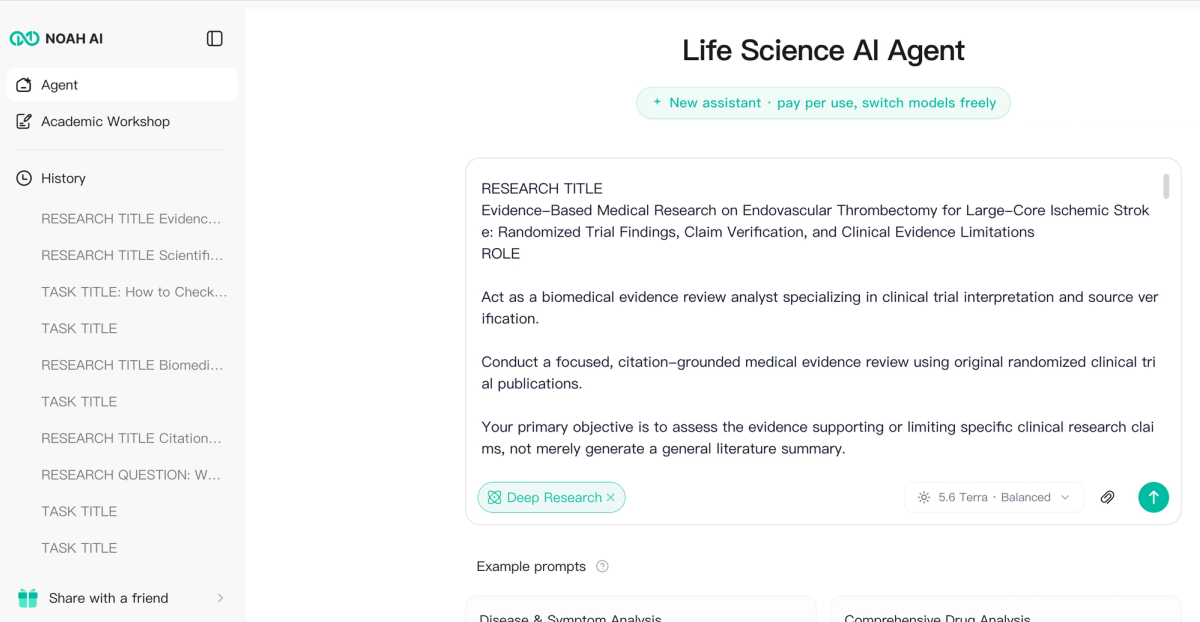
Figure 1. The actual Noah AI Deep Research task defining the randomized evidence review and source-verification objective.
Original Randomized Clinical Evidence
Noah organized SELECT2, ANGEL-ASPECT, and TESLA into a five-column matrix including imaging eligibility, treatment comparison, original primary endpoint, effect estimate, and PMID. The evidence table gives readers a concise overview while keeping statistical approaches attached to the right studies.
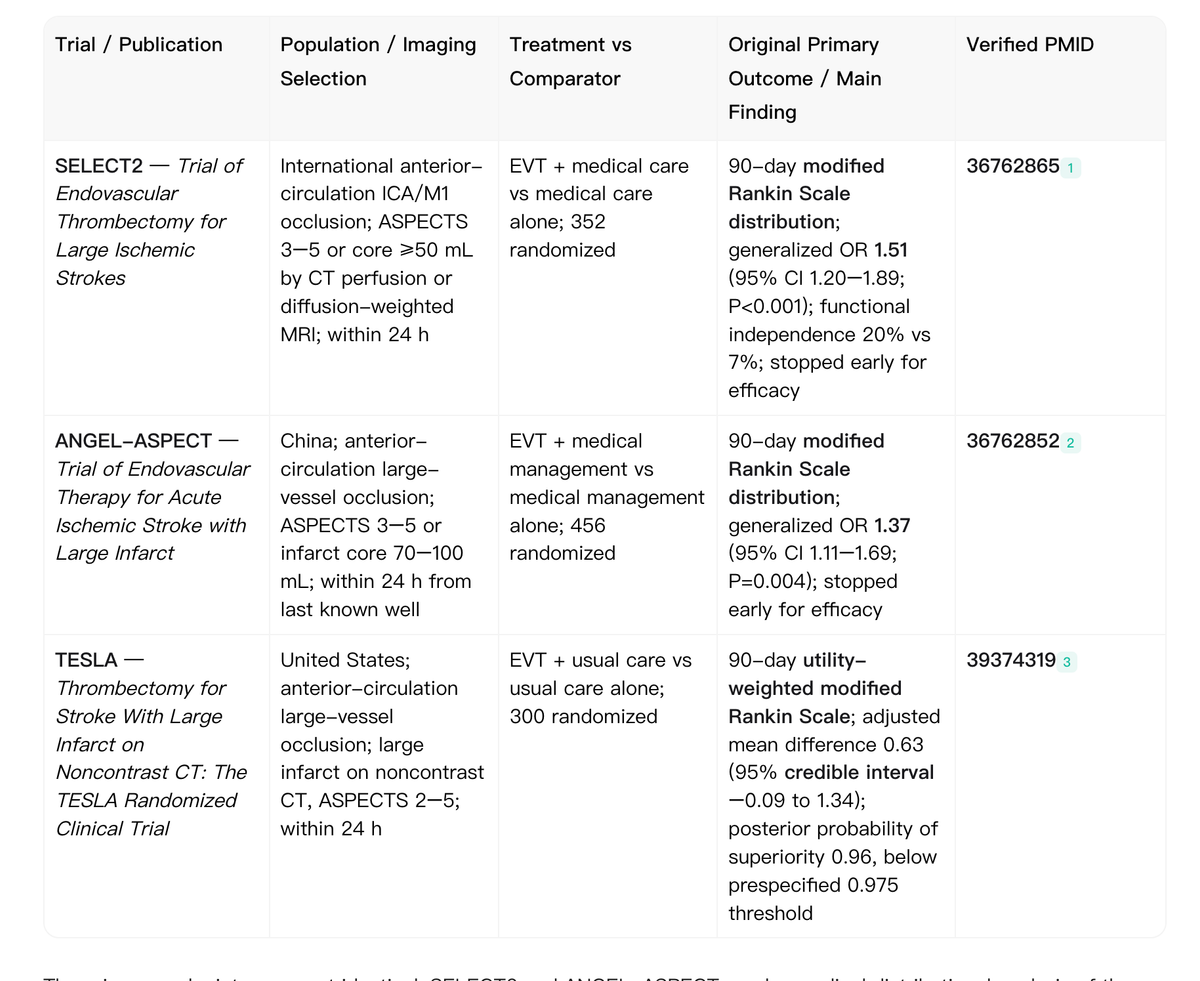
Figure 2. A source-linked table of three original randomized thrombectomy publications. The same trial results are summarized below, with statistical qualifications retained.
| Trial | Participants and selection | Primary finding | What it does not establish |
|---|---|---|---|
| SELECT2 — PMID 36762865 | 352 randomized; anterior-circulation large-vessel occlusion; ASPECTS 3–5 or imaging-defined core ≥50 mL | Favorable 90-day mRS shift: generalized OR 1.51, 95% CI 1.20–1.89 | Does not establish benefit for every large-core patient or prove a survival advantage |
| ANGEL-ASPECT — PMID 36762852 | 456 randomized in China; anterior-circulation occlusion under defined ASPECTS or core-volume criteria | Favorable 90-day mRS shift: generalized OR 1.37, 95% CI 1.11–1.69 | Does not establish that procedural risks are absent; intracranial hemorrhage was more frequent with EVT |
| TESLA — PMID 39374319 | 300 randomized; large infarct on noncontrast CT with ASPECTS 2–5 | Utility-weighted mRS difference 0.63, 95% credible interval −0.09 to 1.34; posterior superiority probability 0.96 | Did not meet the prespecified 0.975 superiority threshold; this is not proof of no possible benefit |
For SELECT2, functional independence was reported in 20% of patients assigned to EVT versus 7% assigned to medical care. ANGEL-ASPECT reported symptomatic intracranial hemorrhage of 6.1% versus 2.7%, and any intracranial hemorrhage of 49.1% versus 17.3%. TESLA used a credible interval rather than a frequentist confidence interval. These distinctions are essential when preparing an evidence-based narrative. SELECT2 · ANGEL-ASPECT · TESLA.
Research Beyond a One-Sentence Answer
Use Noah AI to structure a biomedical question, compare clinical trial evidence, and inspect the resulting source-linked interpretation.
[Try Noah AI](https://www.noah.bio/signup?utm_source=blog)
Medical Claim Verification: What the Evidence Supports
In evidence-based research, the wording of a conclusion matters as much as the numerical result. Noah's claim-verification table classified eight statements about EVT, distinguishing supported claims from unsupported generalizations and inaccurate comparisons.
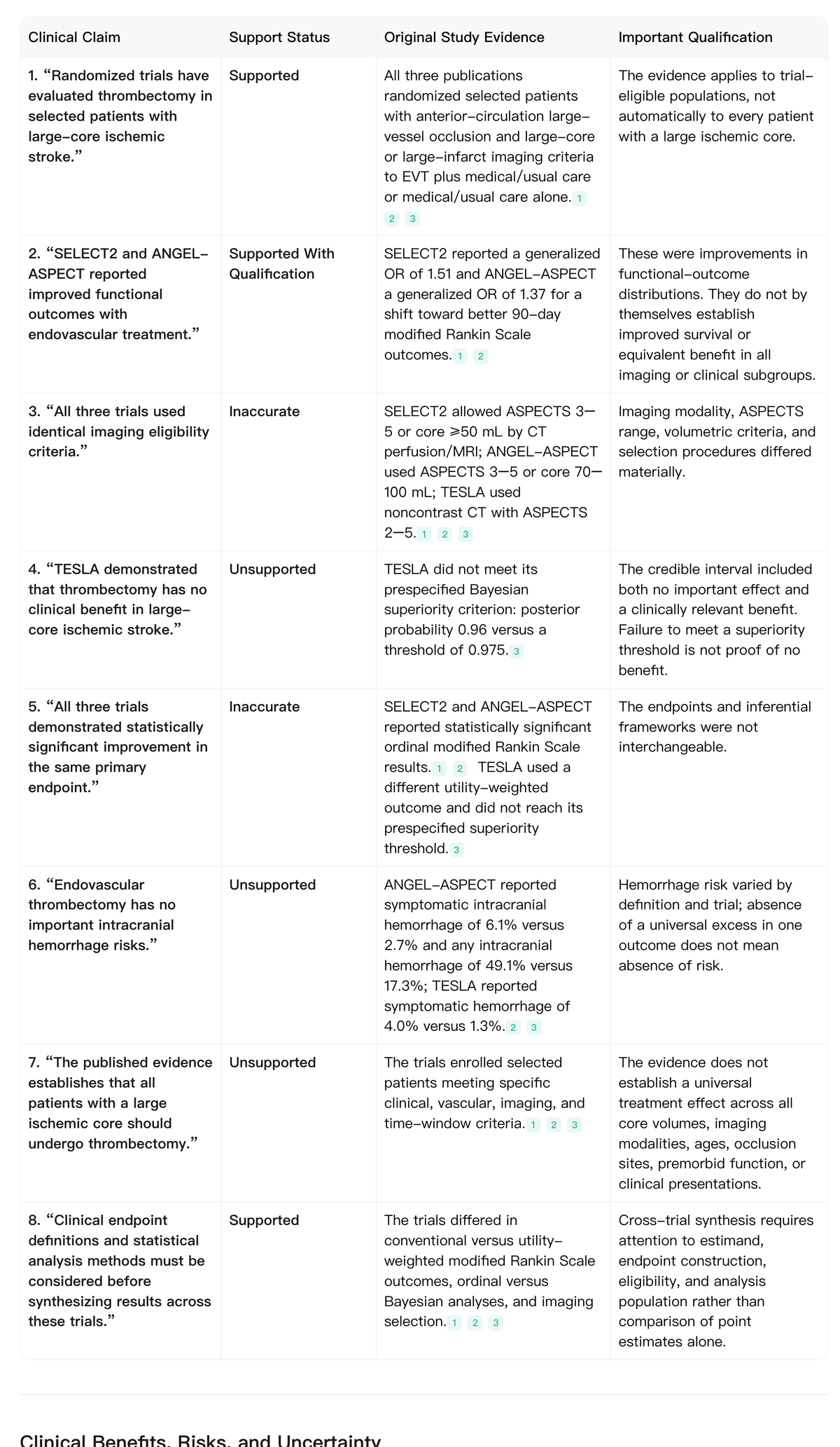
Figure 3. Noah's actual eight-claim verification table. It connects each claim to original-study evidence and explains the limits of the inference.
Two trials supported improvement in conventional functional outcomes
SELECT2 and ANGEL-ASPECT found favorable shifts in their respective 90-day conventional mRS distributions. This supports a benefit for eligible patients enrolled under their trial criteria. It does not mean every patient with a large core should receive the same intervention regardless of vascular anatomy, imaging, premorbid function, or other clinical factors.
TESLA requires a different statistical interpretation
TESLA's posterior probability of superiority was 0.96, below its prespecified Bayesian success threshold of 0.975. The study therefore did not meet its primary efficacy criterion. Yet its 95% credible interval, −0.09 to 1.34 for the adjusted utility-weighted mRS difference, included both little or no benefit and a clinically relevant improvement. Describing this as definitive proof that EVT has no benefit would be a misuse of the trial's result.
Safety outcomes cannot be ignored
Functional efficacy and treatment harms need separate reporting. ANGEL-ASPECT showed more symptomatic and any intracranial hemorrhage in the intervention group. TESLA also reported more symptomatic hemorrhage numerically (4.0% versus 1.3%). SELECT2 reported vascular procedure-related complications, even though symptomatic intracranial hemorrhages were uncommon. Different hemorrhage definitions should not be combined as if they were one outcome.
Statistical and imaging differences limit indirect comparisons
Different imaging selection rules and endpoint scales limit the comparability of trials. A conventional ordinal mRS analysis summarized by a generalized odds ratio is not directly interchangeable with TESLA's utility-weighted mRS difference and Bayesian posterior probability. Nor do the different effect estimates provide a valid head-to-head ranking of patients, procedures, or imaging strategies.
What Makes a Medical Evidence Review Trustworthy?
A useful AI research response should make several checks visible, regardless of the platform used:
- Original research: Distinguish randomized trials from later reviews, editorials, and follow-up analyses.
- Population relevance: Preserve inclusion and exclusion criteria, imaging thresholds, treatment windows, and geography.
- Endpoint precision: Identify what was actually measured, how it was analyzed, and when it was assessed.
- Uncertainty: Keep confidence intervals, credible intervals, P values, and prespecified decision rules in their proper frameworks.
- Benefit and harm: Separate functional improvement, mortality, symptomatic hemorrhage, radiographic hemorrhage, and procedural complications.
- Traceability: Record PMID/DOI identifiers and clearly disclose whether the full paper or only an abstract was inspected.
In the supplied Noah report, source access was not presented as identical across all three studies: it reported PubMed and accessible publication material for SELECT2 and TESLA, and PubMed abstract-level verification for ANGEL-ASPECT. Readers should inspect the original papers when using the report for professional research or publication.
Which EvidenceHunt Alternative Should You Choose?
| If your task is... | Consider | Why |
|---|---|---|
| Develop a source-grounded answer to a specific biomedical research question | Noah AI | The illustrated Deep Research workflow produced a trial matrix and claim-verification table |
| Find, screen, and extract fields across a planned literature set | Elicit | Research Agent plus guided systematic-review capabilities for eligible subscriptions |
| Explore a clinical question and review the studies behind an answer | Consensus | Medical Mode, citation-linked summaries, and study detail tools |
| Locate clinical guidelines and higher-level secondary evidence | Trip Database | Search and evidence-type filters centered on clinical sources |
| Investigate how a paper has been supported or contested in later research | Scite | Smart Citation contexts and supporting/contrasting/mentioning labels |
There is no universal winner. These platforms emphasize different stages of research. EvidenceHunt itself also provides systematic-review and evidence-extraction functions. The appropriate choice depends on the research objective, required audit trail, permitted source access, budget, and need for independent validation.
Frequently Asked Questions
What is a good alternative to EvidenceHunt for medical research?
Can Noah AI help verify clinical research claims?
Does EvidenceHunt support systematic reviews and data extraction?
Does TESLA prove thrombectomy is ineffective?
Can an AI-generated evidence matrix replace a systematic review?
Is a citation or PMID enough to verify a medical claim?
Final Takeaway
EvidenceHunt alternatives differ in what they help researchers do. Elicit is relevant to structured literature workflows; Consensus helps explore evidence-backed questions; Trip Database emphasizes clinical evidence discovery; and Scite adds citation-context information. Noah AI's demonstrated value in this example is a question-led, citation-marked analysis that distinguishes findings supported by original trials from claims that overgeneralize the evidence.
The three-trial stroke example also illustrates the central principle of evidence-based medical research: a clinically meaningful conclusion must preserve the population, intervention, original endpoint, statistical interpretation, and risks of the studies from which it is drawn.
Explore Biomedical Evidence Research with Noah AI
Start from a clinical research question and develop a structured evidence review with source identifiers, trial comparisons, and explicit interpretation limits.
[Start with Noah AI](https://www.noah.bio/signup?utm_source=blog)