Best AI Tools for Treatment Pathway Analysis (2026)
Linda
Compare the best AI tools for treatment pathway analysis, with a real 2026 U.S. EGFR-mutated advanced NSCLC pathway case spanning first-line through later-line therapy.
A treatment pathway is not a list of approved drugs. It is a sequence of clinical decisions.
A useful pathway needs to show what happens at diagnosis, which treatment options are available first, what needs to be reassessed when disease progresses, and how prior treatment changes the options available later.
EGFR-mutated advanced non-small cell lung cancer is a good example. In 2026, the pathway for patients with an EGFR exon 19 deletion or exon 21 L858R mutation includes several first-line strategies, molecular reassessment at progression, different approaches for localized versus systemic progression, and new later-line targeted or antibody-drug-conjugate options.
Real-case test: We used Noah AI to map the current U.S. treatment pathway for adults with locally advanced or metastatic EGFR-mutated NSCLC using evidence available through September 2026.
The 2026 EGFR-Mutated NSCLC Pathway in Six Steps
- Confirm diagnosis, stage, performance status, and baseline CNS involvement.
- Confirm the EGFR mutation with comprehensive molecular profiling. Tissue-based NGS remains important, with plasma ctDNA used as a complementary approach when appropriate.
- Select a first-line treatment strategy. Major options include osimertinib monotherapy, osimertinib plus platinum-pemetrexed chemotherapy, and amivantamab plus lazertinib.
- Reassess the pattern of progression. CNS-only, oligoprogressive, and widespread systemic progression do not automatically follow the same next step.
- Move to an appropriate post-EGFR-TKI strategy when systemic progression occurs. Amivantamab plus carboplatin and pemetrexed is an FDA-supported option after progression on or after an EGFR TKI.
- Plan later-line treatment based on prior exposure. Datopotamab deruxtecan is an FDA-approved option under accelerated approval after prior EGFR-directed therapy and platinum-based chemotherapy.
That sequence is more useful than a simple drug comparison because each later decision depends on what happened earlier in the pathway.
Where the Pathway Branches
The pathway is not completely linear. Several points require a branch in the decision process.
Branch 1: Which first-line strategy?
There is no single first-line option that automatically fits every patient.
Current options include:
- osimertinib monotherapy,
- osimertinib plus platinum-pemetrexed,
- amivantamab plus lazertinib.
Disease burden, CNS involvement, treatment intensity, toxicity, comorbidities, convenience, infusion burden, and patient preference can all affect the choice.
These first-line options should not be ranked simply by extracting PFS or response rates from separate trials. FLAURA2 and MARIPOSA answer different comparative questions and do not constitute a direct comparison between the two intensified strategies.
Branch 2: What kind of progression occurred?
Progression should be classified before changing the entire treatment strategy.
- Oligoprogression: selected patients may receive local treatment while continuing an otherwise effective EGFR TKI.
- CNS-only progression: local therapy, CNS imaging, systemic treatment, and sometimes CSF-based molecular assessment may need to be integrated.
- Systemic progression: this usually triggers molecular and histologic reassessment and a transition to a broader post-TKI strategy.
Branch 3: Did resistance biology change?
Resistance after EGFR-directed therapy is heterogeneous. Repeat tissue biopsy or plasma ctDNA may identify mechanisms such as MET amplification, EGFR C797S, HER2 alterations, downstream pathway changes, or histologic transformation.
A resistance mechanism can create a clinical-trial or biomarker-directed branch rather than a single universal next-line treatment.
How We Ran the Treatment Pathway Analysis in Noah AI
Noah's refreshed Agent experience now makes the research setup more explicit. Instead of beginning from a generic search interface, the user can define the task, choose the research domain, select a research mode, and choose the model configuration that fits the depth of the task.
For this run, the visible workflow was:
- Agent
- Medical & Academia
- Deep Research
- 5.6 Luna · Fast
We asked Noah to connect diagnosis, biomarker confirmation, first-line treatment, progression assessment, resistance testing, post-TKI therapy, local treatment, and later-line options into one evidence-backed pathway.
The prompt also explicitly asked Noah to separate FDA-approved treatment, guideline-supported treatment, pivotal-trial evidence, and clinical interpretation.
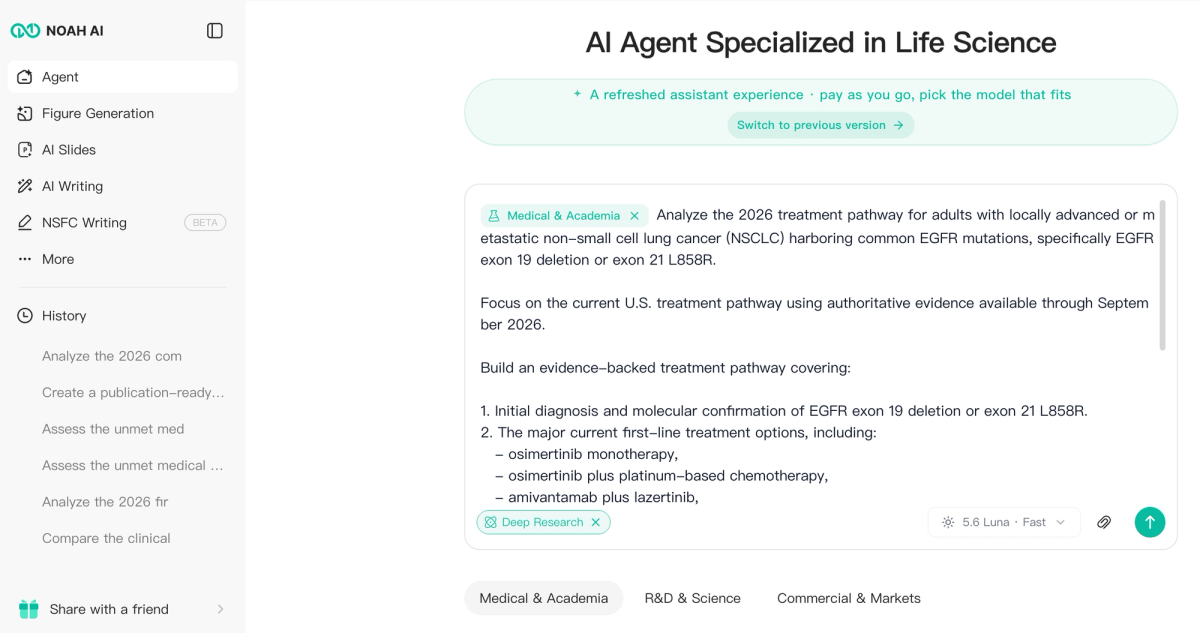
Noah AI's refreshed Agent interface used for an EGFR-mutated NSCLC treatment pathway research task.
What Noah Returned: A Pathway Rather Than a Drug List
The most useful part of the result was the concise 2026 U.S. pathway.
Instead of returning isolated summaries of osimertinib, amivantamab, lazertinib, chemotherapy, and datopotamab deruxtecan, Noah placed them into the sequence in which treatment decisions arise.
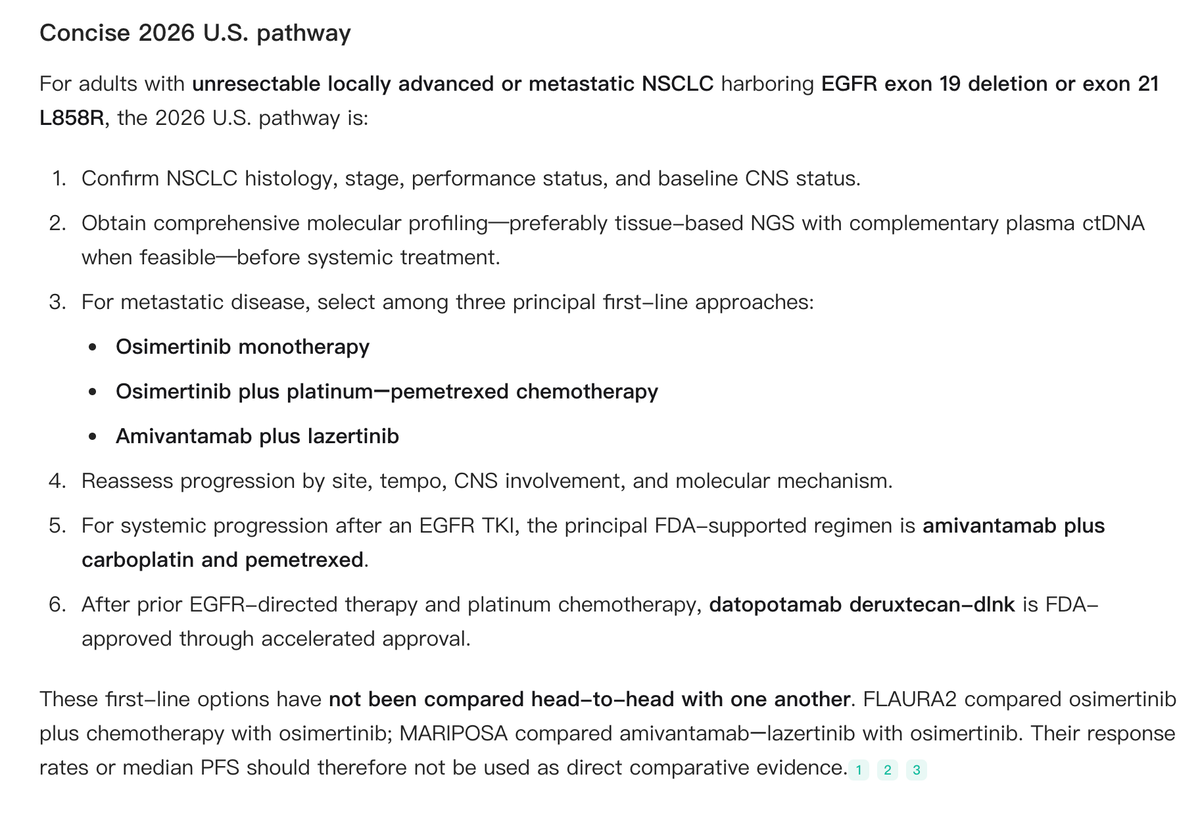
Noah AI summarizes the treatment pathway from diagnosis and molecular confirmation through first-line therapy, progression reassessment, post-EGFR-TKI treatment, and later-line therapy.
Research Treatment Pathways with Noah AI for Free
Use Noah AI to research treatment sequences, guideline recommendations, clinical evidence, patient populations, and current standard-of-care pathways.
Free to use · Free credits included · No credit card required
Research Treatment Pathways with Noah AI →
Three Pathway Decisions That Matter Most
First-line treatment is now a strategy choice
The pathway is no longer accurately represented as:
EGFR mutation → osimertinib → chemotherapy
Combination approaches have expanded the first-line decision.
Osimertinib monotherapy remains an established option, while osimertinib plus platinum-pemetrexed and amivantamab plus lazertinib provide intensified approaches.
The decision therefore includes a trade-off between treatment intensity, efficacy evidence, toxicity, route of administration, monitoring, and patient preference.
Progression does not always mean immediately replacing the current TKI
A single progressing lesion and widespread systemic progression are different clinical problems.
Selected oligoprogressive disease may be treated locally while maintaining an effective EGFR-directed systemic therapy.
Systemic progression, by contrast, usually requires broader reassessment and movement into a post-EGFR-TKI pathway.
Later-line eligibility depends on previous treatment
Later-line treatment cannot be understood without treatment history.
Datopotamab deruxtecan, for example, is positioned after prior EGFR-directed therapy and platinum-based chemotherapy.
That makes pathway analysis fundamentally different from a simple "available therapies" list.
A Simple Treatment Pathway Decision Table
| Decision Point | Core Question | Typical Action |
|---|---|---|
| Diagnosis | Is this advanced EGFR exon 19 deletion or L858R NSCLC? | Confirm histology, stage, CNS status, performance status, and comprehensive molecular profile. |
| First line | How much treatment intensity is appropriate? | Consider osimertinib, osimertinib + chemotherapy, or amivantamab + lazertinib. |
| Progression | Is progression localized, CNS-only, or systemic? | Re-image, characterize progression, and consider molecular or histologic reassessment. |
| Oligoprogression | Can local therapy preserve systemic disease control? | Consider SRS, SBRT, surgery, or another local approach in selected patients. |
| Systemic post-TKI progression | What systemic therapy is supported next? | Consider amivantamab + carboplatin + pemetrexed where appropriate. |
| Later line | Has the patient already received EGFR-directed therapy and platinum? | Datopotamab deruxtecan may enter the pathway, along with clinical trials and other later-line options. |
Which Tool Fits Which Part of Treatment Pathway Research?
| Research Need | Best-Fit Tool or Source | Role |
|---|---|---|
| Confirm FDA-approved treatment positioning | FDA / prescribing information | Verify indication, treatment setting, prior-treatment requirements, dosing, and regulatory status. |
| Build the full treatment sequence | Noah AI | Connect diagnosis, biomarkers, treatment choices, progression, resistance, and later lines into one cited pathway. |
| Verify guideline recommendations | NCCN / ASCO / NCI | Confirm current treatment recommendations and areas requiring judgment. |
| Find ongoing pathway-changing studies | ClinicalTrials.gov | Identify emerging resistance-directed and next-generation treatment programs. |
| Extract evidence across many papers | Elicit | Useful for larger structured literature-review and extraction workflows. |
| Read individual pivotal papers deeply | SciSpace | Useful for methods, endpoints, subgroup data, resistance mechanisms, and supplementary evidence. |
| Broad multi-source research | ChatGPT Deep Research / Perplexity Research | Useful when pathway research extends across publications, regulatory sources, registries, and recent public updates. |
What AI Still Cannot Decide
Treatment pathway research can organize the evidence, but several decisions remain patient-specific.
- Whether a specific patient should receive first-line monotherapy or an intensified combination.
- Whether asymptomatic CNS disease should be treated immediately with radiation or initially managed with CNS-active systemic therapy.
- Whether oligoprogression is sufficiently limited to justify local treatment while continuing the current TKI.
- Whether a repeat biopsy is necessary, feasible, and likely to change treatment.
- How to sequence treatment after a patient has already received an intensified first-line regimen.
- Which resistance mechanism is truly driving progression in a heterogeneous tumor.
Important Sequencing Questions Still Unresolved in 2026
Several parts of the pathway remain unsettled.
- There is no randomized head-to-head trial directly comparing osimertinib plus chemotherapy with amivantamab plus lazertinib.
- The optimal post-progression sequence after first-line amivantamab plus lazertinib remains less directly established.
- The value of continuing osimertinib with chemotherapy after progression is still dependent on context rather than being a universal standard.
- Resistance-directed strategies for MET amplification, C797S, HER2 amplification, and other acquired mechanisms remain partly dependent on clinical trials and assay interpretation.
- The best later-line sequence after datopotamab deruxtecan is not established.
Frequently Asked Questions
What is treatment pathway analysis?
Treatment pathway analysis maps the sequence of clinical decisions from diagnosis through first-line therapy, progression assessment, subsequent treatment, and later-line care.
How is treatment pathway analysis different from standard-of-care analysis?
Standard-of-care analysis asks which treatments are currently supported in a defined setting. Treatment pathway analysis asks how those choices connect over time as the patient's disease and prior treatment change.
Why is molecular reassessment important after EGFR TKI progression?
Resistance may arise through different genomic or histologic mechanisms. Tissue biopsy, plasma ctDNA, and sometimes CNS-specific testing can help identify resistance patterns that may change the next treatment decision.
Does progression always mean stopping osimertinib immediately?
Not necessarily. In selected oligoprogressive or CNS-limited situations, local therapy while continuing an otherwise effective EGFR TKI may be considered. Widespread systemic progression usually requires a different pathway.
Can AI choose the best treatment sequence?
AI can organize regulatory evidence, guidelines, pivotal trials, and treatment dependencies. It cannot replace individualized clinical judgment about toxicity, comorbidities, disease tempo, goals of care, or patient preference.
Why should cross-trial results not be used to rank first-line regimens?
FLAURA2 and MARIPOSA involved different study designs and comparisons. Results from separate trials should not be treated as though the regimens were randomized directly against one another.
Final Takeaway
Treatment pathway analysis is about sequence, not just availability.
In EGFR-mutated advanced NSCLC, the relevant question is no longer simply which EGFR-targeted drug exists. Researchers need to understand how diagnosis, molecular confirmation, first-line treatment, CNS status, progression pattern, resistance biology, previous therapy, and later-line eligibility connect.
Noah AI is useful when the research goal is to turn those scattered regulatory, guideline, trial, and biomarker decisions into one structured, reviewable treatment pathway.