Best AI Tools for Oncology Treatment Landscape Analysis (2026)
Linda
Compare the best AI tools for oncology treatment landscape analysis. We test Noah AI on the 2026 HER2+ metastatic breast cancer landscape: approved therapies, biomarker subgroups, pivotal trials, and recent changes.
Oncology treatment landscape analysis is more complex than simply listing approved drugs. Researchers and life science teams often need to understand how therapies are positioned across treatment lines, which biomarkers or subgroups they apply to, what pivotal trials support them, how recent approvals have changed clinical practice, and which investigational approaches may reshape the market next.
In oncology, this work is especially difficult because the evidence base is fragmented. Important information may be spread across FDA approval pages, trial publications, ClinicalTrials.gov records, company materials, and conference-driven updates.
AI tools can help organize that information, but they differ in how well they map treatment settings, preserve source traceability, distinguish approved therapies from investigational approaches, and turn scattered evidence into a usable treatment landscape.
Evaluation note: We tested Noah AI directly using a real oncology use case: the 2026 treatment landscape for HER2-positive metastatic breast cancer in the United States. Other tools were evaluated from their current official documentation and published workflows.
What Is Oncology Treatment Landscape Analysis?
A treatment landscape analysis is not just a summary of drugs in a disease area. A useful landscape should explain:
- which treatments are FDA approved,
- where they are typically positioned in the patient journey,
- which biomarker-defined subgroups they apply to,
- what therapeutic classes are involved,
- which pivotal trials support major options,
- what major recent changes have altered the landscape,
- what safety considerations differentiate treatment classes,
- which unmet needs remain,
- which late-stage investigational approaches may matter next.
In other words, the goal is not only to identify the therapies, but to understand the structure of the treatment ecosystem.
Best AI Tools for Oncology Treatment Landscape Analysis
| Tool | Best For | Evidence Search | Landscape Structuring | Source Traceability | Typical Output |
|---|---|---|---|---|---|
| Noah AI | Structured biomedical treatment landscape research | Strong | Strong | Strong | Cited overview and landscape table |
| Elicit | Evidence extraction and multi-study synthesis | Strong | Strong | Strong | Evidence tables and reports |
| Consensus | Rapid academic evidence exploration | Strong | Moderate | Strong | Literature-based synthesis |
| SciSpace | Reading and extracting details from oncology papers | Strong | Moderate | Strong | Paper-level analysis |
| ChatGPT Deep Research | Multi-source oncology research | Strong | Strong | Strong | Source-documented research brief |
| Perplexity Research | Fast cross-source landscape orientation | Moderate–Strong | Strong | Strong | Cited research report |
Noah AI
Best for: turning an oncology research question into a structured, cited treatment landscape.
Noah AI is particularly useful when the work begins with a disease-area question and needs to end in a practical output such as a treatment landscape table, a structured overview, or a review-ready comparison.
The platform is well suited to tasks where the researcher needs to distinguish approved therapies from investigational options, map the therapies to treatment settings, and keep the supporting evidence visible.
Example: HER2-Positive Metastatic Breast Cancer in 2026
We tested Noah AI using the HER2-positive metastatic breast cancer landscape in the United States as of 2026.
This is a strong test case because the landscape is clinically important, biomarker-driven, and recently updated. It includes established HER2-targeted antibodies, antibody-drug conjugates, HER2 tyrosine kinase inhibitors, chemotherapy combinations, endocrine-based strategies, and a newly approved CDK4/6-based maintenance option for HR-positive, HER2-positive disease.
The prompt asked Noah to identify FDA-approved systemic treatment options, line-specific positioning, major treatment classes, biomarker-defined subgroups, pivotal trials, key 2025-2026 changes, important safety considerations, and remaining unmet needs.
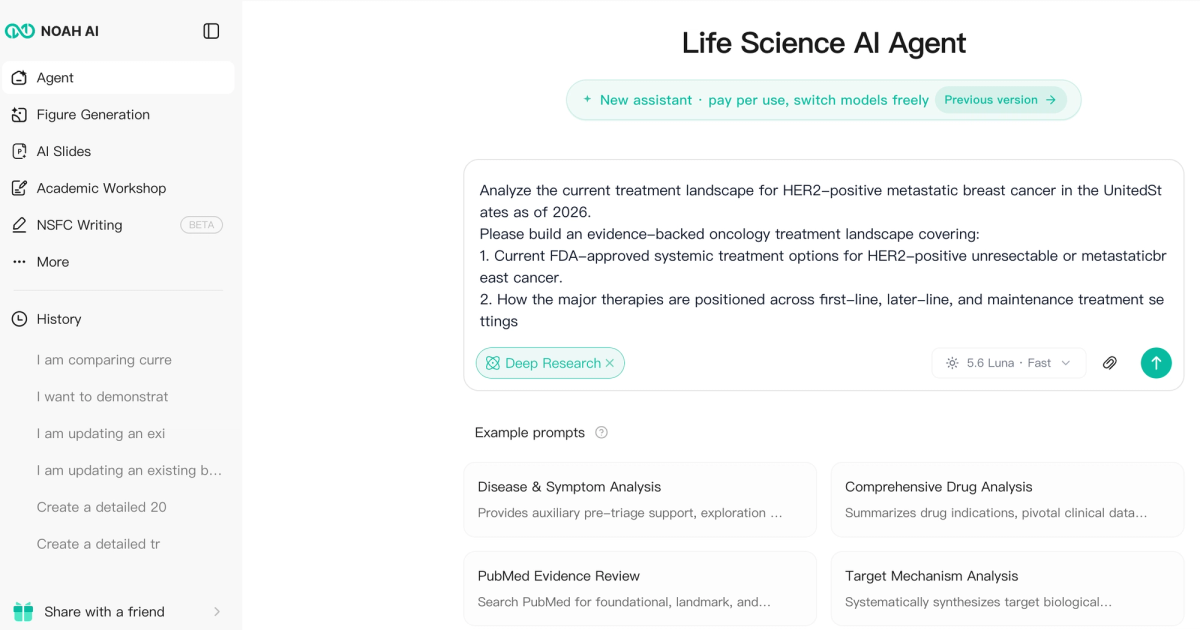
A treatment landscape research prompt entered into Noah AI for HER2-positive metastatic breast cancer in the United States as of 2026.
What Noah Returned
Noah returned a structured treatment-landscape table rather than a vague narrative summary. The table organized therapies by regimen, therapeutic class, FDA approval or status, typical positioning, biomarker or subgroup, pivotal supporting trial, and other key fields.
That structure is important because landscape work is not simply about finding drug names. It requires showing how therapies fit into the broader treatment ecosystem.
In this example, Noah surfaced the major 2025-2026 changes that materially altered the landscape. One was the FDA approval of fam-trastuzumab deruxtecan-nxki (T-DXd; Enhertu) plus pertuzumab for first-line unresectable or metastatic HER2-positive breast cancer in December 2025. Another was the FDA approval in June 2026 of palbociclib with trastuzumab, with or without pertuzumab, and endocrine therapy for maintenance treatment in adults with HR-positive, HER2-positive locally advanced or metastatic breast cancer following induction treatment.
Noah also preserved an important distinction between approved therapies and the broader investigational pipeline, which is essential in oncology landscape work.
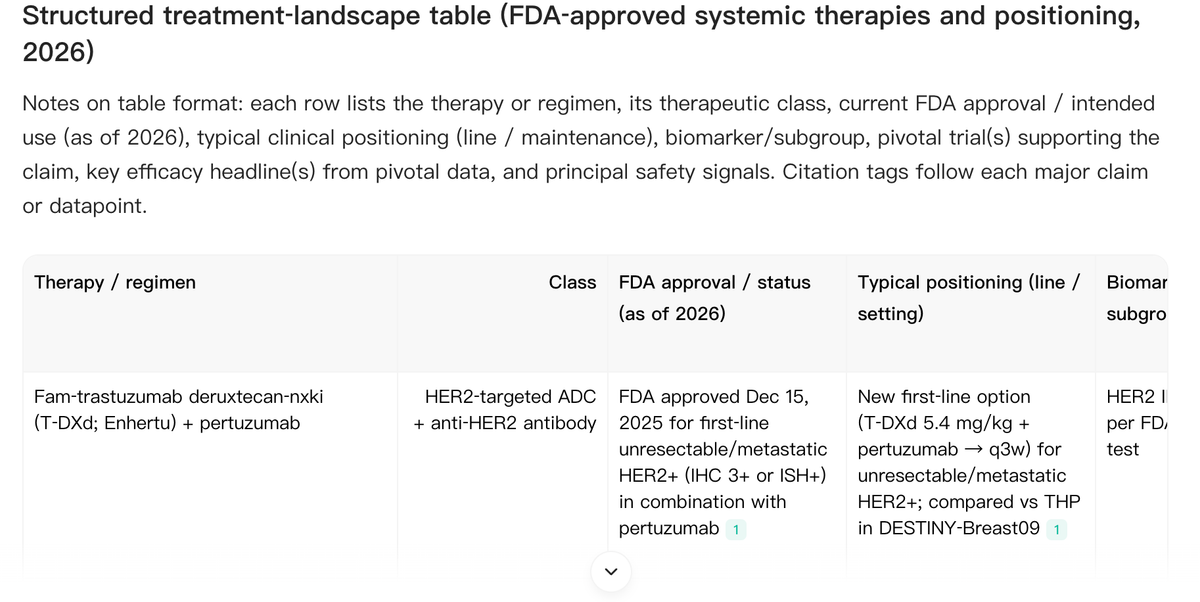
Noah AI organizes the HER2-positive metastatic breast cancer landscape into a structured table covering therapy, class, approval status, treatment positioning, subgroup, and pivotal evidence.
Why This Is a Good Landscape Example
A good oncology landscape example should show more than a static list of therapies. HER2-positive metastatic breast cancer is a strong example because the landscape changed recently and now reflects a more segmented treatment structure.
The 2025 FDA approval of T-DXd plus pertuzumab created a new first-line option for HER2-positive unresectable or metastatic breast cancer. Then, in 2026, the approval of a palbociclib-based maintenance regimen added a new option for the HR-positive, HER2-positive subgroup after induction treatment.
Those developments make this a real treatment-landscape question rather than a simple "best drug" comparison.
Major 2025-2026 Changes in the Landscape
A New First-Line Option
FDA approved T-DXd in combination with pertuzumab for the first-line treatment of adults with unresectable or metastatic HER2-positive breast cancer on December 15, 2025. This approval was supported by DESTINY-Breast09.
That matters because the first-line landscape is where major commercial and clinical positioning decisions are often most important.
A New Maintenance Strategy for HR+/HER2+ Disease
On June 24, 2026, FDA approved palbociclib with trastuzumab, with or without pertuzumab, and endocrine therapy for maintenance treatment in adults with HR-positive, HER2-positive locally advanced or metastatic breast cancer following induction treatment.
This approval, based on PATINA, added a new maintenance option that is relevant only to a biomarker-defined subgroup. That is exactly the kind of nuance a treatment landscape analysis should capture.
The Landscape Is Increasingly Segmented
The HER2-positive metastatic breast cancer landscape is no longer just a simple linear sequence of HER2 drugs. It now includes different therapeutic classes and more explicit subgrouping by treatment line and hormone receptor status.
A useful AI tool should therefore help organize:
- first-line treatment choices,
- maintenance approaches,
- later-line HER2-targeted options,
- HR-positive / HER2-positive subgroup strategies,
- approved options versus investigational approaches.
Final Takeaway
The best AI tool for oncology treatment landscape analysis depends on the type of research output you need.
Elicit, Consensus, and SciSpace are useful for different parts of evidence discovery, literature review, and structured extraction. ChatGPT Deep Research and Perplexity Research can help when the evidence base spans publications, regulatory sources, registries, company materials, and other public information.
Noah AI is particularly useful when the goal is to move from an oncology research question to a structured, cited treatment landscape that brings together approved therapies, treatment positioning, biomarker-defined subgroups, pivotal evidence, and recent changes in one workflow.
The key principle is simple: an oncology treatment landscape should show not only which therapies exist, but how they are positioned, which patients they apply to, what evidence supports them, and how the landscape is changing.
Try Noah AI for Free
Use Noah AI to search medical evidence, compare therapies, map biomarker-defined subgroups, and turn complex oncology research into a structured, cited treatment landscape.
Free to use · Free credits included · No credit card required
Create Your Free Noah Account →
Related Research Guides
- Best AI Tools for Clinical Trial Results Analysis (2026)
- How to Analyze Clinical Trial Results with AI Using Noah AI
- Best AI Tools for Turning Research Questions into Evidence Tables (2026)
- Best AI Tools for Medical Literature Search and Research Writing (2026)
- Best Elicit Alternatives for Biomedical Literature Review (2026)