Best AI Tools for Medical Literature Review and Evidence Synthesis (2026)
Linda
Compare the best AI tools for medical literature review and evidence synthesis in 2026, with a real Noah AI workflow across major NSCLC trials.
Finding medical papers and synthesizing medical evidence are not the same task.
A literature search may identify dozens of relevant studies. Evidence synthesis asks a harder question: what do those studies collectively show, where do they disagree, how comparable are their populations and endpoints, and how strong is the resulting conclusion?
For this guide, we tested Noah AI, a life-science-focused research Agent, using a real oncology question involving four major randomized trials of perioperative or neoadjuvant immunotherapy in resectable non-small cell lung cancer.
We also compare where tools such as Elicit, Consensus, SciSpace, Scite, and ChatGPT Deep Research fit into the broader medical literature-review workflow.
Quick Answer: Which AI Tool Is Best for Which Research Task?
| Tool | Best Fit | Where It Stands Out |
|---|---|---|
| Noah AI | Biomedical question → structured cited synthesis | Useful for medical and life-science questions that require evidence retrieval, trial comparison, structured tables, interpretation, and cited outputs. |
| Elicit | Systematic review workflow | Strong for protocol development, search, screening, structured extraction, and reproducible evidence-review workflows. |
| Consensus | Rapid academic evidence synthesis | Useful for breaking a research question into targeted searches and generating a structured synthesis of published literature. |
| SciSpace | Literature search and full-paper analysis | Useful for finding papers, applying filters, reading PDFs, and investigating methods or details inside individual studies. |
| Scite | Citation context and evidence checking | Useful for checking whether later literature supports, contrasts with, or simply mentions a published finding. |
| ChatGPT Deep Research | Flexible multi-source research | Useful when a question spans publications, regulatory sources, websites, uploaded files, and other source types. |
| PubMed | Primary biomedical literature verification | Not an AI synthesis tool, but still essential for confirming publications, PMIDs, abstracts, and indexed biomedical evidence. |
Literature Search Is Only the First Half of the Job
The difficult part of a medical review often begins after the papers have already been found.
Researchers still need to determine:
- which studies provide the strongest evidence,
- whether trial populations are comparable,
- whether endpoint definitions differ,
- which analyses are primary versus exploratory,
- whether follow-up maturity differs,
- whether biomarker eligibility changes interpretation,
- and whether apparently conflicting results are actually answering different questions.
That is the difference between a paper list and an evidence synthesis.
Real Case: Perioperative Immunotherapy in Resectable NSCLC
To test a real synthesis workflow, we asked:
In adults with resectable NSCLC, how effective and safe is perioperative immune checkpoint inhibitor therapy combined with chemotherapy compared with chemotherapy-based perioperative treatment alone?
The core randomized evidence included:
- KEYNOTE-671
- AEGEAN
- CheckMate 77T
- CheckMate 816
These trials are related, but they are not interchangeable. Three used perioperative immunotherapy before and after surgery, while CheckMate 816 tested a neoadjuvant-only immunotherapy strategy.
How We Ran the Review in Noah AI
We used Noah's Agent workflow with:
- Medical & Academia
- Deep Research
- 5.6 Terra · Balanced
The prompt asked Noah to identify the major randomized trials, extract a common set of clinical fields, distinguish perioperative from neoadjuvant-only designs, separate primary analyses from later follow-up, and avoid ranking unrelated trial results as though they were head-to-head.
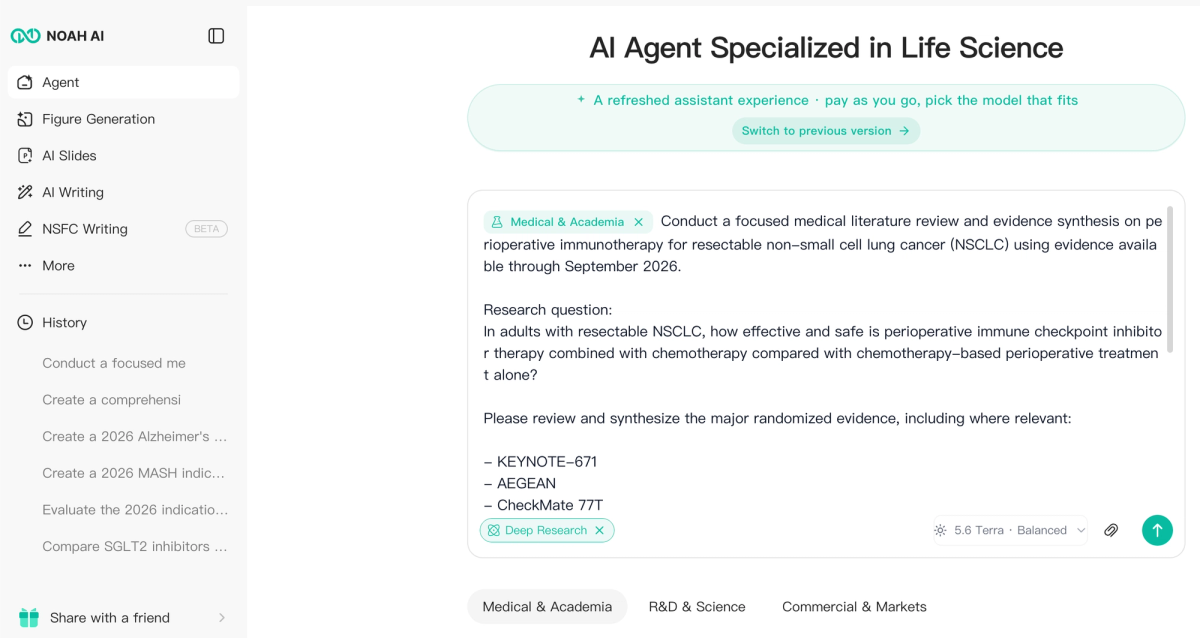
A focused medical literature review and evidence-synthesis task entered into Noah AI.
From Four Trials to One Structured Evidence Set
One of the most useful outputs was a structured evidence synthesis table.
Instead of summarizing each trial in a separate paragraph, Noah aligned them across common dimensions such as:
- phase and population,
- biomarker eligibility,
- neoadjuvant treatment,
- adjuvant treatment,
- comparator,
- primary endpoints,
- EFS,
- pCR,
- overall survival,
- safety,
- and study limitations.
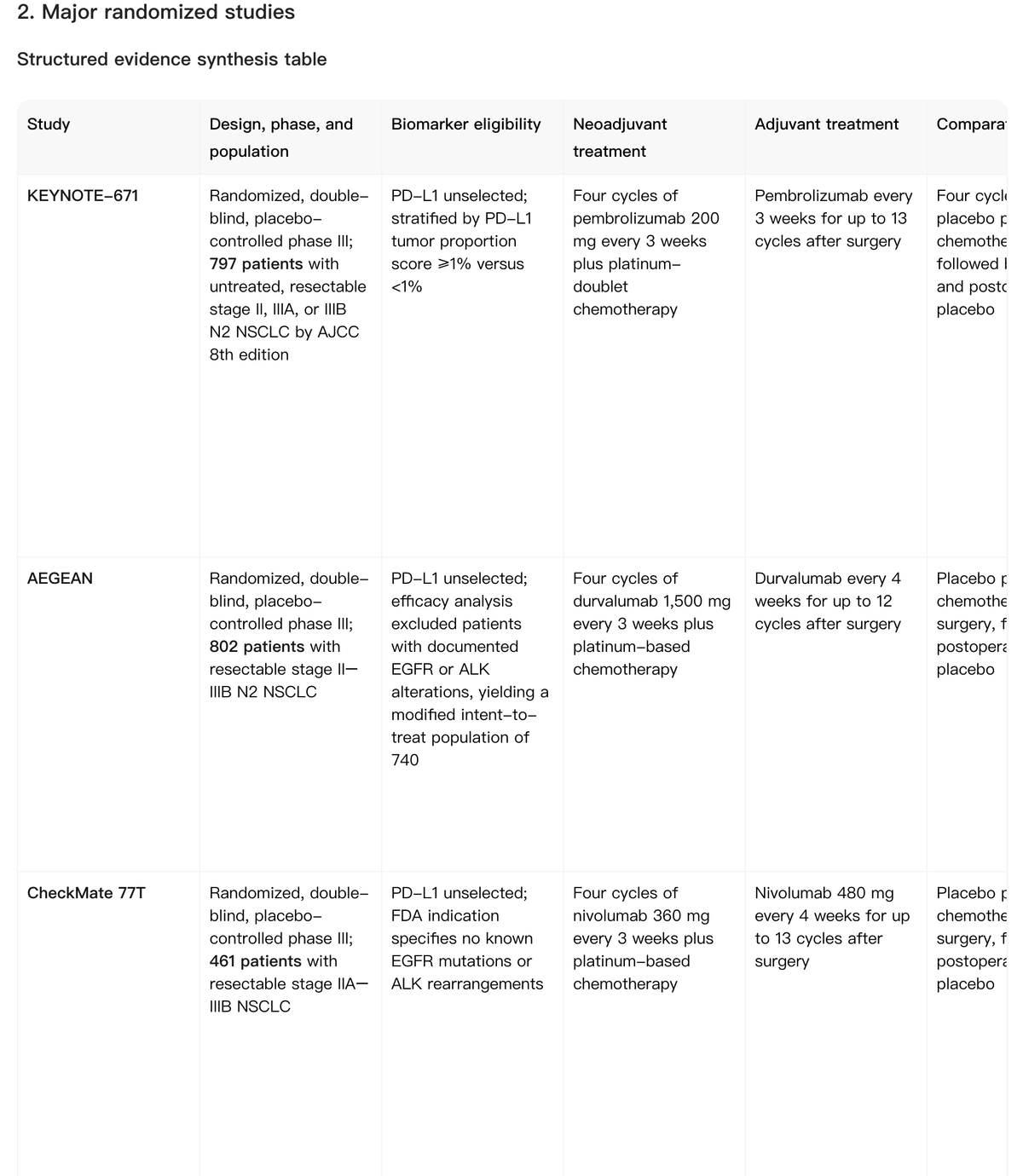
Noah AI places major perioperative NSCLC trials into a shared evidence-extraction framework
Try Noah AI for Free
Use Noah AI to search, compare, and analyze biomedical evidence with AI-powered research workflows.
Free credits are available, and no credit card is required to get started.
A Simplified View of the Four Major Trials
| Trial | Strategy | Key Evidence Role | Important Interpretation Point |
|---|---|---|---|
| KEYNOTE-671 | Perioperative pembrolizumab + chemotherapy | Demonstrated EFS and mature OS benefit with a preoperative-plus-postoperative strategy. | The design cannot isolate how much benefit comes specifically from the postoperative pembrolizumab component. |
| AEGEAN | Perioperative durvalumab + chemotherapy | Improved EFS and pCR in resectable NSCLC. | Overall-survival evidence remains less mature, and EGFR/ALK-altered disease requires separate consideration. |
| CheckMate 77T | Perioperative nivolumab + chemotherapy | Improved EFS and pathological response. | Mature OS evidence remains more limited than for KEYNOTE-671 or CheckMate 816. |
| CheckMate 816 | Neoadjuvant nivolumab + chemotherapy | Demonstrated improved EFS, pCR, and mature OS without mandated postoperative checkpoint inhibition. | It shows that a neoadjuvant-only strategy can work, but does not prove that adjuvant immunotherapy is unnecessary for every patient. |
The Difference Between Evidence Comparison and Evidence Synthesis
A comparison table answers:
What happened in each study?
Evidence synthesis asks:
What conclusion remains after the studies are interpreted together?
Noah's synthesis identified a consistent EFS benefit across all four randomized trials while also preserving the methodological differences between them.
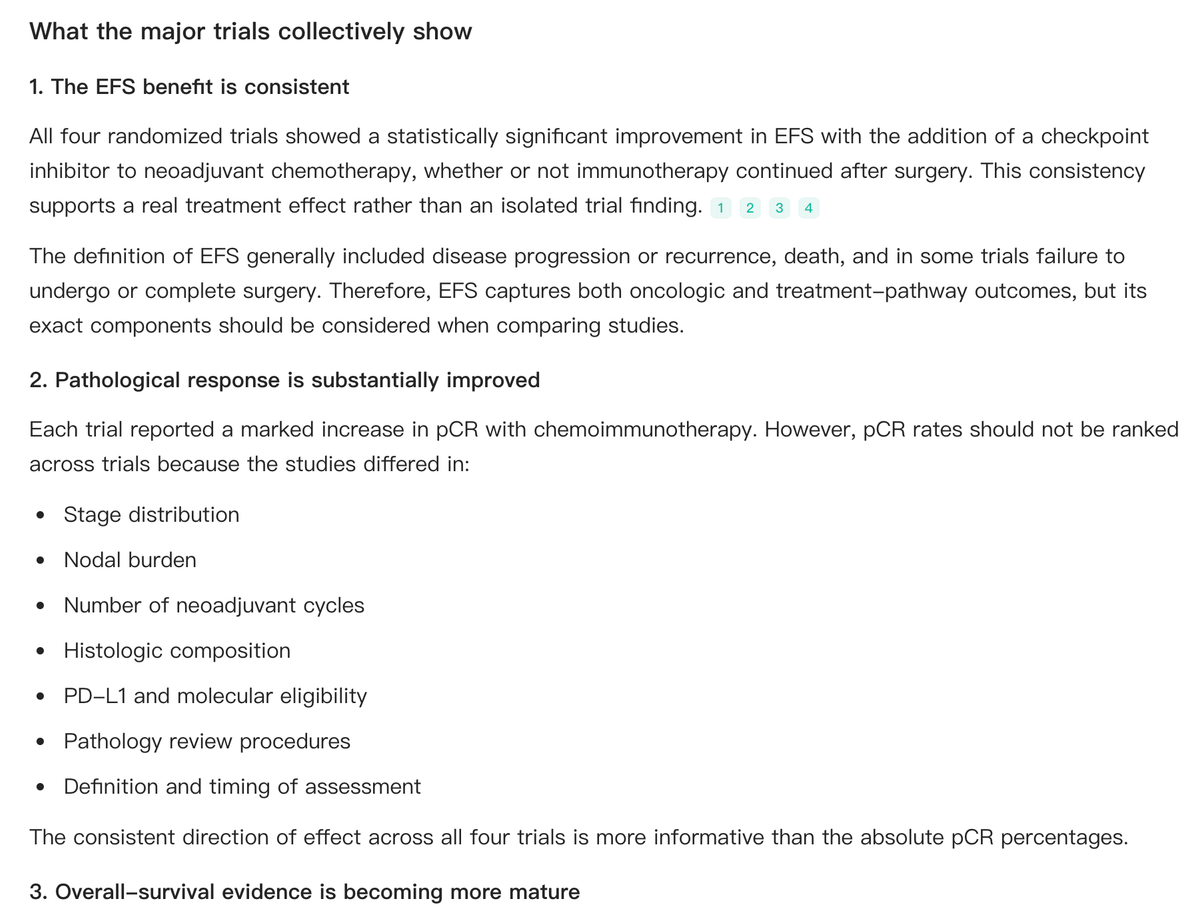
Noah AI synthesizes the direction of EFS and pathological-response evidence while warning against direct numerical ranking across separate trials.
What the Trials Collectively Show
Event-free survival moves in a consistent direction
Across the four randomized programs, adding checkpoint inhibition to neoadjuvant chemotherapy improved EFS compared with chemotherapy-based control strategies.
That consistency is more informative than treating one trial's hazard ratio as proof that one checkpoint inhibitor is superior to another.
Pathological response is consistently improved
All four trials reported substantially higher pathological complete-response rates with chemoimmunotherapy.
But the absolute pCR percentages should not be ranked directly because trial stage distribution, nodal burden, number of treatment cycles, biomarker eligibility, pathology procedures, and assessment timing differed.
Overall-survival evidence has different levels of maturity
Mature OS evidence is available for KEYNOTE-671 and CheckMate 816. AEGEAN and CheckMate 77T have supportive but less mature survival evidence.
This is an important evidence-synthesis principle: an immature survival result is not evidence of no survival benefit.
Perioperative and neoadjuvant-only strategies answer different questions
KEYNOTE-671, AEGEAN, and CheckMate 77T administered immunotherapy before and after surgery.
CheckMate 816 administered nivolumab with chemotherapy before surgery without protocol-mandated postoperative checkpoint inhibition.
Therefore, the current trials demonstrate that both types of strategy can improve outcomes, but they do not directly determine how much incremental benefit the adjuvant component adds after the same neoadjuvant regimen.
Why You Should Not Rank the Trials by Headline Numbers
One of the easiest mistakes in AI-generated medical evidence reviews is to create a table such as:
Trial A: pCR X% Trial B: pCR Y% Trial C: pCR Z%
and conclude that the largest number represents the strongest treatment.
That ignores differences in:
- disease stage,
- nodal status,
- PD-L1 distribution,
- molecular eligibility,
- neoadjuvant treatment duration,
- adjuvant treatment,
- endpoint definition,
- follow-up maturity,
- and statistical analysis.
Cross-trial synthesis should identify consistent patterns, not manufacture head-to-head comparisons that never occurred.
Best AI Tools for Different Parts of the Workflow
Noah AI — Best Fit for Biomedical Question-to-Synthesis Workflows
Noah is particularly useful when the starting point is a specific medical or life-science question rather than a generic literature topic.
Its Search + Agent workflow can combine medical evidence search, research planning, structured comparison, and cited synthesis in one workspace.
In our test, the strongest part was the transition from four separate trials into one structured evidence table and then into a cross-trial synthesis that preserved comparability limits.
Elicit — Strong for Systematic Review Workflows
Elicit is especially relevant when the task resembles a formal systematic review.
Its workflow supports protocol refinement, literature search, title and abstract screening, full-text screening, structured extraction, and evidence synthesis.
This makes it particularly useful when researchers need a reproducible screening-and-extraction process across a large literature set.
Consensus — Strong for Rapid Academic Synthesis
Consensus is useful when the goal is to move quickly from a research question to an organized view of the academic literature.
Its Deep Review workflow can break a broad question into subquestions, run multiple targeted academic searches, and synthesize the resulting evidence.
It is a useful option for evidence orientation and research-field overview, while complex protocol-level extraction still requires careful source review.
SciSpace — Strong for Literature Search and Paper-Level Investigation
SciSpace works well when researchers need to discover relevant studies and then investigate individual papers more deeply.
Literature Review supports search filters and paper discovery, while deeper review workflows can help researchers inspect the content of the literature set.
It is particularly useful when important methodological details are buried in full papers rather than visible in abstracts.
Scite — Strong for Citation Context
Scite addresses a different problem: not simply whether a paper has been cited, but how later literature has cited it.
Smart Citations can help researchers identify whether later papers support, contrast with, or mention an earlier finding.
That makes Scite useful as an evidence-checking layer after major studies have already been identified.
ChatGPT Deep Research — Strong for Flexible Multi-Source Research
ChatGPT Deep Research is useful when the research question extends beyond journal literature alone.
It can research across the public web, specified websites, uploaded files, and other available sources, then synthesize them into a documented report.
That flexibility is useful for questions that combine literature, regulatory documents, industry information, and user-provided materials.
How to Choose the Right Tool
| If Your Main Task Is... | Start With... |
|---|---|
| Find and verify biomedical papers | PubMed |
| Turn a medical question into a structured cited synthesis | Noah AI |
| Run a systematic screening and extraction workflow | Elicit |
| Get a rapid academic overview of a research question | Consensus |
| Read and investigate individual papers deeply | SciSpace |
| Check whether later literature supports or challenges a finding | Scite |
| Combine papers with web, documents, and other source types | ChatGPT Deep Research |
What Researchers Still Need to Verify
None of these tools removes the need for expert verification.
Before using an AI-generated medical evidence synthesis, researchers should check:
- the original trial publication,
- protocol and analysis population,
- exact endpoint definitions,
- follow-up duration,
- primary versus exploratory analyses,
- biomarker eligibility,
- molecular exclusions,
- regulatory-label wording,
- subgroup sample size,
- and whether a cross-trial conclusion exceeds what the evidence supports.
Frequently Asked Questions
What is the best AI tool for medical literature review?
There is no universal best tool. Noah AI is well suited to biomedical question-to-synthesis workflows, Elicit to systematic screening and extraction, SciSpace to literature and paper-level investigation, Consensus to rapid academic synthesis, and Scite to citation-context checking.
What is the difference between literature review and evidence synthesis?
Literature review identifies and organizes relevant research. Evidence synthesis goes further by comparing study quality, populations, endpoints, results, consistency, uncertainty, and the strength of the conclusion across studies.
Can AI perform a systematic review?
AI can assist with protocol development, searching, screening, extraction, and synthesis. A formal systematic review still requires a transparent methodology, expert oversight, source verification, and appropriate reporting standards.
Can AI compare clinical trials?
Yes, AI can organize clinical trials into common comparison fields. Researchers should not interpret differences between unrelated trials as randomized head-to-head evidence.
Why is evidence synthesis harder in medicine?
Medical studies frequently differ in population, disease stage, biomarkers, treatment history, endpoints, follow-up, safety reporting, and statistical analysis.
A useful synthesis needs to preserve those differences instead of averaging them away.
Should AI-generated citations be verified?
Yes. Major clinical claims should be checked against the original publication, regulatory source, trial registry, or authoritative guidance.