Best AI Tools for Medical Evidence Gap Analysis (2026)
Linda
Learn how to identify medical evidence gaps with Noah AI — separating established evidence from open questions, methodological limits, and ongoing trials — using a real 2026 TNBC pembrolizumab case.
A medical evidence gap is not simply a topic with few papers. The more useful question is whether the existing evidence can actually support a clinical decision. Researchers need to distinguish what is established, what remains unknown, why the current studies cannot answer the question, and which ongoing trials are designed to close the gap.
For this guide, we used a real 2026 breast-cancer case: whether adjuvant pembrolizumab is independently necessary after pathologic complete response (pCR) in patients with high-risk early-stage triple-negative breast cancer (TNBC) who already received neoadjuvant pembrolizumab plus chemotherapy.
This is a good evidence-gap case because KEYNOTE-522 established the benefit of the complete perioperative pembrolizumab strategy, but it did not separately randomize patients after surgery and pCR confirmation to continued pembrolizumab versus observation. That leaves a clinically important question unresolved.
Quick answer: Noah AI is a strong fit when a focused biomedical question needs to be turned into a cited map of established evidence, unresolved questions, methodological limitations, and ongoing studies. Elicit is stronger for systematic-review-led search and extraction. Consensus is useful for rapid literature synthesis. Scite is useful for citation-context checking. DistillerSR is better suited to large, auditable, protocol-driven evidence-review workflows.
The Clinical Question Is Narrower Than "Does Pembrolizumab Work?"
The broad efficacy question has already been answered. KEYNOTE-522 randomized patients with high-risk early-stage TNBC to neoadjuvant pembrolizumab plus chemotherapy followed by adjuvant pembrolizumab, or to neoadjuvant chemotherapy followed by adjuvant placebo. The trial demonstrated improvements in pCR and event-free survival, and later showed an overall-survival benefit for the complete treatment strategy.
The unresolved question appears only after a patient has responded very well:
If a patient has already achieved pCR after neoadjuvant pembrolizumab plus chemotherapy, does continuing postoperative pembrolizumab add enough independent benefit to justify additional treatment, or can observation be used without materially increasing recurrence risk?
That is not the same causal question tested by KEYNOTE-522.
What Is Already Established
| Evidence question | What current evidence supports | What it does not prove |
|---|---|---|
| Does the complete perioperative strategy improve outcomes? | Yes. KEYNOTE-522 showed improved pCR and EFS, and the later OS analysis confirmed a survival benefit for the full pembrolizumab-containing strategy. | It does not isolate the contribution of postoperative pembrolizumab after surgery. |
| Do patients with pCR generally have better prognosis? | Yes. pCR is strongly associated with lower recurrence risk than residual invasive disease. | Favorable prognosis does not prove that continued treatment has no benefit. |
| Can the pCR subgroup estimate the adjuvant effect? | It can describe outcomes among patients who achieved pCR. | It cannot isolate a causal postoperative treatment effect because pCR is a post-randomization variable. |
In the KEYNOTE-522 EFS publication, 36-month event-free survival was 84.5% with the pembrolizumab-containing perioperative strategy versus 76.8% with the control strategy, with a hazard ratio of 0.63. In the final OS analysis, five-year overall survival was 86.6% versus 81.7%.
These results establish the value of the complete assigned strategy. They do not tell us how much of the benefit came from neoadjuvant pembrolizumab, adjuvant pembrolizumab, interaction between the two phases, or treatment-induced changes in the probability of achieving pCR.
Running the Evidence-Gap Question in Noah's New Agent Interface
Noah's current Agent interface allows the research scope to be defined before the evidence synthesis begins. For this case, the category was set to Medical & Academia, the task was run in Deep Research, and the available model control displayed 5.6 Terra · Balanced.
The prompt did not ask Noah to summarize TNBC treatment. It explicitly asked the system to identify what KEYNOTE-522 establishes, what it cannot establish, why pCR subgroup data are insufficient for the postoperative causal question, and which ongoing trials are designed to resolve the uncertainty.

Figure 1. Noah AI Agent configured for a focused medical evidence-gap question using Medical & Academia, Deep Research, and 5.6 Terra · Balanced.
Where the Evidence Stops
The central limitation is trial design. KEYNOTE-522 randomized treatment before neoadjuvant therapy. It did not perform a second randomization after surgery among the subgroup that achieved pCR.
That means the clinically relevant de-escalation question was never directly tested:
Among patients who already received neoadjuvant pembrolizumab plus chemotherapy and achieved pCR, is continued adjuvant pembrolizumab better than observation?
This matters because a post-randomization subgroup is not equivalent to a newly randomized population. Pembrolizumab itself changes the probability of pCR, so the patients who end up in the pCR subgroup can differ between treatment arms. An exploratory hazard ratio within that subgroup therefore cannot be interpreted as the independent causal effect of the adjuvant phase.
The Most Useful Noah Output: Medical Evidence Gap Matrix
The strongest result from the run was a structured matrix that separated established evidence from direct evidence gaps, hypotheses, and exploratory analyses. That is more useful than a conventional efficacy summary because it explains why the current evidence cannot answer the decision.
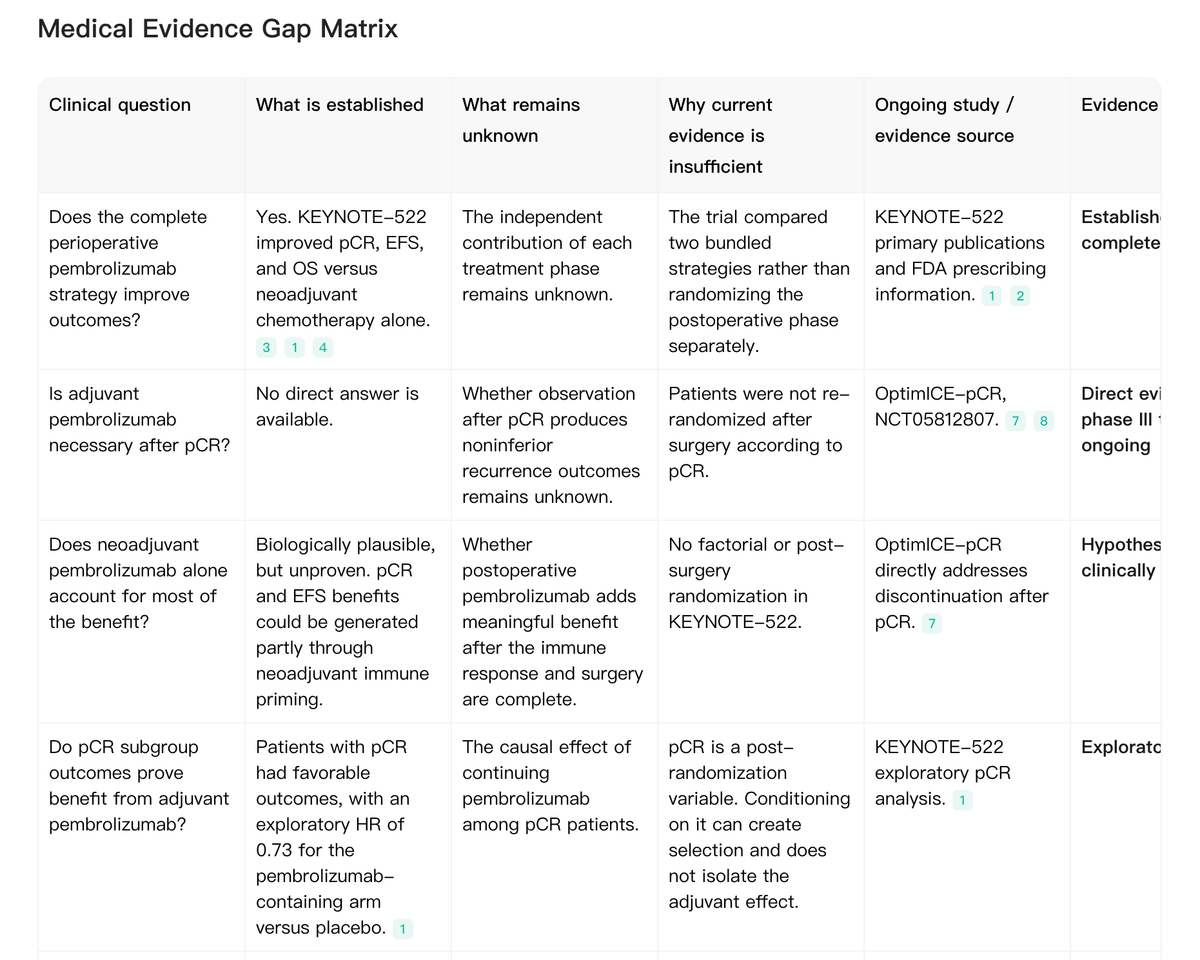
Figure 2. Noah AI separates what KEYNOTE-522 established from the unresolved post-pCR treatment question and the evidence needed to close it.
Research Biomedical Evidence with Noah AI for Free
Use Noah AI to search, compare, and organize biomedical evidence while keeping established findings, evidence gaps, exploratory analyses, and hypotheses clearly separated.
Free to use · Free credits included · No credit card required
[Research Biomedical Evidence with Noah AI →](https://www.noah.bio/signup?utm_source=blog)
Four evidence states are visible in the same matrix
- Established: the complete perioperative pembrolizumab strategy improves clinically important outcomes.
- Direct evidence gap: there is no completed post-pCR randomization establishing whether adjuvant pembrolizumab can be safely omitted.
- Hypothesis: much of the benefit may occur during neoadjuvant treatment and immune priming, but that has not been clinically isolated.
- Exploratory evidence: pCR subgroup outcomes are informative but cannot independently establish the benefit or lack of benefit of postoperative pembrolizumab.
This is the key distinction in evidence-gap analysis: "unknown" does not mean "no effect," and "subgroup signal" does not mean "causal answer."
OptimICE-pCR Is Designed Around the Missing Decision Point
OptimICE-pCR (NCT05812807) is directly relevant because it studies patients with early-stage TNBC who have already completed neoadjuvant checkpoint-inhibitor-containing therapy, undergone surgery, and achieved pCR. The trial compares continued postoperative pembrolizumab with observation.
That design addresses the exact feature missing from KEYNOTE-522: treatment allocation at the point when pCR status is already known.
| Design element | Why it matters for the evidence gap |
|---|---|
| Population selected after pCR | Focuses on the patients for whom de-escalation is actually being considered. |
| Continued pembrolizumab vs observation | Directly isolates the postoperative continuation question. |
| Recurrence-free survival | Tests whether omission can preserve disease-control outcomes within the prespecified trial framework. |
| Quality-of-life and toxicity objectives | Measures the trade-off between avoiding treatment burden and preserving recurrence outcomes. |
| Economic and patient-value outcomes | Addresses costs and productivity consequences that are not captured by efficacy endpoints alone. |
Until a trial designed around this decision reports mature comparative results, routine omission of postoperative pembrolizumab after pCR should not be treated as an established evidence-based standard.
Why Subgroup Data Cannot Close the Gap
KEYNOTE-522 reported exploratory outcomes among patients who achieved pCR. Those results are clinically informative because they show that patients with pCR generally have a favorable prognosis and still experience some recurrences. But the subgroup does not recreate randomization after pCR.
- pCR occurs after treatment assignment;
- pembrolizumab changes the probability of achieving pCR;
- the biological composition of responders may differ between randomized arms;
- event counts are lower in the pCR subgroup;
- the subgroup analysis was not designed to isolate the postoperative treatment phase.
This is a useful general lesson for AI evidence review: a model should not turn a favorable subgroup outcome into a treatment-stopping recommendation unless the underlying design supports that causal conclusion.
Biomarkers May Refine the Question, but They Do Not Yet Close It
Another emerging question is whether pCR can be combined with circulating tumor DNA or molecular residual disease to identify patients at especially low recurrence risk. That would move the decision from pathology alone toward a pathology-plus-molecular framework.
The potential logic is attractive: a patient with pCR and no detectable postoperative molecular residual disease might be a stronger candidate for de-escalation than a patient selected by pCR alone. But prognostic association is not the same as validated treatment-selection utility.
A biomarker-guided strategy still needs evidence on assay sensitivity, timing, false-negative risk, reproducibility, recurrence prediction, and—most importantly—whether changing treatment based on the biomarker improves the benefit-risk balance.
Best AI Tools for Different Evidence-Gap Workflows
| Tool | Best fit | Useful role in evidence-gap analysis | Main limitation |
|---|---|---|---|
| Noah AI | Focused biomedical question → cited evidence-gap synthesis | Useful for connecting publications, trials, current clinical evidence, methodological limitations, and unresolved questions into a structured matrix | Researchers still need to verify primary sources and distinguish generated interpretation from formal statistical or guideline conclusions |
| Elicit | Systematic-review search, screening, and extraction | Useful when the evidence gap must be demonstrated through a reproducible review process across a defined literature set | The clinical importance of a gap still depends on the review question and expert interpretation |
| Consensus | Rapid peer-reviewed literature exploration | Useful for quickly testing what published research says about a focused medical question and identifying studies that need deeper review | Literature synthesis alone may not capture every regulatory, registry, or trial-design nuance needed for a causal evidence-gap assessment |
| Scite | Citation-context checking | Useful for seeing how later literature supports, contrasts with, or discusses influential findings | It does not by itself build the complete clinical decision framework or determine whether a missing randomized comparison is practice-relevant |
| DistillerSR | Large, protocol-driven and auditable evidence reviews | AI-enabled screening, evidence extraction, configurable workflows, audit trails, and reproducible review operations | Best suited to formal evidence-review programs rather than a quick question-to-answer workflow |
How to Tell a Real Evidence Gap From "No Data Found"
Not finding a paper is not enough to prove that a medical evidence gap exists. A defensible gap usually has three components:
- A decision that matters: treatment continuation, stopping, escalation, screening, monitoring, sequencing, or patient selection.
- Existing evidence that gets close but cannot answer the decision: for example, a bundled trial strategy or exploratory subgroup analysis.
- A clear missing design or evidence type: such as post-response randomization, longer follow-up, representative populations, validated biomarkers, or direct comparative data.
| Statement | Interpretation |
|---|---|
| No studies were found in one search | Search limitation until the strategy and sources are checked |
| Only exploratory subgroup evidence exists | Potential evidence gap, depending on the decision being asked |
| The pivotal trial did not randomize at the relevant clinical decision point | Direct causal evidence gap |
| An ongoing Phase III trial directly tests the unresolved decision | Strong evidence that the question is recognized and not yet settled |
What Would Actually Close This Gap?
- randomization after surgery and pCR confirmation;
- a prespecified and clinically acceptable noninferiority framework;
- adequate recurrence follow-up;
- postoperative toxicity isolated from neoadjuvant toxicity;
- quality-of-life and treatment-burden outcomes;
- financial and productivity outcomes where relevant;
- prospective biomarker analyses, including ctDNA/MRD where appropriate;
- representation of older, frail, autoimmune, and medically complex patients;
- separate interpretation for pCR versus residual disease.
Limitations of AI Evidence-Gap Analysis
AI can make missing evidence easier to see, but it can also manufacture apparent gaps if the source search is incomplete or the research question is poorly specified. Several checks are necessary:
- verify whether the "missing" comparison truly has not been done;
- check registry status and update history for ongoing studies;
- separate primary endpoints from exploratory analyses;
- do not treat post-randomization subgroups as newly randomized cohorts;
- verify effect estimates, confidence intervals, and follow-up against primary publications;
- separate prognostic biomarkers from validated treatment-selection biomarkers;
- do not convert "ongoing trial" into "future standard of care."
FAQ
What is a medical evidence gap analysis?
Medical evidence gap analysis identifies clinically important questions that current evidence cannot adequately answer. It should show what is established, what remains unknown, why the available studies are insufficient, and what evidence would close the gap.
Is an evidence gap the same as an unmet medical need?
No. An unmet medical need describes a patient or treatment problem that remains insufficiently addressed. An evidence gap describes something to a clinician or researcher cannot determine reliably from the current evidence. The two can overlap, but they are not interchangeable.
Does KEYNOTE-522 prove that adjuvant pembrolizumab is necessary after pCR?
No. KEYNOTE-522 proves the benefit of the complete perioperative strategy. It did not re-randomize patients after surgery and pCR confirmation to continued pembrolizumab versus observation, so the independent postoperative contribution in pCR patients remains unresolved.
Does favorable prognosis after pCR prove pembrolizumab can be stopped?
No. Prognosis and treatment effect are different questions. A low-risk group can still receive treatment benefit, and a favorable subgroup result does not establish that omission is safe.
Can ctDNA close the evidence gap?
Potentially, but not from prognostic association alone. A ctDNA-guided treatment strategy needs prospective validation showing that treatment decisions based on the assay preserve outcome improve clinical outcomes.
Which AI tool is best for evidence gap analysis?
It depends on the workflow. Noah AI is a strong fit for focused question-to-synthesis work. Elicit and DistillerSR are stronger for formal review operations. Consensus is useful for fast literature exploration, while Scitation is useful for citation-context verification.
Final Takeaway
Medical evidence gap analysis is valuable when it identifies the exact point at which the current evidence paradigm stops supporting a clinical decision.
In this TNBC case, the evidence boundary is clear. KEYNOTE-522 establishes the value of the complete perioperative pembrolizumab strategy, but it does not isolate whether postoperative pembrolizumab is independently necessary among patients who already achieved pCR. OptimICE-pCR is designed around that missing decision point.
Noah's Evidence Gap Matrix is most useful when it keeps established evidence, direct gaps, exploratory analyses, and hypotheses visibly separate compared to flattening them into one narrative.