Best AI Tools for Medical Evidence Coverage Checking in 2026
Linda
Compare the best AI tools for medical evidence coverage checking in 2026 and learn how AI can identify evidence gaps, population blind spots, and research priorities.
A medical literature search can tell you what evidence exists. A literature review can summarize what that evidence says. But neither automatically tells you whether the evidence base is actually complete enough to support a clinical or research decision.
That is where medical evidence coverage checking becomes useful. Instead of asking only, “What do the studies show?”, evidence coverage analysis asks a different set of questions:
- Are the most important patient populations represented?
- Are efficacy, safety, and patient-centered outcomes all covered?
- Do we have direct randomized evidence or only subgroup analyses?
- Are high-risk populations missing from the evidence base?
- Is long-term evidence mature enough?
- Which uncertainties should be searched next?
In this guide, we tested Noah AI directly using a real medical evidence coverage task involving anti-amyloid therapy for early Alzheimer’s disease. We also compare several other research tools that can support literature discovery, evidence extraction, citation checking, and evidence synthesis.
Disclosure: We tested Noah AI directly. Other tools are discussed based on their documented workflows and publicly described research features.
What Is Medical Evidence Coverage Checking?
Evidence coverage checking is not the same as a conventional literature review. A literature review usually focuses on synthesizing existing studies. A coverage audit instead evaluates whether the available evidence addresses all of the clinical dimensions needed for the question.
For example, a treatment may have several large randomized trials and still have important coverage gaps if those trials contain few:
- very old adults,
- patients receiving anticoagulants,
- racial or ethnic minority populations,
- patients with important comorbidities,
- long-term patient-centered outcomes, or
- real-world implementation data.
Key distinction:
Evidence coverage asks “What important questions are represented?”
Evidence quality asks “How trustworthy is the evidence that exists?”
Why Evidence Volume Is Not the Same as Evidence Coverage
One of the easiest mistakes in medical research is to equate the number of publications with the completeness of the evidence base. Ten papers examining essentially the same population and outcome do not necessarily provide broader coverage than one carefully designed study.
A useful evidence coverage audit therefore evaluates several dimensions at the same time:
| Dimension | What to Check |
|---|---|
| Population | Whether clinically important patient groups are represented |
| Outcomes | Whether efficacy, function, quality of life, safety, and long-term outcomes are covered |
| Directness | Whether evidence directly answers the question or comes from indirect subgroup inference |
| Evidence type | RCTs, extensions, observational studies, guidelines, regulatory evidence, and real-world data |
| Maturity | Whether follow-up is long enough for the outcome being assessed |
| Implementation | Whether trial findings can realistically be translated into routine care |
Best AI Tools for Medical Evidence Coverage Checking in 2026
| Tool | Best Use | Coverage-Checking Role |
|---|---|---|
| Noah AI | Biomedical and medical evidence analysis | Building coverage matrices, identifying population and outcome gaps, and converting gaps into research priorities |
| Elicit | Systematic review workflows | Searching, screening, structured extraction, and comparing whether required evidence fields are represented |
| Scite | Citation context and claim checking | Checking whether key findings have supporting, contrasting, or additional citing evidence |
| Consensus | Rapid research discovery and synthesis | Exploring related populations, study designs, and outcomes that may be missing from an initial search |
| SciSpace | Paper analysis and literature review workflows | Reviewing papers, extracting methodological details, and exploring potential research gaps |
1. Noah AI — Best for Structured Medical Evidence Coverage Audits
Noah AI is particularly useful when the question is not simply “find papers about this topic,” but:
“Does the current evidence base actually cover everything we need to know?”
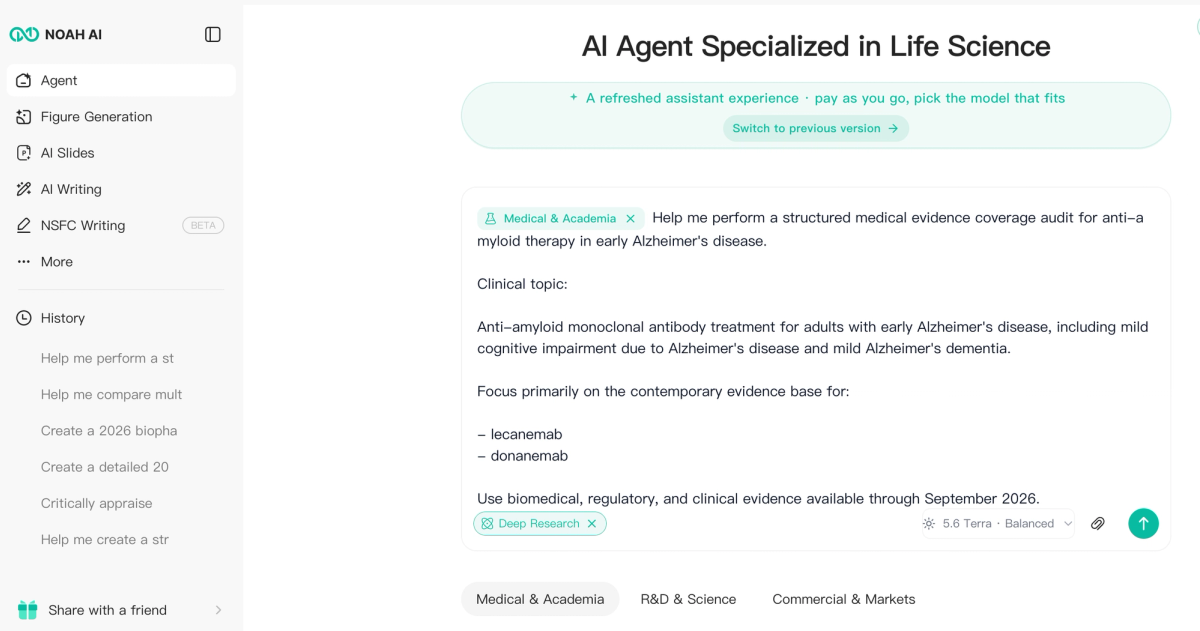
For our test case, we asked Noah AI to perform a structured medical evidence coverage audit of lecanemab and donanemab for early Alzheimer’s disease.
The task required Noah to distinguish evidence across patient populations, clinical efficacy, biomarkers, ARIA safety, anticoagulant use, APOE genotype, long-term outcomes, and real-world implementation.
Step 1: Define the Coverage Question
We first gave Noah a specific clinical scope rather than asking for a generic Alzheimer’s literature review. The prompt focused on anti-amyloid monoclonal antibody therapy in adults with mild cognitive impairment due to Alzheimer’s disease or mild Alzheimer’s dementia.
We also explicitly told Noah that the goal was not treatment ranking. Instead, the objective was to identify:
- what is strongly covered,
- what is only partially covered,
- what remains uncertain,
- which populations are underrepresented, and
- what evidence should be searched next.
Step 2: Define What “Complete Evidence” Should Look Like
Before checking whether evidence is missing, you need to define what the evidence base is supposed to contain. Otherwise, there is no standard against which “coverage” can be judged.
For this case, the framework included:
- disease stage,
- APOE ε4 genotype,
- age and demographic representation,
- vascular and bleeding risk,
- amyloid and tau biomarkers,
- cognitive and functional outcomes,
- quality of life and caregiver burden,
- ARIA and intracerebral hemorrhage,
- treatment discontinuation,
- long-term outcomes, and
- real-world treatment implementation.
This step matters because evidence gaps are defined relative to the questions that actually matter clinically.
Step 3: Separate Different Types of Evidence
One useful part of the workflow is keeping different evidence classes separate instead of treating every publication as equivalent.
| Evidence Type | What It Can Tell You |
|---|---|
| Randomized trials | Direct comparative efficacy and safety within the studied population |
| Extension studies | Longer-term patterns, but usually with weaker causal inference after randomized follow-up ends |
| Subgroup analyses | Potential differences between patient groups, often with lower statistical precision |
| Regulatory evidence | Authorized populations, warnings, contraindications, and monitoring requirements |
| Real-world evidence | Eligibility, adherence, implementation, safety, and effectiveness outside controlled trials |
Step 4: Build the Main Evidence Coverage Matrix
The main output is the Evidence Coverage Matrix. Instead of giving every paper the same weight, Noah rated individual evidence domains using:
- Strong coverage
- Moderate coverage
- Limited coverage
- Missing
- Uncertain
Importantly, those ratings describe coverage, not whether a treatment works well or poorly.
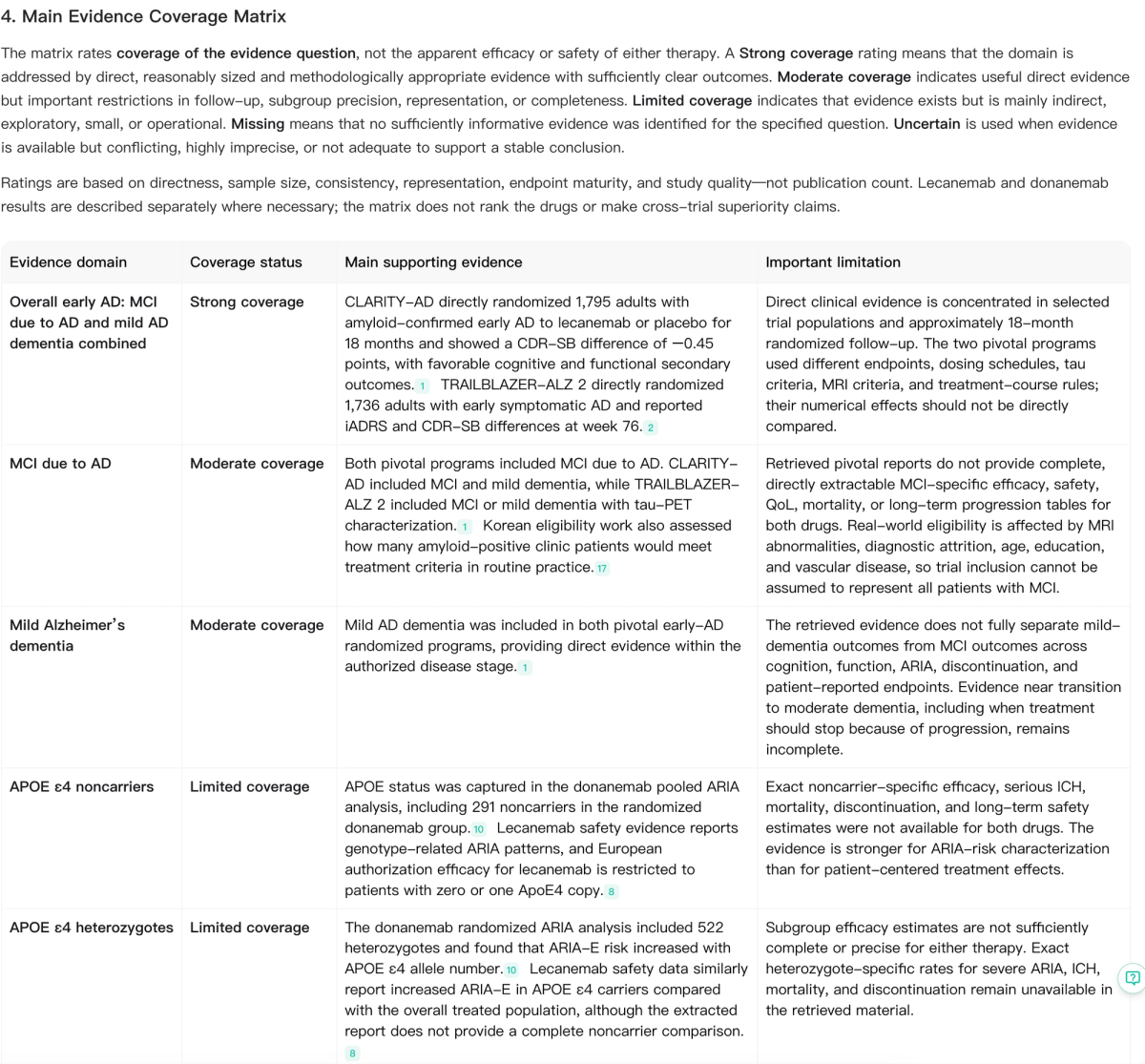
This is much more useful than a binary “evidence exists / evidence does not exist” framework. For example, a subgroup may appear in a pivotal trial but still receive a Limited rating if the subgroup-specific efficacy and safety estimates are incomplete.
Step 5: Audit Patient Population Coverage
Population coverage is often where an apparently mature medical evidence base begins to look less complete.
For early Alzheimer’s disease, relevant questions include:
- Are MCI and mild dementia both represented?
- Are APOE ε4 noncarriers, heterozygotes, and homozygotes adequately characterized?
- Are adults aged 80 years or older sufficiently represented?
- What do we know about patients receiving anticoagulants?
- How much evidence exists for patients with vascular comorbidity or MRI risk features?
- Are racial and ethnic minority populations adequately represented?
The important principle is: inclusion in a study does not automatically mean strong subgroup coverage.
Step 6: Audit Outcome Coverage
Next, check whether the evidence covers all outcomes needed for a real clinical decision.
Short-term cognition may be well studied while other outcomes remain immature. A complete coverage audit should therefore separate:
- cognitive outcomes,
- functional outcomes,
- quality of life,
- caregiver burden,
- institutionalization,
- hospitalization,
- mortality,
- biomarker changes, and
- safety outcomes.
Do not merge biomarkers and clinical outcomes.
Evidence that a treatment changes amyloid or tau does not automatically establish effects on independence, institutionalization, quality of life, or long-term survival.
Step 7: Check Safety Coverage Separately
Safety deserves its own coverage audit because the patients with the greatest potential risk are often the patients most likely to have been excluded from pivotal trials.
For anti-amyloid therapy, this means checking evidence for:
- ARIA-E,
- ARIA-H,
- symptomatic or serious ARIA,
- intracerebral hemorrhage,
- APOE genotype-specific risk,
- anticoagulant and antiplatelet exposure,
- MRI risk features, and
- long-term safety.
A particularly important evidence principle is: excluding a high-risk population from a trial does not establish safety in that population.
Step 8: Identify the Evidence Blind Spots
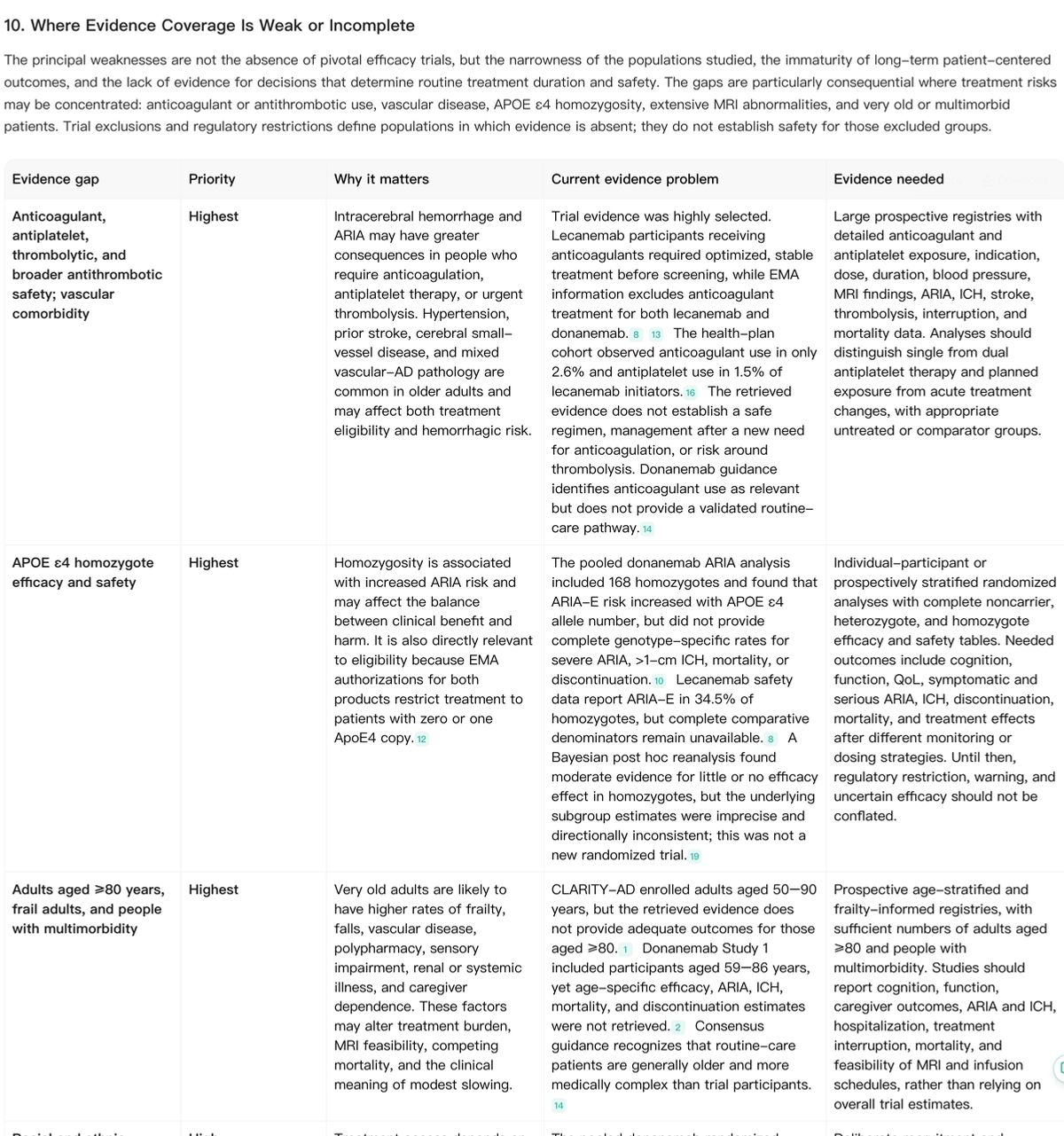
The most valuable part of evidence coverage checking is often not identifying what we know, but identifying where the evidence base stops being reliable.
In our Noah test, the high-priority gaps included:
- anticoagulant and broader antithrombotic safety,
- APOE ε4 homozygote efficacy and safety,
- adults aged 80 years or older, frail adults, and patients with multimorbidity,
- racial and ethnic diversity,
- long-term clinical outcomes, and
- treatment decisions after amyloid clearance.
Step 9: Distinguish Missing Evidence from Uncertain Evidence
Not every weak area should simply be labeled “no evidence.” Different evidence problems require different interpretations.
| Situation | Interpretation |
|---|---|
| No direct trial evidence | Potentially missing evidence |
| Small subgroup analysis | Evidence exists, but precision and generalizability may be limited |
| Post hoc analysis | Often hypothesis-generating rather than definitive |
| Immature follow-up | Evidence exists but cannot yet answer the long-term question |
| Observational evidence only | May support real-world applicability but not substitute automatically for randomized evidence |
| Population excluded from trials | Evidence boundary — not proof of benefit, safety, or harm |
Step 10: Turn Evidence Gaps Into a Search Plan
Evidence coverage checking should not end with the sentence: “More research is needed.”
Each gap should instead become a specific next research task.
| Identified Gap | Next Search | Preferred Evidence |
|---|---|---|
| Adults aged ≥80 | Age-stratified anti-amyloid outcomes | Subgroup analyses and prospective registries |
| Anticoagulant safety | Anticoagulant exposure + ARIA/ICH outcomes | Large prospective safety registries |
| Long-term independence | Institutionalization, progression, hospitalization, and independence | Long-term follow-up and linked real-world datasets |
| Post-clearance treatment | Stopping, continuation, maintenance, and restarting strategies | Prospective comparative or randomized studies |
Step 11: Produce a Final Evidence Coverage Verdict
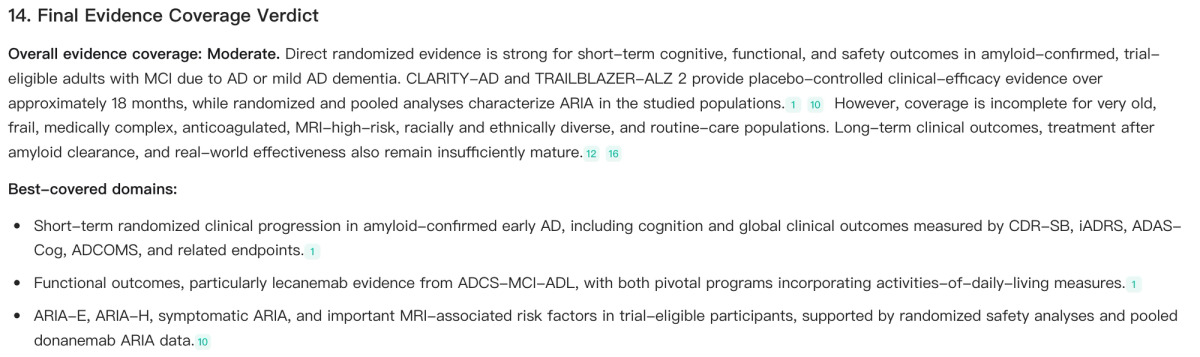
A coverage audit should finish with an actionable verdict rather than another long narrative summary.
In our test, Noah classified the overall evidence coverage as Moderate. The strongest coverage was concentrated in short-term randomized clinical outcomes and ARIA characterization within trial-eligible patients, while important gaps remained in high-risk, underrepresented, and real-world populations.
Try Noah AI for Free
Use Noah AI to search, compare, and analyze biomedical evidence with AI-powered research workflows.
Free credits are available, and no credit card is required to get started.Sign Up and Try Noah AI →
Evidence Coverage vs Evidence Quality
These two concepts are related but should never be treated as interchangeable.
| Evidence Coverage | Evidence Quality |
|---|---|
| What questions are represented? | How trustworthy are the results? |
| Focuses on breadth and completeness | Focuses on validity and bias |
| Finds missing populations and outcomes | Finds methodological weaknesses |
| Asks “What is absent?” | Asks “Can this result be trusted?” |
For example, one large, well-designed randomized trial may provide high-quality evidence but narrow coverage if it excludes very old adults or patients with important comorbidities.
Conversely, a topic may have dozens of observational studies but still provide poor coverage of a causal clinical question.
Where Elicit Fits
Elicit is particularly useful when evidence coverage checking begins with a larger systematic-review workflow. Researchers can use it to organize papers, apply screening criteria, extract structured fields, and compare whether the evidence set actually contains the populations, interventions, and outcomes required by the review question.
For coverage analysis, its strongest role is usually earlier in the process: building and structuring the evidence set before the final gap audit.
Where Scite Fits
Scite approaches the problem from a different direction. Instead of primarily asking whether a population or outcome has been represented, it can help researchers examine how a finding has subsequently been cited and whether later literature supports, contrasts with, or simply mentions it.
This makes it useful for checking whether an apparently well-covered conclusion is based on a finding that has been repeatedly challenged or qualified.
Where Consensus Fits
Consensus is useful for rapidly exploring academic literature around a clinical question and testing whether adjacent populations, study designs, or outcomes may have been missed by the initial evidence set.
It can therefore work well as a discovery layer before a more formal coverage matrix is built.
Where SciSpace Fits
SciSpace can support the paper-level part of the workflow: finding relevant studies, inspecting individual papers, extracting methods and results, and exploring research gaps.
It is particularly useful when the researcher still needs to understand the individual studies before moving into a structured cross-study coverage audit.
Which Tool Should You Use?
| If You Need To... | Useful Tool |
|---|---|
| Run a structured biomedical evidence coverage audit | Noah AI |
| Screen and extract evidence systematically | Elicit |
| Check how findings are supported or contradicted in later literature | Scite |
| Rapidly discover adjacent research and potential missing evidence | Consensus |
| Read, organize, and analyze individual research papers | SciSpace |
Common Mistakes When Checking Medical Evidence Coverage
Counting Papers Instead of Mapping Questions
A large publication count can still represent a narrow evidence base. Always map evidence against predefined populations, outcomes, safety questions, and study types.
Treating a Subgroup Analysis as Strong Coverage
A subgroup appearing in a paper does not mean the study was powered to answer the subgroup question. Check the sample size, prespecification, precision, and consistency of the subgroup evidence.
Treating Excluded Patients as “Covered”
If patients with a specific risk factor were excluded from pivotal trials, the correct conclusion is usually that direct evidence is limited or missing — not that the treatment is safe or unsafe in that group.
Mixing Biomarker Evidence with Patient Benefit
A biomarker can show biological activity without establishing effects on function, independence, quality of life, hospitalization, or survival. Keep these evidence domains separate.
Ending With “More Research Is Needed”
A useful evidence audit should specify which evidence is needed next, for which population or outcome, and which study design would most efficiently reduce uncertainty.
A Practical Evidence Coverage Checklist
- Have the pivotal trials been identified?
- Are primary and follow-up publications separated?
- Are the intended patient populations represented?
- Are important age and demographic subgroups covered?
- Are clinically important comorbidities represented?
- Are efficacy and safety outcomes both covered?
- Are patient-centered outcomes separated from biomarkers?
- Are subgroup analyses distinguished from direct evidence?
- Are long-term outcomes mature?
- Is real-world implementation represented?
- Are trial exclusion criteria being treated as evidence boundaries?
- Have the highest-priority evidence gaps been converted into targeted searches?
Final Takeaway
The value of AI in evidence synthesis is not only that it can help researchers find and summarize more papers. A more useful application is helping researchers understand what the current evidence base still cannot answer.
Medical evidence coverage checking forces the literature to be viewed as a structured decision map: which populations are represented, which outcomes are mature, where safety evidence stops, what is based only on subgroup inference, and which questions require a new search or a new study.
In our test, Noah AI turned a complex early Alzheimer’s disease evidence base into a coverage matrix, prioritized the major blind spots, and produced an overall coverage verdict rather than simply generating another narrative review.
For researchers, medical affairs teams, biotech teams, and evidence-synthesis workflows, that distinction can be more useful than simply asking an AI tool to summarize the literature.
Try Noah AI for Free
Use Noah AI to search, compare, and analyze biomedical evidence with AI-powered research workflows.
Free credits are available, and no credit card is required to get started.