Best AI Tools for Searching PubMed in 2026
Linda
The best AI tools for PubMed search in 2026, organized by what you actually need to do: search & synthesize, extract data, or discover new papers. Includes Noah AI, Elicit, Consensus, SciSpace, and more.
"Best AI tool" depends entirely on what you're trying to do. Searching and synthesizing across papers is a different task from extracting structured data for a systematic review, which is different from discovering related papers through citation networks. This article organizes AI tools by the function they serve in a biomedical research workflow, so you can pick the right tool for your specific task.
For a comparison focused on AI engine capabilities, see Best PubMed AI Search Engines in 2026.
How We Evaluated
We tested Noah AI directly by running the demo query below. Other tools were evaluated based on their official documentation, published feature descriptions, and publicly available workflows. The task-based categories below reflect how each tool's documented features map to common research activities.
Task-to-Tool Matching
| Research Task | Best Tool(s) | Why |
|---|---|---|
| Search PubMed + get a structured evidence summary | Noah AI | PICO-aware query handling, MeSH/synonym expansion, structured brief with citations |
| Get a quick directional answer from the literature | Consensus | Consensus Meter shows evidence direction; useful for focused questions |
| Extract structured data across multiple papers | Elicit | Custom column extraction for evidence tables |
| Discover related papers via citation networks | Semantic Scholar | Citation graphs, influence scores, TLDR summaries |
| Understand a specific paper's content | SciSpace | Chat-with-paper interface for sections, tables, and methods |
| Explore a topic with general web + academic sources | Perplexity | General AI search that can surface academic sources |
| Reproducible Boolean search for systematic reviews | PubMed Advanced Search | Full control, documented search strings, MeSH indexing |
Category 1: Search + Synthesize
These tools go beyond returning a list of papers — they read the results and produce a synthesized answer or summary.
Noah AI
Noah AI is designed for biomedical evidence search. You enter a clinical or research question in natural language, and the platform searches PubMed while supporting PICO-aware query handling, MeSH term expansion, and synonym mapping. The output is a structured evidence brief with inline citations linked to PubMed papers.
According to the Noah AI website, a structured summary takes approximately 10-20 minutes to generate. Researchers should still verify key findings by checking the cited original papers.
Best for: Getting a structured overview of evidence on a clinical or research question, with citations you can trace to PubMed.
Consensus
Consensus is designed for answering focused research questions and summarizing what the literature says. Its signature feature is the Consensus Meter, which provides a directional signal across the papers considered for a question.
Best for: Quick directional answers to focused research questions.
Category 2: Extract + Organize
These tools help you pull specific data points from papers and organize them into structured formats.
Elicit
Elicit's core feature is data extraction. You can define custom columns such as sample size, population, intervention, primary outcome, or effect size, and Elicit attempts to extract those fields from retrieved papers. This is particularly useful for building evidence tables for systematic reviews.
Best for: Building structured comparison tables across multiple papers.
SciSpace
SciSpace takes a per-paper approach. You can upload a PDF and ask questions about methodology, tables, terminology, or specific sections. It also offers literature-search features with AI summaries.
Best for: Reading comprehension for individual papers, especially those with complex methods or domain-specific terminology.
Category 3: Discover + Explore
These tools help you find relevant papers you didn't know existed, typically through citation networks or broad search.
Semantic Scholar
Semantic Scholar provides AI-assisted academic discovery across a broad research index. Features such as TLDR summaries, citation information, and related-paper recommendations can help users scan a field and identify important papers.
Best for: Exploring a new topic, identifying key papers, and understanding citation relationships between studies. For a deeper look at using citation networks to find papers faster, see How to Find Relevant Papers on PubMed Faster.
PubMed Advanced Search
PubMed's native Advanced Search remains essential for reproducible, documented searches. It provides full control over Boolean logic, MeSH terms, publication filters, and study-type restrictions.
Best for: Formal systematic-review searches, documented search strategies, and cases where reproducibility is required. See How to Search PubMed Without Boolean Operators if you find Boolean syntax challenging.
Demo: CAR-T Cell Therapy for B-Cell Lymphoma
Query to enter in Noah AI (Agent -> Search -> PubMed Search)
What is the current evidence on CAR-T cell therapy for relapsed or refractory B-cell lymphoma, including complete response rates, durability of remission, and cytokine release syndrome management strategies across approved products (axicabtagene ciloleucel, tisagenlecleucel, lisocabtagene maraleucel)?
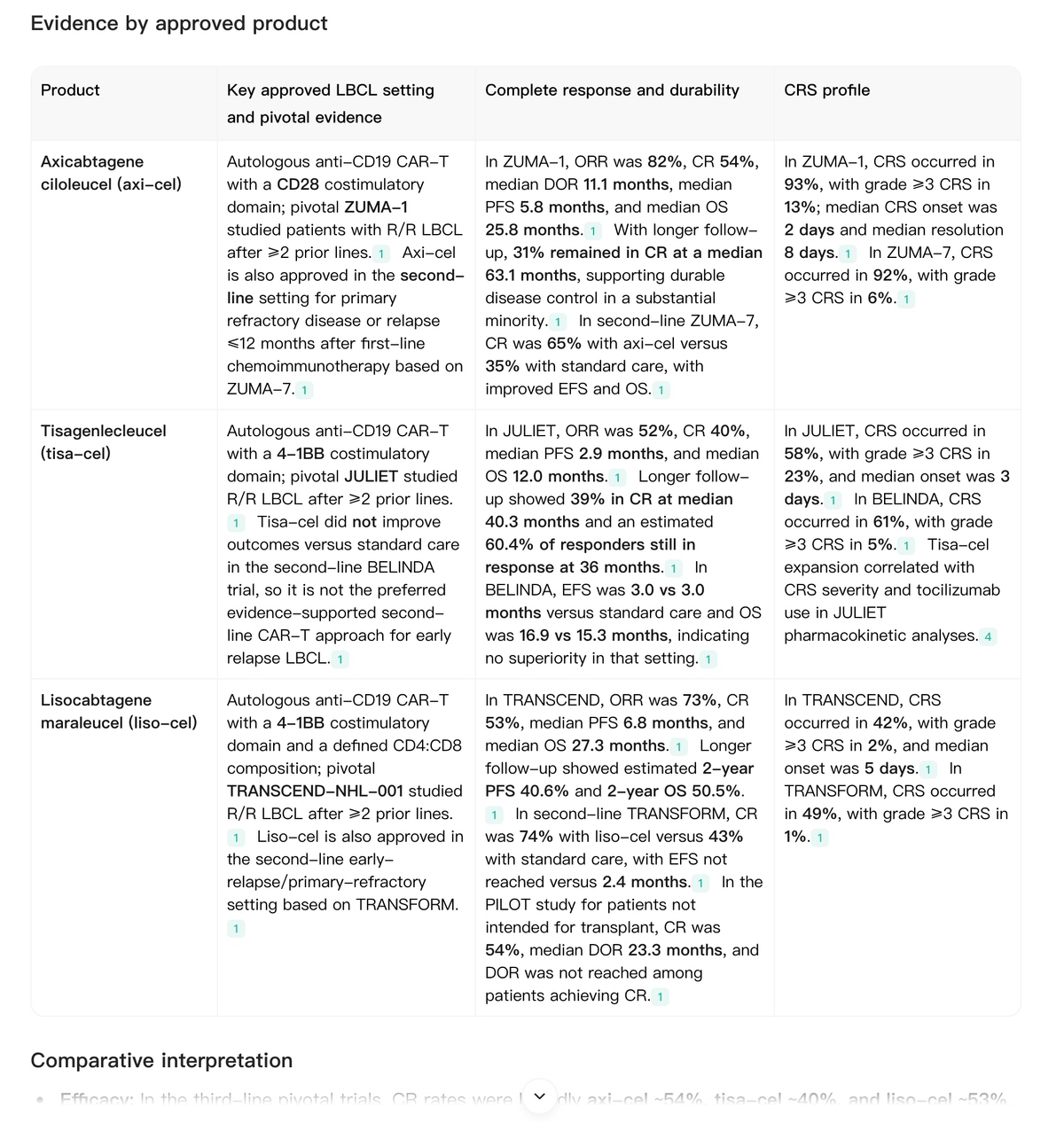
Figure 1. Noah AI structured evidence brief comparing axi-cel, tisa-cel, and liso-cel for relapsed or refractory B-cell lymphoma, with cited findings on response rates, durability, and CRS.
Building a Multi-Tool Workflow
For comprehensive research, many researchers combine tools across categories:
- Phase 1 — Scoping: Use Noah AI to get an initial structured evidence overview of your topic. Identify which sub-questions, trials, and evidence gaps deserve deeper investigation.
- Phase 2 — Data extraction: Use Elicit to build an evidence table comparing specific outcomes across the key trials identified in Phase 1.
- Phase 3 — Discovery: Use Semantic Scholar's citation features to find related papers, including recent publications that cite key trials.
- Phase 4 — Documentation: Run a formal PubMed Advanced Search to create a reproducible, documented search strategy for your methods section.
This multi-tool approach uses each tool where it's strongest, rather than asking any single tool to do everything.
Try Noah AI for Free
Use Noah AI to search, compare, and analyze biomedical evidence with AI-powered research workflows.
Free credits are available, and no credit card is required to get started.
FAQ
Can one AI tool handle all my PubMed search needs?
For many research questions, a single tool like Noah AI can provide a useful starting point. But for systematic reviews, building evidence tables, or deep citation exploration, combining tools by function can be more appropriate. See our full tools comparison for details.
Which tool should I try first if I've never used AI for PubMed?
You can start with Noah AI if your goal is a structured PubMed-focused evidence overview from a natural-language question. See our step-by-step tutorial for a walkthrough.
Are these tools accurate enough for clinical decisions?
AI tools can help find and organize evidence, but they are not decision-making tools. Always verify findings against original papers and appropriate clinical guidelines.
Do I still need PubMed Advanced Search if I use AI tools?
Yes, for systematic reviews and any work requiring a documented, reproducible search strategy. AI tools complement traditional search but do not replace transparent database-search methods.