Best AI Tools for Drug Efficacy and Safety Comparison (2026)
Linda
Compare the best AI tools for drug efficacy and safety comparison. We test Noah AI on the SURMOUNT-5 head-to-head trial of tirzepatide versus semaglutide.
Comparing two drugs is not simply a matter of putting efficacy percentages and adverse-event rates next to each other. The evidence only supports a direct comparison when study design, patient population, treatment setting, follow-up, endpoint definitions, and exposure are sufficiently aligned.
That is why head-to-head randomized trials are especially useful for drug efficacy and safety comparison. They place both treatments inside the same study framework, reducing many of the interpretation problems that arise when data are taken from separate trials.
AI research tools can help researchers retrieve the relevant evidence, extract efficacy and safety outcomes, preserve trial context, and turn the findings into a structured comparison. The quality of the final answer, however, depends on whether the tool keeps the evidence source and interpretation limits visible.
Evaluation note: We tested Noah AI directly using the SURMOUNT-5 head-to-head trial of tirzepatide versus semaglutide. Other tools were evaluated from their current official documentation and published workflows.
What Makes a Good Drug Efficacy and Safety Comparison?
A useful comparison should answer more than “which drug worked better?”
Researchers usually need to establish:
- whether the drugs were compared directly or indirectly,
- the study population and treatment setting,
- the primary efficacy endpoint,
- key secondary efficacy outcomes,
- overall and common adverse-event patterns,
- treatment discontinuations due to adverse events,
- serious or clinically important safety findings,
- whether the study was powered for a formal safety comparison,
- which claims come from the trial and which come from prescribing information.
These distinctions are important because efficacy and safety evidence do not always have the same statistical strength. A trial may be designed and powered to test efficacy superiority without being powered to detect small differences in uncommon adverse events.
Best AI Tools for Drug Efficacy and Safety Comparison
| Tool | Best For | Clinical Evidence Search | Efficacy Extraction | Safety Extraction | Comparison Output |
|---|---|---|---|---|---|
| Noah AI | Structured biomedical drug comparison | Strong | Strong | Strong | Structured cited comparison |
| Elicit | Evidence synthesis across multiple studies | Strong | Strong | Strong | Evidence tables and reports |
| Consensus | Rapid peer-reviewed evidence exploration | Strong | Moderate–Strong | Moderate | Literature synthesis |
| SciSpace | Extracting details from clinical papers and PDFs | Strong | Strong | Strong | Paper-level extraction |
| ChatGPT Deep Research | Multi-source clinical research | Strong | Strong | Strong | Documented research report |
| Perplexity Research | Fast cross-source orientation | Moderate–Strong | Moderate–Strong | Moderate–Strong | Cited research report |
Noah AI
Best for: turning a biomedical drug-comparison question into a structured, cited efficacy and safety analysis.
Noah AI is particularly relevant when the researcher wants the comparison to remain tied to identifiable clinical evidence rather than receiving a generic answer generated from model memory.
The workflow can begin with a drug-level question, specify which study should be treated as the primary comparative evidence, and request separate treatment of efficacy, safety, and interpretation limitations.
Example: Tirzepatide vs Semaglutide in SURMOUNT-5
We tested Noah using SURMOUNT-5, a phase 3b randomized, open-label head-to-head trial comparing tirzepatide with semaglutide in adults with obesity but without type 2 diabetes.
The trial randomized 751 participants and evaluated the maximum tolerated dose of tirzepatide 10 mg or 15 mg versus semaglutide 1.7 mg or 2.4 mg once weekly for 72 weeks.
The prompt asked Noah to compare trial design, the primary efficacy endpoint, key secondary efficacy outcomes, adverse events, gastrointestinal events, discontinuations, serious safety findings, prescribing-information warnings, and the limitations of the safety comparison.
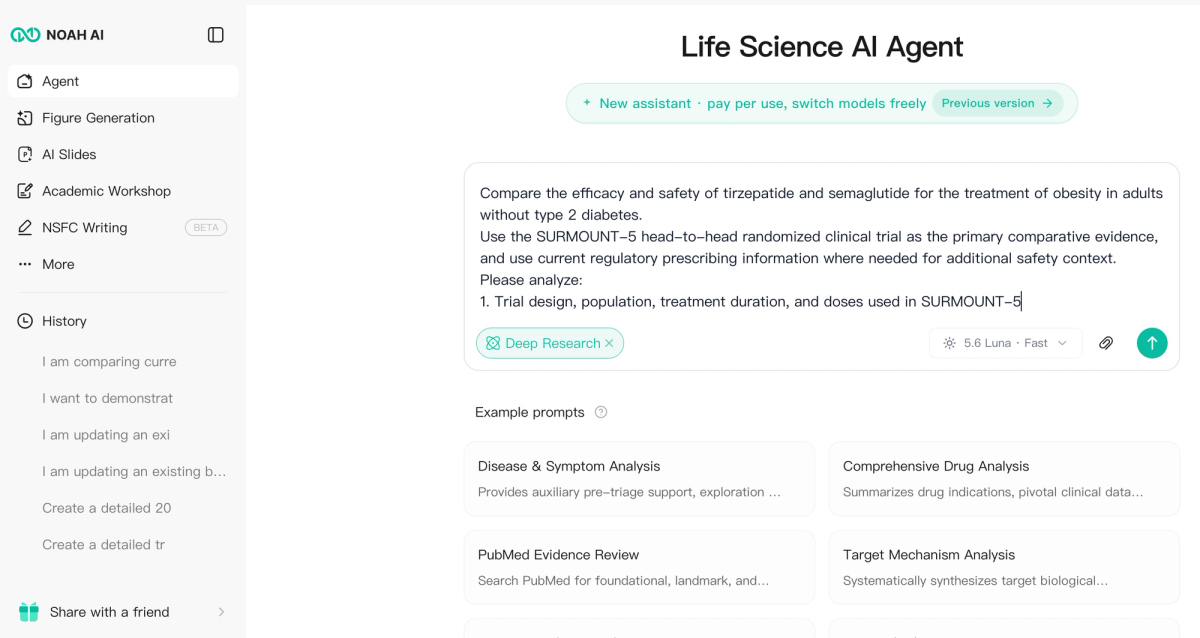
A head-to-head drug efficacy and safety comparison prompt entered into Noah AI using the SURMOUNT-5 trial.
What Noah Returned
Noah began with a concise overall comparison that separated the efficacy conclusion from the more cautious safety interpretation. It then organized the trial design and head-to-head efficacy outcomes into structured tables with source citations.
In SURMOUNT-5, the least-squares mean percentage change in body weight at week 72 was −20.2% with tirzepatide and −13.7% with semaglutide. The between-group difference was statistically significant.
Waist circumference also decreased more with tirzepatide: −18.4 cm versus −13.0 cm with semaglutide. Participants receiving tirzepatide were more likely to reach the prespecified 10%, 15%, 20%, and 25% weight-loss thresholds.
For safety, the most common adverse events in both groups were gastrointestinal and were generally mild to moderate, occurring mainly during dose escalation. Treatment discontinuation due to adverse events was reported in 6.1% of participants receiving tirzepatide and 8.0% receiving semaglutide.
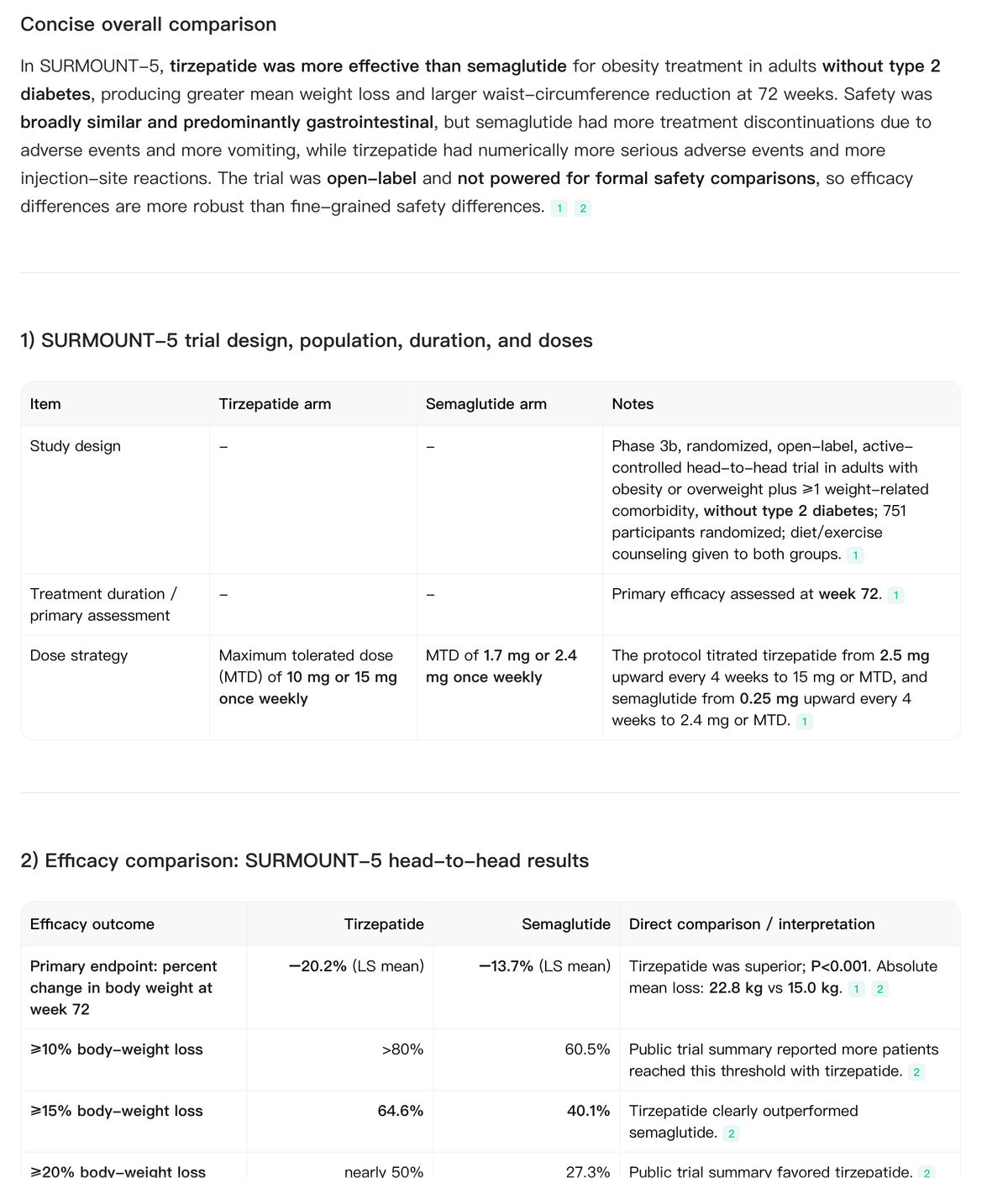
Noah AI summarizes the head-to-head efficacy and safety interpretation from SURMOUNT-5 and organizes trial design and efficacy outcomes into a cited comparison.
Why the Head-to-Head Design Matters
This case is more appropriate for a direct drug comparison than placing results from two unrelated trials side by side. Both drugs were studied within the same randomized trial, in the same broad patient population, over the same 72-week treatment period.
Even then, the interpretation needs qualification. SURMOUNT-5 was designed to test efficacy superiority and was not powered to establish formal differences in safety and tolerability. Small numerical differences in adverse-event rates should therefore not be treated as definitive evidence that one drug has a universally better safety profile.
Elicit
Best for: evidence extraction and synthesis when the comparison spans multiple studies.
Elicit is particularly useful when a drug comparison cannot be answered by one head-to-head trial and the researcher needs to assemble evidence across a larger literature set.
Its Research Agent can search scientific sources, extract structured information, and generate reports or tables. This is useful for organizing fields such as patient population, intervention, comparator, efficacy endpoints, safety outcomes, and follow-up across multiple studies.
The main caution remains study comparability: a clean evidence table does not by itself make separate trials directly comparable.
Official documentation: Introducing Elicit Research Agent.
Consensus
Best for: fast exploration of peer-reviewed evidence around efficacy or safety questions.
Consensus is useful when the first task is understanding what the academic literature says about a focused question. Its Deep Review workflow can break a question into subquestions, run targeted searches, and synthesize the most relevant papers.
Typical questions might include:
- Which trials directly compared drug A with drug B?
- What efficacy endpoints have been reported for both drugs?
- Which adverse events are repeatedly reported in randomized trials?
- Where does the literature disagree?
Official documentation: Consensus Deep Review.
SciSpace
Best for: extracting efficacy and safety details from trial publications and PDFs.
Important clinical data often sit inside tables, methods sections, appendices, or supplementary documents rather than the abstract.
SciSpace can help researchers locate and inspect those details within individual papers. This is useful when the main bottleneck is paper-level extraction rather than broad evidence discovery.
For example, researchers can investigate:
- the exact efficacy analysis population,
- endpoint definitions,
- adverse-event frequencies,
- discontinuations,
- serious adverse events,
- study limitations.
Official documentation: How to Conduct a Literature Review Using SciSpace.
ChatGPT Deep Research
Best for: broad drug-comparison research across publications, registries, prescribing information, websites, and uploaded files.
Drug efficacy and safety evidence can be distributed across several source types. Deep Research can search the public web or specific sites, work with uploaded files, and generate a documented report with citations or source links.
This is useful when a comparison requires both trial evidence and broader regulatory or prescribing-information context.
Official documentation: Deep research in ChatGPT.
Perplexity Research
Best for: rapid cross-source research before a deeper evidence review.
Perplexity Research performs iterative searches, reads source material, and produces a synthesized report. It can be useful for quickly finding the major trials, regulatory sources, safety documents, and current literature relevant to a drug comparison.
As with any broad research tool, the researcher should verify important numerical outcomes against the original trial or regulatory document.
Official documentation: What is Perplexity Research mode?.
Try Noah AI for Free
Use Noah AI to search, compare, and analyze biomedical evidence with AI-powered research workflows.
Free credits are available, and no credit card is required to get started.
Direct Comparison Is Better Than Naive Cross-Trial Comparison
Drug-comparison articles often make a methodological mistake: they take an efficacy result from one trial and compare it directly with a result from another trial as if both estimates came from the same experiment.
That can be misleading when trials differ in population, baseline risk, treatment setting, dose, comparator, endpoint definition, follow-up, analysis population, or calendar time.
A useful AI workflow should therefore identify the evidence relationship before interpreting the numbers:
- Head-to-head randomized evidence: supports the clearest direct comparison.
- Separate randomized trials: useful for contextual comparison, not automatic ranking.
- Observational evidence: can add real-world context but introduces additional confounding.
- Prescribing information: useful for approved safety warnings and product-specific context.
How to Compare Drug Efficacy and Safety with AI
Define the Clinical Question
Specify the population, indication, treatment setting, drugs, outcomes, and time horizon. “Compare drug A and drug B” is usually too broad.
Look for Head-to-Head Evidence First
Before assembling separate trials, determine whether a randomized direct comparison already exists. This can substantially improve interpretability.
Separate Efficacy from Safety
Extract efficacy outcomes and safety outcomes into separate fields rather than compressing them into a single “better/worse” conclusion.
Preserve Outcome Definitions
Record the exact endpoint, analysis population, follow-up, treatment dose, and statistical measure behind each result.
Distinguish Trial Safety from Label Warnings
An adverse-event rate observed in a trial and a warning in prescribing information are not the same type of evidence. They should be reported separately.
Check Whether Safety Differences Were Formally Tested
A trial powered for efficacy may not be powered to detect small differences in adverse events. Numerical differences should not automatically be interpreted as statistically established safety advantages.
Verify High-Impact Claims
Recheck numerical results, denominators, endpoint definitions, and safety findings against original publications, trial registries, and regulatory documents.
Which Tool Should You Choose?
Choose Noah AI when you want to start with a biomedical comparison question and produce a structured, cited analysis that keeps efficacy, safety, trial context, and interpretation limits visible.
Choose Elicit when the comparison requires evidence extraction across a larger set of studies or a systematic-review-style workflow.
Choose Consensus when you need fast exploration of peer-reviewed evidence around a focused efficacy or safety question.
Choose SciSpace when the main task is extracting detailed clinical information from individual trial papers or PDFs.
Choose ChatGPT Deep Research when the comparison spans publications, registries, websites, prescribing information, and uploaded files.
Choose Perplexity Research when you need rapid cross-source orientation before conducting a more rigorous evidence review.
Frequently Asked Questions
Can AI compare the efficacy and safety of two drugs?
Yes. AI can help retrieve, extract, and organize efficacy and safety evidence. The comparison is most reliable when the evidence comes from a direct head-to-head study or when limitations of indirect cross-trial comparison are clearly stated.
What is the best evidence for comparing two drugs?
A well-designed randomized head-to-head trial generally provides stronger direct comparative evidence than comparing results from separate trials. Formal meta-analysis or network meta-analysis may also be useful when direct trials are unavailable and appropriate assumptions can be met.
Can adverse-event rates from different trials be compared directly?
Usually not without qualification. Differences in exposure duration, population, event definitions, ascertainment, dose, and study design can materially affect adverse-event rates.
Should prescribing-information warnings be mixed with clinical trial adverse-event rates?
No. Trial-event frequencies and regulatory warnings provide different types of information and should be presented separately.
Can AI determine which drug is safer?
AI can summarize the available safety evidence, but a universal “safer” conclusion may not be justified. Safety depends on the patient population, outcome of interest, exposure, contraindications, warnings, and strength of comparative evidence.
Why use a head-to-head trial for an AI drug comparison example?
A head-to-head randomized trial evaluates both drugs within the same study framework, which makes the efficacy comparison more interpretable than simply placing results from unrelated trials side by side.
Final Takeaway
Drug efficacy and safety comparison is fundamentally an evidence-design problem, not just a summarization problem.
Elicit, Consensus, and SciSpace are useful at different stages of evidence discovery and paper-level analysis. General deep-research systems can help when the evidence spans multiple public and uploaded sources.
Noah AI is particularly relevant when the goal is to begin with a biomedical comparison question and produce a structured, cited output that keeps the trial design, efficacy outcomes, safety findings, and interpretation limits visible together.
The key rule is simple: prefer direct comparative evidence when available, and do not turn numerical differences into stronger conclusions than the study design supports.
Want to compare drug efficacy and safety with the same workflow? Use Noah AI to search medical evidence, organize head-to-head trial results, and turn the findings into a structured, cited comparison.
Related Research Guides
- Best AI Tools for Clinical Trial Results Analysis (2026)
- How to Analyze Clinical Trial Results with AI Using Noah AI
- Best AI Tools for Turning Research Questions into Evidence Tables (2026)
- Best AI Tools for Medical Literature Search and Research Writing (2026)
- Best Elicit Alternatives for Biomedical Literature Review (2026)