Best AI Tools for Critical Appraisal of Clinical Research Papers (2026)
Linda
Compare the best AI tools for critical appraisal of clinical research papers in 2026, with a real KEYNOTE-671 example covering risk of bias, validity, clinical significance, and applicability.
Summarizing a clinical paper is relatively easy. Critically appraising it is not.
A summary asks:
What did the study report?
Critical appraisal asks a more difficult set of questions:
What does the study actually establish, what methodological uncertainties remain, how clinically important are the results, and how far can the findings reasonably be applied beyond the trial population?
That requires more than extracting an abstract, P value, or hazard ratio.
Researchers need to examine randomization, allocation procedures, masking, endpoint definitions, missing data, statistical maturity, safety, external validity, and the difference between what a trial directly establishes and what readers may be tempted to infer.
AI can help researchers locate and organize the evidence needed for this process. It should not make the final methodological judgement on whether a study is simply “trustworthy” or “untrustworthy.”
To test how AI can support this workflow, we used Noah AI to critically appraise the randomized Phase 3 KEYNOTE-671 trial of perioperative pembrolizumab in resectable non-small cell lung cancer (NSCLC).
Quick Answer
The best AI tools for critical appraisal should do more than summarize a paper.
They should help researchers:
- separate reported facts from interpretation;
- identify evidence relevant to risk of bias;
- examine endpoint definitions and statistical maturity;
- compare efficacy with treatment burden and safety;
- identify limits to generalizability;
- distinguish what the study supports from what it does not establish;
- and surface methodological questions that require additional source verification.
AI can assist with evidence extraction, organization, and reasoning.
The final judgement about risk of bias, certainty, applicability, and methodological credibility remains a human research task supported by primary-source verification and established appraisal frameworks.
Best AI Tools for Critical Appraisal of Clinical Research Papers
Different tools are useful at different stages of the appraisal workflow.
No single tool removes the need to inspect the original publication.
⚠️ 待补表格|工具对比表(飞书内嵌表,接口读不到,需作者补行列文字)
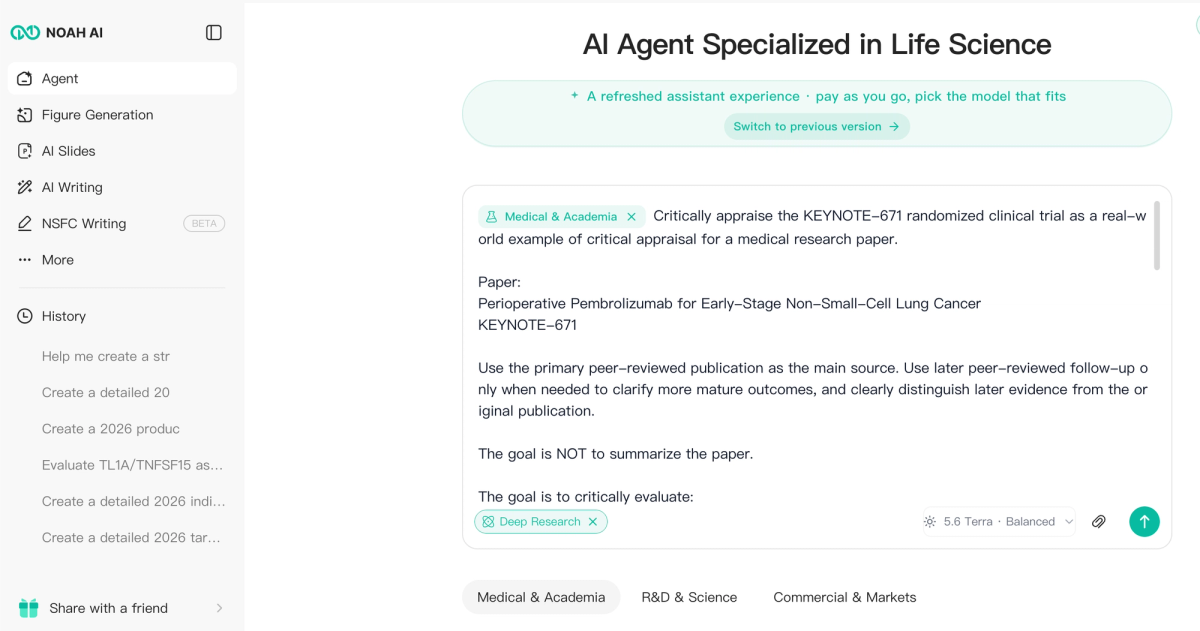
We tested Noah AI directly in the workflow shown below.
Other tools are included based on their documented roles in literature review, paper reading, evidence extraction, citation analysis, and research reasoning.
What Is Critical Appraisal?
Critical appraisal is a structured evaluation of the methodological strengths, uncertainties, clinical relevance, and applicability of research evidence.
The goal is not to find faults for the sake of finding faults.
The goal is to identify the evidence that should inform a researcher’s judgement about how much confidence a particular result deserves.
| Tool | Useful For | Role in Critical Appraisal |
|---|---|---|
| Noah AI | Biomedical and clinical research analysis | Structuring appraisal questions, linking evidence to sources, identifying methodological uncertainties, and examining clinical applicability |
| Elicit | Structured paper extraction | Comparing study characteristics, methods, populations, and reported outcomes |
| SciSpace | Reading full-text papers | Inspecting methods, results, definitions, and paper-specific details |
| Scite | Citation context | Checking how later publications support, discuss, or challenge a claim |
| ChatGPT | General research reasoning | Explaining statistical, methodological, and appraisal concepts |
| PubMed | Primary biomedical literature | Verifying original publications, follow-up papers, PMIDs, and publication history |
A paper can report statistically significant results and still require careful interpretation.
Likewise, an important randomized trial can contain strong design features while still leaving unanswered questions about applicability, endpoint interpretation, missing information, or extrapolation.
The Real Clinical Trial We Used
For this example, we critically appraised:
KEYNOTE-671 — Perioperative Pembrolizumab for Early-Stage Non-Small-Cell Lung Cancer
The core clinical question was whether adding perioperative pembrolizumab to cisplatin-based neoadjuvant chemotherapy improves outcomes in patients with previously untreated, resectable stage II, IIIA, or N2-limited stage IIIB NSCLC.
The trial compared pembrolizumab plus chemotherapy followed by surgery and postoperative pembrolizumab with the same chemotherapy and surgical framework plus matching placebo.
Start With the Clinical Question, Not the Abstract Conclusion
Before judging whether a paper is convincing, reconstruct the actual research question.
A PICO framework helps:
| Paper Summary | Critical Appraisal |
|---|---|
| What was studied? | Was the research question clinically appropriate? |
| What were the results? | Could important sources of bias affect the result? |
| What was statistically significant? | Was the effect clinically meaningful? |
| Who participated? | How closely does the target patient resemble the study population? |
| What did the authors conclude? | Does the design directly support that conclusion? |
The distinction between neoadjuvant and perioperative treatment matters.
KEYNOTE-671 tested a complete treatment strategy before and after surgery.
It therefore does not isolate pembrolizumab in only one treatment phase.
That distinction becomes important later when interpreting what the trial can and cannot establish.
Ask AI to Appraise the Paper — Not Just Summarize It
A weak prompt would be:
Summarize KEYNOTE-671.
That usually produces study design, sample size, outcomes, and the authors’ conclusions.
Useful, but not enough.
Instead, we explicitly asked Noah AI to examine:
- internal validity;
- evidence relevant to risk of bias;
- endpoint definitions;
- statistical interpretation;
- clinical significance;
- safety;
- applicability;
- methodological limitations;
- and conclusions that go beyond what the randomized comparison directly establishes.
We also asked Noah to keep the primary publication separate from later follow-up evidence.
What Noah Flagged in the KEYNOTE-671 Appraisal
The Noah workflow did not simply restate the efficacy results.
It surfaced specific questions that required methodological interpretation and source verification.
1.1 A methodological risk or uncertainty to investigate
The available evidence supported centralized randomization and treatment masking.
However, some methodological details—such as the exact allocation-concealment procedures and certain details related to missing data or protocol deviations—were not fully verified from the retrieved evidence.
The appropriate response is not to assume those domains are automatically low risk.
Instead, Noah surfaced them as questions requiring additional verification in the full publication, protocol, statistical analysis plan, or supplementary materials.
1.2 An applicability limitation
KEYNOTE-671 enrolled previously untreated patients with resectable stage II, IIIA, or N2-limited stage IIIB NSCLC and ECOG performance status 0–1.
The findings therefore apply most directly to relatively fit, operable patients who resemble the enrolled trial population.
The trial does not by itself establish the same benefit–risk balance for:
- substantially frailer patients;
- unresectable NSCLC;
- patients who have already received systemic therapy;
- or clinical settings in which the complete perioperative treatment pathway cannot be delivered.
1.3 A conclusion the trial cannot support
KEYNOTE-671 does not prove that perioperative pembrolizumab is superior to other perioperative immunotherapy regimens.
Those regimens were not randomized comparators in this trial.
The trial also cannot determine how much of the observed treatment benefit came from:
- the neoadjuvant pembrolizumab component;
- the postoperative pembrolizumab component;
- or the complete perioperative strategy as a combined package.
These are examples of how AI can help identify interpretive boundaries.
They are inputs to critical appraisal, not final methodological verdicts.
Researchers still need to verify the original sources and apply an appropriate appraisal framework before making a final judgement.
Free to use · Free credits included · No credit card required
Run This Critical Appraisal Workflow with Noah AI →
Read the Methods Before the Results
One of the simplest ways to improve critical appraisal is to avoid letting the abstract conclusion frame the entire interpretation.
Before focusing on efficacy numbers, examine:
- randomization;
- allocation procedures;
- blinding;
- the comparator;
- eligibility criteria;
- analysis population;
- endpoint definitions;
- missing data;
- participant flow;
- and follow-up maturity.
A statistically impressive result does not repair a fundamentally biased design.
Likewise, a randomized design should not automatically end the risk-of-bias assessment.
Was Randomization Adequate?
“Randomized” should never be the end of the appraisal.
KEYNOTE-671 used 1:1 central assignment through an interactive response technology system, with stratification by:
- disease stage;
- PD-L1 expression;
- histology;
- and geographic region.
These features support internal validity because they reduce opportunities for investigators to influence treatment assignment and help balance important prognostic factors.
But critical appraisal should also distinguish between:
what the available source explicitly documents
and
what the reviewer assumes probably occurred.
If a specific sequence-generation or allocation-concealment procedure cannot be verified from the sources being reviewed, it should be flagged for further verification rather than silently assumed.
Was Blinding Sufficient?
KEYNOTE-671 was double-blind and placebo-controlled.
Participants, investigators, and sponsor personnel were masked, while local pharmacists were unmasked for treatment preparation.
That provides useful protection against several sources of bias.
But a perioperative study introduces additional questions.
Researchers may still need to determine:
- Were surgeons blinded?
- Were pathologists blinded?
- Were outcome assessors blinded?
- Could knowledge of treatment assignment influence decisions about operability?
- Could it influence adverse-event attribution?
- Could it influence treatment continuation?
If the retrieved evidence does not adequately document one of these procedures, the correct response is:
information not yet verified
rather than automatically assigning a favourable methodological judgement.
Evaluate the Population Before Generalizing the Result
Internal validity and applicability answer different questions.
Internal validity asks whether the observed treatment comparison is likely to reflect the effect of the randomized strategies.
Applicability asks how closely another patient, centre, or treatment setting resembles the context in which the evidence was generated.
KEYNOTE-671 enrolled a selected population:
previously untreated patients with resectable stage II, IIIA, or N2-limited stage IIIB NSCLC and ECOG performance status 0–1.
| PICO Element | KEYNOTE-671 |
|---|---|
| Population | Previously untreated, resectable stage II, IIIA, or N2-limited stage IIIB NSCLC |
| Intervention | Pembrolizumab + cisplatin-based neoadjuvant chemotherapy, surgery, then adjuvant pembrolizumab |
| Comparator | Matching placebo + the same neoadjuvant chemotherapy and surgical pathway |
| Primary outcomes | Event-free survival and overall survival |
The correct interpretation is not that the evidence is weak because the population is selected.
Most randomized clinical trials use defined eligibility criteria.
The appraisal question is:
How far beyond that population is extrapolation justified?
Appraise Each Endpoint Separately
EFS, OS, MPR, and pCR should not be collapsed into one generic category called “efficacy.”
Each endpoint answers a different clinical question.
Event-Free Survival
KEYNOTE-671 defined EFS broadly to include events such as:
- local progression preventing planned surgery;
- unresectable disease;
- progression or recurrence;
- and death.
This is clinically relevant in a perioperative trial because treatment failure can occur before or after surgery.
But EFS is also a composite endpoint.
Losing surgical eligibility, experiencing postoperative recurrence, and dying are all clinically important, but they are not clinically identical events.
A critical appraisal should therefore understand both:
why the composite endpoint is useful
and
what is being combined inside it.
Overall Survival
OS is more straightforward because it measures death from any cause.
An important appraisal point in KEYNOTE-671 is that the original first-interim OS analysis did not meet its prespecified statistical significance criterion.
A later peer-reviewed follow-up with longer follow-up did meet its prespecified OS threshold.
Those two time points should not be collapsed into one undifferentiated result.
Evidence maturity changes over time.
A critical appraisal should therefore state which data cutoff or publication is being interpreted.
Pathological Complete Response
pCR provides an earlier measure of pathological treatment activity.
But a higher pCR rate should not automatically be interpreted as:
- proof of cure;
- proof of long-term survival for an individual patient;
- or a complete replacement for mature survival evidence.
The endpoint can be clinically informative without supporting conclusions beyond what it directly measures.
Statistical Significance Is Not the Same as Clinical Importance
P values answer a narrow statistical question.
They do not tell researchers how much a result matters clinically.
Critical appraisal should also consider:
- relative effect;
- confidence intervals;
- absolute differences;
- follow-up duration;
- treatment burden;
- toxicity;
- and the clinical meaning of the endpoint.
| Trial Population Feature | Clinical Question to Ask |
|---|---|
| ECOG 0–1 | Does the same benefit–risk balance apply to substantially frailer patients? |
| Resectable disease | Should the result be extrapolated to unresectable disease? |
| Previously untreated patients | Does the evidence apply after prior systemic therapy? |
| Trial-selected surgical candidates | Can the complete treatment pathway be delivered similarly in routine practice? |
A critical appraisal should avoid turning one favourable efficacy measure into an overall judgement about the treatment without considering the rest of the evidence package.
Check Attrition and Missing Data
Perioperative trials are especially vulnerable to complicated participant flow.
Patients may:
- discontinue treatment before surgery;
- become unresectable;
- not undergo surgery;
- lack evaluable pathology;
- not begin postoperative treatment;
- or stop therapy because of toxicity.
Intention-to-treat analysis protects the randomized treatment comparison.
But participant-flow information still matters because it shows how often the intended treatment pathway was actually completed.
This is particularly relevant when the intervention is not one isolated drug exposure but a multi-stage perioperative strategy.
Appraise Safety With the Same Rigor as Efficacy
Avoid vague conclusions such as:
The safety profile was manageable.
Instead, ask exactly what was measured.
Distinguish between:
- all-cause adverse events;
- treatment-related adverse events;
- grade ≥3 events;
- treatment-related deaths;
- immune-mediated events;
- treatment discontinuation;
- and surgical complications.
Also verify whether safety and efficacy use the same analysis population.
A treatment can improve an efficacy endpoint and still create additional treatment burden or toxicity.
Those findings should be interpreted together rather than in separate narratives.
Build a Domain-by-Domain Appraisal Before Assigning Risk of Bias
Risk of bias should not be reduced to:
Randomized trial = low risk.
Different methodological domains require separate evidence.
A structured appraisal may examine:
- the randomization process;
- deviations from intended interventions;
- missing outcome data;
- outcome measurement;
- and selection of the reported result.
In our Noah workflow, the available evidence supported several important design strengths, including centralized randomization and masking.
Other methodological questions required additional verification rather than assumptions.
For example, where the retrieved evidence did not completely document a procedure, Noah surfaced that gap instead of converting missing information into a favourable rating.
⚠️ 待补图片|Noah AI evidence review for risk-of-bias considerations in the KEYNOTE-671 clinical trial(飞书图片,接口暂不可用)
When a formal risk-of-bias judgement is required, researchers should apply an established framework such as Cochrane RoB 2 to the specific result being assessed.
AI can help retrieve and organize evidence relevant to those domains.
It should not replace the framework or the researcher’s final judgement.
Separate “What the Trial Establishes” From “What It Does Not Establish”
This is one of the most useful parts of critical appraisal.
What KEYNOTE-671 Supports
The trial supports that:
- the tested perioperative pembrolizumab strategy improved EFS versus its randomized control;
- pathological response rates were higher with the pembrolizumab strategy;
- later follow-up supports an OS benefit;
- and severe treatment-related toxicity was more frequent with pembrolizumab.
What KEYNOTE-671 Does Not Establish
The trial does not establish that:
- perioperative pembrolizumab is superior to other perioperative immunotherapy regimens;
- every patient with resectable NSCLC should receive the regimen;
- pCR fully predicts long-term survival;
- the neoadjuvant and adjuvant pembrolizumab components contribute equally to the observed benefit;
- or patients substantially different from the enrolled population will experience an equivalent benefit–risk balance.
These are not criticisms of the trial.
They are boundaries created by the research question and randomized comparison.
Good critical appraisal makes those boundaries explicit.
Internal Validity and Generalizability Are Different Questions
| Concept | Question |
|---|---|
| Internal validity | Are the observed differences likely to reflect the randomized treatment comparison? |
| External validity / applicability | How closely do the target patients, centres, and treatment context resemble those studied in the trial? |
A trial can have strong internal validity and still have narrower applicability.
Those are not contradictory conclusions.
For example, strong randomization and masking can support confidence in the randomized comparison while eligibility criteria still limit how confidently the findings can be extrapolated to frailer or otherwise different populations.
Summarize the Major Strengths and Limitations
A useful final appraisal should put the strongest arguments on both sides in the same view.
For KEYNOTE-671, important strengths include:
- randomized Phase 3 design;
- placebo control;
- treatment masking;
- a clinically relevant perioperative comparator;
- survival endpoints;
- and later follow-up evidence.
Important interpretive limitations or boundaries include:
- a selected, relatively fit surgical population;
- a composite EFS endpoint;
- additional treatment-related toxicity;
- a treatment strategy spanning both neoadjuvant and adjuvant phases;
- and methodological details that may require verification from sources beyond the main publication.
Build a Bottom-Line Appraisal Without Letting AI Make the Final Judgement
Avoid ending with:
This was a high-quality study.
That is too vague.
It collapses multiple methodological questions into one label.
A stronger final appraisal separates the evidence into distinct dimensions.
Design Strengths
KEYNOTE-671 used a randomized, double-blind, placebo-controlled design, which provides important protection against several potential sources of bias.
Methodological Uncertainty
Some methodological details may still require verification from the full publication, protocol, statistical analysis plan, or supplementary materials rather than being inferred from abbreviated reporting.
Clinical Importance
The trial showed meaningful EFS improvement and later OS benefit, while also adding treatment burden and toxicity.
Applicability
The evidence applies most directly to fit, previously untreated patients with resectable NSCLC who resemble the enrolled population.
Interpretive Boundary
The trial supports the tested perioperative pembrolizumab strategy versus its randomized control.
It does not establish superiority over other perioperative immunotherapy regimens.
It also does not isolate the relative contribution of neoadjuvant versus postoperative pembrolizumab.
The role of AI is to organize these questions, retrieve relevant evidence, and surface areas that deserve attention.
The final judgement about risk of bias, certainty, methodological credibility, and applicability should be made by the researcher after primary-source verification and, where appropriate, application of a formal appraisal framework.
AI Tools Still Need Human Appraisal Frameworks
Not every useful critical-appraisal resource needs to be AI-based.
Established methodological frameworks remain important because they force reviewers to answer predefined questions rather than accepting a narrative interpretation at face value.
A practical workflow is:
AI-assisted evidence extraction → structured appraisal questions → primary-source verification → formal framework where required → researcher judgement
This division of labour is important.
AI is useful for helping researchers work through large or complex evidence packages.
But an AI-generated answer should not be treated as an independent certification that a study is “low quality,” “high quality,” “trustworthy,” or “untrustworthy.”
Those judgements depend on:
- the exact result being assessed;
- the methodological framework;
- the available documentation;
- the clinical question;
- and human interpretation.
Common Critical-Appraisal Mistakes
- Treating “randomized” as proof of zero bias
Randomization reduces confounding, but allocation procedures, missing data, deviations from intervention, outcome measurement, and reporting still matter.
- Reading the abstract before understanding the methods
A strong abstract conclusion can frame how the rest of the paper is interpreted. Understand the study design and endpoint definitions first.
- Confusing a P value with clinical importance
Statistical significance should be interpreted alongside effect size, absolute benefit, confidence intervals, toxicity, treatment burden, and follow-up.
- Ignoring analysis timing
An immature interim analysis and a later mature follow-up are different pieces of evidence. Do not merge them without specifying the relevant publication or data cutoff.
- Assuming an intermediate endpoint proves survival benefit
pCR, MPR, response rate, and other intermediate outcomes may be informative. They should not automatically be treated as substitutes for OS unless that interpretation is justified.
- Generalizing beyond the enrolled population
A trial result is strongest for patients who resemble the population that generated the evidence. Extrapolation should be explicit rather than assumed.
- Letting AI assign a final credibility label
AI can identify relevant methodological evidence and missing information. The final appraisal still requires primary-source verification and human methodological judgement.
Researcher Verification Checklist
Before accepting an AI-assisted critical appraisal, verify:
- the correct primary publication;
- trial phase and design;
- randomization procedures;
- allocation procedures;
- population and eligibility criteria;
- intervention and comparator;
- endpoint definitions;
- analysis population;
- effect estimates and confidence intervals;
- interim versus mature follow-up;
- safety definitions and denominators;
- missing-data and attrition information;
- relevant protocol or supplementary information;
- and any unsupported extrapolation beyond the randomized comparison.
Also ask:
Which statements came directly from the study, and which are interpretations?
That distinction should remain visible in the final appraisal.
Frequently Asked Questions
Can AI critically appraise a clinical research paper?
AI can assist with critical appraisal by extracting study-design details, organizing evidence, identifying methodological questions, examining endpoint definitions, and surfacing potential limitations or unsupported extrapolations.
It should not independently make the final methodological judgement.
Researchers should verify important findings against the original publication and apply appropriate appraisal frameworks where required.
What is the difference between critical appraisal and paper summarization?
Summarization describes what the study did and found.
Critical appraisal examines whether the methods support the reported findings, what uncertainties remain, how clinically important the results are, and how far the conclusions can reasonably be applied.
What should I check first in a randomized clinical trial?
Start with:
- the research question;
- randomization;
- allocation;
- blinding;
- comparator;
- population;
- endpoint definitions;
- analysis population;
- participant flow;
- and follow-up maturity.
Only then move to the headline efficacy results.
Does randomization mean a trial has low risk of bias?
Not automatically.
Randomization is one important protection, but other domains such as missing data, deviations from intended intervention, outcome measurement, and reporting still need assessment.
Is statistical significance the same as clinical significance?
No.
Statistical significance concerns the statistical compatibility of the observed data with a specified null hypothesis.
Clinical importance also requires consideration of:
- effect size;
- absolute benefit;
- confidence intervals;
- toxicity;
- treatment burden;
- follow-up;
- and relevance to the target population.
Can AI replace a formal risk-of-bias tool?
No.
AI can help retrieve, summarize, and organize evidence relevant to a risk-of-bias assessment.
A formal risk-of-bias framework and direct verification of the relevant source material remain important when a defensible methodological judgement is required.
Can AI decide whether a paper is trustworthy?
Not on its own.
“Trustworthy” is too broad to be treated as a simple AI-generated label.
Different outcomes within the same study may involve different methodological considerations, and applicability may also vary across populations and clinical contexts.
AI is more useful when it shows why a specific methodological issue deserves attention than when it produces a single overall credibility label.
Final Takeaway
Critical appraisal is not about deciding whether a paper is simply “good” or “bad.”
It is about asking:
What does this evidence directly establish, what methodological uncertainties remain, how clinically meaningful is the result, and where should interpretation stop?
In the KEYNOTE-671 example, Noah helped surface concrete appraisal questions rather than merely summarizing the trial.
It identified:
- methodological details requiring further verification;
- limits to applying the evidence beyond the enrolled surgical population;
- and conclusions that cannot be inferred from the randomized comparison, including superiority over other perioperative immunotherapy regimens.
The randomized, placebo-controlled, double-blind design provides important support for the treatment comparison, while later follow-up strengthens the survival evidence.
But rigorous appraisal still requires clear boundaries.
KEYNOTE-671 evaluates a complete perioperative treatment strategy.
EFS is a composite endpoint.
Treatment-related toxicity is higher.
The population is selected.
And the trial cannot answer every comparative or treatment-component question that readers may want to ask.
That is where AI can be most useful:
reported result → relevant methodological evidence → identified uncertainty → source verification → human judgement
AI can help researchers move through that workflow more efficiently.
It should not replace the final methodological judgement.
Critically Appraise Medical Research with Noah AI
Use Noah AI to examine study design, endpoint definitions, statistical interpretation, evidence relevant to risk of bias, clinical significance, applicability, strengths, limitations, and unsupported extrapolations in biomedical research papers.
Free to use · Free credits included · No credit card required
Critically Appraise a Research Paper with Noah AI →