Best AI Tools for Clinical Trial Patient Population Comparison (2026)
Linda
Compare AI tools for clinical trial patient population analysis, with a real Noah AI case across DESTINY-Breast03, Breast04, and Breast06.
Two clinical trials can study the same drug class or the same broad disease area and still enroll fundamentally different patients.
That matters because cross-trial comparisons often go wrong before anyone reaches the efficacy table. If one study enrolled HER2-positive disease after HER2-directed therapy, another enrolled HER2-low disease after metastatic chemotherapy, and a third enrolled HR-positive HER2-low or ultralow disease before metastatic chemotherapy, their outcome percentages should not be treated as though they came from interchangeable populations.
Clinical trial patient population comparison is therefore a distinct research task: before comparing results, researchers need to determine who was actually eligible, who was ultimately enrolled, and where the populations meaningfully diverge.
Real-case test: We used Noah AI to compare the patient populations of DESTINY-Breast03, DESTINY-Breast04, and DESTINY-Breast06.
Can These Three Trial Populations Be Compared Directly?
Not as equivalent efficacy populations.
All three trials evaluated trastuzumab deruxtecan in unresectable or metastatic breast cancer, but they answered different clinical questions and enrolled different biological and treatment populations.
| Trial | Core Population | Prior-Treatment Context | What Makes It Different |
|---|---|---|---|
| DESTINY-Breast03 | HER2-positive metastatic breast cancer | Prior trastuzumab and taxane exposure | Conventional HER2-positive biology and an established HER2-directed treatment pathway. |
| DESTINY-Breast04 | HER2-low metastatic breast cancer | Previously treated with chemotherapy in the metastatic setting | Mostly HR-positive and more treatment-experienced than the DESTINY-Breast06 population. |
| DESTINY-Breast06 | HR-positive, HER2-low or HER2-ultralow metastatic breast cancer | Prior endocrine therapy but no metastatic chemotherapy | A chemotherapy-naive metastatic population after endocrine progression. |
The shared drug does not erase those differences. Population context has to come before numerical outcome comparison.
Why Patient Population Comparison Comes Before Efficacy Comparison
Researchers often begin cross-trial analysis with PFS, OS, ORR, or adverse-event rates. But those outcomes only become interpretable after the population is understood.
At minimum, a useful patient population comparison should examine:
- disease setting and subtype,
- biomarker definition,
- hormone-receptor status,
- prior systemic treatment,
- prior chemotherapy exposure,
- prior targeted therapy,
- prior endocrine therapy,
- treatment line,
- CNS eligibility,
- and important baseline characteristics.
These variables can change prognosis, treatment sensitivity, expected outcomes, and the clinical role of the intervention.
A Real Noah AI Patient-Population Comparison Workflow
For this case, we asked Noah a deliberately narrow question: compare the populations rather than compare which DESTINY trial produced the strongest efficacy result.
The refreshed Noah Agent workflow was configured with:
- Agent
- Medical & Academia
- Deep Research
- 5.6 Terra · Balanced
The prompt asked Noah to distinguish eligibility criteria from enrolled baseline populations and to preserve differences in HER2 biology, hormone-receptor status, treatment history, line of therapy, and CNS eligibility.
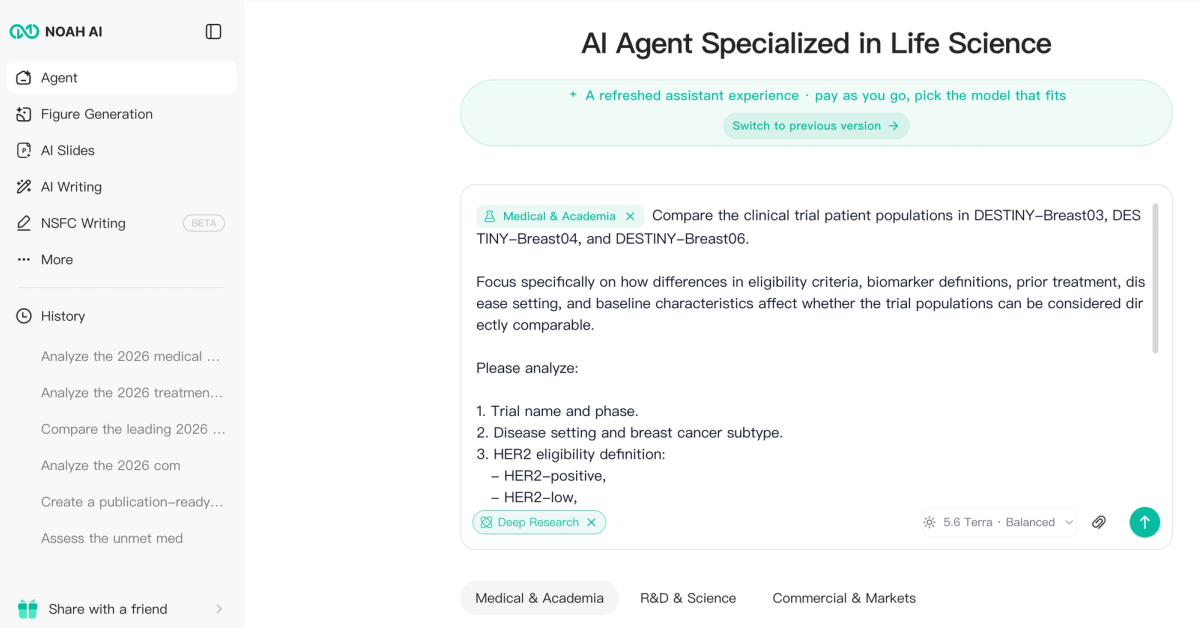
A patient-population comparison task entered into Noah AI for DESTINY-Breast03, DESTINY-Breast04, and DESTINY-Breast06.
What Noah Returned
The most useful part of the output was not an efficacy summary. It was a structured population table that aligned the three trials across the same patient characteristics.
This made several differences visible immediately:
- HER2-positive versus HER2-low versus HER2-ultralow eligibility,
- mixed versus exclusively HR-positive enrollment,
- different prior chemotherapy requirements,
- different endocrine-treatment histories,
- different prior HER2-directed treatment requirements,
- and different positions in the metastatic treatment sequence.
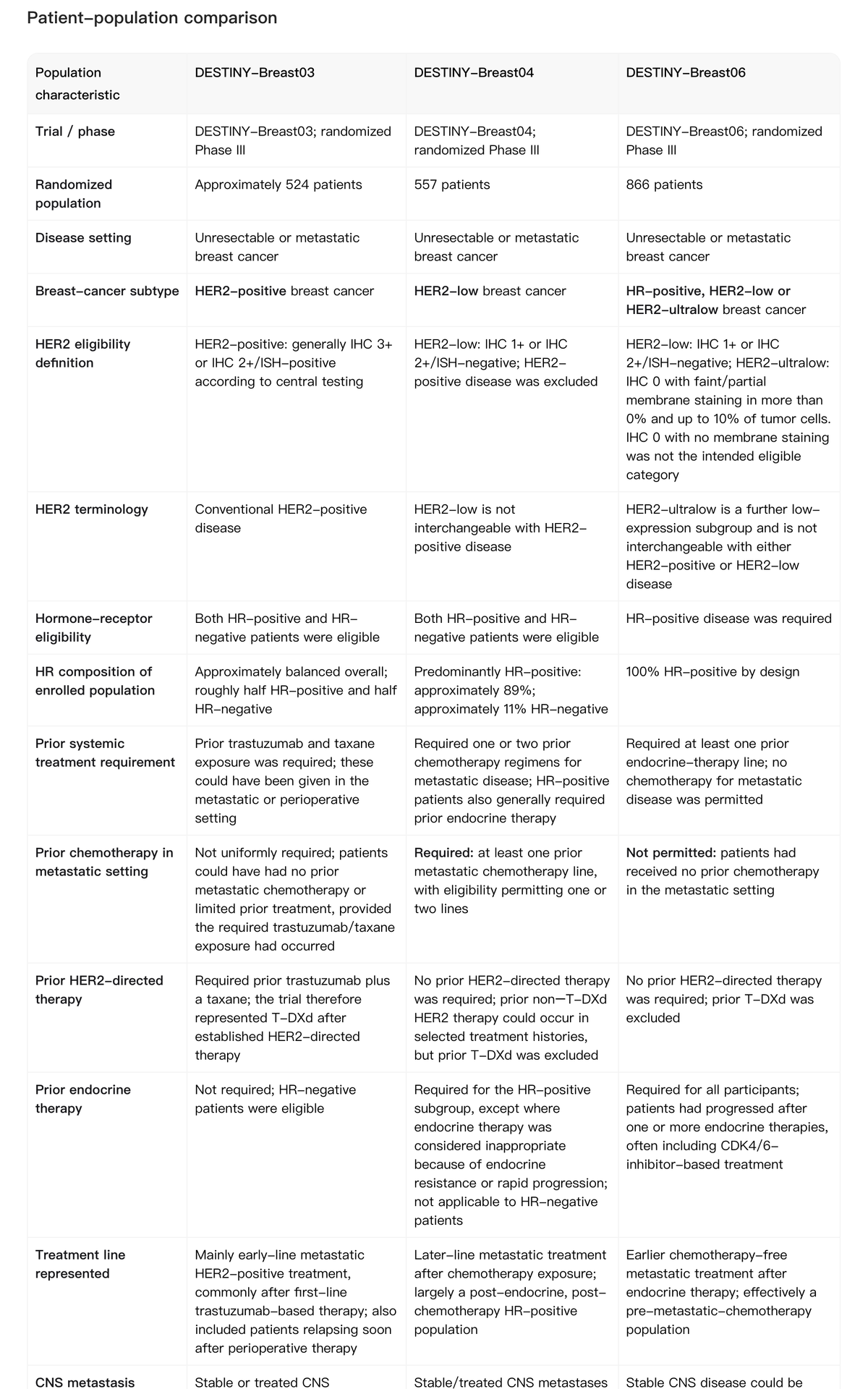
Noah AI structures the three DESTINY-Breast trials by biomarker definition, hormone-receptor status, prior treatment, and metastatic treatment line.
Free to use · Free credits included · No credit card required
[Compare Clinical Trial Patient Populations with Noah AI →](https://www.noah.bio/signup?utm_source=blog)
Five Population Differences That Change the Interpretation
- HER2-positive, HER2-low, and HER2-ultralow are not interchangeable — DESTINY-Breast03 studied conventional HER2-positive disease. DESTINY-Breast04 instead studied HER2-low disease, defined as IHC 1+ or IHC 2+/ISH-negative. DESTINY-Breast06 expanded the question further by enrolling HR-positive patients with HER2-low or HER2-ultralow metastatic disease. The biology and treatment pathways are therefore different before treatment outcomes are even considered.
- Hormone-receptor composition changes substantially — DESTINY-Breast03 enrolled both HR-positive and HR-negative disease. DESTINY-Breast04 was predominantly HR-positive but still included an HR-negative population. DESTINY-Breast06 was different again: HR-positive disease was required by design. That difference matters because HR status influences endocrine-treatment history, available treatment options, tumor biology, and the point at which T-DXd enters the pathway.
- Previous metastatic chemotherapy separates Breast04 from Breast06 — This is one of the clearest examples of why population comparison matters. DESTINY-Breast04 represented a previously chemotherapy-treated metastatic population. DESTINY-Breast06 specifically studied patients who had progressed after endocrine-based therapy but had not received chemotherapy for metastatic disease. A patient entering Breast06 therefore occupied an earlier chemotherapy position than a patient entering Breast04.
- Prior HER2-directed treatment is fundamentally different — DESTINY-Breast03 required prior trastuzumab and taxane exposure, placing it within an established HER2-positive treatment sequence. DESTINY-Breast04 and DESTINY-Breast06 studied HER2-low or ultralow populations and did not represent the same conventional HER2-directed treatment pathway.
- Treatment line changes what the outcome means — A response observed after multiple lines of metastatic treatment and a response observed before metastatic chemotherapy do not carry identical clinical context. Treatment exposure can influence prognosis, resistance patterns, toxicity tolerance, and subsequent treatment options, which is why treatment line should remain visible whenever clinical-trial results are compared.
What Not to Do in a Cross-Trial Comparison
Once the population differences are visible, several common comparison mistakes become easier to avoid.
Do not compare headline PFS numbers as though the trials were head-to-head — DESTINY-Breast03, DESTINY-Breast04, and DESTINY-Breast06 were designed for different populations and treatment contexts. A higher PFS or response percentage in one trial does not demonstrate that its population, treatment strategy, or therapeutic effect was superior to another trial.
Do not collapse all HER2 expression groups into one population — HER2-positive, HER2-low, and HER2-ultralow terminology has clinical meaning. Combining those groups can hide exactly the population difference that explains why the trials were conducted separately.
Do not treat eligibility criteria as identical to the enrolled population — Eligibility tells researchers who could enter a study; the baseline table shows who actually entered. A trial may technically permit multiple subgroups while still enrolling a population heavily concentrated in one category.
Do not ignore treatment history — Prior chemotherapy, HER2-directed therapy, endocrine therapy, and treatment line can materially affect cross-trial interpretation.
Which Tool Fits Which Part of Patient-Population Research?
| Research Need | Best-Fit Tool or Source | Why |
|---|---|---|
| Compare trial populations across multiple evidence sources | Noah AI | Useful for turning a biomedical comparison question into a structured, cited table while preserving major trial-level differences. |
| Verify formal inclusion and exclusion criteria | ClinicalTrials.gov | Primary registry source for study criteria, design, enrollment, arms, and trial identifiers. |
| Verify the actually enrolled baseline population | Primary trial publication | Baseline characteristics tables and trial papers show who ultimately entered the randomized population. |
| Extract repeated population fields across many studies | Elicit | Useful for systematic-review-oriented screening and structured extraction. |
| Inspect trial papers, protocols, and PDFs closely | SciSpace | Useful when population definitions or subgroup details are buried inside full-text documents. |
| Explore published evidence around a question | Consensus | Useful for literature-first research and rapid evidence orientation. |
| Broad source-documented investigation | ChatGPT Deep Research | Useful when population research spans publications, registries, uploaded files, and other public sources. |
Where Noah Fits Best
Noah is most useful here when the research question is already specific:
Are the patient populations in these three clinical trials actually comparable?
That question requires more than finding three papers. The researcher needs the same variables extracted across every study and then those differences interpreted without turning separate trials into artificial head-to-head evidence.
Noah's structured output provides a useful starting point for that workflow. It does not replace verification against the protocol, registry, publication, and statistical analysis plan.
What Researchers Still Need to Verify
- Exact eligibility criteria in the protocol version used for enrollment
- Randomized versus safety or efficacy analysis populations
- HER2 testing method and central versus local assessment
- Hormone-receptor definitions
- Prior treatment requirements and actual prior-treatment distribution
- Number of prior metastatic therapy lines
- CNS metastasis criteria
- ECOG performance status
- Visceral and liver metastasis distribution
- Regional enrollment differences
- Treatment duration and follow-up
Frequently Asked Questions
What is clinical trial patient population comparison?
Clinical trial patient population comparison examines whether participants across different studies are sufficiently similar for meaningful cross-trial interpretation.
Which population variables are most important?
Important variables commonly include disease subtype, biomarker definition, treatment setting, prior therapies, line of therapy, age, performance status, CNS involvement, disease burden, and other baseline prognostic factors.
Are eligibility criteria the same as baseline characteristics?
No. Eligibility criteria define who could enter the study, whereas baseline characteristics describe the patients who were actually enrolled.
Can efficacy be compared when patient populations differ?
Outcomes can be described side by side, but differences should not automatically be interpreted as treatment differences. Population, design, comparator, endpoint, and treatment-line differences may each explain part of the variation.
Why are DESTINY-Breast04 and DESTINY-Breast06 not directly comparable?
One major difference is prior metastatic chemotherapy. DESTINY-Breast04 studied a previously chemotherapy-treated population, whereas DESTINY-Breast06 studied HR-positive patients after endocrine therapy but before chemotherapy for metastatic disease.
Can AI replace formal indirect treatment comparison?
No. AI can help organize trial populations and identify comparability problems, but formal adjusted indirect comparisons require appropriate statistical methods, sufficiently detailed data, and prespecified analytical assumptions.
Final Takeaway
Cross-trial comparison should start with the patient population, not with the efficacy number.
DESTINY-Breast03, DESTINY-Breast04, and DESTINY-Breast06 all contribute important evidence for trastuzumab deruxtecan, but they do so in different biological populations and at different points in the treatment pathway.
Noah AI is a strong fit when researchers need to turn those population differences into a structured comparison before moving on to efficacy, safety, or broader cross-trial interpretation.